Learning From Video Browse Behavior Learning From Video Browse - - PowerPoint PPT Presentation

learning from video browse behavior learning from video
SMART_READER_LITE
LIVE PREVIEW

Learning From Video Browse Behavior Learning From Video Browse - - PowerPoint PPT Presentation

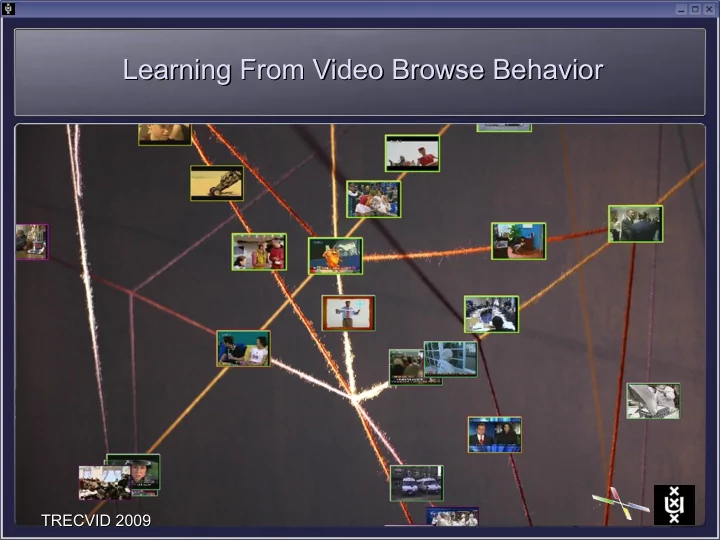
Learning From Video Browse Behavior Learning From Video Browse Behavior TRECVID 2009 TRECVID 2009 Learning From Video Browse Behavior 2 2 Problem Statement Problem Statement Starting results relatively weak Starting results relatively weak


slide-1
SLIDE 1

Learning From Video Browse Behavior Learning From Video Browse Behavior

TRECVID 2009 TRECVID 2009
slide-2
SLIDE 2

2 2 Learning From Video Browse Behavior

Problem Statement Problem Statement

Starting results relatively weak Starting results relatively weak

 Combination of query methods troublesome

Combination of query methods troublesome

Possible solutions: Possible solutions:

 Optimize result selection

Optimize result selection

 Visualize multiple query methods simultaneously

Visualize multiple query methods simultaneously

 Analyze user browse behavior

Analyze user browse behavior

slide-3
SLIDE 3

3 3 Learning From Video Browse Behavior

Optimize Result selection? Optimize Result selection? Focus + Context browsing Focus + Context browsing

focus shot context

slide-4
SLIDE 4

4 4 Learning From Video Browse Behavior

Focus + Context browsing Focus + Context browsing

Focus: Focus:

 defined by the current focal shot

defined by the current focal shot Context: Context:

 defined by the rest of the interface

defined by the rest of the interface

 We use: multi thread browsing

We use: multi thread browsing A thread is a linked sequence of shots in a A thread is a linked sequence of shots in a specified order, based upon an aspect of their specified order, based upon an aspect of their content content

focus shot context

slide-5
SLIDE 5

5 5 Learning From Video Browse Behavior

Threads used Threads used

query threads query threads

 merged result of query-by-text and/or query-by-

merged result of query-by-text and/or query-by- concept and/or query-by-example concept and/or query-by-example

time threads time threads

 based on the shots in the video containing the

based on the shots in the video containing the focal shot focal shot

visual threads visual threads

 based on visual similarity of focal shot

based on visual similarity of focal shot

history thread history thread

 based on the previous user browse behavior

based on the previous user browse behavior

slide-6
SLIDE 6

6 6 Learning From Video Browse Behavior

Multi Thread Browsing: ForkBrowser Multi Thread Browsing: ForkBrowser

focal shot time thread history thread query thread visual thread visual thread

slide-7
SLIDE 7

7 7 Learning From Video Browse Behavior

Multi Thread Browsing: ForkBrowser Multi Thread Browsing: ForkBrowser

slide-8
SLIDE 8

8 8 Learning From Video Browse Behavior

Problem Statement Problem Statement

Starting results relatively weak Starting results relatively weak

 Combination of query methods troublesome

Combination of query methods troublesome Possible solutions: Possible solutions:

 Optimize result selection

Optimize result selection

 Visualize multiple query methods simultaneously

Visualize multiple query methods simultaneously

 Analyze user browse behavior

Analyze user browse behavior

We propose:

Multi Thread Browsing

We propose:

Focus + Context

We propose:

Relevance Feedback based on context

slide-9
SLIDE 9

9 9 Learning From Video Browse Behavior

Relevance Feedback based on Context Relevance Feedback based on Context

Based on online SVM learning Based on online SVM learning

 User provides positive annotations

User provides positive annotations

 System gathers negative annotations based on user

System gathers negative annotations based on user browse behavior browse behavior using displayed context using displayed context User switches query thread when current results seem User switches query thread when current results seem exhausted exhausted

slide-10
SLIDE 10

10 10 Learning From Video Browse Behavior

Relevance Feedback based on Context Relevance Feedback based on Context

Pseen 0.25 0.2 0.1 0.05

All displayed shots accumulate a score to have been seen by the user All displayed shots accumulate a score to have been seen by the user When a shot reaches a threshold that shot is used as a negative example When a shot reaches a threshold that shot is used as a negative example

slide-11
SLIDE 11

11 11 Learning From Video Browse Behavior

How to evaluate performance? How to evaluate performance?

Problem with measuring real world users Problem with measuring real world users Component level evaluation requires user simulation Component level evaluation requires user simulation

# of coffee of user a > user b ? system a performs better than system b ? airco temp. @ room a < room b ? # of sleep of user a > user b ? computer speed user a > user b ? monitor size user a > user b ? user a played more games ? time of day ? ..... and so on affinity with topics user a > user b ?

slide-12
SLIDE 12

12 12 Learning From Video Browse Behavior

User Simulation with a State Machine User Simulation with a State Machine

slide-13
SLIDE 13

13 13 Learning From Video Browse Behavior

Experimental Setup Experimental Setup

TRECVID TRECVID 2008 2008 dataset dataset

 200 hours of video

200 hours of video

 48 topics, with (incomplete) annotations

48 topics, with (incomplete) annotations

 57 semantic concepts (21 of '08, 37 of '07)

57 semantic concepts (21 of '08, 37 of '07)

 best concepts taken as optimal starting query

best concepts taken as optimal starting query Experiment A: Experiment A: What is the benefit of having multiple threads? What is the benefit of having multiple threads? Experiment B: Experiment B: When should a user switch to relevance feedback results? When should a user switch to relevance feedback results?

slide-14
SLIDE 14

14 14 Learning From Video Browse Behavior

Experiment A Experiment A

What is the benefit of having multiple threads? What is the benefit of having multiple threads?

Measure Measure

 retrieval performance vs number of shown threads

retrieval performance vs number of shown threads

 number of positives after 500 actions, repeat for:

number of positives after 500 actions, repeat for:

similarity thread 2 similarity thread 1 query time history

sf

  • query only
  • query + time (CrossBrowser)
  • query + time + visual similarity (ForkBrowser)
slide-15
SLIDE 15

15 15 Learning From Video Browse Behavior

Experiment A Experiment A

slide-16
SLIDE 16

16 16 Learning From Video Browse Behavior

Experiment B Experiment B

When should a user switch to relevance When should a user switch to relevance feedback results? feedback results? Measured Measured

 optimal # of actions without results before using

  • ptimal # of actions without results before using

relevance feedback relevance feedback

slide-17
SLIDE 17

17 17 Learning From Video Browse Behavior

Experiment B Experiment B

RF after 10 irrelevant baseline with no RF RF after 15 irrelevant RF after 25 irrelevant RF after 50 irrelevant for topics with a low baseline RF has the most benefit the earlier relevance feedback is used the better

slide-18
SLIDE 18

18 18 Learning From Video Browse Behavior

TRECVID 2009 results TRECVID 2009 results

visual threads relevance feedback concept detectors

slide-19
SLIDE 19

19 19 Learning From Video Browse Behavior

Conclusions Conclusions

Results indicate: Results indicate:

showing multiple threads yield better performance showing multiple threads yield better performance also increases the time to perceive results for real world humans also increases the time to perceive results for real world humans

We found a inverse correlation between # of threads shown and importance of initial We found a inverse correlation between # of threads shown and importance of initial query query

Relevance Feedback yields greatest benefit for topics which would otherwise have Relevance Feedback yields greatest benefit for topics which would otherwise have limited results. limited results. ForkBrowser Focus + Context browsing paradigm, together with good initial concepts, ForkBrowser Focus + Context browsing paradigm, together with good initial concepts, consistently performs well consistently performs well

slide-20
SLIDE 20

20 20 Learning From Video Browse Behavior

Any questions? Any questions?