
SLIDE 1
Appeared in Proceedings of the 41st Annual Meeting of the Association for Computational Linguistics (ACL 2003), Companion Volume, Sapporo, July 2003.
Learning Non-Isomorphic Tree Mappings for Machine Translation
Jason Eisner, Computer Science Dept., Johns Hopkins Univ.
<jason@cs.jhu.edu>
Abstract
Often one may wish to learn a tree-to-tree mapping, training it
- n unaligned pairs of trees, or on a mixture of trees and strings.
Unlike previous statistical formalisms (limited to isomorphic trees), synchronous TSG allows local distortion of the tree topol-
- gy. We reformulate it to permit dependency trees, and sketch
EM/Viterbi algorithms for alignment, training, and decoding.
1 Introduction: Tree-to-Tree Mappings
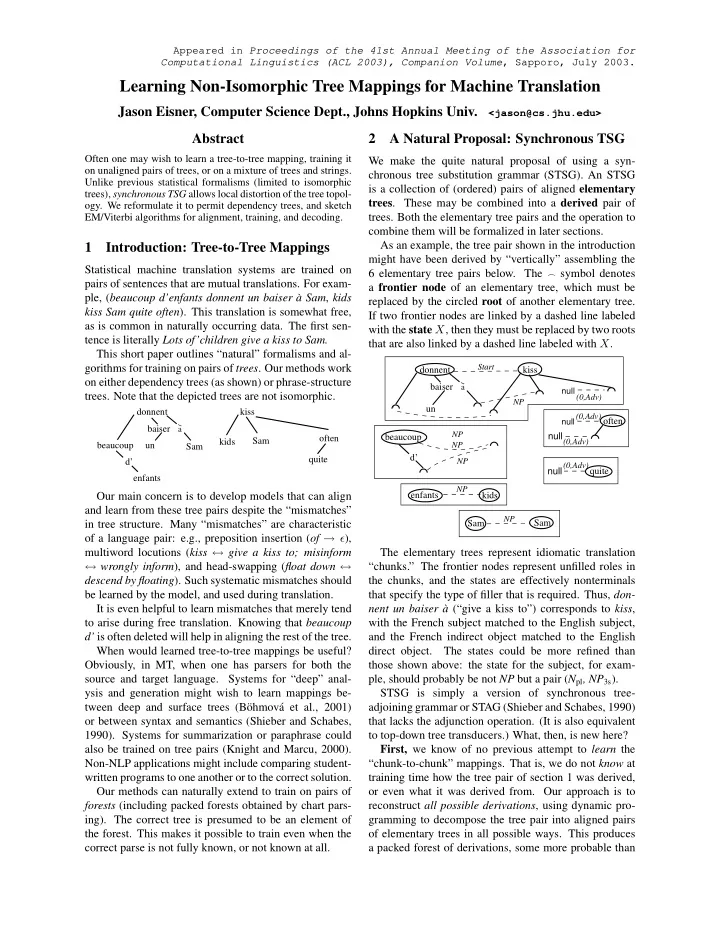
Statistical machine translation systems are trained on pairs of sentences that are mutual translations. For exam- ple, (beaucoup d’enfants donnent un baiser ` a Sam, kids kiss Sam quite often). This translation is somewhat free, as is common in naturally occurring data. The first sen- tence is literally Lots of’children give a kiss to Sam. This short paper outlines “natural” formalisms and al- gorithms for training on pairs of trees. Our methods work
- n either dependency trees (as shown) or phrase-structure
- trees. Note that the depicted trees are not isomorphic.
a
kiss baiser donnent Sam
- ften
quite beaucoup un Sam d’ enfants kids
Our main concern is to develop models that can align and learn from these tree pairs despite the “mismatches” in tree structure. Many “mismatches” are characteristic
- f a language pair: e.g., preposition insertion (of → ǫ),
multiword locutions (kiss ↔ give a kiss to; misinform ↔ wrongly inform), and head-swapping (float down ↔ descend by floating). Such systematic mismatches should be learned by the model, and used during translation. It is even helpful to learn mismatches that merely tend to arise during free translation. Knowing that beaucoup d’ is often deleted will help in aligning the rest of the tree. When would learned tree-to-tree mappings be useful? Obviously, in MT, when one has parsers for both the source and target language. Systems for “deep” anal- ysis and generation might wish to learn mappings be- tween deep and surface trees (B¨
- hmov´
a et al., 2001)
- r between syntax and semantics (Shieber and Schabes,
1990). Systems for summarization or paraphrase could also be trained on tree pairs (Knight and Marcu, 2000). Non-NLP applications might include comparing student- written programs to one another or to the correct solution. Our methods can naturally extend to train on pairs of forests (including packed forests obtained by chart pars- ing). The correct tree is presumed to be an element of the forest. This makes it possible to train even when the correct parse is not fully known, or not known at all.
2 A Natural Proposal: Synchronous TSG
We make the quite natural proposal of using a syn- chronous tree substitution grammar (STSG). An STSG is a collection of (ordered) pairs of aligned elementary
- trees. These may be combined into a derived pair of
- trees. Both the elementary tree pairs and the operation to
combine them will be formalized in later sections. As an example, the tree pair shown in the introduction might have been derived by “vertically” assembling the 6 elementary tree pairs below. The ⌢ symbol denotes a frontier node of an elementary tree, which must be replaced by the circled root of another elementary tree. If two frontier nodes are linked by a dashed line labeled with the state X, then they must be replaced by two roots that are also linked by a dashed line labeled with X.
a
kiss
null (0,Adv) Start
un baiser
NP
donnent
NP NP
beaucoup
NP
d’
(0,Adv)
null
null
- ften
(0,Adv) (0,Adv)
null quite enfants kids
NP
Sam Sam
NP
The elementary trees represent idiomatic translation “chunks.” The frontier nodes represent unfilled roles in the chunks, and the states are effectively nonterminals that specify the type of filler that is required. Thus, don- nent un baiser ` a (“give a kiss to”) corresponds to kiss, with the French subject matched to the English subject, and the French indirect object matched to the English direct object. The states could be more refined than those shown above: the state for the subject, for exam- ple, should probably be not NP but a pair (Npl, NP3s). STSG is simply a version of synchronous tree- adjoining grammar or STAG (Shieber and Schabes, 1990) that lacks the adjunction operation. (It is also equivalent to top-down tree transducers.) What, then, is new here? First, we know of no previous attempt to learn the “chunk-to-chunk” mappings. That is, we do not know at training time how the tree pair of section 1 was derived,
- r even what it was derived from. Our approach is to
reconstruct all possible derivations, using dynamic pro- gramming to decompose the tree pair into aligned pairs
- f elementary trees in all possible ways. This produces