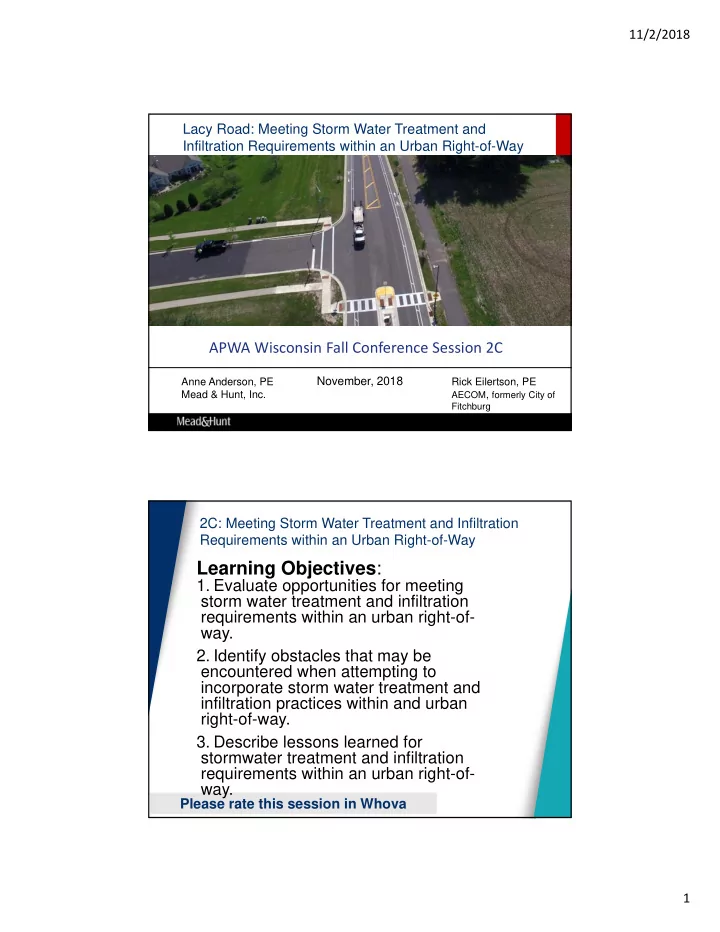
Learning Objectives : 1. Evaluate opportunities for meeting storm - - PDF document

learning objectives
SMART_READER_LITE
LIVE PREVIEW

Learning Objectives : 1. Evaluate opportunities for meeting storm - - PDF document

11/2/2018 Lacy Road: Meeting Storm Water Treatment and Infiltration Requirements within an Urban Right-of-Way APWA Wisconsin Fall Conference Session 2C November, 2018 Anne Anderson, PE Rick Eilertson, PE Mead & Hunt, Inc. AECOM , formerly


slide-1
SLIDE 1

11/2/2018 1

APWA Wisconsin Fall Conference Session 2C

Anne Anderson, PE Mead & Hunt, Inc. Rick Eilertson, PE

AECOM, formerly City of Fitchburg

Lacy Road: Meeting Storm Water Treatment and Infiltration Requirements within an Urban Right-of-Way

November, 2018

Please rate this session in Whova

Learning Objectives:

  • 1. Evaluate opportunities for meeting

storm water treatment and infiltration requirements within an urban right-of- way.

  • 2. Identify obstacles that may be

encountered when attempting to incorporate storm water treatment and infiltration practices within and urban right-of-way.

  • 3. Describe lessons learned for

stormwater treatment and infiltration requirements within an urban right-of- way.

2C: Meeting Storm Water Treatment and Infiltration Requirements within an Urban Right-of-Way

slide-2
SLIDE 2

11/2/2018 2

Lacy Road Agenda

  • Project Background
  • Obstacles/Challenges
  • Stormwater Options
  • BMP Maintenance
  • Lessons Learned

Existing Conditions

  • Lacy Road was a 2-

lane rural roadway with 3' paved shoulders

  • Major Collector,

traverses the entire east-west length of the City (6 miles)

  • Many residential

properties and many community destinations

slide-3
SLIDE 3

11/2/2018 3

Project Costs

  • In 2014, the Lacy Road project was awarded funding from

the MPO

  • Grant to cover 50% of construction costs
  • Maximum grant contribution: $2,540,000
  • Total stormwater cost: $520,000
  • Total project cost: $5M

 Rural Urban  Minimize right‐of‐way acquisition  Provide pedestrian and bicycle accommodations  Improve safety

 Enhance driveway access and improve sight distance  Speed Limit compliance

 Reconstruct facilitate drainage

 Utilize sustainable stormwater management techniques

Project Goals

slide-4
SLIDE 4

11/2/2018 4

 City of Fitchburg  Street Construction  40% TSS reduction  New Construction NEW IMPERVIOUS  Maintain pre‐development runoff rates  Remove 80% TSS  Infiltrate 90%  WisDOT Stormwater Treatment Goals Summary  40% TSS reduction, rural to urban

Cost Effective

Stormwater Goals Stormwater Challenges

  • Limited Right‐of‐Way
  • Existing topography
  • Municipal & private well locations
  • Number of drainage outfalls
  • Presence of rock
slide-5
SLIDE 5

11/2/2018 5

Limited Right-of-Way

Right‐of‐way width varies from 66’ to 90’ Existing Lacy Road is not centered in right‐of‐way

Existing Topography

Grades fall quickly to the north Steep driveways on the north Challenging to widen road footprint

slide-6
SLIDE 6

11/2/2018 6

Municipal and Private Well Locations 3 Drainage Area Outfalls

  • Insert drainage area map

Fish Hatchery Road Syene Road West Central East

slide-7
SLIDE 7

11/2/2018 7

13

Central Drainage Area Outfall Locations of Rock

slide-8
SLIDE 8

11/2/2018 8

Potential Stormwater Components

  • Ponds
  • Bioswales
  • Permeable street pavers
  • Porous path

Stormwater Options

  • Bioswales Option
  • Porous Bike Lane Option
slide-9
SLIDE 9

11/2/2018 9

OFF SITE TREATMENT

Bioswale Option

Bioswale Widths

  • North side 22

feet minimum

  • South side 14

feet minimum

2’ 6’

slide-10
SLIDE 10

11/2/2018 10

Potential Pond Porous Bike Lane

slide-11
SLIDE 11

11/2/2018 11

Comparing Options

Option - Bioswales and Ponds: $2,730,000 Option - Porous Pavement: $2,072,000

Option B and P costs include basic road & storm sewer costs for ease of comparison

Bioswales Porous Bike Lane

Selected Typical Section on Lacy Road

 10’ travel lanes (11’)  4’ buffered bike lanes (2’

buffer)

 24‐inch curb and gutter (30”)  8’‐10’ shared use path  5’ sidewalk  7’ terrace

slide-12
SLIDE 12

11/2/2018 12

Stormwater Alternatives

  • Ponds
  • Bioswales
  • Permeable street pavers
  • Porous path
  • r…
  • Pervious Pipe &

Infiltration Trench Pervious Pipe & Infiltration Trench

slide-13
SLIDE 13

11/2/2018 13

Selected Stormwater Treatment Main Treatment

  • Pervious Pipe & Infiltration Trenches
  • Porous asphalt path

Pre‐Treatment

  • Inlet filters and, 3 foot sumps and back‐

pitched pipes

Stormwater Modeling

  • Started with HydroCAD for existing development
  • In order to analyze peak flows, the sections of storm sewer with

perforations were modeled in Storm and Sanitary Analysis (SSA)

slide-14
SLIDE 14

11/2/2018 14

Stormwater Modeling

48% TSS 165%

slide-15
SLIDE 15

11/2/2018 15

Infiltration Trench

Outfall SLAMM CONTROL Trench Width Trench Depth (ft) Trench Area (sf) Infiltration Rate (in/hr) West infiltration trench modeled as biofiltration 10 3.5 feet, 1 foot below pipe 5,720 0.500 Central infiltration trench modeled as biofiltration 14 4 feet total, 1 foot below pipe 22,115 0.500 East trench modeled as biofiltration and porous path 10 4 feet total, 1 foot below pipe 10,740 0.500

Cost Comparisons

Option Construction Cost Maintenance Cost Bioswales and Ponds $2.7 M $ Permeable Street & Ponds $2.1M $$$ Infiltration Trenches & Porous Pipe $2.1M $

slide-16
SLIDE 16

11/2/2018 16

Pervious Pipe Infiltration Trench Locations of Infiltration Trenches

slide-17
SLIDE 17

11/2/2018 17

Locations of Infiltration Trenches Locations of Infiltration Trenches

  • Add a plan sheet showing location of trenches…
slide-18
SLIDE 18

11/2/2018 18

Stormwater Infiltration Trenches

slide-19
SLIDE 19

11/2/2018 19

Storm Sewer Installation

Pre-Treatment

  • Inlet Filters
  • Back-pitched pipes
slide-20
SLIDE 20

11/2/2018 20

Permanent Inlet Filter Bags

Oil absorbent pouches clip into filter bag

Location of porous asphalt path

slide-21
SLIDE 21

11/2/2018 21

Porous asphalt path Porous Asphalt Path

Ayres Associates image

slide-22
SLIDE 22

11/2/2018 22

Porous Asphalt Path

BMP Maintenance, Storm System

  • Inspect the system annually and after large rain events
  • Inspect structures annually for sediment buildup
  • Remove sediment with vacuum pump when > 6 inches
  • Street sweep a minimum of 2 x / year
  • Inspect inlet filters 2 x / year
  • Replace oil absorbent pouches
slide-23
SLIDE 23

11/2/2018 23

BMP Maintenance, Porous Asphalt Path

  • Use broom or rubber blade on plow

for snow removal to minimize scraping

  • Vacuum sweep the porous

pavement two times per year

Lessons Learned – Stone Bedding

  • Open graded stone: WisDOT specifications, use a Special item

for stone so you get washed stone instead of open-graded base aggregate (OGBA)

slide-24
SLIDE 24

11/2/2018 24

47

  • Concrete collar specified, but special couplers are now

available

  • Shallow plastic pipe requires special care by contractor

and subcontractors to minimize damage

Lessons Learned – Pipe Lessons Learned – Trench Transitions

  • Consider transitions to solid pipe and less pervious

bedding when you want to minimize flow horizontally along the trench bedding

slide-25
SLIDE 25

11/2/2018 25

Lessons Learned

  • Modeling: non-conventional design

may require flexible software

  • Inlets: weir overflow wall off-center
slide-26
SLIDE 26

11/2/2018 26

51

APWA Wisconsin Fall Conference Session 2C

Anne Anderson, PE Mead & Hunt, Inc. Rick Eilertson, PE

AECOM, formerly City of Fitchburg

Lacy Road: Meeting Storm Water Treatment and Infiltration Requirements within an Urban Right-of-Way

November, 2018

Thank You

slide-27
SLIDE 27

11/2/2018 27 Please rate this session in Whova

Learning Objectives:

  • 1. Evaluate opportunities for meeting

storm water treatment and infiltration requirements within an urban right-of- way.

  • 2. Identify obstacles that may be

encountered when attempting to incorporate storm water treatment and infiltration practices within and urban right-of-way.

  • 3. Describe lessons learned for

stormwater treatment and infiltration requirements within an urban right-of- way.

2C: Meeting Storm Water Treatment and Infiltration Requirements within an Urban Right-of-Way