Learning Objectives 1.) Describe the role of the vagus nerve in PTSD - - PDF document

learning objectives
SMART_READER_LITE
LIVE PREVIEW

Learning Objectives 1.) Describe the role of the vagus nerve in PTSD - - PDF document

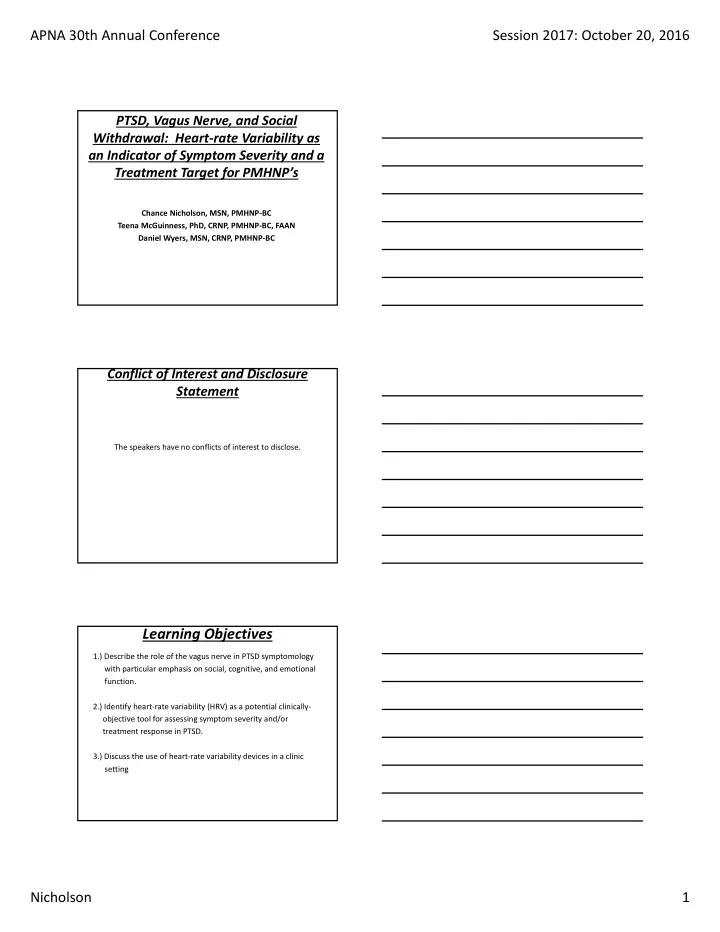
APNA 30th Annual Conference Session 2017: October 20, 2016 PTSD, Vagus Nerve, and Social Withdrawal: Heart rate Variability as an Indicator of Symptom Severity and a Treatment Target for PMHNPs Chance Nicholson, MSN, PMHNP BC Teena


slide-1
SLIDE 1

APNA 30th Annual Conference Session 2017: October 20, 2016 Nicholson 1

Chance Nicholson, MSN, PMHNP‐BC Teena McGuinness, PhD, CRNP, PMHNP‐BC, FAAN Daniel Wyers, MSN, CRNP, PMHNP‐BC

PTSD, Vagus Nerve, and Social Withdrawal: Heart‐rate Variability as an Indicator of Symptom Severity and a Treatment Target for PMHNP’s Conflict of Interest and Disclosure Statement

The speakers have no conflicts of interest to disclose.

Learning Objectives

1.) Describe the role of the vagus nerve in PTSD symptomology with particular emphasis on social, cognitive, and emotional function. 2.) Identify heart‐rate variability (HRV) as a potential clinically‐

  • bjective tool for assessing symptom severity and/or

treatment response in PTSD. 3.) Discuss the use of heart‐rate variability devices in a clinic setting

slide-2
SLIDE 2

APNA 30th Annual Conference Session 2017: October 20, 2016 Nicholson 2

PTSD

  • Chronic and debilitating mental disorder which affects

approximately 8‐10% of the general population and 15% of those returning from combat.

  • Characterized by:

1.) Re‐experiencing trauma 2.) Alterations in arousal and activity 3.) Emotional numbness and avoidance 4.) Dysregulation of cognitive, emotional and social processing1

PTSD and Hyperinflammation

  • Number of studies have found increased pro‐inflammatory

mediators (cytokines, Th1 & 17, etc.) and reduced anti‐ inflammatory mediators (IL‐4, Treg, etc.) are predictive of symptom severity

  • Retrospective analysis of Iraq and Afghanistan vets in the VA

system identified a drastic increase in the development of inflammatory disorders (e.g., IBS, lupus, etc.) compared to civilians 2,3

PTSD and Hyperinflammation

  • Prospective study of Marines showed increased pro‐

inflammatory mediators predicted post‐deployment PTSD

  • Autonomic dysfunction results from chronic‐inflammation

likely due to disrupted vagal‐sympathetic arousal.2,3

slide-3
SLIDE 3

APNA 30th Annual Conference Session 2017: October 20, 2016 Nicholson 3

Vagus Nerve

  • The vagus nerve “wanderer” or cranial nerve X is a major

component of the autonomic nervous system that influences neuronal, endocrine, and immune functions.

  • Primary role is physio‐inflammatory homeostasis: regulates

gastrointestinal, cardiovascular, respiratory, and select cognitive function via its autonomic parasympathetic control.

  • Exerts a powerful immune effect via its cholinergic anti‐

inflammatory pathway.4,5

Vagus Nerve and PTSD

Neurovisceral Integration Model (Thayer & Lane, 2000)

  • Vagal connections permit a cardio‐cortical information

exchange which regulates metabolic changes via inhibitory parasympathetic activity.

  • Allows for an adaptive central nervous system which can

respond effectively to environmental changes (i.e., stressors).6

Vagus Nerve and PTSD

  • Vagal‐autonomic subsystems:

(1) social communication (e.g., facial expression, listening, etc.) (2) mobilization (e.g., fight‐flight) (3) immobilization (e.g., withdrawal, behavioral dysfunction, etc.). 7 Polyvagal Theory (Porges, 2007)

slide-4
SLIDE 4

APNA 30th Annual Conference Session 2017: October 20, 2016 Nicholson 4

Vagus Nerve and PTSD

1.) Re‐experiencing trauma ‐ dyregulated fear extinction interferes with memory formation and consolidation ‐ hyper‐acquisition of fear, disrupting plasticity in the amygdala and preventing extinction learning 8,9 2.) Alterations in arousal and activity ‐ disrupted control over sympathetic nervous system10 3.) Emotional numbness and avoidance ‐ sickness syndrome 11

Vagus Nerve and PTSD

4.) Dysregulation of cognitive, emotional and social processing Cognitive ‐ prefrontal cortex function is reduced in favor of norepinephrine’s stimulation of the amygdala and HPA‐axis (stress pathways). ‐ decreased vagal tone: impaired executive function, speed of processing, attention, and psychomotor speed 10,12,13

Vagus Nerve and PTSD

4.) Dysregulation of cognitive, emotional and social processing Emotion ‐ altered brainstem nuclei activity disinhibits the amygdala and medullary cardioaccelertory circuits which destabilizes affect 49 Social withdrawal ‐ inflammation is inversely associated with the degree of withdrawal ‐ inflammation disrupts oxytocin and encourages withdrawal 10, 14, 15

slide-5
SLIDE 5

APNA 30th Annual Conference Session 2017: October 20, 2016 Nicholson 5

How Do We Measure Vagal Function?

Heart‐rate variability (HRV): quantitative assessment of variation in interbeat intervals. Modulated by parasympathetic and sympathetic branches via sinoatrial node. Frequency

  • Low frequency (LF): stated to reflect baroreflex (sympathetic

and parasympathetic activity)

  • High frequency (HF): represents (parasympathetic vagal‐tone).
  • LF/HF ratio: indirect index of sympatho‐vagal balance

Time Domain

  • Standard deviation of all N‐N intervals (SDNN) and Root mean

square of successive differences (RMSSD) 16,17

How Do We Interpret HRV in PTSD?

  • HRV and its HF component is reduced (with increased HR)

compared to controls whilst the low‐frequency (LF) component is elevated.

  • Increased LF/HF ratio and decreased SDNN, RMSDD indicates

reduced HRV

  • Reduced HRV in PTSD suggest autonomic inflexibility due to

sympathetic overactivity and/or parasympathetic insufficiency 18

HRV and PTSD

  • Unlike controls, PTSD patients demonstrate no LF or HF

reactivity to recalling a traumatic event

  • Diminished HRV before trauma increase the likelihood of stress

disorder symptoms after trauma.

  • Diminished HRV immediately after trauma can predict

development of PTSD

slide-6
SLIDE 6

APNA 30th Annual Conference Session 2017: October 20, 2016 Nicholson 6

HRV and PTSD

  • HRV at rest determines degree of pre‐frontal cortical activity and

intrusive thoughts

  • Early detection of dysautonomia can predict onset of depression

in PTSD and TBI patients 19‐23

What Comorbidities in PTSD and Factors Affect HRV?

  • Sleep disorders (i.e., sleep

apnea)

  • Depression
  • Smoking
  • ETOH and illicit drugs
  • Gender
  • Age
  • Obesity
  • Medications 24‐34
  • Chronic pain, chronic fatigue

syndrome, or fibromyalgia

  • Metabolic disorders
  • GI disturbances (e.g., IBS)
  • Eating disorders
  • Breathing problems or

asthma

  • TBI
  • Cardiovascular disorders

Treatment and Therapies That Can Improve HRV

  • Medications 35,36

‐ ex: prazosin, beta‐blockers, ketamine, cyclobenzaprine, citalopram, fluoxetine

  • Psychotherapy 37

‐ ex: Cognitive Processing Therapy, CBT, & EMDR

  • Exercise 37, 38

‐ improves cardio‐cortical inhibitory control of intrusive thoughts; regulates arousal; and increases adaptiveness to metabolic stress

slide-7
SLIDE 7

APNA 30th Annual Conference Session 2017: October 20, 2016 Nicholson 7

Treatment and Therapies That Can Improve HRV

  • Yoga and Mindfulness38,39,40

‐ improves homeostatic capacity and autonomic, metabolic, and physiological resilience

  • HRV‐Biofeedback 41,42,43

‐ significant reduction in pro‐inflammatory markers effect on HRV (increasing tonicity) ‐ reduces PTSD symptoms and provides general health benefits

Treatment and Therapies That Can Improve HRV

  • Vagus Nerve Stimulation (transcutaneous/aurical) 44

‐ tVNS downregulates inflammatory mediators via cholinergic anti‐inflammatory pathway

  • Other neuromodulatory techniques 45,46

‐ transdermal electrical neurosignaling ‐ transcranial direct current stimulation (tDCS)

How Can We Measure HRV in Practice?

  • Devices

‐ Actiheart ‐ Biofeedback Stone ‐ Bioforce HRV ‐ BLE HR & HRV Recorder ‐ emWave2/PRO ‐ Firstbeat Technologies ‐ FitPal ‐ Polarband ‐ Breathe Sync™ ‐ CardioMood HRV Expert ‐ Cardiofit ‐ Elite HRV

slide-8
SLIDE 8

APNA 30th Annual Conference Session 2017: October 20, 2016 Nicholson 8

How Can We Involve Patients? The ABCD’S

  • Apps and HRV technology:

(1) Feasibility; (2) Compatibility; (3) Interpretability

  • Benefits:

(1) Education; (2) Fitness; (3) Well‐being

  • Coach:

(1) Motivation; (2) Exploration; (3) Communication

  • Determine next step in treatment

(1) Hesitation; (2) Readiness; (3) Exposure

Questions?