
SLIDE 1
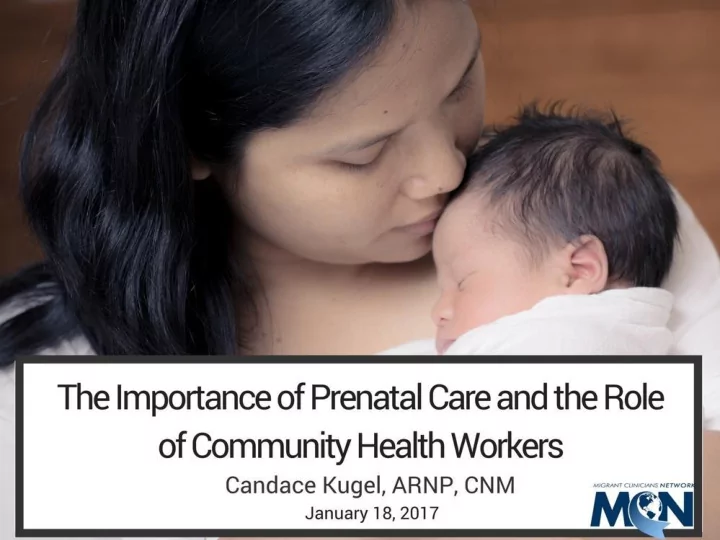
Learning Objectives Participants will Identify the two HRSA - - PowerPoint PPT Presentation
Learning Objectives Participants will Identify the two HRSA performance measures related to pregnancy care Reflect on the role of community health workers in improving access to prenatal care Identify two unique risk factors for
Learning Objectives
Participants will…
related to pregnancy care
in improving access to prenatal care
migrant farmworker women
assist pregnant women to access prenatal care
Early Entry into Prenatal Care
Percentage of pregnant women beginning prenatal care in the first trimester 1
Association between early care and good
Early care means good access to care Establishes a care relationship Encourages early behavior changes
Why Do We Need Early Prenatal Care?
Percentage of babies born to health center patients whose birth weight was below normal (less than 2500 grams)
Healthy birth weight is related to healthy pregnancy Low (and high) birth weight associated with various risk factors
abuse)
Can be associated with life-long problems for the infant
Why is Birth Weight Important? 3,4
AAP & ACOG, 2002
Challeng es for Health Care Programs
No shows No records Follow up of tests & tx Cultural differences
preventive care gender issues
Language issues
forms classes and handouts legal consent
Legal status
eligibility for services
The Role of CHWs in Improving Performance in Pregnancy Care
Importance of prenatal care Due date & trimesters Prenatal visit schedule Common discomforts Prenatal care and testing Fetal development Risks, complications & danger signs Prenatal education: self care, birth prep Post partum care
check-ups if a pregnant woman is feeling well?
benefits of prenatal care?
– In terms of outcomes – In personal terms
women about this?
What’s the difference between different types
Calculation of due date 6
✓ LMP ✓ Estimated date of confinement (EDC) is calculated based on the first day of the last menstrual period (LMP) by adding 9 months and 7 days from that date.
OR
✓ …subtract 3 months and add one year and 7 days ✓ Test: EDC for LMP of today
Trimesters 7
Duration of pregnancy is measured in weeks, counting from the LMP. The EDC is 40 weeks after the LMP. Pregnancy is also measured in trimesters
Weeks 0-12 Weeks 13-28 Weeks 29-Birth
Timing of visits 8
The standard schedule of prenatal visits for a normal pregnancy is:
✓ Every 4 weeks for the first 28 weeks ✓ Every 2 weeks for 28-36 weeks ✓ Every week from 36 weeks to birth ✓ Postpartum visit 6 weeks after birth
Note: This schedule may vary for a woman who is considered high risk
Medical and social history Risk screening—identification of problems or potential problems
Examination: Initial labs (more on this later) Vitamins
Weight Blood pressure Urine dip Fetal heart rate Fundal height Edema Fetal position and movement Other labs Topics of discussion & education Cervical exam (at term)
Pregnancy week-by-week 9
Common discomforts & symptoms 10
increased size, leaking
11
Some symptoms are normal (and even good!) Consejos—whic h might help and which might hurt? Coping skills Relaxation
Prenatal testing—in sequence 12
First Trimester (usually done at initial examination):
screening, blood lead screening, varicella immunity
16-18 weeks
26-28 weeks
35-37 weeks
Prenatal testing…
Age—teen or
Past deep vein thrombosis (DVT) or pulmonary embolus (PE)
Infertility Previous cesarean section Multiple pregnancies Previous pregnancy loss Family history/genetic conditions
Thyroid disease Diabetes, Type I or II Kidney disease Heart disease Seizures Cervical cancer Breast cancer Psychiatric disorder
Domestic violence Poverty Language other than provider Homelessness Cultural barriers to care Scheduling or transportation problems Exposure to hazardous/toxic agents Substance abuse Inadequate support Developmental disability Low level of education
Pregnancy complications 13
rubella
http://www.diabetes-cure.me/
Routine testing 24-28 weeks
Additional monitoring during pregnancy Testing after pregnancy Higher risk of DM later in life Nutrition education Glucose monitoring Possibly insulin
Danger Signs
month)
Preterm labor
Contractions every 10 minutes or less Change in discharge—flui d or bleeding Pelvic pressure Dull backache Period-like cramping
Preterm labor
Risk to baby—lungs and other organs not mature
Oral health during pregnancy…
✓ Treatment of periodontal disease can decrease risk of GDM, PTL
– No live viruses (varicella, MMR, HPV) – Flu, tetanus, pertussis OK
to talk)
stretching
activities
tub, etc.
marathon of childbirth!
Substanc e Abuse
Smoking—smoking cessation treatment
2nd hand smoke higher in tar, nicotine, CO Spouses and babies of smokers have more respiratory illnesses
Alcohol—fetal alcohol syndrome
No safe amount
Drugs—refer for treatment
Drug screening may be done
High risk for pregnancy and newborn complications
At home and work Lead screening Pesticide exposure
Prenatal Nutrition16
normal weight; 15-20 lb if overweight
supplements—Fe & folic acid & calcium especially important
Prenatal nutrition
HTN, hemorrhage, sepsis
becoming a victim of attempted or successful homicide is 3 times more frequent in pregnancy”
Other Self-Care Measures 16
Eat meat that is thoroughly cooked Clean fruits and veggies before eating Have someone else clean litter boxes or wear gloves Wear gloves when gardening Wash hands frequently! Avoid sick people Avoid touching eyes, nose and mouth Call provider if sick
Migrant Women 18
increasingly migrating for work
Labor National Ag Workers Survey—24% women
Pregnancy in Migrant Women 19
Limited research, but majority are Mexican so we extrapolate
– ↓ preterm birth, LBW, infant mortality – Outcomes worsen with length of residence in US
diabetes among Latinas—indication for prenatal screening
Mobility as a risk factor
population is outpacing availability of appropriate services in many locations—various studies
good nutrition, social isolation
14,20
– Lack of access to health care – Lack of access to telephone – Separation from support system
– Male dominance in families & relationships
well-being of children
exposure to household members
known
Pesticide exposure (work & home)
Agmart and Carlitos21
AP Photo
4 women lived in the same labor camps and worked in the same fields in North Carolina and Florida
Within 7 weeks of
Carlitos born without arms or legs Jesus born with Pierre Robin syndrome Violeta born with multiple birth defects, died within 3 days 4th baby with similar birth defects in Mexico
Resources...
22
Comic book: pregnancy & pesticides 23
Lo Que Bien Empieza...Bien Acaba http://www.migrantclinician.org/issues/occupational-health/pesticides/pesticide-comic-books.html
Pregnancy patient education resources
Other resources:
text to pregnant women and new mothers in English and
fotonovelas
(www.augercommunications.com)
(www1.wfubmc.edu/fam_med/Research/Educational )
(www.migranthealth.org/materials_and_tools/)
http://findahealthcenter.hrsa.gov/
(www.hesperian.org)
Questions?
Candace Kugel, FNP, CNM, MS Migrant Clinicians Network, Inc. Specialist, Clinical Systems and Women’s Health ckugel@migrantclinician.org (512) 579-4540
References
1. http://bphc.hrsa.gov/qualityimprovement/performancemeasures/qualitycare.ht ml 2. http://bphc.hrsa.gov/qualityimprovement/performancemeasures/healthoutcom es.html 3. http://www.marchofdimes.org/complications/low-birthweight.aspx 4. http://www.marchofdimes.org/complications/gestational-diabetes.aspx 5. http://www.womenshealth.gov/pregnancy/ 6. http://www.hopkinsmedicine.org/healthlibrary/conditions/pregnancy_and_child birth/calculating_a_due_date_85,p01209/ 7. http://womenshealth.gov/pregnancy/you-are-pregnant/stages-of-pregnancy.ht ml 8. http://www.womenshealth.gov/pregnancy/you-are-pregnant/prenatal-care-test s.html#b 9. http://www.mayoclinic.org/healthy-lifestyle/pregnancy-week-by-week/multime dia/fundal-height/img-20008049 10. http://www.womenshealth.gov/pregnancy/you-are-pregnant/stages-of-pregnan cy.html 11. https://www.ncbi.nlm.nih.gov/pmc/articles/PMC1913060/
References
12. http://www.womenshealth.gov/pregnancy/you-are-pregnant/prenatal-care-test s.html#c 13. http://www.womenshealth.gov/pregnancy/you-are-pregnant/pregnancy-compli cations.html 14. http://www.migrantclinician.org/issues/womenshealth 15. http://www.migrantclinician.org/toolsource/resource/comic-lo-que-bien-empiez a...bien-acaba-pesticide-prevention-during-pregnancy.htm 16. http://www.womenshealth.gov/pregnancy/you-are-pregnant/staying-healthy-sa fe.html 17. http://www.migrantclinician.org/toolsource/resource/evaluation-tool-physical-a buse-english-and-spanish.html 18. https://www.cdc.gov/niosh/topics/aginjury/naws/demotables.html 19. https://www.ncbi.nlm.nih.gov/pmc/articles/PMC1448590/ 20. http://www.migrantclinician.org/issues/migrant-info/health-problems.html 21. https://migrantclinician.wikispaces.com/Pesticide+Exposure+and+Birth+Defects- +The+Case+of+Farmworker+Women+and+Agmart 22. http://www.migrantclinician.org/services/network.html 23. http://www.migrantclinician.org/issues/occupational-health/pesticides/pesticid e-comic-books.html