Lecture 5: Probability Distributions Random Variables - - PDF document

lecture 5 probability distributions
SMART_READER_LITE
LIVE PREVIEW

Lecture 5: Probability Distributions Random Variables - - PDF document

3/26/2019 Lecture 5: Probability Distributions Random Variables Probability Distributions Discrete Random Variables Continuous Random Variables and their Distributions Discrete Joint Distributions Continuous Joint


slide-1
SLIDE 1

3/26/2019 1

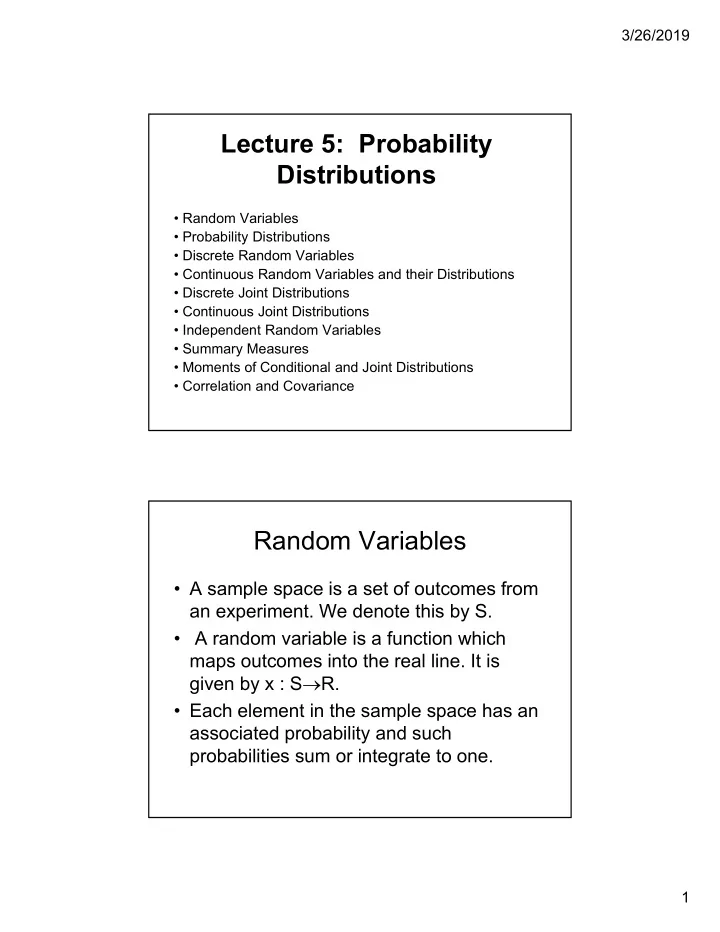
Lecture 5: Probability Distributions

  • Random Variables
  • Probability Distributions
  • Discrete Random Variables
  • Continuous Random Variables and their Distributions
  • Discrete Joint Distributions
  • Continuous Joint Distributions
  • Independent Random Variables
  • Summary Measures
  • Moments of Conditional and Joint Distributions
  • Correlation and Covariance

Random Variables

  • A sample space is a set of outcomes from

an experiment. We denote this by S.

  • A random variable is a function which

maps outcomes into the real line. It is given by x : SR.

  • Each element in the sample space has an

associated probability and such probabilities sum or integrate to one.

slide-2
SLIDE 2

3/26/2019 2

Probability Distributions

  • Let A  R and let Prob(x  A) denote the

probability that x will belong to A.

  • Def. The distribution function of a random

variable x is a function defined by F(x')  Prob(x  x'), x'  R.

Key Properties

P.1 F is nondecreasing in x. P.2 lim

xF(x) = 1 and lim xF(x) = 0.

P.3 F is continuous from the right. P.4 For all x', Prob(x > x') = 1 - F(x').

slide-3
SLIDE 3

3/26/2019 3

Discrete Random Variables

  • If the random variable can assume only a

finite number or a countable infinite set of values, it is said to be a discrete random variable.

Key Properties

P.1 Prob(x = x')  f(x')  0. (f is called the probability mass function or the probability function.) P.2 f x

  • b x

x

i i i i

( ) Pr ( )

   

    

1 1

1. P.3 Prob(x  A) = f xi

x A

i

( ).

slide-4
SLIDE 4

3/26/2019 4

Examples

Example: #1 Consider the random variable associated with 2 tosses of a fair coin. The possible values for the #heads x are {0, 1, 2}. We have that f(0) = 1/4, f(1) = 1/2, and f(2) = 1/4. f(x) F(x) 1 X 1/2 X 3/4 X 1/4 X X 1/4 X 0 1 2 0 1 2

Examples

#2 A single toss of a fair die. f(x) = 1/6 if xi = 1,2,3,4,5,6. F(xi) = xi/6.

slide-5
SLIDE 5

3/26/2019 5

Continuous Random Variables and their Distributions

  • Def. A random variable x has a continuous distribution if there exists a nonnegative function f

defined on R such that for any interval A of R Prob (x  A) = f x dx

x A

( )

 . The function f is called the probability density function of x and the domain of f is called the support of the random variable x.

Properties of f

P.1 f(x)  0, for all x. P.2 f x dx ( ) .

 

 1 P.3 If dF/dx exists, then dF/dx = f(x), for all x. In terms of geometry F(x) is the area under f(x) for x'  x.

slide-6
SLIDE 6

3/26/2019 6

Example

Example: The uniform distribution on [a,b].  1/(b-a), if x  [a,b] f(x) =   0, otherwise Note that F is given by F(x) = [ / ( )] ( ) | ( ) ( ) . 1 1 1 b a dx b a x a b a b a x

a x a x

         Also, f x dx

a b ( )

  [ / ( )] ( ) | ( ) ( ) . 1 1 1 b a dx b a x a b a b b a

a b a b

         

Example

F(x) 1 slope =1/(b-a)

  • a/(b-a) a b x

f(x) 1/(b-a) a b x

slide-7
SLIDE 7

3/26/2019 7

Discrete Joint Distributions

  • Let the two random variables x and y have

a joint probability function f(xi',,yi') = Prob(xi = xi' and yi = yi').

Properties of Prob Function

P.1 f(xi, yi)  0. P.2 Prob((xi,yi)  A) = f x y

i i x y A

i i

( , )

( , )

 . P.3 f x y

i i x y

i i

( , )

( , )

 = 1.

slide-8
SLIDE 8

3/26/2019 8

The Distribution Function Defined

F(xi

', yi ') = Prob( xi  xi ' and yi  yi ') =

f x y

i i x y L

i i

( , )

( , )

 , where L = {(xi, yi) : xi  xi

' and yi  yi '}.

Marginal Prob and Distribution Functions

  • The marginal probability function

associated with x is given by f1(xj )  Prob(x = xj) =

  • The marginal probability function

associated with y is given by f2(yj)  Prob(y = yj) = f x y

y j i

i

( , ) 

f x y

x i j

i

( , ) 

slide-9
SLIDE 9

3/26/2019 9

Marginal distribution functions

  • The marginal distribution function of x is

given by

  • Likewise for y, the marginal distribution

function is

F1(xj) = Prob(xi  xj) = lim

yjProb(xi  xj and yi  yj) = lim yjF(xj,yj).

F2(y

j) = lim xj F(x j,yj).

Example

An example. Let x and y represent random variables representing whether or not two different stocks will increase or decrease in price. Each of x and y can take on the values 0 or 1, where a 1 means that its price has increased and a 0 means that it has decreased. The probability function is described by f(1,1) = .50 f(0,1) = .35 f(1,0) = .10 f(0,0) = .05. Answer each of the following questions.

  • a. Find F(1,0) and F(0,1). F(1,0) = .1 + .05 = .15. F(0,1) = .35 + .05 = .40.
  • b. Find F1(0) = lim

y1 F(0,y) = F(0,1) = .4

  • c. Find F2(1) = lim

x1 F(x,1) = F(1,1) = 1.

  • d. Find f1(0) =

f y

y

( , )   f(0,1) + f(0,0) = .4.

  • e. Find f1(1) =

f y

y

( , ) 1   f(1,1) +f(1,0) =.6

slide-10
SLIDE 10

3/26/2019 10

Conditional Distributions

  • After a value of y has been observed, the

probability that a value of x will be

  • bserved is given by
  • The function

Prob(x = xi | y = yi ) = Pr ( & ) Pr ( )

  • b x

x y y

  • b y

y

i i i

   .

g1(xi | yi)  f x y

f y

i i i

( , ) ( ) .

2

is called the conditional probability function of x, given y. g2(yi | xi) is defined analogously.

Properties of Conditional Probability Functions

(i) g1(xi | yi)  0. (ii)

xi

 g1(xi | yi) =

xi

 f(xi,yi) /

xi

 f(xi,yi) = 1.

((i) and (ii) hold for g2(yi | xi)) (iii) f(xi,yi) = g1(xi | yi)f2(yi) = g2(yi | xi)f1(xi).

slide-11
SLIDE 11

3/26/2019 11

Conditional Distribution Functions

F1(xi | yi) = f x y f y

i i i x xi

( , ) / ( )

2 

 , F2(yi | xi) = f x y f x

i i i y yi

( , ) / ( )

1 

 .

The stock price example revisited

  • a. Compute g1(1 | 0) = f(1,0)/f2(0). We have that f2(0) = f(0,0) + f(1,0) = .05 + .1 = .15. Further

f(1,0) = .1. Thus, g1(1 | 0) = .1/.15 = .66.

  • b. Find g2(0 | 0) = f(0,0)/f1(0) = .05/.4 = .125. Here f1(0) =

f y i

yi

( , )  = f(0,0) + f(0,1) = .05 + .35 = .4.

slide-12
SLIDE 12

3/26/2019 12

Continuous Joint Distributions

  • The random variables x and y have a

continuous joint distribution if there exists a nonnegative function f defined on R2 such that for any A  R2

  • f is called the joint probability density

function of x and y.

Prob((x,y) A) = f x y dxdy

A

( , )  .

Properties of f

  • f satisfies the usual properties:

P.1 f(x,y)  0. P.2

 

 

 f(x,y)dxdy = 1.

slide-13
SLIDE 13

3/26/2019 13

Distribution function

F(x',y') = Prob(x  x' and y  y') =



y' 

x'

f(x,y)dxdy. If F is tw i c e d if fe re nt ia b le , th e n w e h a ve t ha t f(x ,y) =  2F ( x,y )/ x y .

Marginal Density and Distribution Functions

  • The marginal density and distribution

functions are defined as follows:

  • a. F1(x) = lim

yF(x,y) and F2(y) = lim xF(x,y). (marginal distribution functions)

  • b. f1(x) = f x y

y

( , )  dy and f2(y) = f x y

x

( , )  dx.

slide-14
SLIDE 14

3/26/2019 14

Example

Let f(x,y) = 4xy for x,y [0,1] and 0 otherwise.

  • a. Check to see that

1

1

4xydxdy = 1.

  • b. Find F(x',y'). Clearly, F(x',y') = 4

y '

x '

xydxdy = (x')2 (y')2. Note also that 2F/xy = 4xy = f(x,y).

  • c. Find F1(x) and F2(y). We have that

F1(x) = lim

y

x y

1 2 2 = x2.

Using similar reasoning, F2(y) = y2.

  • d. Find f1(x) and f2(y).

f1(x) =

1

f(x,y)dy = 2x and f2(y) =

1

f(x,y)dx = 2y.

Conditional Density

  • We have

The conditional density function of x, given that y is fixed at a particular value is given by g

1(x | y) = f(x,y)/f2(y).

Likewise, for y we have g

2(y | x) = f(x,y)/f1(x).

It is clear that g

1(x | y)dx = 1.

slide-15
SLIDE 15

3/26/2019 15

Conditional Distribution Functions

  • We have

The conditional distribution functions are given by G1(x' | y) =



x'

g1(x |y)dx, G2(y' | x) =



y'

g2(y |x)dy.

Example

: Let us revisit example #2 above. We have that f = 4xy with x,y  (0,1). g1(x | y) = 4xy/2y = 2x and g2(y | x) = 4xy/2x = 2y. Moreover, G1(x' | y) = 2

x'

 x dx = 2 ( ')

x 2 2

= (x')2. By symmetry. G2(y’ | x) = (y')2. It turns out that in this example, x and y are independent random variables, because the conditional distributions do not depend on the other random variable.

slide-16
SLIDE 16

3/26/2019 16

Independent Random Variables

  • Def. The random variables (x1, ... ,xn) are said to be independent if for any n sets of real numbers

Ai, we have Prob(x1  A1 & x2  A2 &...& xn  An) = Prob(x1  A1)Prob(x2  A2)Prob(xn  An).

Results on Independence

  • The random variables x and y are

independent iff

  • Further, iff x and y are independent, then

F(x,y) = F1(x)F2(y) or f(x,y) = f1(x)f2(y). g1(x | y) = f(x,y)/f2(y) = f1(x)f2(y)/ f2(y) = f1(x).

slide-17
SLIDE 17

3/26/2019 17

Extensions

  • The notion of a joint distribution can be

extended to any number of random variables.

  • The marginal and conditional distributions

are easily extended to this case.

  • Let f(x1,...,xn) represent the joint density.

Extensions

  • The marginal density for the ith variable is

given by

  • The conditional density for say x1 given

x2,...,xn is

fi(xi) = ... f(x1,...,xn)dx1...dxi-1dxi+1...dxn. g1(x1 | x2,...,xn) = f(x1,...,xn)/ f(x1,...,xn)dx1.

slide-18
SLIDE 18

3/26/2019 18

Summary Measures of Probability Distributions

  • Summary measures are scalars that convey

some aspect of the distribution. Because each is a scalar, all of the information about the distribution cannot be captured. In some cases it is of interest to know multiple summary measures of the same distribution.

  • There are two general types of measures.
  • a. Measures of central tendency: Expectation,

median and mode

  • b. measures of dispersion: Variance

Expectation

  • The expectation of a random variable x is

given by

E(x) =  xif(xi) (discrete) E(x) =  xf(x)dx. (continuous)

slide-19
SLIDE 19

3/26/2019 19

Examples

#1. A lottery. A church holds a lottery by selling 1000 tickets at a dollar each. One winner wins $750. You buy one ticket. What is your expected return? E(x) = .001(749) + .999(-1) = .749 - .999 = -.25. The interpretation is that if you were to repeat this game infinitely your long run return would be - .25. #2. You purchase 100 shares of a stock and sell them one year later. The net gain is xi. The distribution is given by. (-500, .03), (-250, .07), (0,.1), (250, .25),(500, .35), (750, .15), and (1000, .05). E(x) = $367.50

Examples

#3. Let f(x) = 2x for x  (0,1) and = 0 , otherwise. Find E(x). E(x) =

1

 2x2 dx = 2/3.

slide-20
SLIDE 20

3/26/2019 20

Properties of E(x)

P.1 Let g(x) be a function of x. Then E(g(x)) is given by E(g(x)) =  g(xi) f(xi) (discrete) E(g(x)) =  g(x)f(x) dx. (continuous) P.2 If k is a constant, then E(k) = k. P.3 Let a and b be two arbitrary constants. Then E(ax + b) = aE(x) + b.

Properties of E(x)

P.4 Let x1, ... ,xn be n random variables. Then E(x

i) = E(xi).

P.5 If there exists a constant k such that Prob(x  k) = 1, then E(x)  k. If there exists a constant k such that Prob(x  k) = 1, then E(x)  k. P.6 Let x1, ... ,x

n be n independent random variables. Then E(

xi

i n 

1

) =

E xi

i n

( )

1

.

slide-21
SLIDE 21

3/26/2019 21

Median

  • Def. If Prob(x  m)  .5 and Prob(x  m)

 .5, then m is called a median.

  • a. The continuous case
  • b. In the discrete case, m need not be
  • unique. Example: (x1,f(x1)) given by

(6,.1), (8,.4), (10, .3), (15, .1), (25, .05), (50, .05). In this case, m = 8 or 10.

f x dx

m

( )



 = f x dx

m

( )



 = .5.

Mode

  • Def. The mode is given by mo = argmax

f(x).

  • A mode is a maximizer of the density
  • function. It need not be unique.
slide-22
SLIDE 22

3/26/2019 22

A Summary Measure of Dispersion: The Variance

  • In many cases the mean the mode or the

median are not informative.

  • In particular, two distributions with the

same mean can be very different

  • distributions. One would like to know how

common or typical is the mean. The variance measures this notion by taking the expectation of the squared deviation about the mean.

Variance

  • Def. For a random variable x, the variance

is given by E[(x-)2], where  = E(x).

  • The variance is also written as Var(x) or as

2. The square root of the variance is called the standard deviation of the

  • distribution. It is written as .
slide-23
SLIDE 23

3/26/2019 23

Illustration

Jan Feb Mar Apr May Jun Jul Aug Sep Oct Nov Dec

E(x) Var(x) Lawrence 28 34 46 57 66 75 80 78 70 58 46 34 56 334 Santa Barbara 52 54 55 57 58 62 65 67 66 62 57 52 58.91667 28.62879

Computation: Examples

  • a. For the discrete case, Var(x) =  (xi -)2 f(xi). As an example, if (xi, f(xi)) are given by (0, .1),

(500, .8), and (1000, .1). We have that E(x) = 500. Var(x) = (0-500)2(.1) + (500 - 500)2(.8) + (1000 - 500)2(.1) = 50,000.

  • b. For the continuous case, Var(x) =  (x-)

2f(x)dx. Consider the example above where f = 2x

with x  (0,1). From above, E(x) = 2/3. Thus, Var(x) =

1

 (x - 2/3)22x dx = 1/18.

slide-24
SLIDE 24

3/26/2019 24

Properties of Variance

P.1 Var(x) = 0 iff there exists a c such that Prob(x = c) = 1. P.2 For any constants a and b, Var(ax +b) = a2V ar(x). P.3 Var(x) = E(x2) - [E(x)]2. P.4 If x i, i = 1, ... ,n, are independent, then Var(x i) =  V ar(x i). P.5 If x i are independent, i = 1, ... ,n, then Var(aix i) =  ai

2Var(x i).

A remark on moments

  • Var (x) is sometimes called the second moment

about the mean, with E(x-) = 0 being the first moment about the mean.

  • Using this terminology, E(x-)3 is the third

moment about the mean. It can give us information about the skewedness of the

  • distribution. E(x-)4 is the fourth moment about

the mean and it can yield information about the modes of the distribution or the peaks (kurtosis).

slide-25
SLIDE 25

3/26/2019 25

Moments of Conditional and Joint Distributions

Given a joint probability density function f(x1, ... , xn), the expectation of a function of the n variables say g(x1, ... , xn) is defined as E(g(x1, ... , xn)) =   g(x1, ... , xn) f(x1, ... , x

n) dx1  dx n.

If the random variables are discrete, then we would let xi = (x1

i, ... , xn i) be the ith observation and

write E(g(x1, ... , xn)) =  g(xi) f(xi).

Unconditional expectation of a joint distribution

  • Given a joint density f(x,y), E(x) is given

by

  • Likewise, E(y) is

E(x) =

 

 xf1(x)dx =

 

 

 xf(x,y)dxdy.

E(y) =

 

 yf2(y)dy =

 

 

 yf(x,y)dxdy.

slide-26
SLIDE 26

3/26/2019 26

Conditional Expectation

  • The conditional expectation of x given that

x and y are jointly distributed as f(x,y) is defined by (I will give definitions for the continuous case only. For the discrete case, replace integrals with summations)

E(x | y) =

 

 xg1(x | y) dx

Conditional Expectation

  • Further the conditional expectation of y

given x is defined analogously as

E(y | x) =

 

 yg2(y | x) dy

slide-27
SLIDE 27

3/26/2019 27

Conditional Expectation

  • Note that E(E(x | y)) = E(x). To see this,

compute and the result holds.

E(E(x | y)) =

   

 [

   

 xg 1(x |y)dx]f 2dy =

   

 {

 

 x[f(x,y)/( f2)]dx}f2dy =

 

 

 xf(x,y)dxdy,

Covariance.

  • Covariance is a moment reflecting direction of

movement of two variables. It is defined as

  • When this is large and positive, then x and y

tend to be both much above or both much below their respective means at the same time. Conversely when it is negative. Cov(x,y) = E[(x-x)(y-y)].

slide-28
SLIDE 28

3/26/2019 28

Computation of Cov

Computation of the covariance. First compute (x-x)(y-y) = xy - xy - yx +xy. Taking E, E(xy) - xy - xy + xy = E(xy) - xy. Thus, Cov(x, y) = E(xy) - E(x)E(y). If x and y are independent, then E(xy) = E(x)E(y) and Cov(xy) = 0.