lecture 7 Integer multiplication (grade school) How to do - - PowerPoint PPT Presentation

lecture 7 integer multiplication grade school how to do
SMART_READER_LITE
LIVE PREVIEW

lecture 7 Integer multiplication (grade school) How to do - - PowerPoint PPT Presentation

lecture 7 Integer multiplication (grade school) How to do (unsigned) integer multiplication in binary ? Sequential circuits 3 multiplicand - integer multiplication and division multiplier - floating point arithmetic product - finite


slide-1
SLIDE 1

lecture 7 Sequential circuits 3

  • integer multiplication and division
  • floating point arithmetic
  • finite state machines

February 1, 2016

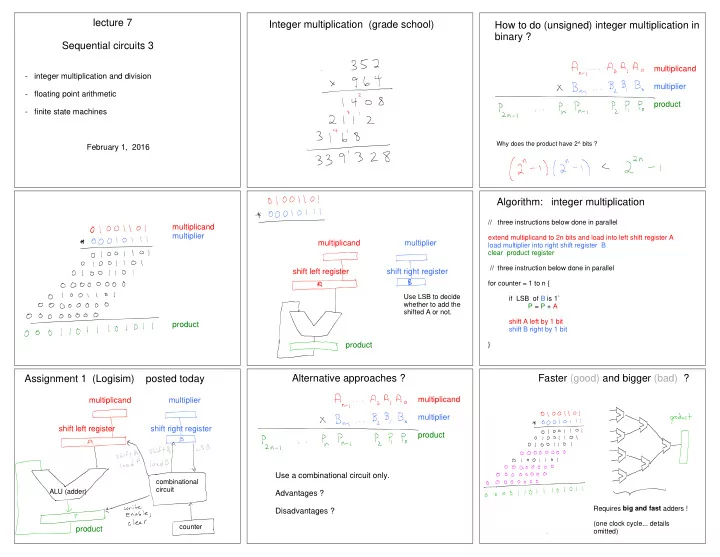
Integer multiplication (grade school) How to do (unsigned) integer multiplication in binary ?

multiplicand multiplier product

Why does the product have 2^ bits ?

multiplicand multiplier product

Use LSB to decide whether to add the shifted A or not.

multiplicand multiplier shift left register shift right register product

Algorithm: integer multiplication

// three instructions below done in parallel extend multiplicand to 2n bits and load into left shift register A load multiplier into right shift register B clear product register // three instruction below done in parallel for counter = 1 to n { if LSB of B is 1` P = P + A shift A left by 1 bit shift B right by 1 bit }

multiplicand multiplier shift left register shift right register

combinational circuit counter

product

ALU (adder)

Assignment 1 (Logisim) posted today

Use a combinational circuit only. Advantages ? Disadvantages ?

Alternative approaches ?

multiplicand multiplier product

Faster (good) and bigger (bad) ?

Requires big and fast adders ! (one clock cycle... details

  • mitted)
slide-2
SLIDE 2

Use registers. Take several clock cycles. In terms of speed and size of circuit, this one falls between the

  • riginal approach

(Assignment 1) and the approach

  • n the previous

slide.

Long Division

How would you write

  • ut this grade school

algorithm? Not obvious !

quotient dividend remainder remainder remainder divisor quotient dividend remainder remainder remainder remainder divisor

Sketch only (ignore register initialization)

divisor (shift right register) quotient (shift left register) remainder combinational logic

divisor < remainder ?

Algorithm (time permitting) Recall Floating Point Addition (lecture 2)

x = 1.00100100010000010100001 * 2^ 2 y = 1.10101000000000000101010 * 2^ {-3} x + y = ? x = 1.00100100010000010100001 00000 * 2^2 y = .00001101010000000000001 01010 * 2^2 but the result x+y has more than 23 bits of significand To do floating point addition (or subtraction), we need to:

  • compare exponents
  • shift right (x or y with smaller exponent)
  • use a big adder

(recall we can use two's complement to do subtraction or to add with negative numbers)

  • normalize / shift

(or treat specially if the result is non-normalized)

  • round off

Details omitted. I just wanted to mention the basic idea. Similar to integer multiplication, but ...

  • significand must be approximated
  • we must take care of exponents too, including handling
  • verflow and underflow.

(Underflow means getting a non-normalized number.)

Floating Point Multiplication Floating Point Division

Similar to integer division, but we don't stop when remainder is less than divisor.

slide-3
SLIDE 3

Finite State Machines

Defined by:

  • clock (discrete time)
  • memory ("state" may change with each time step)
  • input and output values
  • next state (i+1) depends on current state and/or input (i)
  • output (i) may depend on currentState and/or input (i)

Finite State Machine

called "finite automata" in COMP 330

input i current state i output i nextState i+1 (memory) (memory)

The table has variables with values that can be written in binary. However, you cannot implement it with a combinational circuit only. You need sequential circuits too (and a clock to control time).

state (memory) input output combinational circuit combinational circuit

The behavior of the machine is determined by an initial state and a sequence of inputs.

e.g. turnstile e.g. turnstile

input current state output next state 0=coin 0=locked 0= ~turn 0=locked 1=push 1=unlocked 1= turn 1=unlocked 0 0 0 0 0 1 0 1 1 0 0 0 1 1 1 1

Announcements

  • A1 posted today (due Wed. Feb. 10 at 23:59)

TA (Josh and Noor) office hours will be posted soon.

  • Quiz 2 next Monday covers lectures 3-6

lastname A-H write in ARTS 145