Lecture 7: Visitor, Strategy, State, Chain of Responsibility, - - PowerPoint PPT Presentation

lecture 7 visitor strategy state chain of responsibility
SMART_READER_LITE
LIVE PREVIEW

Lecture 7: Visitor, Strategy, State, Chain of Responsibility, - - PowerPoint PPT Presentation

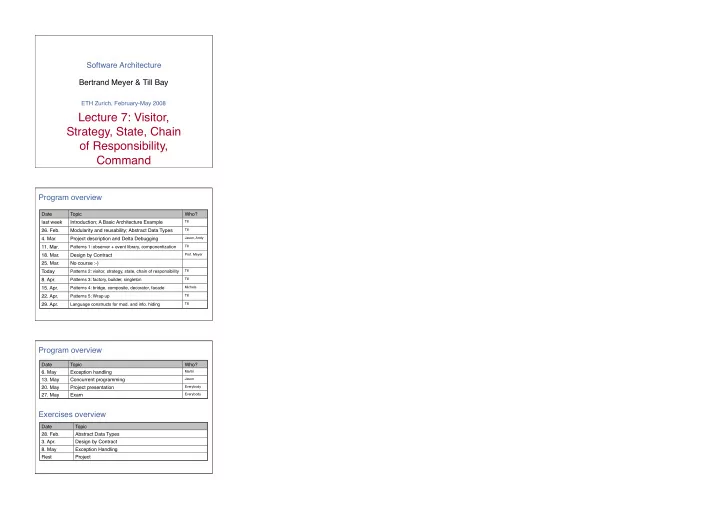
Software Architecture Bertrand Meyer & Till Bay ETH Zurich, February-May 2008 Lecture 7: Visitor, Strategy, State, Chain of Responsibility, Command Program overview Date Topic Who? last week Introduction; A Basic Architecture Example


slide-1
SLIDE 1

Software Architecture Bertrand Meyer & Till Bay

ETH Zurich, February-May 2008

Lecture 7: Visitor, Strategy, State, Chain

  • f Responsibility,

Command

Program overview

Date Topic Who? last week Introduction; A Basic Architecture Example

Till

  • 26. Feb.

Modularity and reusability; Abstract Data Types

Till

  • 4. Mar.

Project description and Delta Debugging

Jason, Andy

  • 11. Mar.

Patterns 1: observer + event library, componentization

Till

  • 18. Mar.

Design by Contract

  • Prof. Meyer
  • 25. Mar.

No course :-) Today

Patterns 2: visitor, strategy, state, chain of responsibility

Till

  • 8. Apr.

Patterns 3: factory, builder, singleton

Till

  • 15. Apr.

Patterns 4: bridge, composite, decorator, facade

Michela

  • 22. Apr.

Patterns 5: Wrap up

Till

  • 29. Apr.

Language constructs for mod. and info. hiding

Till

Program overview

Date Topic Who?

  • 6. May

Exception handling

Martin

  • 13. May

Concurrent programming

Jason

  • 20. May

Project presentation

Everybody

  • 27. May

Exam

Everybody

Date Topic

  • 28. Feb.

Abstract Data Types

  • 3. Apr.

Design by Contract

  • 8. May

Exception Handling Rest Project

Exercises overview

slide-2
SLIDE 2

comerge inc.

visitor

  • Process the elements of an (unbounded)

data structure.

  • Apply computations depending on the type of

data node.

  • Store the code outside of the data structure.
  • Most of the time used together with the

composite pattern.

comerge inc.

visitor example

INTEGER_ EXPRESSION ADDITION_ EXPRESSION MULTIPLICATION_ EXPRESSION EXPRESSION_ COMPUTATION_ VISITOR Return the integer value. Compute the left and right subtree, then add the values. Compute the left and right subtree, then multiply the values. CODE_ GENERATOR_ VISITOR Generate code that stores the value on the stack. Generate code for the left and right subtree, then code that pops two elements off the stack and adds them. Generate code for the left and right subtree, then code that pops two elements off the stack and multiplies them.

Double dispatch

comerge inc.

double dispatch

  • “Double dispatch” is code selection based on

the dynamic type of two objects.

  • Available in some languages like Dylan,

MultiJava, LISP, Python (via language extensions)

  • Not available in Eiffel
  • Can be emulated by dispatching twice:

dynamic binding on the visitor and the subject

  • Caveat: Preparation needed
slide-3
SLIDE 3

comerge inc.

double dispatch

EXPRESSION_ COMPUTATION_ VISITOR ADDITION_ EXPRESSION process (Current) process_addition (Current)

comerge inc.

deferred class EXPRESSION_VISTOR feature -- Processing process_integer (e: INTEGER_EXPRESSION) is

  • - Process integer constants.

deferred end process_addition (e: ADDITION_EXPRESSION) is

  • - Process additions.

deferred end process_multiplication (e: MULTIPLICATION_EXPRESSION) is

  • - Process multiplications.

deferred end end

abstract visitor

Some contracts skipped for brevity!

comerge inc.

deferred class EXPRESSION feature -- Processing process (v: EXPRESSION_VISITOR) is

  • - Process this node by visitor `vʼ.

require not_void: v /= Void deferred end end

process features

slide-4
SLIDE 4

comerge inc.

class INTEGER_EXPRESSION inherit EXPRESSION feature -- Access value: INTEGER

  • - Representation of expression

feature -- Processing process (v: EXPRESSION_VISITOR) is

  • - Process this node by visitor `vʼ.

do v.process_integer (Current) end end

process features

comerge inc.

class ADDITION_EXPRESSION inherit EXPRESSION ... feature -- Processing process (v: EXPRESSION_VISITOR) is

  • - Process this node by visitor `vʼ.

do v.process_addition (Current) end ... end

process features

comerge inc.

class EXPRESSION_COMPUTATION_VISTOR feature -- Access last_result: INTEGER feature -- Processing process_integer (e: INTEGER_EXPRESSION) is

  • - Process integer constants.

do last_result := e.value end

concrete visitor

slide-5
SLIDE 5

comerge inc.

process_addition (e: ADDITION_EXPRESSION) is

  • - Process additions.

local right_value, left_value: INTEGER do e.left.process (Current) left_value := last_result e.right.process (Current) right_value := last_result last_result := right_value + left_value end

  • - (same for process_multiplication)

end

concrete visitor

comerge inc.

class EXPRESSION_ITERATOR inherit EXPRESSION_VISITOR feature -- Processing process_integer (e: INTEGER_EXPRESSION) is

  • - Process integer constants.

do end process_addition (e: ADDITION_EXPRESSION) is

  • - Process additions.

do e.left.process (Current) e.right.process (Current) end ... end

iterating visitor

comerge inc.

visitor summary

  • Elegant solution to traverse unbounded data

structures

  • Emulating double dispatch
  • Needs preparation
  • Introducing new node types requires the

adaptation of the abstract visitor and its children

  • Result values are stored in attributes
slide-6
SLIDE 6

comerge inc.

Strategy

Purpose

“Define a family of algorithms, encapsulate each

  • ne, and make them interchangeable. Strategy

lets the algorithm vary independently from clients that use it”. [Gamma et al., p 315]

Example application selecting a sorting algorithm on-the-fly

comerge inc.

Life without strategy: a sorting example

feature -- Sorting sort (a_list: LIST [INTEGER]; a_strategy: INTEGER) is

  • - Sort a_list using algorithm indicated by a_strategy.

require a_list_not_void: a_list /= Void a_strategy_valid: is_strategy_valid (a_strategy) do inspect a_strategy when binary then … when quick then … when bubble then … else … end ensure a_list_sorted: … end What if a new algorithm is needed ?

comerge inc.

Strategy pattern: overall architecture

+ STRATEGY_A

+

STRATEGY_B + STRATEGY_C * STRATEGY

+

CONTEXT do_something do_something+ do_something+ do_something+ do_something* strategy

slide-7
SLIDE 7

comerge inc.

Class STRATEGY

deferred class STRATEGY feature -- Basic operation do_something

  • - Do something (perform some algorithm).

deferred end end

comerge inc.

Class CONTEXT

class CONTEXT create make feature {NONE} -- Initialization make (a_strategy: like strategy) is

  • - Set strategy to a_strategy.

require a_strategy_not_void: a_strategy /= Void do strategy := a_strategy ensure strategy_set: strategy = a_strategy end

comerge inc.

feature – Basic operations do_something

  • - Do something (call algorithm cooresponding to strategy ).

do strategy.do_something end set_strategy (a_strategy: like strategy)

  • - Set strategy to a_strategy.

require a_strategy /= Void do strategy := a_strategy ensure strategy = a_strategy end

Class CONTEXT

slide-8
SLIDE 8

comerge inc.

feature {NONE} – Implementation strategy: STRATEGY

  • - Strategy to be used

invariant strategy_not_void: strategy /= Void end

Class CONTEXT

comerge inc.

Using strategy pattern

sorter_context: SORTER_CONTEXT bubble_strategy: BUBBLE_STRATEGY quick_strategy: QUICK_STRATEGY create sorter_context.make (bubble_strategy) sorter_context.sort (a_list) sorter_context.set_strategy (quick_strategy) sorter_context.sort (a_list)

Now, what if a new algorithm is needed ?

hash_strategy: HASH_STRATEGY sorter_context.set_strategy (hash_strategy) sorter_context.sort (a_list)

comerge inc.

Strategy - Consequences

  • Families of related algorithms
  • An alternative to subclassing
  • Eliminate conditional statements
  • A choice of implementations
  • Clients must be aware of different Strategies
  • Communication overhead between Strategy and Context
  • Increased number of objects
slide-9
SLIDE 9

comerge inc.

Strategy - Participants

Strategy

declares an interface common to all supported algorithms.

Concrete strategy

implements the algorithm using the Strategy interface.

Context

  • is configured with a concrete strategy object.
  • maintains a reference to a strategy object.

comerge inc.

Chain of responsibility

Purpose “Avoid[s] coupling the sender of a request to its receiver by giving more than one object a chance to handle the request. [It] chain[s] the receiving objects and pass[es] the request along the chain until an object handles it.” [Gamma et al., p 223] Example application A GUI event is passed from level to level (such as from button to dialog and then to application)

comerge inc.

35

Chain of responsibility

* HANDLER[G] + INTERMEDIATE_ HANDLER[G] + FINAL_HANDLER[G]

next can_handle + do_handle + can_handle+ do_handle+ handle can_handle* do_handle* handled set_next

APPLICATION

slide-10
SLIDE 10

comerge inc.

Class HANDLER [G]

deferred class HANDLER [G] create default_create, make feature {NONE } -- Initialization make (n : like next) is

  • - Set next to n.

do next := n ensure next_set: next = n end feature -- Access next : HANDLER [G]

  • - Successor in the chain of responsibility

feature -- Status report can_handle (r : G): BOOLEAN is deferred end

  • - Can this handler handle r?

handled: BOOLEAN

  • - Has request been handled?

comerge inc.

Class HANDLER [G]

feature -- Basic operations handle (r : G) is

  • - Handle r if can_handle otherwise forward it to next.
  • - If no next, set handled to False.

do if can_handle (r ) then do_handle (r ) ; handled := True else if next /= Void then next.handle (r ) ; handled := next.handled else handled := False end end ensure can_handle (r ) implies handled (not can_handle (r ) and next /= Void) implies handled = next.handled (not can_handle (r ) and next = Void) implies not handled end

comerge inc.

Class HANDLER [G]

feature -- Element change set_next (n : like next) is

  • - Set next to n.

do next := n ensure next_set: next = n end feature {NONE} – Implementation do_handle (r : G) is

  • - Handle r.

require can_handle: can_handle (r) deferred end end

slide-11
SLIDE 11

comerge inc.

Using chain of responsibility

btn_help_provider: BUTTON_HELP_HANDLER [CLICK_REQUEST] dialog_help_provider: DIALOG_HELP_HANDLER [CLICK_REQUEST] win_help_provider: WINDOW_HELP_HANDLER [CLICK_REQUEST] create win_help_provider create dialog_help_provider.make (win_help_provider) create btn_help_provider.make (dialog_help_provider) btn_help_provider.handle (a_click_request)

btn_helper_provider dialog_help_provider win_help_provider

comerge inc.

Chain of responsibility - Consequences

Reduced coupling

An object only has to know that a request will be handled

"appropriately“. Both the receiver and the sender have no explicit knowledge of each other

Added flexibility in assigning responsibilities to

  • bjects

Ability to add or change responsibilities for handling a request

by adding to or otherwise changing the chain at run-time

Receipt isn't guaranteed

the request can fall off the end of the chain without ever being handled

comerge inc.

Chain of responsibility - Participants

Handler

  • defines an interface for handling requests.
  • (optional) implements the successor link.

Concrete handler

  • handles requests it is responsible for.
  • can access its successor.
  • if the Concrete handler can handle the request, it does so; otherwise it

forwards the request to its successor.

Client

initiates the request to a Concrete handler object on the chain.

slide-12
SLIDE 12

comerge inc.

State

Purpose

“Allows an object to alter its behavior when its internal state changes. The object will appear to change its class”. [Gamma et al., p 305]

Application example:

  • add attributes without changing class
  • state machine simulation

comerge inc.

State

+ INITIAL_STATE + INTERMEDIARY _STATE + FINAL_STATE

*

STATE + CONTEXT do_something do_something+ do_something+ do_something+ do_something* state context

What’s the difference between state and strategy ?

comerge inc.

Class CONTEXT

class CONTEXT … feature – Basic operations do_something is

  • - Do something depending on the state.

do state .do_something end feature {NONE} -- Implementation state: STATE

  • - Current state

some_other_state: STATE

  • - Other managed state

end

slide-13
SLIDE 13

comerge inc.

Class STATE

deferred class STATE … feature – Basic operations do_something is

  • - Do something

deferred end feature -- Access context: CONTEXT

  • - Context where current is used

… end

comerge inc.

Class CONCRETE_STATE

class CONCRETE_STATE inherit STATE feature – Basic operations do_something is

  • - Do something

do … context.set_state (context.some_other_state) end end

comerge inc.

Using state: Class WEBSITE_CONTEXT

class WEBSITE_CONTEXT feature – Basic operations login is

  • - Login.

do state.login end logout is

  • - Logout.

do state.logout end visit_url (a_url: URL) is

  • - Visit URL a_url.

do state.visit (a_url) end

slide-14
SLIDE 14

comerge inc.

Using state: Class WEBSITE_CONTEXT

feature {NONE} -- Implementation state: ACCOUNT_STATE

  • - Current state

feature {ACCOUNT_STATE} -- Implementation loggedin_state, loggedout_state: like state

  • - States

set_state (a_state: like state) is

  • - Logout state

require a_state_not_void: a_state /= Void do state := a_state ensure state_set: state = a_state end end

comerge inc.

Using state: Class ACCOUNT_STATE

deferred class ACCOUNT_STATE feature – Basic operations login is deferred end logout is deferred end visit_url (a_url: URL) is require a_url_not_void: a_url /= Void deferred end feature{NONE} – Implementation context: WEBSITE_CONTEXT

  • - Context

… end

comerge inc.

Using state: Class LOGIN_STATE

class LOGGEDIN_STATE inherit ACCOUNT_STATE feature – Basic operations login is do end logout is do context.set_state(context.loggedout_state) end visit_url (a_url: URL) is do

  • - Go to URL.

end end

slide-15
SLIDE 15

comerge inc.

Using state: Class LOGOUT_STATE

class LOGGEDOUT_STATE inherit ACCOUNT_STATE feature – Basic operations login is do context.set_state(context.loggedin_state) end logout is do end visit_url (a_url: URL) is do

  • - Disallow visit.

end end

comerge inc.

State - Consequences

It localizes state-specific behavior and partitions behavior for different states It makes state transitions explicit State objects can be shared

comerge inc.

State - Participants

Context

  • defines the interface of interest to clients.
  • maintains an instance of a Concrete state subclass that defines the current

state.

State

defines an interface for encapsulating the behavior associated with a particular state of the Context.

Concrete state

each subclass implements a behavior associated with a state of the Context

slide-16
SLIDE 16

comerge inc.

Command

Purpose

Way to implement an undo-redo mechanism, e.g. in text editors. [OOSC, p 285-290] ”Way to encapsulate a request as an object, thereby letting you parameterize clients with different requests, queue or log requests, and support undoable operations.” [Gamma et al., p 233]

Application example EiffelStudio

comerge inc.

The problem

Enabling users of an interactive system to cancel the effect of the last command. Often implemented as “Control-Z”. Should support multi-level undo-redo, with no limitation other than a possible maximum set by the user A good review of O-O techniques

comerge inc.

Working example: text editor

Notion of “current line”. Assume commands such as:

  • Insert line after current position
  • Insert line before current position
  • Delete current line
  • Replace current line
  • Swap current line with next if any
  • ...

This is a line-oriented view for simplicity, but the discussion applies to more sophisticated views

slide-17
SLIDE 17

comerge inc.

Underlying class (from “business model”)

class EDIT_CONTROLLER feature text : LINKED_LIST [STRING] remove is

  • - Remove line at current position.

require not off do text.remove end put_right (line: STRING) is

  • - Insert line after current position.

require not after do text.put_right (line) end ... end

comerge inc.

Key step in devising a software architecture

Here: The notion of “command”

Finding the right abstractions

(Interesting object types)

comerge inc.

Keeping the history of the session

The history list:

Insert Insert Remove Swap Insert Oldest Most recent

history : LINKED_LIST [COMMAND]

slide-18
SLIDE 18

comerge inc.

Whatʼs a “command” object?

An instance of COMMAND includes information about

  • ne execution of a command by the user, sufficient

to:

  • Execute the command
  • Cancel the command if requested later

For example, in a delete command object, we need:

  • The position of the line being deleted
  • The content of that line

comerge inc.

General notion of command

deferred class COMMAND feature execute is

  • - Carry out one execution of this command.

undo is

  • - Cancel an earlier execution of this command.

end deferred : done end deferred end done: BOOLEAN is

  • - Has this command been executed?

ensure already: done require already: done

comerge inc.

Command class hierarchy

COMMAND

DELETION INSERTION execute∗ undo*

execute+

(undo+

line index ... execute+

(undo+

index ...

+ +

+

deferred effective

slide-19
SLIDE 19

comerge inc.

A command class (sketch, no contracts)

class DELETION inherit COMMAND feature execute controller : EDIT_CONTROLLER

  • - Access to business model

line : STRING

  • - Line being deleted

index : INTEGER

  • - Position of line being deleted

execute is

  • - Remove current line and remember it.

do line := controller.item ; index := controller.index controller.remove ; done := True end undo is

  • - Re-insert previously removed line.

do controller.go_ith (index) controller.put_left (line) end end

comerge inc.

Executing a user command

decode_user_request if “Request is normal command” then “Create command object c corresponding to user request” history.extend (c) c.execute elseif “Request is UNDO” then if not history.before then -- Ignore excessive requests history.item.undo history.back end elseif “Request is REDO” then if not history.is_last then -- Ignore excessive requests

history.forth

history.item.execute end end

Insert Insert Remove Insert item

comerge inc.

Command pattern

APPLICATION HISTORY

history

* COMMAND

commands execute* undo* redo* execute can_undo, can_redo undo, redo undo_all, redo_all extend

+ COMMAND_1

execute + undo+ redo+

+ COMMAND_2

execute + undo+ redo+

slide-20
SLIDE 20

comerge inc.

The undo-redo pattern

  • Has been extensively used (e.g. in Eiffel

tools)

  • Fairly easy to implement
  • Details must be handled carefully (e.g. some

commands may not be undoable)

  • Elegant use of O-O techniques
  • Disadvantage: explosion of small classes
  • In Java, can use “inner” classes.

comerge inc.

Using agents

For each user command, have two routines:

  • The routine to do it
  • The routine to undo it!

comerge inc.

The history list using agents

The history list simply becomes a list of agents pairs: history : LINKED_LIST [TUPLE [PROCEDURE [ANY, TUPLE], PROCEDURE [ANY, TUPLE]] Basic scheme remains the same, but no need for command

  • bjects any more; the history list simply contains agents.

Insert Insert Remove Swap Insert De-insert De-insert Re-insert Swap De-insert

slide-21
SLIDE 21

decode_user_request if “Request is normal command” then “Create command object c corresponding to user request” history.extend (c) c.execute elseif “Request is UNDO” then if not history.before then -- Ignore excessive requests history.item.undo history.back end elseif “Request is REDO” then if not history.is_last then -- Ignore excessive requests history.forth

  • history. item.execute

end end

comerge inc.

Executing a user command (before)

Insert Insert Remove Insert item

comerge inc.

Executing a user command (now)

“Decode user_request giving two agents do_it and undo_it ” if “Request is normal command” then history.extend ([do_it, undo_it ]) do_it.call ([]) elseif “Request is UNDO” then if not history.before then history.item.item (2) .call ([]) history.back end elseif “Request is REDO” then if not history.is_last then history.forth history.item.item (1) .call ([]) end end

Insert Insert Remove Swap De- insert De- insert Re- insert Swap

comerge inc.

Command - Consequences

  • Command decouples the object that invokes

the operation from the one that knows how to perform it.

  • Commands are first-class objects. They can

be manipulated and extended like any other

  • bject.
  • You can assemble commands into a

composite command.

  • It's easy to add new Commands, because you

don't have to change existing classes.

slide-22
SLIDE 22

comerge inc.

Command - Participants

Command

declares an interface for executing an operation.

Concrete command

  • defines a binding between a Receiver object and an action.
  • implements Execute by invoking the corresponding operation(s) on Receiver.

Client

creates a ConcreteCommand object and sets its receiver.

Invoker

asks the command to carry out the request.

Receiver

knows how to perform the operations associated with carrying out a request. Any class may serve as a Receiver.

End of lecture 7