
Leftmost Longest Regular Expression Matching in Reconfigurable Logic
Kubilay Atasu IBM Research - Zurich kat@zurich.ibm.com
Abstract—Regular expression (regex) matching is an essential part of text analytics and network intrusion detection systems. The leftmost longest regex matching feature enables finding a leftmost derivation of an input text and helps resolve ambiguities that can arise in natural-language parsing. We show that leftmost longest regex matching can be efficiently performed in a data- flow pipeline by combining a recently proposed regex-matching architecture with simple last-in first-out (LIFO) buffers and streaming filter units, without creating significant back-pressure
- r using costly sorting operations. The techniques we propose can
be used to compute overlapping and non-overlapping leftmost longest and rightmost longest regex matches. In addition, we show that the latency of the LIFO buffers can be hidden by
- verlapping the processing of subsequent input streams, without
replicating the buffer space. Experiments on an Altera Stratix IV FPGA show a 200-fold improvement of the processing rates compared with a multithreaded software implementation.
I. INTRODUCTION We live in a data-centric world. Data is driving discovery in many fields, such as in healthcare analytics, cyber-security, weather forecasting, and computational astrophysics etc. The so-called big data has become a new natural resource, and discovering insights in big data will be the key capability of future computing platforms. The explosion in the size of the datasets is leading to a paradigm shift in system design. The need to achieve an efficient integration of massive data and computation is resulting in a major re-thinking of memory hierarchies and computing fabrics in datacentres. Data-centric systems diverge from traditional computer architectures in two main aspects. First, to improve the bandwidth of data access, computation is being moved closer to the data [1]. Secondly, the energy consumption of datacentres is increasing at an alarming rate, and energy costs start to exceed equip- ment costs [2]. Scaling up datacentre performance simply by increasing the number of processor cores is no longer feasible economically. To improve both performance and en- ergy efficiency and to exploit the data-access bandwidth more efficiently, data-centric systems are increasingly relying on heterogeneous compute resources, such as graphics-processing units (GPUs) and field-programmable gate arrays (FPGAs). The process of extracting information from large-scale unstructured text is called text analytics and has applications in business analytics, healthcare, and security intelligence. Analyzing unstructured text and extracting insights hidden in it at high bandwidth and low latency are computationally challenging tasks. In particular, text analytics functions rely heavily on regexs and dictionaries for locating named entities,
- Fig. 1.
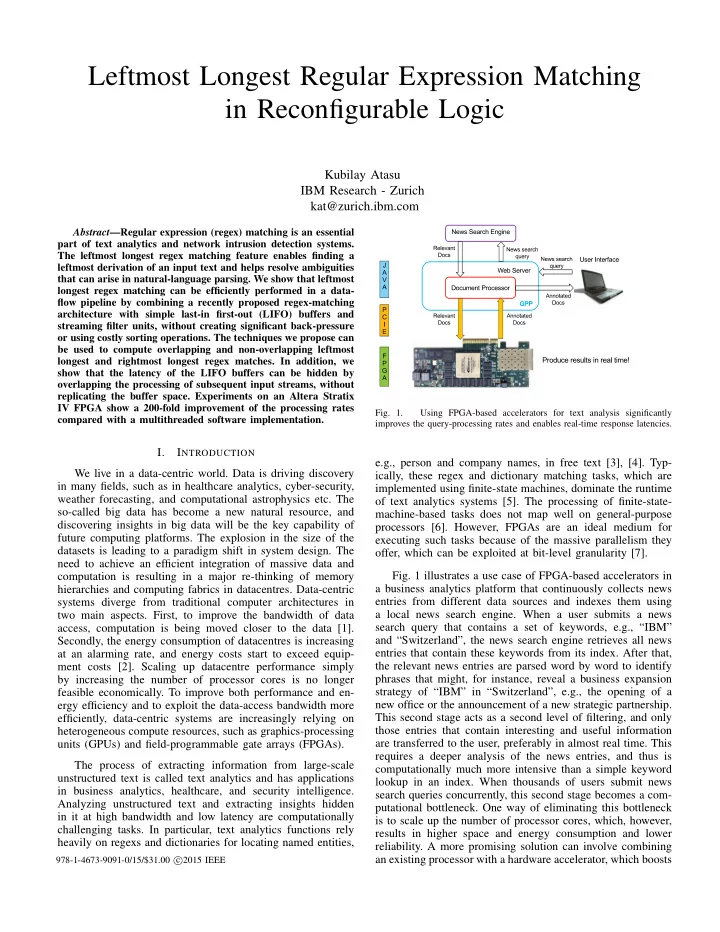
Using FPGA-based accelerators for text analysis significantly improves the query-processing rates and enables real-time response latencies.
e.g., person and company names, in free text [3], [4]. Typ- ically, these regex and dictionary matching tasks, which are implemented using finite-state machines, dominate the runtime
- f text analytics systems [5]. The processing of finite-state-
machine-based tasks does not map well on general-purpose processors [6]. However, FPGAs are an ideal medium for executing such tasks because of the massive parallelism they
- ffer, which can be exploited at bit-level granularity [7].
- Fig. 1 illustrates a use case of FPGA-based accelerators in
a business analytics platform that continuously collects news entries from different data sources and indexes them using a local news search engine. When a user submits a news search query that contains a set of keywords, e.g., “IBM” and “Switzerland”, the news search engine retrieves all news entries that contain these keywords from its index. After that, the relevant news entries are parsed word by word to identify phrases that might, for instance, reveal a business expansion strategy of “IBM” in “Switzerland”, e.g., the opening of a new office or the announcement of a new strategic partnership. This second stage acts as a second level of filtering, and only those entries that contain interesting and useful information are transferred to the user, preferably in almost real time. This requires a deeper analysis of the news entries, and thus is computationally much more intensive than a simple keyword lookup in an index. When thousands of users submit news search queries concurrently, this second stage becomes a com- putational bottleneck. One way of eliminating this bottleneck is to scale up the number of processor cores, which, however, results in higher space and energy consumption and lower
- reliability. A more promising solution can involve combining
an existing processor with a hardware accelerator, which boosts
978-1-4673-9091-0/15/$31.00 c 2015 IEEE