LEGAL AUTHORITY LEGAL AUTHORITY The DFG Lake and Streambed - - PDF document

legal authority legal authority
SMART_READER_LITE
LIVE PREVIEW

LEGAL AUTHORITY LEGAL AUTHORITY The DFG Lake and Streambed - - PDF document

Ecology and Conservation of Coastal California's Riparian Areas May 12, 2005 CALIFORNIA DEPARTMENT OF FISH AND GAME RIPARIAN RESOURCES AND REGULATORS: LEGAL AUTHORITY LEGAL AUTHORITY The DFG Lake and Streambed Alteration 1600 Process


slide-1
SLIDE 1

1

CALIFORNIA DEPARTMENT OF FISH AND GAME

RIPARIAN RESOURCES AND REGULATORS: The DFG Lake and Streambed Alteration “1600” Process

Serge Glushkoff CENTRAL COAST REGION YOUNTVILLE SPRING 2005

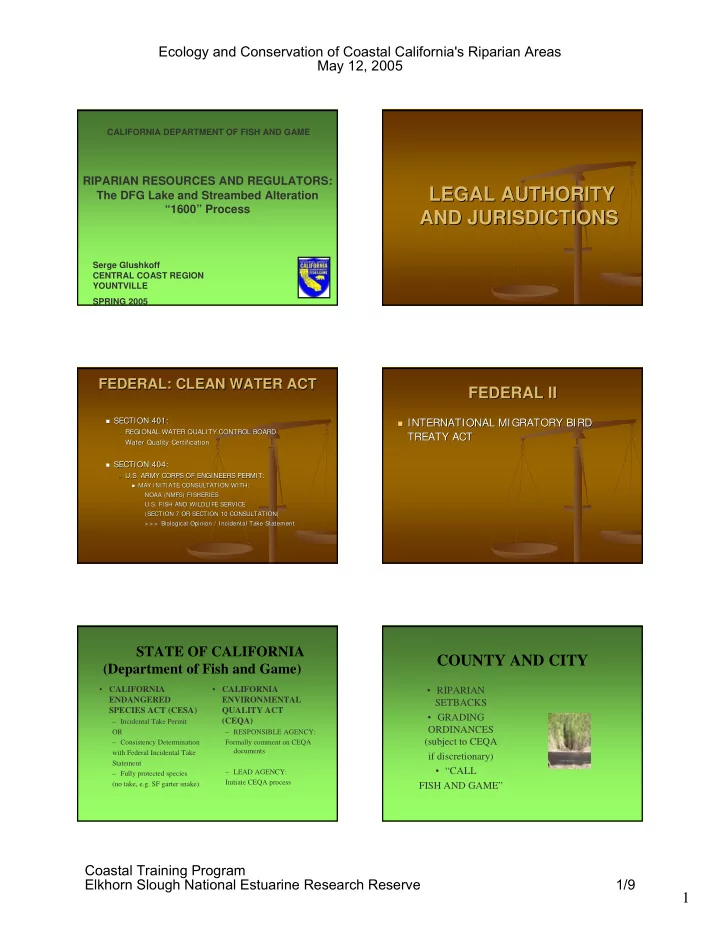
LEGAL AUTHORITY LEGAL AUTHORITY AND JURISDICTIONS AND JURISDICTIONS

FEDERAL: CLEAN WATER ACT FEDERAL: CLEAN WATER ACT

  • SECTION 401:

SECTION 401:

  • REGIONAL WATER QUALITY CONTROL BOARD

REGIONAL WATER QUALITY CONTROL BOARD Water Quality Certification Water Quality Certification

  • SECTION 404:

SECTION 404:

  • U.S. ARMY CORPS OF ENGINEERS PERMIT:

U.S. ARMY CORPS OF ENGINEERS PERMIT:

  • MAY INITIATE CONSULTATION WITH:

MAY INITIATE CONSULTATION WITH: NOAA (NMFS) FISHERIES NOAA (NMFS) FISHERIES U.S. FISH AND WILDLIFE SERVICE U.S. FISH AND WILDLIFE SERVICE (SECTION 7 OR SECTION 10 CONSULTATION) (SECTION 7 OR SECTION 10 CONSULTATION) > > > Biological Opinion / Incidental Take Statement > > > Biological Opinion / Incidental Take Statement

FEDERAL II FEDERAL II

  • INTERNATIONAL MIGRATORY BIRD

INTERNATIONAL MIGRATORY BIRD TREATY ACT TREATY ACT

STATE OF CALIFORNIA (Department of Fish and Game)

  • CALIFORNIA

ENDANGERED SPECIES ACT (CESA)

– Incidental Take Permit OR – Consistency Determination with Federal Incidental Take Statement – Fully protected species (no take, e.g. SF garter snake)

  • CALIFORNIA

ENVIRONMENTAL QUALITY ACT (CEQA)

– RESPONSIBLE AGENCY: Formally comment on CEQA documents – LEAD AGENCY: Initiate CEQA process

COUNTY AND CITY

  • RIPARIAN

SETBACKS

  • GRADING

ORDINANCES (subject to CEQA if discretionary)

  • “CALL

FISH AND GAME”

Ecology and Conservation of Coastal California's Riparian Areas May 12, 2005 Coastal Training Program Elkhorn Slough National Estuarine Research Reserve 1/9

slide-2
SLIDE 2

2

The Mission of the Department of Fish and Game is to manage California's diverse fish, w ildlife, and plant resources, and the habitats upon w hich they depend, for their ecological values and for their use and enjoyment by the public.

Department of Fish and Game Code Sections 1600-1616 (amended January 1,2004)

The 1600 process protects waterways, lakes, ponds, riparian areas and associated resources by providing guidance to design projects so as to avoid or reduce impacts to a less than significant level in these areas.

Who needs to apply for a 1600 agreement with the Department of Fish and Game?

The Fish and Game Code Section 1602 requires notification for any project that … Ecology and Conservation of Coastal California's Riparian Areas May 12, 2005 Coastal Training Program Elkhorn Slough National Estuarine Research Reserve 2/9

slide-3
SLIDE 3

3

…that will substantially divert

  • r obstruct the natural flow of,
  • r substantially change or use

any material …. from the bed, channel, or bank of any river, stream, or lake … The Department must decide whether 1) project sites and impacts may affect a stream or lake, and whether 2)potential changes may be substantial

On Jurisdiction

Active Channel Floodplain Floodplain Terrace Hillslope Hillslope Shading, dripline and root zone Source of Large Woody Debris (LWD) Source of fine litter

change the bed, channel, or bank

  • f any river, stream, or lake ….

Ecology and Conservation of Coastal California's Riparian Areas May 12, 2005 Coastal Training Program Elkhorn Slough National Estuarine Research Reserve 3/9

slide-4
SLIDE 4

4

Once notified the Department will review the notification and determine if it is necessary to schedule a site visit to determine if the project has potential impacts and 1) needs an agreement, and 2) needs full (CEQA) environmental review. 1602 Reviews should assess:

  • Alteration to bed or bank
  • Alteration of water quantity or flow

characteristics

  • Alteration of water quality
  • Impacts to special status species
  • Effects on aquatic resources
  • Effects on riparian vegetation
  • Effects on terrestrial species

“Critical (program) Flows”

PREVIOUSLY EXISTING PROJECTS RECREATIONAL SUMMER DAMS AGRICULTURAL DIVERSIONS / IMPOUNDMENTS GRAVEL OPERATIONS

Ecology and Conservation of Coastal California's Riparian Areas May 12, 2005 Coastal Training Program Elkhorn Slough National Estuarine Research Reserve 4/9

slide-5
SLIDE 5

5

Instream gravel mining “New flows”

  • Horizontal directional drilling

(HDD):through (and sometimes into) the jurisdictional alluvium

  • Bridge projects with effects on the channel
  • “But there’s no fish here!”

Riparian ecologistics

  • Fish
  • Frogs and herptiles
  • Birds and bats
  • Sedimentation
  • Invasive species
  • Native species, local

genotypes

  • Corridors
  • Cumulative impacts
  • Habitat

heterogeneity

  • Channel “integrity”

Ecology and Conservation of Coastal California's Riparian Areas May 12, 2005 Coastal Training Program Elkhorn Slough National Estuarine Research Reserve 5/9

slide-6
SLIDE 6

6

Riparian ecologistics

  • Fish
  • Frogs and herptiles
  • Birds and bats
  • Germination
  • Sedimentation
  • Invasive species
  • Native genotypes
  • Corridors
  • Cumulative impacts
  • Habitat

heterogeneity

  • Channel “integrity”

Waterscapes

  • Large woody debris (LWD)
  • Retain vegetation for bank stability
  • Dissipate new hydraulic energy entering

channel

  • Protect riffles, pools, and spawnable

substrate

Waterscapes and introduced hardscapes

  • When feasible, retain access to floodplain
  • When feasible, use bioengineering
  • Avoid overarmoring (but engineer

adequately)

  • Adequately sized culverts (fish and flood

passage)

  • Bridges vs. culverts

NRCS Bio- engineered Stream bank Stabilization

Design by Bob Albers and Phill Blake, Napa Field Office Ellie Insley Property Severe streambank erosion left an 11 foot high vertical bank that After. Bank has stabilized, and willows are providing excellent set up further potential for significant property loss. NRCS design erosion protection and enhanced riparian habitat. Stream called for a brush layering treatment, and woven willow revetment meander is stabilized, without negatively effecting downstream

  • wall. The brush layering consists of 3 alternating lifts of soil, properties. This project has successfully withstood several

willow cuttings, and wraps of coconut erosion control fabric. The near-flood stage events and is providing excellent stabilization. willow revetment, constructed of posts and weavings of live, dormant willows will become a live structure, established and maintained with a drip irrigation system. A rock barb was placed just upstream of the brush layering reach, to deflect and roll stream tractive forces back into the channel center.

Ecology and Conservation of Coastal California's Riparian Areas May 12, 2005 Coastal Training Program Elkhorn Slough National Estuarine Research Reserve 6/9

slide-7
SLIDE 7

7

Waterscapes and introduced hardscapes

  • When feasible, retain access to floodplain
  • When feasible, use bioengineering
  • Avoid overarmoring (but engineer

adequately)

  • Adequately sized culverts (fish and flood

passage)

  • Bridges vs. culverts

The California Environmental Quality Act (CEQA) /1600 process

Superior Court of California County of Mendocino, Ukiah Branch

Mendocino Environmental Center

vs

California Department of Fish and Game

February 3, 1999

This court order changed the process for obtaining Lake or Streambed Alteration Agreements after May 1, 1999.

The Court found:

… the Department of Fish and Game must comply with the California Environmental Quality Act (CEQA) when issuing Lake or Streambed Alteration Agreements How has CEQA changed the 1600 process?

  • The process now generally takes more

time because an environmental review, subject to CEQA parameters, is done in addition to the field review.

  • The environmental review requires that

the impacts of the project be assessed and determinations made concerning the significance of those impacts to resources.

Ecology and Conservation of Coastal California's Riparian Areas May 12, 2005 Coastal Training Program Elkhorn Slough National Estuarine Research Reserve 7/9

slide-8
SLIDE 8

8

  • To make these determinations, it is

sometimes necessary to require additional surveys or for the Department to consult with other agencies.

  • The assessments and determinations are

subject to public review and input as part

  • f the process.

!Reality Check!

Resource protection mandates depend on staffing

Who prepares the CEQA document?

  • Fish and Game
  • r …
  • Another agency

Key Concept Key Concept

CEQA r QA revi view ew s m must st cov cover r the the

entire project

Can a previously prepared CEQA document be used? Yes, if it adequately covers the current project … Ecology and Conservation of Coastal California's Riparian Areas May 12, 2005 Coastal Training Program Elkhorn Slough National Estuarine Research Reserve 8/9

slide-9
SLIDE 9

9

How to save time, money and the resource:

  • Plan the project to avoid or

minimize impacts to sensitive areas.

  • Apply early.

– This is no longer a “hood of the truck”

  • process. The less impacts the project

has, the quicker it will move through environmental review. The current expected time from receipt of notification by DFG to the mailing of the draft 1600 agreement in the Central Coast Region is 90 days for complete notifications.

Impacts, rather than size of project, ultimately dictate the level of agreement conditions and CEQA review required.

  • Apply well.

– Follow the directions and provide the information requested. – Include amounts (linear feet, area, cubic yards, etc.) – Completely describe the project including equipment to be used, erosion control measures planned, and the time schedules required to do the project.

Notification/Application forms are available online:

www.dfg.ca.gov/1600 Or Calling (707) 944-5520 Ecology and Conservation of Coastal California's Riparian Areas May 12, 2005 Coastal Training Program Elkhorn Slough National Estuarine Research Reserve 9/9