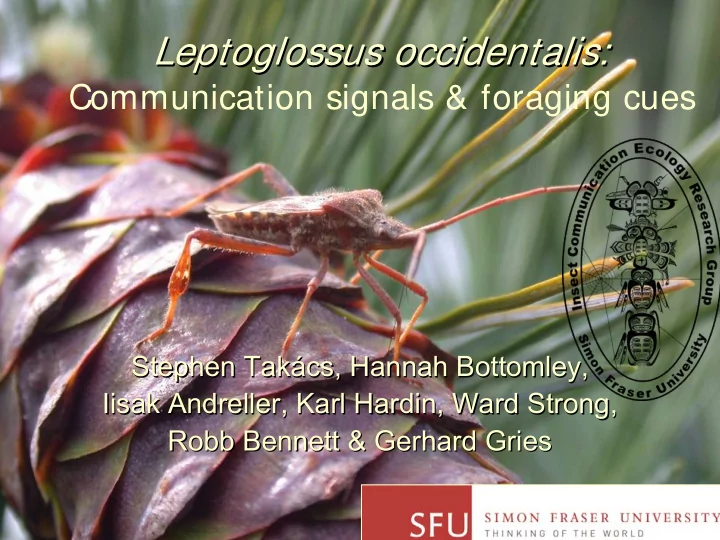
SLIDE 1 Leptoglossus Leptoglossus occidentalis
:
Communication signals & foraging cues
Stephen Stephen Tak Taká ács cs, Hannah , Hannah Bottomley Bottomley, , Iisak Iisak Andreller Andreller, Karl Hardin, Ward Strong, , Karl Hardin, Ward Strong, Robb Bennett & Gerhard Gries Robb Bennett & Gerhard Gries
SLIDE 2
Other Research …..
SLIDE 3
Pheromone of Contarinia oregonensis
SLIDE 4 Pheromone of Contarinia oregonensis
Captures of male midges in pheromone-baited traps are predictive of crop damage (monitoring tool)
SLIDE 5 Pheromone of Contarinia oregonensis
Captures of male midges in pheromone-baited traps are predictive of crop damage (monitoring tool) Pheromone-based control of populations ?
SLIDE 6
Pheromone of Mayetiola thujae
SLIDE 7
Pheromone of Mayetiola thujae
Development of the pheromone as a tool
for monitoring and possibly control is still be done
SLIDE 8 Communication signals:
Pheromone and sound
Foraging cues:
Infrared radiation Visible light wavelengths Cone size Semiochemicals
Leptoglossus Leptoglossus occidentalis
SLIDE 9
Pheromones
SLIDE 10
Sound
SLIDE 11
Recording substrate-borne sound
SLIDE 12
Sound analyses
SLIDE 13
Results
SLIDE 14 Bioassay
Played-back signal Computer-regenerated signal
SLIDE 15
SLIDE 16
Results
SLIDE 17
SLIDE 18
Results
SLIDE 19 Substrate-borne sound
SLIDE 20 Substrate-borne sound Airborne sound
SLIDE 21
Results
SLIDE 22 Airborne sound
Reviewer’s argued: No evidence for..
SLIDE 23
Pentatomomorpha
The flat bugs, seed bugs, leaf-footed bugs, and stink bugs are some of the most distinctive groups within the Pentatomomorpha. All members except… …possess 2 or more trichobothria on several abdominal segments
SLIDE 24
Trichobothria ….shown to be receptors of airborne sound
SLIDE 25 Trichobothria ….also present on abdomen of Leptoglossus
Leptoglossus occidentalis
SLIDE 26
Foraging cues
SLIDE 27 Prediction: cones emit more IR radiation than surrounding foliage, providing a foraging cue for L. occidentalis
Infrared (IR) radiation?
SLIDE 28
Electromagnetic Spectrum Electromagnetic Spectrum
SLIDE 29 Supporting Evidence Supporting Evidence
- Differential IR radiation emission by cones
Differential IR radiation emission by cones
- L.
- L. occidentalis
- ccidentalis possess IR receptors
possess IR receptors
- L.
- L. occidentalis
- ccidentalis is attracted to IR stimuli
is attracted to IR stimuli
- Occluded specimens no longer respond to
Occluded specimens no longer respond to IR stimuli IR stimuli
SLIDE 30 Supporting Evidence Supporting Evidence
- Differential IR radiation emission by cones
Differential IR radiation emission by cones
- L.
- L. occidentalis
- ccidentalis possess IR receptors
possess IR receptors
- L.
- L. occidentalis
- ccidentalis is attracted to IR stimuli
is attracted to IR stimuli
- Occluded specimens no longer respond to
Occluded specimens no longer respond to IR stimuli IR stimuli
SLIDE 31
SLIDE 32 Supporting Evidence Supporting Evidence
- Differential IR radiation emission by cones
Differential IR radiation emission by cones
- L.
- L. occidentalis
- ccidentalis possess IR receptors
possess IR receptors
- L.
- L. occidentalis
- ccidentalis is attracted to IR stimuli
is attracted to IR stimuli
- Occluded specimens no longer respond to
Occluded specimens no longer respond to IR stimuli IR stimuli
SLIDE 33 Scanning Electron Micrograph Scanning Electron Micrograph
Merimna atrata Australian “fire-beetle” Schmitz H. et al. 2000
1 cm
SLIDE 34 Scanning Electron Micrograph Scanning Electron Micrograph
Merimna atrata Australian “fire-beetle” Schmitz H. et al. 2000
200 µm
SLIDE 35 Method for IR-Receptograms
Recording electrode Indifferent electrode IR Source First Face Mirror Glass Tube
SLIDE 36 Results for IR Results for IR-
Receptograms
SLIDE 37 Supporting Evidence Supporting Evidence
- Differential IR radiation emission by cones
Differential IR radiation emission by cones
- L.
- L. occidentalis
- ccidentalis possess IR receptors
possess IR receptors
- L.
- L. occidentalis
- ccidentalis is attracted to IR stimuli
is attracted to IR stimuli
- Occluded specimens no longer respond to
Occluded specimens no longer respond to IR stimuli IR stimuli
SLIDE 38 Bioassay Set-up
1 m Red light
SLIDE 39
Bioassay Criteria
SLIDE 40
Bioassay Criteria
SLIDE 41 6.0°C 38.0°C 10 20 30
Bioassay Set-up
SLIDE 42 Reflection of IR Radiation Reflection of IR Radiation
0.6°C 27.9°C 5 10 15 20 25 0.6°C 27.9°C 5 10 15 20 25
SLIDE 43 Response of Response of L.
- L. occidentalis
- ccidentalis to
to IR Radiation IR Radiation
SLIDE 44
Field Study Field Study
SLIDE 45 12.7°C 33.6°C 15 20 25 30
empty ice water
Field Study Field Study
SLIDE 46
SLIDE 47 Field Response of Field Response of L.
- L. occidentalis
- ccidentalis to IR Radiation
to IR Radiation
SLIDE 48 Supporting Evidence Supporting Evidence
- Differential IR radiation emission by cones
Differential IR radiation emission by cones
- L.
- L. occidentalis
- ccidentalis possess IR receptors
possess IR receptors
- L.
- L. occidentalis
- ccidentalis is attracted to IR stimuli
is attracted to IR stimuli
- Occluded specimens no longer respond to
Occluded specimens no longer respond to IR stimuli IR stimuli
SLIDE 49 Occlusion Experiments Occlusion Experiments
silica/acrylic – – opaque to IR
SLIDE 50 Occlusion Experiments Occlusion Experiments
Occluded
Control
SLIDE 51 Occlusion Bioassay Set-up
1 m Red light
SLIDE 52 Results Results
Control 17 Insects
Non-responding
Occluded 35 Insects
Non-responding
SLIDE 53 Concluding Summary Concluding Summary
- Differential IR radiation emission by cones
Differential IR radiation emission by cones
- L.
- L. occidentalis
- ccidentalis possess IR receptors
possess IR receptors
- L.
- L. occidentalis
- ccidentalis is attracted to IR stimuli
is attracted to IR stimuli
- Occluded specimens no longer respond to
Occluded specimens no longer respond to IR stimuli IR stimuli
SLIDE 54 Prediction: cones emit specific wavelengths of visible light that provide a foraging cue for L. occidentalis
Wavelengths of visible light?
SLIDE 55 Prediction: cones emit specific wavelengths of visible light that provide a foraging cue for L. occidentalis
Wavelengths of visible light?
SLIDE 56
Wavelength reflection profiles
SLIDE 57 May 25, 2007 12:45 Ambient = 17 °C Sechelt
Trap color
SLIDE 58
Trapping results
SLIDE 59
Green = Green?
SLIDE 60
Attraction of Indian meal moth (Plodia interpunctella) to specific wavelengths of light
Tom Cowan
SLIDE 61 Experiment 1: Bioassay Setup
- Approx. 1.5m
- Approx. 1.5m
Release Stand Delta Trap
SLIDE 62 Proportion IMM response to 4 spectra at the same intensity
5 10 15 20 25 30 35 % Response
Results of Experiments 1-3
V♀ G♀
♂
n = 10
SLIDE 63 Spectral Power Distribution of Blue LEDs
405nm 435nm 450nm 470nm
SLIDE 64 Results: Experiment 4
Proportion of gravid females responding to blue LEDs emitting at the same intensity
10 20 30 40 50 60 70 % response 470nm 450nm 435nm 405nm
n = 10
a b b b
SLIDE 65
LED Trap in Action
SLIDE 66 L.
- L. occidentalis
- ccidentalis
Does a specific wavelength of green
provide an optimal foraging cue?
Is there an interaction between a specific
wavelength and IR radiation?
SLIDE 67 May 25, 2007 12:45 Ambient = 17 °C Sechelt
SLIDE 68 June 20, 2007 1:20 Ambient = 25 °C Kalamalka
SLIDE 69 Prediction: cone/trap size matters as a foraging cue
Cone size?
SLIDE 70
SLIDE 71
Trap size
SLIDE 72
SLIDE 73 Prediction: semiochemicals contribute to the complex
- f foraging cues. However…..
Semiochemicals?
SLIDE 74 …when traps are suspended from trees, synthetic cone semiochemicals may not be needed.
SLIDE 75
Semiochemicals
Are some cone volatile blends more
attractive than others?
Bait traps in seed orchards of Douglas-fir,
lodgepole pine, or spruce with e.g. volatiles from western white pine cones?
SLIDE 76
Management
Trap design:
IR radiation
SLIDE 77
Management
Trap design:
IR radiation Specific wavelength of visible light
SLIDE 78
Management
Trap design:
IR radiation Specific wavelength of visible light Proper size
SLIDE 79
Management
Trap design:
IR radiation Specific wavelength of visible light Proper size Semiochemical bait?
SLIDE 80
Management
Trap design:
IR radiation Specific wavelength of visible light Proper size Semiochemical bait? Airborne sound?
SLIDE 81
Management
Trap design:
IR radiation !!! Specific wavelength of visible light !!! Proper size !!! Semiochemical bait? Airborne sound?
SLIDE 82 Management
Timing of trap placement:
Early in the spring when trap-derived cues outcompete cues from natural cones
SLIDE 83
Management
Removal of cones in the fall
SLIDE 84 Acknow ledgem ents
- Patti Brown and colleagues (Canfor Seed
Orchard)
- Jane Gale
- James Drummond (Paprican)
- Forest Genetics Council of British Columbia
- Natural Sciences and Engineering Research
Council of Canada (NSERC)
SLIDE 85
Thank you! Thank you!
Thank you! Thank you!