Lets talk about the airport 2050 The Queenstown Airport Corporation - - PowerPoint PPT Presentation

let s talk about the airport 2050
SMART_READER_LITE
LIVE PREVIEW

Lets talk about the airport 2050 The Queenstown Airport Corporation - - PowerPoint PPT Presentation

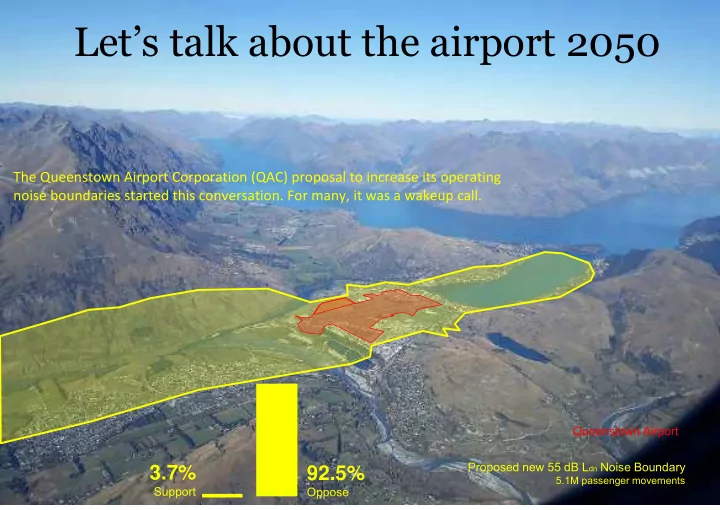
Lets talk about the airport 2050 The Queenstown Airport Corporation (QAC) proposal to increase its operating noise boundaries started this conversation. For many, it was a wakeup call. Queenstown Airport Proposed new 55 dB L dn Noise Boundary


slide-1
SLIDE 1

Let’s talk about the airport 2050

Proposed new 55 dB Ldn Noise Boundary

5.1M passenger movements

Queenstown Airport

92.5%

Oppose

3.7%

Support

The Queenstown Airport Corporation (QAC) proposal to increase its operating noise boundaries started this conversation. For many, it was a wakeup call.

slide-2
SLIDE 2

When David Jerram and Gillian Macleod attended the “Shaping Our Future” forum, participants were asked to complete written feedback on three key questions: 1. Who are the people that make up our community? 2. What are your aspirations or vision for our community? 3. What are the obstacles that could hinder us from achieving this vision? This, and the following two slides, use WORDLEs to give a pictorial summary of people’s responses. In the WORDLE, each word is sized relative to the frequency in which it appeared in the responses people wrote - more frequently used words become larger.

WHO ARE WE?

Source: Shaping our Future forum 2018

Frankton Community’s vision for the future

slide-3
SLIDE 3

WHAT DO WE WANT?

Source: Shaping our Future forum 2018

Frankton Community’s ideal future?

The question “What are your aspirations or vision for

  • ur community?” highlighted the values of those who

live here.

slide-4
SLIDE 4

WHAT WILL STOP US?

Source: Shaping our Future forum 2018

What are the challenges to achieving this vision?

The participants’ responses to this simple question was the Penny Drop moment. While issues with infrastructure, traffic congestion and rapid growth are all concerning, the airport is seen as the single largest obstacle to achieving a livable community. This is what caused Gillian and David to question the inevitability of the airport in Frankton.

slide-5
SLIDE 5

HOW DID WE GET HERE?

Source: Lands and Survey Map 1965

50 years ago, the small airport was 7.2 km from historic Queenstown

As experts in architecture, urban planning and design, David and Gillian know the incremental, evolutionary nature by which communities grow and develop. For over one century, Queenstown Bay was the centre and heart of this district and in 1937 the small township of Frankton, some 7 km from Queenstown, was the natural place to locate an

  • airfield. The aircraft were small and

flights infrequent.

slide-6
SLIDE 6

HOW DID WE GET HERE?

Sources: Data from QAC Master Plan, QAC Annual Report 2018, map from Lands and Survey 1965

But Frankton has grown to become the centre of the district

1.5 M At 2.2 million passenger movements the airport has now

consumed the Frankton flats

Over recent decades, the population of our district has ballooned. The transition from airfield to Airport, according to Queenstown Airport Corporation (QAC), can be marked at 1 July 1995 when the airport welcomed its first international flight, from Sydney. The two decades since have seen a dramatic increase in the number of scheduled domestic and international jet services, with commensurate rapid expansion of the airport facilities. This explosive growth was further fuelled on 23 May 2016 with the introduction of extended hours and night flights. In the process of this transition, the Airport has consumed the Frankton Flats. Its’ associated noise boundaries control and suppress building and development over an increasingly large swathe of the Wakatipu Basin.

Passenger movements trebled in the years from 2005 to 2016 Lot 6 Queenstown Airport Property

slide-7
SLIDE 7

WHERE ARE WE GOING?

Source: Data from QAC Master Plan, map from Lands and Survey 1965

QAC Master Plan

We are here 2.2 M 7.1 M

The QAC Master Plan 2018 forecasts relentless rapid growth to 7.1 million passenger movements by 2045. Its dual airport strategy plans to split these numbers between the Queenstown and Wanaka Airports. In the next 30 years, QAC anticipates growing Queenstown Airport capacity by 250% and Wanaka Airport’s to the size that Queenstown is now. For Queenstown, that amounts to a jet takeoff or landing every 4 minutes during peak hours, starting at 6am and running through to 10pm.

Proposed new 55 dB Ldn Queenstown Airport Property Lot 6

slide-8
SLIDE 8

WHERE ARE WE GOING?

Source: Data from QAC Master Plan till 2045, then projected; map from Lands and Survey 1965

7.1 M We are here 2.2 M

The growth won’t stop

The QAC Master Plan forecasts through to 2045. It is clear, however, that the growth won’t stop there. So the 7.1 million passenger movements is not an end-game, or a proposed cap. It’s just the forecast number reached in 2045. It’s reasonable to project the QAC forecasted growth rates forwards. While it’s not yet clear how QAC plans to split passengers between Queenstown and Wanaka beyond 2045, but based on these projections, it is likely that passenger numbers will exceed 15 million annually within the lives of our young people. How much will aircraft noise and other impacts affect our “livable community” then? Based on growth projections, it’s not a question that moving the airport is impractical, rather that the airport staying is impractical.

Proposed new 55 dB Ldn Queenstown Airport Property Lot 6

slide-9
SLIDE 9

THE PROPOSED NOISE BOUNDARIES

Sources: Queenstown Airport - Proposed Noise Changes, QAC Summary of consultation outcomes (5-week consultation period July-Aug 2018)

Current 55 dB Ldn Proposed new 55 dB Ldn

5.1M passenger movements

What Next?

The boundaries WILL move! Colin Keel

CEO of QAC - to a QLDC councillor

The current Noise Boundaries were established in 2009 They were intended to last till 2037 QAC now expects to reach this limit by 2022

The community’s negative response to QAC’s proposed expanded noise boundaries clearly shows that the airport’s impacts conflict with the values of a “liveable community”. The commercial sector also voiced concerns. 1,484 responses by survey and email: 92.5% opposed, 3.7% for. The airport’s social licence to expand within this urban and natural landscape is challenged.

slide-10
SLIDE 10

Safety RISK

Sources: Jeppesen NavData - Pilot notes, Retired Civil Aviation Authority inspector and pilot Colin Glasgow

All Airlines have special Queenstown limitations that are more conservative than the aircraft manufacturers’ certified limits.

150m extension to provide required 240m RESA 150m extension to provide required 240m RESA

It’s not a question

  • f if there will be

an overrun, but when.

Airbus A320 & Boeing 737 rules for Queenstown:

Crosswind max reduced from 40 knots to 25 knots Tailwind max reduced from 15 knots to 5 knots Only Captain can control aircraft for takeoff and landing

Pilot

ZQN has a BLACK STARsafety rating

Earthworks Earthworks

restricted size of the Frankton location within its mountainous terrain will always pose challenges to safety. Queenstown Airport will forever risk the potential that one serious accident could cause immediate restrictions placed by CAA, ICAO, IFALPA, NZALPA or any other agency to substantially impact its viability. This poses a major and continuing risk to the local and regional economies. In addition, Queenstown Airport is at the worst possible end of the safety spectrum for

  • peration of scheduled commercial jet aircraft.

It has a short runway, difficult wind conditions (at the confluence of three mountain valleys which causes turbulence and windshear), minimum legal RESA’s at 90m and a high level

  • f general aviation traffic. This results in

Queenstown Airport having a Black Star Category X airport safety rating. While in time there may be improvements in some aspects, the essential profile of the

slide-11
SLIDE 11

HOW DID WE GET HERE?

Previously there has been an acceptable coexistence between the airport and the community. The extent of current and proposed growth, however, means that now there is an unresolvable conflict between the desires for airport expansion and the desires and aspirations of our local community. While locals have in the past accepted the benefits of having a local airport, no one ever envisaged the extent to which the airport would grow the become a ‘hub’ for the lower South Island.

slide-12
SLIDE 12

WHAT MIGHT FRANKTON LOOK LIKE WITHOUT AN AIRPORT

BLUE SKY THINKING

Reflecting on all these issues, Gillian and David wondered whether, perhaps, the district might be at a tipping point. With Frankton very much becoming the local community’s focal urban centre, it no longer seemed sensible to have an expanding international airport in the middle of it. As urban planners, they began to wonder how Frankton might develop if the airport wasn’t there. The potential seemed exciting. Instead of Wakatipu Basin filling up with a checkerboard of separate suburban developments forcing people into their cars for work, school, sports shopping - pretty much everything - they imagined an intensive Hobsonville- like development creating a livable, walkable, alpine town. This intensification would generate huge efficiencies in infrastructure such as sewerage and roading, decreasing economic burdens on ratepayers. It would ease traffic growth, increase public transport viability and help with housing affordability. Instead of Frankton becoming a major transport hub, filled with rental cars and industrial level noise, it could become the heart of the growing Wakatipu community. Inspired by this potential, they developed some ideas

  • f how Frankton might look.
slide-13
SLIDE 13

Frankton without the airport?

Source: David Jerram and Gillian Macleod - architecture and urban design

Constraints

Their starting point was to leave surrounding zoning in place and use the airport land mainly for residential development, so as not to compete with existing land owners and developers.

slide-14
SLIDE 14

Frankton without the airport?

Source: David Jerram and Gillian Macleod - architecture and urban design

Opportunities

The next step was to identify the

  • pportunities. Key among these are

connecting the northern and southern retail areas and linking all of Frankton Flats to the lake, the sport and recreation reserves and the river.

slide-15
SLIDE 15

Frankton without the airport?

Source: David Jerram and Gillian Macleod - architecture and urban design

Key Moves

Their key strategic planning initiatives were then: 1. Develop the airport land primarily for medium and high density residential. 2. Retain helicopters and other future vertical lifting aircraft at the eastern end, where the river systems provide natural flying corridors, and create a district transport hub next to this area. 3. Create a linear park with water features within the residential development. This non-traffic boulevard provides a central connector through the community, linking it visually and physically to the lake. 4. Create a broad pedestrian SH6A overpass, to allow freeflow from the boulevard to the lakeside reserve. 5. Create connections through to existing land holdings and land users. 6. Re-purpose the airport buildings for community and council facilities, business

  • r convention centre.

7. Develop the lakeside reserve for community use.

1 2 3 4 6 7

slide-16
SLIDE 16

Frankton without the airport?

Source: David Jerram and Gillian Macleod - architecture and urban design

Transport routes and connections

The existing main roads surrounding the area continue to work as currently developed, routing traffic around the township while allowing access at multiple points. An inner circulation route provides opportunity for effective and constant public transport. Internal roads and alleyways provide low impact transport

  • ptions, while retaining supply

access to all areas. All key community assets (including schools, shops, sporting facilities, recreational areas, community centres and major transport links) are easily accessed, with minimal need for private vehicle use.

slide-17
SLIDE 17

Frankton without the airport?

Source: David Jerram and Gillian Macleod - architecture and urban design

Reserves and green spaces

Good access to high quality reserves and green spaces provides a healthy and replenishing environment.

slide-18
SLIDE 18

Frankton without the airport?

Source: David Jerram and Gillian Macleod - architecture and urban design

Masterplan

Ability to accomodate 5,000 residential units within Frankton Flats reduces pressure to carve up the Wakatipu Basin. Carefully developed zoning and planning rules, modelled in the Hobsonville development, provide flexible and attractive development options while reducing consent costs. Intensive development greatly reduces the per-person cost of building infrastructure such as roading, sewerage, power and so relieves pressure on rates. Provides a wonderfully livable community within the heart of the Wakatipu. An alpine village, with development scope to manage the growth pressures in this district for decades to come.

slide-19
SLIDE 19

Frankton without the airport?

Source: David Jerram and Gillian Macleod - architecture and urban design

Network of key public buildings

A great life within walkable reach!

slide-20
SLIDE 20

WHY THE AIRPORT LAND IS IDEAL FOR HOUSING

  • The airport land is flat, inexpensive to develop for housing and close to services such as

stormwater and sewage. The land can be developed to a comprehensive plan.

  • Housing density will enable much of the housing to be affordable.
  • The housing would be within walkable distance to schools, shops, health facilities,

recreational and community facilities, businesses and workplaces.

  • The new housing together with all these facilities will form a nucleus for Queenstown.
  • There is space for parks within the housing areas.
  • The community will have easy access to the lake, rivers and existing green spaces.
  • The community can be designed with internal transport routes that avoid the need to

use the main highways

  • There is space to build or add to health, schools and community facilities
  • The concentration of population makes community facilities more useful and economic.
  • There is space for a large transport hub. The addition of 10,000 more people in this

area will make alternative transport options, such as a gondola, more economic.

  • Frankton will become all that is envisaged in Shaping Our Future, a peaceful, connected

community with access to all facilities, recreation and a beautiful outdoor environment.

slide-21
SLIDE 21

PROPOSALS FOR WAKATIPU BASIN HOUSING DEMAND

slide-22
SLIDE 22

SPECIAL HOUSING AREAS

slide-23
SLIDE 23

BUT WHAT ABOUT THE AIRPORT

BLUE SKY THINKING

When David and Gillian shared their vision with a larger group, it seemed to us a great idea. The obvious first question we had was: what about the airport? QAC’s Master Plan said moving the airport had been considered, but ruled out because

  • f capital costs, roading and infrastructure

costs, accessibility and environmental impacts. But inspired by Frankton Flats’ potential, we decided to look more deeply into possible relocation. We identified our key questions as follows:

  • 1. The COST ?
  • 2. How to PAY ?
  • 3. To WHERE ?
  • 4. Transition ?
slide-24
SLIDE 24

QAC Expansion Options for Frankton

Source: QAC Master Plan Our starting point was to review the QAC Master Plan for Queenstown Airport. This outlined its strategic preference to adopt a dual-airport approach. QAC outlined three possible options for the development of Queenstown Airport. Option 1 increases capacity to 3.1 million passenger movements, (p.m.) extending the current terminal by nearly double, while Options 2 and 3 enable it to cater for the forecast 5.1 million p.m. expected by 2045. It is immediately apparent that to cater for 5.1 million p.m. QAC expects to make zero use of the existing airport buildings or terminal. They also require building of a new taxiway on land currently

  • wned by Remarkables Park Ltd.

Apart from the land, existing runway and some landing lights, almost none of the existing assets of the airport would have any ongoing use. So essentially, to meet its forecast demand with a dual airport strategy QAC would need an almost totally new build of the airport facilities in Queenstown, PLUS the need to build a second airport in Wanaka with facilities to handle 2 million passengers, the same size as Queenstown Airport is now.

Option 2 in the QAC Master Plan

Apart from

  • land,
  • runway, and
  • some landing lights,

the dual airport strategy is a whole new build - in two locations!

slide-25
SLIDE 25

What would it COST?

Source: QAC Master Plan and WSG

QUEENSTOWN

to service 5.1 million passengers

New Terminal - 5.1 million New Taxiway New Jet Aprons for 13 Jets New Private Jet facilities New Fixed Wing facilities New Helicopter facilities New Car Parks 12x current area Plus Purchase Lot 6 (RPL land) Purchase adjoining houses $60M est. (40 homes) Payment soundproofing homes $10M (est.) WANAKA

to service 2 million passengers (same size as current ZQN)

New Terminal - 2 million Rebuild Runway for Jets New Jet Aprons for 5 Jets New Control Tower New Private Jet Park New Fixed Wing facilities New Helicopter facilities New Car Park facilities Plus Crowd out existing aeronautical business users as happened in ZQN

$350 million investment into Wanaka Airport Colin Keel - to member of WSG, 1 April 2019

ONE new greenfield airport could cost less! Brand new facilities across two locations

QAC’s dual airport strategy is to build brand new facilities to accommodate 7.1 million passenger movements across two different locations. Taking land out of the equation, it is likely that this duplication across two sites would cost more than building one new greenfields airport. Add to this the costs to QAC of:

  • acquiring adjoining properties in Frankton at

“Queenstown” prices,

  • soundproofing homes in the affected areas,
  • purchase of Lot 6 from Remarkables Park Ltd.

Plus the loss to the community of diversified regional business as Wanaka Airport growth crowds

  • ut existing aeronautical businesses, as happened to

users previously based at Queenstown Airport (ZQN)

  • eg. Wakatipu Aero Club. Plus the costs to private

land owners of meeting onerous soundproofing requirements, loss of existing development rights and loss of a liveable environment.

slide-26
SLIDE 26

How to PAY?

We now turn our attention to funding the dual airport strategy. For the year ending 30 June 2018, QAC revenue was $45.6m, trading profit was $14.9m and it carried a $57m debt. Annual profit is inadequate to fund the capital investment needed and would likely be eroded as new debt incurred higher interest costs. QAC increased its debt facilities from $100m to $220m in 2018. Clearly it is prepared to extend into higher levels of debt. As a largely publicly owned, monopoly infrastructural asset, it does have access to debt at relatively low interest rates, averaging just 4% on its $57m debt. But the planned capital investment is substantial. It could require long-term debt of many hundreds of million dollars. Servicing interest on this would consume all trading profits, ending the dividend income to QLDC, and the company would become highly vulnerable to interest rate increases. This risk is amplified by world interest rates currently being at their lowest in recorded history, from 2,000 BCE. The third possible source of funds is new equity. This could be from new capital introduced by either QLDC (debt funded against rates)

  • r from Auckland International Airport (AIA). New equity could also

come from a new investor. Infratil, ACC or the Superannuation Fund might have the money, but probably wouldn’t like the low return on either investment or assets. Perhaps China’s One Belt and Roads strategy might see an option for influence? In summary, it seems most likely that the dual airport strategy would be funded by a large amount of debt, inevitably reducing profitability and creating a high level of interest rate risk. Source: QAC Annual Reports

Current Master Plan Dual Airport Reinvestment ?

  • QAC profit $14.9M (2018) is not enough

Debt ?

  • QAC current debt = $57M (June 2018)
  • In 2018 QAC raised its debt facilities

from $100M to $220M.

  • Debt is clearly a primary approach
  • $350M debt costs $14M pa (at historically low

interest rates of 4%) - this would use ALL profit

  • High debt creates massive interest rate RISK

New equity ?

  • New capital from QLDC (rates or debt) or AIA?
  • A new investor?

High DEBT, High RISK, Low profit

slide-27
SLIDE 27

How to PAY?

Source: QAC Annual Reports - 2010 to 2018

New Greenfield Airport One Airport Sale of Land at Frankton

  • QAC value land at $207M (QAC Annual Report 2018)
  • Increased in value $30M+ for each of past three years
  • Value in 10 years likely to be $414M+ (at 7.2% p.a.)

Note: past 10 years the land value has increased an average 11.86% IRR p.a. At that rate it would be worth $635M in ten years.

  • Alternative valuations suggest residential-use value of

$1.6B (132ha @ $1,500m2 less 20% greenspace. This would grow to well

  • ver $3B at 7.2% over next ten years)
  • Our proposed Frankton urban plan increases the land

value

Debt

  • MUCH LESS, if any, DEBT

New equity

  • No new equity needed.
  • QLDC remains 75.1% owner

Low debt, Higher profit

We next looked at the question of how QAC might pay for a brand new, relocated

  • airport. The difference in outcome proved enormous.

A greenfields option would share all the funding options previously canvassed for the dual airport approach. But it alone has the option of selling the land currently

  • wned by QAC at Frankton. So what difference would this make?

In its 2018 Annual Report, QAC recorded the asset value of its Frankton landholding as $207m. This follows revaluations increasing its value about $30m for each of the previous three years. In 2018, it recorded a ‘Comprehensive Income’ exceeding $47m, even while its trading profit languished at $14.9m, because that includes capital gains made on revaluation of the land. But those impressive gains are of no use if there is never an opportunity of realising them. And they are impressive gains. For the nine years 2010 to 2018, QAC’s IRR (annualized compounding return including purchases and sales) for its Frankton land assets averaged an annual increase of 11.86%. Another ten years at that rate would see the land valued at $635m, much more than enough to fund a new airport. Even at a modest (by Queenstown standards) growth rate of 7.2%, the land will become worth $414m in ten years. Rural zoned land for a greenfields airport would cost much less than this. The difference would equate to a significant new source of funds for the capital investment needed. We have submitted an OIA request for the criteria with which Seagar & Partners valued the QAC land. It is likely the realisable value would be much enhanced if QLDC were to undertake a Plan Change and rezone it for intensive development, as has been proposed by Gillian and David’s urban plan. It’s likely to be at least ten years before all the work, planning, resource consenting and building could be done to fulfill the greenfields airport strategy, but this time would serve only to increase the real value that could be achieved from selling the QAC land. In our view, the two strategies - dual airport or greenfields - might cost roughly the same, but there would be a huge difference in the capacity to fund them.

slide-28
SLIDE 28

How to PAY?

Source: QAC Annual Reports

Current Master Plan Dual Airport New Greenfield Airport One Airport

High DEBT, High RISK, Low profit Low debt, Higher profit

Vs

slide-29
SLIDE 29

Sensible investment?

Return on Assets (ROA) = Profit/Assets

Source: QAC Annual Report 2018, AIA Annual Report 2018

Queenstown Airport Corporation Auckland International Airport

4.3% (2018) 10.19% (2018)

Suppressed Profits

Due to high levels of debt (hundreds of millions of dollars)

Rapidly rising Asset value

QAC land value has increased with a rapid average 11.86% IRR

  • ver past 10 years

divided by

Low ROA indicates inefficient use of resources - an efficient market would redeploy resources to achieve greater productive output.

Profit Land value

The low ROA for Queenstown Airport gives an unfair representation of its business performance. Most would consider a $14.9m after-tax profit on a turnover

  • f $45.6m (2018) to be a healthy trading outcome.

The problem for QAC is that the value of its land has and will continue to grow rapidly out of proportion with its other assets. In 2018, land was 62% of its Frankton-based fixed assets. Projecting the past ten years’ relative growth rates, by the end of the current QAC 30-year strategic plan, the value of its current Frankton landholding would reach $3.8 billion while the value of its remaining assets would reach just $208M. There comes a time, as farmers in this district well know, that running a business earning meagre profits relative to massive capital value tied up in land seems a crazy practice, and it becomes time to sell up and move on. That said, we understand that the airport is not just a normal business, but essential economic infrastructure; comparable to roads and sewerage - and we don’t expect business level profits from those. Also, as a 75.1% publicly owned monopoly, and with community enforced restrictions on growth, QAC could potentially gain Commerce Commission approval for higher landing fees to control numbers and boost profits. But to ignore the underlying massive land value, rather than seek to use it as a tool to expand the business

  • peration as the Master Plan calls for, does not seem a

sensible investment choice.
slide-30
SLIDE 30

EXTERNALISED COSTS

QAC have considered their own costs to achieve this, but they don’t see it as their responsibility to consider the resulting added burden of costs that are external to their operation.

  • The intangible costs of the population dealing with

constant aircraft noise.

  • Increased costs of new buildings needing additional

acoustic treatment.

  • Restrictions on building core infrastructure such as

hospital, health services and schools in logical locations because of sensitivity to noise.

  • Loss to large numbers of private landowners of existing

development rights.

  • Increased housing costs due to lack of supply for additional

workers for the airport and service industries in a restricted supply housing market.

  • The need for airlines and support services to duplicate facilities

if a dual airport model is adopted.

  • High land costs for service industries in an environment where

land supply is very restricted.

  • High added costs for storage of rental cars on expensive land.
  • Additional infrastructure costs for local roading and transport to

accommodate passengers with non-Queenstown destinations.

slide-31
SLIDE 31

Increasing overheads

Source:

Dual airport duplication of

  • verheads reduces profitability

for airport auxiliary businesses

QAC’s Queenstown clients together employ some 600 FTE staff. None would want to duplicate their lease expenses, fit-out costs and other

  • verheads when the dual airport

strategy offers no greater market size than would a single airport. Reducing the profitability of QAC reliant businesses through the dual airport strategy would not make good economic sense for the region.

slide-32
SLIDE 32

Moving makes sense

Source: Air New Zealand Annual General Meeting 2018 - Crux, 28 Sept 2018

Air New Zealand has warned against half-baked

  • r

interim solutions

It's time to step back and not take the Number Eight fencing wire, band aid solution until things break. Is it actually time for us to have a

bigger, bolder, braver

conversation about creating a new Central Otago regional airport that could support Queenstown and Wanaka but from a different location than where those airports exist today? Chris Luxon

CEO, Air New Zealand

Air New Zealand’s submission on QAC’s expanded noise boundary proposal surprised many. It called for growth that is sustainable and in partnership with communities. It rejected the QAC dual airport strategy, stating that even with increases to noise limits at QAC and with investment into Wanaka Airport, it will ultimately not “be sufficient to sustainably grow visitor arrivals and the associated economic health of central Otago.” They seek delivery of GDP growth that “does not either starve or crowd out local communities.” A central Otago airport would fulfil this by much more effectively dispersing visitors throughout the region, not just to the ski fields, but to the wine growing and cycle touring hinterlands and beyond, without damning Queenstown and Wanaka to tourist fatigue.

slide-33
SLIDE 33

A range of greenfield airport possibilities exists

  • utside those reviewed

by QAC in their Master

  • Plan. These offer:

To WHERE?

Source: QAC Master Plan (2018), Google Earth

  • Much cheaper land
  • Unrestricted, safe flight paths
  • Unrestricted flat land for auxiliary business
  • Unrestricted runway length
  • State highway access routes
  • Potential for affordable accommodation
  • Distributed tourism

Our own very preliminary review suggests as many as seven possible locations exist in central Otago, less than an hour from both Queenstown and Wanaka on existing roads. The consenting process of designating a new airport would unquestionably be challenging. But that is no reason not to seriously consider these options, given the important

  • pportunities and issues at stake for both our

region and our country. One of the potential sites identified has fewer than 100 dwellings within a 12 km radius. For the Queenstown Airport, that radius includes the whole Wakatipu basin, extending beyond Arrowtown, the bungy bridge, Jacks Point, Wye Creek, Fernhill and out to Closeburn. For the Wanaka airport it includes Wanaka, Albert Town, Hawea and Luggate. The economics of relocating the airport seems to make good sense, but the hairy question remains - where could it go? Reviewing QAC’s evaluation threw up a

  • surprise. The only greenfield option considered

was Five Rivers. Its review of existing airfields failed to include a viable option in the Lowburn/Cromwell airfield. It mis-labeled the Wanaka and Hawea Downs Airports. This gave the uncomfortable impression that QAC’s evaluation lacked the focus and rigour that should be expected of a 30-year strategic

  • plan. We have submitted an OIA request to

QAC to hopefully gain more insight of their deliberations. There is clearly a substantial body of work yet to be done before the range of greenfields

  • ptions is properly evaluated.
slide-34
SLIDE 34

Access

Kawarau Gorge? Not a problem

Source: QAC Proposed Noise Changes online consultation platform, Oct 2018 Yes, we have noted concerns voiced regarding Kawarau Gorge as the access route to a relocated airport, but our closer look suggests that this is not the problem some imagine. First is the question of traffic volumes. With the information available, it is clear total traffic volumes would likely decrease. Queenstown has changed from a ‘destination’ airport to a ‘regional hub’, driven by both the 2010 strategic alliance with AIA and the 2010-11 Christchurch earthquakes. QAC’s own data, according to General Manager Communications & Community Jen Andrews, shows that 51% of passengers landing at Queenstown head to Wanaka and other Central destinations. Most of these are in private or rental cars or campervans with just 1-3 people per vehicle. In contrast, if the airport were somewhere in Central, the majority of visitors doing the reverse journey from Cromwell to Queenstown would use express airport shuttle buses. Instead of 50 people in 20 vehicles driven nervously slow, many would instead be in one bus driven by an experienced professional. Second is the perceived hazard of the road itself. There is much that has, and will continue to be done, to improve the quality of the road, enhance its safety and even reduce its length. Already the regular daily commuter and supply traffic shows it to be reliably open. Traffic growth could make road straightening or tunnelling viable

  • ptions.

Kawarau Gorge should not be seen as the handbrake on the relocation concept that some would suggest.

slide-35
SLIDE 35

Proximity

Daily inconvenience of congestion and noise versus convenience of airport proximity?

Without question, having the airport in Frankton is convenient. We believe the loss of this convenience will be the single biggest public pushback against its relocation. But this deserves reflection. The majority of people arriving at the airport are tourists. Most will expect - as we do when we travel elsewhere - that there will be time required to reach their final destination. Relocating the airport up to an hour away is not likely to deter visitors from Queenstown. For the 51% who travel on to Wanaka or central, a greenfield airport would likely be more convenient. The loss of proximity impacts on a relatively small number of local people, and the loss of this convenience for them will not have a significant or enduring impact on the local or regional economy. Is the occasional convenience for a few of having an airport 15 rather than 50 minutes from home worth the constant impacts

  • n many of daily having a plane fly overhead every four

minutes? As communities grow, there comes a time when the conveniences of being small - like the ability to park directly

  • utside the shop or be 15 minutes from an airport you don’t

mind as a neighbour - disappear. That’s when new solutions are needed. We are at such a time with the airport.

slide-36
SLIDE 36

Emergency preparedness

Queenstown is in earthquake country. How can we evacuate 100,000 tourists when disaster strikes?

The Christchurch and Kaikoura earthquakes have heightened awareness of natural hazards in our region, amplified by research indicating we are overdue for a catastrophic quake along the Alpine Fault. As a major resort, we must retain the capacity to evacuate people en masse when such an event occurs. With the potential closure of both our Kingston and Kawarau Gorge access roads, air transport must be a cornerstone of our emergency preparedness. For example, Royal Australian Air Force C-17s (pictured) undertake training flights at Queenstown Airport. The C-17’s massive load capacity, ability to handle very short runways (1,070m), cope with rough and unsealed strips and turn on a dime make it an important part of evacuation plans. This essential capacity, the ability to airlift many thousands of people daily from Wakatipu Basin, is not a block to the relocation of Queenstown Airport. We could, for example, take a page from Singapore’s copybook for preparedness. In addition to its two public and six military airports, Singapore designates some stretches of its freeways for emergency military aircraft use. We could do something similar with the Ladies’ Mile straight. With a useful 1,700m of flat straight strip and clear flight paths, it could be designed to meet the requirements of a C- 17 or RNZAF’s C-130Hs. In addition there is ongoing work to plan for evacuation to Kingston by water. Ladies’ Mile

1,700m emergency runway

slide-37
SLIDE 37

WHAT ABOUT WANAKA?

slide-38
SLIDE 38

WHY A DUAL AIRPORT MODEL DOESN’T WORK

  • - Destination Master Plan work has yet to be done - the district’s capacity needs to be understood.

This is what should be driving our growth targets.

  • - Cost. The development of two airports at the same cost as a new airport doesn’t make sense with

the duplication that has to occur

  • - Two airports within 50 minutes of each other?? Where else in the world has this happened?
  • - duplication of on-ground services - inefficient. 2x staff for servicing companies in close proximity.
  • - doesn’t meet any sustainability test you run.
  • - ignores the opportunity to partner with Dunedin and Invercargill airports.
  • - a huge investment for a relatively small ratepayer base.
  • - this is significant transaction which has yet to arrive in any of QLDC Strategic planning documents

e.g. their LTP.

  • - this potentially poses a significant funding risk - two major investments (could these become

stranded assets when/if technology changes?) in the same sector in the same local authority area. Highly risky. What happens in a major tourism downturn and the company struggles to service its debt? Call upon the ratepayer?

  • - further potential loss in Wanaka of General Aviation activity (loss of Warbirds Over Wanaka)- as has

happened at Frankton

slide-39
SLIDE 39

Move the Airport

MULTIPLE Positive Outcomes

Reduces QLDC roading expenditure Reduces traffic pressure Reduces population pressure Increases housing affordability Increases population density Reduces population sprawl Improves infrastructure efficiency Improves public transport

  • ptions

Creates a walkable community Greatly reduces impacts of aircraft noise Increases affordable locations for workforce Better distributes regional tourism

Creates community at heart of Wakatipu

Queenstown becomes a destination Reduces

  • verhead costs

for auxiliary airport business Increases QAC profitability Greatly reduces DEBT Provides a Regional transport HUB

The argument about shifting the airport tends to focus on that one point, shifting the airport. It is not that simple. Moving the airport from Frankton will have many positive effects for

  • ur community and for the region.

Moving the airport solves many of the significant problems that Queenstown has been grappling with in recent years. We have identified some of the benefits on this page, but there are many more. Our website FlightPath2050 will explore each of these in detail.

slide-40
SLIDE 40

Tipping points

  • Noise Boundaries - 94% against, the airport is losing its social licence
  • New investment - once new airport facilities built, it will be locked in
  • High LAND price - sale could fund new investment
  • Frankton as centre - epicentre of the district has moved
  • Population pressure - and resultant infrastructural stress

THE TIME IS NOW

Right now we have a rare opportunity. We are at a fork in the road and can choose

  • ne of two paths.

These go to vastly different places.

slide-41
SLIDE 41

Transition

  • 1. Commit to a new airport strategy
  • 2. Establish interim Bombardier Q300 Dash 8

services to Wanaka

(1:55 hrs Auckland to Wanaka, 50 passengers. These planes can land using the existing Wanaka runway)

  • 3. Divert interim excess to Dunedin and Invercargill
  • 4. Find the right location
  • 5. Drive Resource Consent Process

(Urgency using designation process at national level for critical infrastructure of national importance)

  • 6. Build new airport
  • 7. Develop new heart of Frankton

STOP noise boundary expansion STOP major investment at ZQN STOP major investment at Wanaka Airport Pathway Forward

slide-42
SLIDE 42

How hard can it be?

As a point of reference, Toowoomba Wellcamp Airport, Queensland

Sources: Wagner.com, wikipedia, media reports

  • Completed in 2016
  • Built in just 19 months
  • Cost less than A$200M
  • 2.87 km runway
  • Suitable for wide-bodied long-haul Boeing 747 jets
  • Was a private venture by a single company

Yes, this was a private venture, and Australian building costs are generally cheaper than we face in NZ, but this is a new greenfield airport built within the past five years that can accommodate wide body long-haul jets.

slide-43
SLIDE 43

Join the conversation

Moving Queenstown Airport at first seems a big, hairy, audacious goal.

BUT sometimes that is exactly what we need to see new solutions. David and Gillian’s visionary idea could in fact create many of the changes we want - and avoid many of those we don’t. What are your thoughts? In other forums - on our website FlightPath2050, using Ethelo Open Democracy, in newspapers, and in discussions - we are keen to further develop

  • ur collective understanding of the issues and options.

We encourage you to join the conversation.

slide-44
SLIDE 44

VISION - Frankton without the airport?

Source: David Jerram and Gillian Macleod - architecture and urban design

slide-45
SLIDE 45

Linear park

slide-46
SLIDE 46

Green overpass

slide-47
SLIDE 47

Bus hub

slide-48
SLIDE 48

Boulevard

slide-49
SLIDE 49

A variety of Medium density housing

slide-50
SLIDE 50
slide-51
SLIDE 51
slide-52
SLIDE 52

A peaceful lakefront for all.

slide-53
SLIDE 53

An operation the size of an airport has no time to wait for evolution. Evolution is what happens afterwards, through an endless process of conversions, corrections, extensions, and diversions, in the search for a perfection that will never come. In an airport, evolution is a retroactive concept: it happens not before, but ever after. Rainier de Graaf Four Walls and a Roof