level of collaboration between the Health CFT meetings that are - - PowerPoint PPT Presentation

level of collaboration between the health cft meetings
SMART_READER_LITE
LIVE PREVIEW

level of collaboration between the Health CFT meetings that are - - PowerPoint PPT Presentation

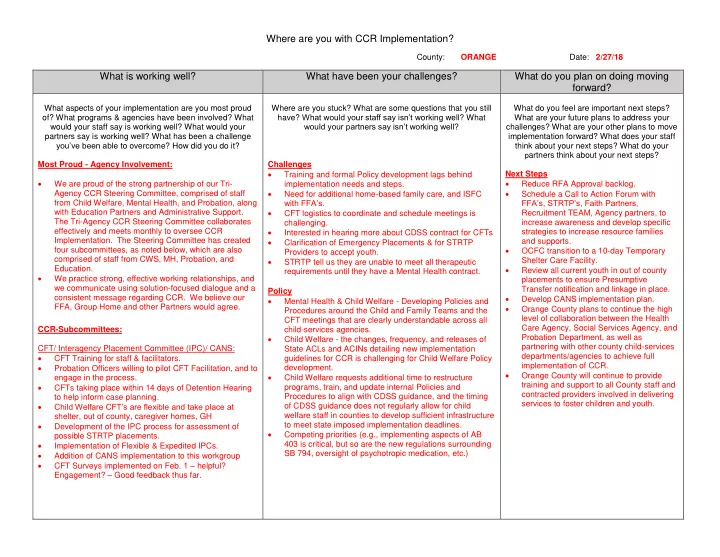
Where are you with CCR Implementation? County: ORANGE Date: 2/27/18 What is working well? What have been your challenges? What do you plan on doing moving forward? What aspects of your implementation are you most proud Where are you stuck?


slide-1
SLIDE 1

Where are you with CCR Implementation? County: ORANGE Date: 2/27/18 What is working well? What have been your challenges? What do you plan on doing moving forward?

What aspects of your implementation are you most proud

  • f? What programs & agencies have been involved? What

would your staff say is working well? What would your partners say is working well? What has been a challenge you’ve been able to overcome? How did you do it? Most Proud - Agency Involvement:  We are proud of the strong partnership of our Tri- Agency CCR Steering Committee, comprised of staff from Child Welfare, Mental Health, and Probation, along with Education Partners and Administrative Support. The Tri-Agency CCR Steering Committee collaborates effectively and meets monthly to oversee CCR

  • Implementation. The Steering Committee has created

four subcommittees, as noted below, which are also comprised of staff from CWS, MH, Probation, and Education.  We practice strong, effective working relationships, and we communicate using solution-focused dialogue and a consistent message regarding CCR. We believe our FFA, Group Home and other Partners would agree. CCR-Subcommittees: CFT/ Interagency Placement Committee (IPC)/ CANS:  CFT Training for staff & facilitators.  Probation Officers willing to pilot CFT Facilitation, and to engage in the process.  CFTs taking place within 14 days of Detention Hearing to help inform case planning.  Child Welfare CFT’s are flexible and take place at shelter, out of county, caregiver homes, GH  Development of the IPC process for assessment of possible STRTP placements.  Implementation of Flexible & Expedited IPCs.  Addition of CANS implementation to this workgroup  CFT Surveys implemented on Feb. 1 – helpful? Engagement? – Good feedback thus far. Where are you stuck? What are some questions that you still have? What would your staff say isn’t working well? What would your partners say isn’t working well? Challenges  Training and formal Policy development lags behind implementation needs and steps.  Need for additional home-based family care, and ISFC with FFA’s.  CFT logistics to coordinate and schedule meetings is challenging.  Interested in hearing more about CDSS contract for CFTs  Clarification of Emergency Placements & for STRTP Providers to accept youth.  STRTP tell us they are unable to meet all therapeutic requirements until they have a Mental Health contract. Policy  Mental Health & Child Welfare - Developing Policies and Procedures around the Child and Family Teams and the CFT meetings that are clearly understandable across all child-services agencies.  Child Welfare - the changes, frequency, and releases of State ACLs and ACINs detailing new implementation guidelines for CCR is challenging for Child Welfare Policy development.  Child Welfare requests additional time to restructure programs, train, and update internal Policies and Procedures to align with CDSS guidance, and the timing

  • f CDSS guidance does not regularly allow for child

welfare staff in counties to develop sufficient infrastructure to meet state imposed implementation deadlines.  Competing priorities (e.g., implementing aspects of AB 403 is critical, but so are the new regulations surrounding SB 794, oversight of psychotropic medication, etc.) What do you feel are important next steps? What are your future plans to address your challenges? What are your other plans to move implementation forward? What does your staff think about your next steps? What do your

partners think about your next steps?

Next Steps  Reduce RFA Approval backlog.  Schedule a Call to Action Forum with FFA’s, STRTP’s, Faith Partners, Recruitment TEAM, Agency partners, to increase awareness and develop specific strategies to increase resource families and supports.  OCFC transition to a 10-day Temporary Shelter Care Facility.  Review all current youth in out of county placements to ensure Presumptive Transfer notification and linkage in place.  Develop CANS implementation plan.  Orange County plans to continue the high level of collaboration between the Health Care Agency, Social Services Agency, and Probation Department, as well as partnering with other county child-services departments/agencies to achieve full implementation of CCR.  Orange County will continue to provide training and support to all County staff and contracted providers involved in delivering services to foster children and youth.

slide-2
SLIDE 2

STRTP:  Tri-Agency meetings with Group Home Providers to clarify County expectations prior to distribution of Letters of Support of STRTP Program Statements.  Support and TA to Providers and guidance on budget and staffing levels for STRTP applications.  Discussion of CCR and STRTP Requirements at Quarterly Group Home Forums with Providers.  Master Agreement approved by Board of Supervisors for Mental Health Plan/HCA.  HCA meeting with Providers as soon as they submitted their STRTP for licensure to work on preparations for formal MH contract. FFA:  Ongoing meetings with the FFAs to provide technical assistance regarding RFA Implementation, and to meet the needs of sibling sets and children with challenging behaviors. Presumptive Transfer – AB1299:  PT Contact List in place.  Forms in place – Guidelines out soon  Figured out how much, and with whom, to share information across counties RFA:  Executive Oversight  Steering Committee  Emergency Placement  Approval & Assessment  Data Collection & Tracking  Quality Assurance & Appeals  Contracts/Financial Services/FC Eligibility  Communications/Change Management  BINTI database  Training  Conversion  Quality of Care  Continued commitment to and success in placing children with Relative or NREFM caregivers whenever possible. Shelter Transition:  Engagement of Child Welfare staff, managers, and shelter staff to identify both current and new activities to support the transition to 10-day shelter.  Engagement of Community Partners regarding the need for increased family-based homes in Orange County and the development of ISFC and Therapeutic Foster Care.  Working on Addendum to Shelter Transition Plan Where are you stuck? CFT:  Continued clarification needed regarding ability to talk with Mental Health Partners and youth’s mental health needs, with parent present – County Counsel concerns CANS Assessment:  There are growing questions about the many tools that impact level of care – SDM, SOP, for example – and how CANS can be integrated in a meaningful way for staff and families.  What will training look like?  How does CANS interface with LOC? Rates:  LOC roll out  Will SCI be allowed in addition to LOC?  ISFC – clarify $2600 for 2 months, then what?  Support & Services contract provided by FFA – what is the rate for this?  TFC – lots of questions about Caregiver writing MH notes Shelter Transition:  Concerned about not having the Resource Homes in the community, and exceeding the 10-day stay. Lack of Home-Based Care Resources:  Orange County has identified a resource gap for many youth who have not been successful in traditional foster homes, but who may not meet the criteria for STRTPs, and who might be served best in ISFC or TFC if we had families willing to provide this type of care and level of support.  Orange County is experiencing a number of orders from Juvenile Court that complicate staff’s ability to best match children to family homes, i.e. the Court is ordering: Siblings to Remain Together; Child/ren to Remain In County; Child/ren to Attend his/her School of Origin; and, Increased Parent/Child Visitation. Group Home transitions to STRTP:  Some STRTP Program Statements continue to need revisions to meet our expectations.  Concerned the STRTP Providers will refuse to take Emergency Placements, or to serve our high needs youth  Request STRTP submit their own report and explanation

  • f non-admissions, similar to Counties tracking &

submitting (will add to our Master Agreement) RFA:  Significant backlog created over the past 2 years, given various versions of RFA Written Directives modified, necessitating continuous refinement of procedures, development of new forms/procedures, etc.  Increasing awareness among Court partners as to the impact of court-ordered services, supports, and placement

slide-3
SLIDE 3

Challenges Overcome  One of the challenges is becoming familiar with all of the different Departments in each Agency.

  • However, representatives from each Agency

are open to educating others about their respective Departments and systems of

  • peration.
  • This level of communication increases

everyone’s understanding regarding how CFTs will impact each Agency.  We overcame the challenge of organizing such a large project by pooling the resources of CWS, MH and Probation and frequently meeting together to keep things moving forward. parameters on expediting a child’s placement into home- based family care. Overall CCR Implementation:  The timeline to implement all components of CCR continues to be a challenge. Implementation Scale: Rate your implementation on a scale from 0-10, where 0 means nothing has been done around implementation and 10 means that you are at full implementation of CCR.

6 10 8

If not already identified, what do you need to do to move up one number? ____________________________________________________________________________________

slide-4
SLIDE 4

Imperial County has established a Continuum of Care (CCR) Implementation Team comprised of administrators from Imperial County Department

  • f Social Services Child Welfare Services, Imperial County Behavioral Health Services, Imperial County Probation Department, and Imperial

County Office of Education. The team holds ongoing regular meetings in which topics such as CCR Memorandum of Understanding (MOU), Child and Family Team Protocol, and AB1299 are discussed. What is working well:  Built on existing strengths -- Strengthened collaboration and coordination among all service providers and agencies, including but not limited to ongoing communication for each youth that comes to the attention of each systems  Each child/youth upon entry into the Child Welfare and/or Probation system receives complete mental health assessments and receives mental health services in a timely manner  New CWS management, culture change, progressing quicker with CCR goals  Small county, same key players at table What are some Challenges:  Resource Family Approval – timely approval of relatives and /or newly recruited resource families.  Lack of ISFC and TFC Homes  Small County, same key players at table Short/Long Tem Plans for continued implementation:  Continue to collaborate with Foster Family Agencies for recruitment and placement purposes  Develop a plan to ensure that staff are receiving ongoing training to maintain high quality skills and abilities to serve children/youth  Emergency Shelter transition to Temporary Shelter Care Facility (TSCF) by June 2018