Lexington-Fayette Urban County Government Workshop with the - - PDF document

lexington fayette urban county government workshop with
SMART_READER_LITE
LIVE PREVIEW

Lexington-Fayette Urban County Government Workshop with the - - PDF document

Lexington-Fayette Urban County Government Workshop with the Development and Construction Industry Municipal Separate Storm Sewer System (MS4) Permit, Construction Site Stormwater Runoff Control, and Post-Construction Stormwater Management


slide-1
SLIDE 1

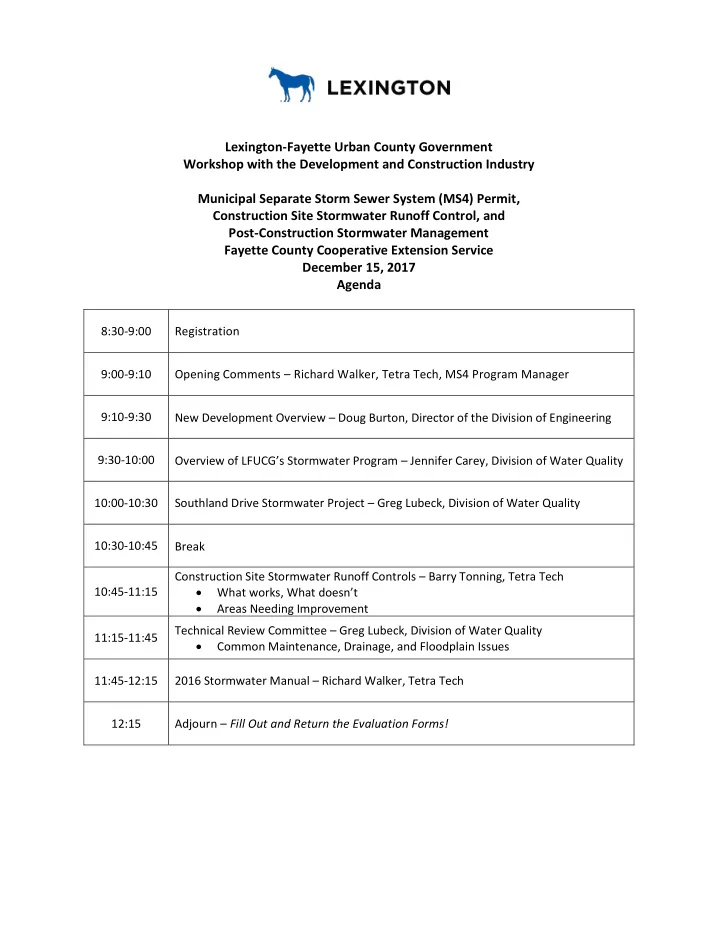
Lexington-Fayette Urban County Government Workshop with the Development and Construction Industry Municipal Separate Storm Sewer System (MS4) Permit, Construction Site Stormwater Runoff Control, and Post-Construction Stormwater Management Fayette County Cooperative Extension Service December 15, 2017 Agenda

8:30-9:00 Registration 9:00-9:10 Opening Comments – Richard Walker, Tetra Tech, MS4 Program Manager 9:10-9:30 New Development Overview – Doug Burton, Director of the Division of Engineering 9:30-10:00 Overview of LFUCG’s Stormwater Program – Jennifer Carey, Division of Water Quality 10:00-10:30 Southland Drive Stormwater Project – Greg Lubeck, Division of Water Quality 10:30-10:45 Break 10:45-11:15 Construction Site Stormwater Runoff Controls – Barry Tonning, Tetra Tech  What works, What doesn’t  Areas Needing Improvement 11:15-11:45 Technical Review Committee – Greg Lubeck, Division of Water Quality  Common Maintenance, Drainage, and Floodplain Issues 11:45-12:15 2016 Stormwater Manual – Richard Walker, Tetra Tech 12:15 Adjourn – Fill Out and Return the Evaluation Forms!

slide-2
SLIDE 2

DIVISION OF ENGINEERING

Doug Burton, P.E. Director

Common Design Issues – Early Stages

  • Incomplete submissions
  • Missing forms
  • Executive Summary
  • Downstream drainage studies
  • Lack depth/breadth to verify capacity
  • Site plans
  • No stormwater designs
  • Misunderstanding of process
  • Engineering only one of many divisions involved

Division of Engineering

slide-3
SLIDE 3

Common Design Issues – Early Stages

  • Public infrastructure
  • Provide plan/profile
  • Surety/minor plats associated
  • Public vs private infrastructure
  • Label clearly on plans
  • Subject to development plan
  • Let us know asap to expedite process

Division of Engineering

Common Design Issues – Early Stages

  • Internal drops
  • Not permitted in sanitary sewers
  • Entrance apron
  • Use LFUCG standard detail
  • Commercial Laterals
  • Must be 6” diameter
  • Water quality features
  • If using infiltration, must provide test (ASTM D3385)

Division of Engineering

slide-4
SLIDE 4

Common Design Issues – Late Stages

  • As-builts
  • Don’t match field conditions
  • Example…Grading issues that lead to drainage issues
  • Detention Basin Certification
  • Can’t close LDP or sign off on CO until complete
  • Surety creation
  • Recommend punchlist walk-thru with Engineering
  • Revisions (design/construction)
  • Must be submitted to Engineering

Division of Engineering

Common Construction Issues

  • Expansion joints
  • Full depth
  • Offset storm structures
  • Should’ve been caught by owner’s inspector
  • Sidewalk ramps
  • Review updated standard drawing
  • Sanitary sewer cleanouts
  • Rolled per LFUCG detail
  • Not installed in 12:00 position

Division of Engineering

slide-5
SLIDE 5

Common Construction Issues

  • Inspections
  • Engineering inspectors are acting as on-site inspectors
  • Finding issues that should’ve been caught during installation
  • EOR as inspector vs owner’s inspectors
  • More communication needed with owner
  • Owner
  • Have inspectors onsite during installation
  • Submit inspector reports/certifications

Division of Engineering

How we can help

  • NOV form
  • New version relates to Engineering specific issues
  • Help you understand what needs fixed
  • Website
  • Submission checklist
  • Consolidate manuals somewhat
  • Better organize website
  • Group relevant info
  • Staffing
  • Josh Dezarn
  • Commercial
  • Currently down 1 person
  • Hope to fill in January

Division of Engineering

slide-6
SLIDE 6

Questions?

slide-7
SLIDE 7

OVERVIEW OF LFUCG’S STORMWATER PROGRAM

Jennifer M. Carey, P.E. MS4 / Water Quality Section Manager

LFUCG’s Stormwater Program

  • Stormwater Quality Management Program
  • MS4 Permit Requirement
  • 10 Sections
  • 9 Program Elements
  • 1 Narrative Section
  • 2017 Highlights
  • MON
  • TMDLs/IWs + PI
  • PC

LFUCG’s Stormwater Program

slide-8
SLIDE 8

Water Quality Monitoring

  • Watershed-Focused Monitoring Program

LFUCG’s Stormwater Program

Water Quality Monitoring

  • Watershed-Focused Monitoring Program – Cane Run
  • 2 Phase 1 Screening Trainings
  • August 2016 (33)
  • 2 Phase 1 Screenings
  • September 2016 (15) & October 2016 (19)
  • 1 Phase 2 Screening Training
  • May 2017 (5 new)
  • 10 Phase 2 Screenings
  • May to September 2017 (avg. 15)

LFUCG’s Stormwater Program

slide-9
SLIDE 9

Water Quality Monitoring

  • Watershed-Focused Monitoring Program – S. Elkhorn
  • 2 Phase 1 Screening Trainings
  • August 2017 (14 new)
  • 2 Phase 1 Screenings
  • September 2017 (23) & October 2017 (15)
  • 1 Phase 2 Screening Training
  • Spring 2018
  • 10 Phase 2 Screenings
  • May to September 2018

LFUCG’s Stormwater Program

slide-10
SLIDE 10
slide-11
SLIDE 11
slide-12
SLIDE 12

TMDLs and Impaired Waters + Public Involvement and Participation

  • Approved Pathogen TMDLs for
  • Cane Run
  • North Elkhorn
  • South Elkhorn
  • Town Branch
  • Wolf Run
  • TMDL Implementation Strategy
  • What?
  • How?

LFUCG’s Stormwater Program

slide-13
SLIDE 13

TMDLs and Impaired Waters + Public Involvement and Participation

LFUCG’s Stormwater Program

TMDLs and Impaired Waters + Public Involvement and Participation

LFUCG’s Stormwater Program

slide-14
SLIDE 14

Post-Construction Stormwater Management

  • Workshop Held for Design Professionals in February
  • Excellent Presentations
  • Excellent Attendance
  • Plenty of PDHs/CEUs for FREE
  • FREE lunch
  • What can we provide for the Development and

Construction Industry in 2018?

LFUCG’s Stormwater Program

Questions?

slide-15
SLIDE 15

Southland Area Storm Drainage Project Wolf Run Watershed

December 15, 2017 Department of Environmental Quality & Public Works Division of Water Quality

This project was undertaken in connection with the settlement of an enforcement action under the Clean Water Act, United States et al, v. Lexington-Fayette Urban County Government, brought on behalf of the U.S. Environmental Protection Agency. This project is a Supplemental Environmental Project (“SEP”) to be funded by LFUCG as part of the Consent Decree entered on January 3, 2011 styled United States & Commonwealth

  • f Kentucky v. Lexington-Fayette Urban County Government, United States District Court for the Eastern

District of Kentucky, Civil Action No. 5:06-cv-386-KSF (the “Consent Decree”). S o u t h l a n d / W o l f R u n P r o j e c t

slide-16
SLIDE 16

S o u t h l a n d / W o l f R u n P r o j e c t S o u t h l a n d / W o l f R u n P r o j e c t

WATER COURSE TRIBUTARY TO BEACON HILL DRIVE.

slide-17
SLIDE 17

SOUTHLAND AREA PRIORITY SW PROJECTS

S o u t h l a n d / W o l f R u n P r o j e c t S o u t h l a n d / W o l f R u n P r o j e c t

slide-18
SLIDE 18

S o u t h l a n d / W o l f R u n P r o j e c t

  • Reduce flooding for target design storm.
  • Benefit in‐stream water quality.
  • Tangential benefits (traffic management, quality of life).
  • Sanitary sewer impacts:

– Sump pump redirections – concurrent with stormwater project – Capital project impact (2020 – 2024 construction window)

PROJECT GOALS

Likely project challenges / hurdles

  • Management of public expectations will be an ongoing challenge. Flood mitigation projects
  • ften perceived by public as an “I’ll never flood again” solution – which obviously isn’t the

case.

  • Once alternative flood mitigation solutions are developed, buy‐in by affected property
  • wners will likely be a hurdle for implementation. Properties that flood are usually at the

bottom of a hill, most infrastructure related solutions to that flooding are typically somewhere up the hill, where property owners don’t perceive themselves as having a problem.

Project Overview

S o u t h l a n d / W o l f R u n P r o j e c t

slide-19
SLIDE 19

S o u t h l a n d / W o l f R u n P r o j e c t

Existing Condition Model Results

S o u t h l a n d / W o l f R u n P r o j e c t

slide-20
SLIDE 20

S o u t h l a n d / W o l f R u n P r o j e c t S o u t h l a n d / W o l f R u n P r o j e c t

slide-21
SLIDE 21

S o u t h l a n d / W o l f R u n P r o j e c t

slide-22
SLIDE 22

Construction Stormwater Management

2017 Update: What Works, What Doesn’t, and Areas Needing Improvement

Lexington-Fayette Urban County Government

Why construction sites are inspected

From LFUCG’s MS4 Permit, issued by the Kentucky Division of Water

slide-23
SLIDE 23

Lexington takes these legal requirements seriously

slide-24
SLIDE 24

What’s working:

  • Most developers and contractors

understand the need for erosion and sediment controls

  • Most construction sites comply with most

requirements most of the time

  • Most informal violation notices and NOVs

are addressed in a timely manner (sometimes with a friendly reminder!)

slide-25
SLIDE 25

What’s not working . . . ???

Let’s take a little tour of some construction sites.

slide-26
SLIDE 26

June 2017: 614 Inspections, 502 Violations

Number Type of NOV and/or Verbal Warning

2 Check dams not installed / maintained 14 Concrete washout not maintained 19 Trash not properly stored / maintained 30 Inactive disturbed areas not stabilized 33 Inlets not protected 46 Construction / parking area not stabilized 51 Soil and mud not being kept off streets 60 Plan not onsite / being followed 89 Inspection reports not onsite 158 Silt fence not installed / maintained

Stabilization: seeding and mulching

slide-27
SLIDE 27

Protect your investment!

  • Apply seed/mulch/sod ASAP
  • Keep a small working footprint
  • Disk/punch in straw if needed
  • Use blankets and mats for

ditches and long steep slopes

slide-28
SLIDE 28

Silt fences: getting better . . . Still a few challenges out there

slide-29
SLIDE 29

Silt Fences

  • When can I remove a

silt fence?

– Section 11.5.4 of the Stormwater Manual: “Silt fences shall be removed when they have served their useful purpose, but not before the upslope area has been permanently stabilized.”

Stabilized construction site exits

slide-30
SLIDE 30

Rock checks / sediment traps

  • Maximize distance

upstream of culvert

  • Face with small rock
  • r filter fabric
  • Do not include

underdrain pipe

slide-31
SLIDE 31

Kentucky ESC BMP Technical Manual Sediment Trap Drawing http://www.kyt2.com/assets/files/uploads/ 09bmpmanual_final.pdf

Protecting post- construction BMPs

  • Identify any post-

construction BMPs on ESC plan sheets

– Location, type, installation date

  • Use a series of protective

BMPs for infiltration sites

– Do not compact the soils! – Divert flows around the site – Stabilize upslope area quickly – Use multiple silt fences

slide-32
SLIDE 32

Land Disturbance Permits

  • Permittee is

responsible for site ESC compliance at all times

  • Ongoing discussions

regarding permittee issues

LDP Permitting Procedure

  • Permittee develops

SWPPP / ESC Plan

  • Permittee applies for LDP
  • LFUCG DOE reviews plan
  • DOE accepts plan,

convenes meeting, and OKs initial BMPs

  • DWQ inspects BMPs and

OKs LDP issuance by DOE

slide-33
SLIDE 33

Land Disturbance Permittees:

  • Shall submit a Notice of

Termination to DOE when final stabilization has been achieved

  • Shall maintain an active

Land Disturbance Permit until all portions of the development are complete and the Surety posted with the LFUCG Division of Engineering is released by the DOE

Land Disturbance Permits

  • The only way an active LDP can be canceled or
  • therwise terminated before stabilization is

complete and temporary BMPs are removed would be in cases where the named permittee did not apply for the permit

– Permit was requested and acquired by a third party – Unknowing permittee requests that permit be canceled – In those cases the site would be operating without a permit, after the fraudulent permit was cancelled – Existing protocols for enforcement for those situations

slide-34
SLIDE 34

LDP Closeout Requirements

  • Site and soil stabilization

– Stormwater Manual Section 11.4.3: If vegetative cover is not established within 21 days, the area shall be

  • reseeded. If less than 70 percent groundcover is

established, seed and fertilize, using half of rates

  • riginally applied, and mulch. If less than 40 percent

groundcover occurs, follow original seedbed preparation methods, seeding and mulching recommendations, and apply lime and fertilizer as needed according to soil tests. – KYR10: Uniform (e.g., evenly distributed, without large bare areas) perennial vegetative cover with a density of 70% or more of the natural background vegetative cover

Land Disturbance Permits

  • Permits can be terminated when the site is stabilized (i.e.,

70% uniform vegetated cover, stable ditches, temporary BMPs removed, site cleaned up, etc.)

  • Permits that expire prior to site stabilization are considered

expired permits, with responsibility for site conditions assigned to the expired permittee

– These would be considered as sites operating without a permit – The expired permittee would be expected to renew the permit and keep up with permit responsibilities (e.g., BMP maintenance, inspections, etc.), or face enforcement action

slide-35
SLIDE 35

Desired construction site condition at final project close-out

  • Site is stabilized
  • Temporary BMPs have been removed
  • Drainage system is stable
  • Final housekeeping tasks are completed
  • Sediment ponds that will become

stormwater ponds have been cleaned out; drainage system is ready to go

And now, it’s time to play . . .

slide-36
SLIDE 36

True or False!

True or False

  • The project engineer is required to train

construction site personnel and subcontractors on ESC plan requirements.

slide-37
SLIDE 37

True!

  • Stormwater Manual

11.3.7 Education/Training

– The education and training requirements for implementation of the plan shall be accomplished by the Engineer, who shall provide for initial training and continuing education for all construction employees and subcontractors of the contractor to inform them of the plan requirements.

True or False?

  • ESC plans are required to have a schedule

for the inspection of BMPs identified in the plan.

slide-38
SLIDE 38

True!

  • Stormwater Manual

11.3.5 O&M Plan

– An operation and maintenance (O & M) plan shall be developed which provides a schedule for inspection, maintenance, and repair of BMPs during construction activities.

True or False?

  • There are a number of non-enforceable

guidelines for designing sediment control BMPs, but there are no hard and fast rules about the amount of rain they must handle.

slide-39
SLIDE 39

False!

  • Stormwater Manual

11.2.4 Structural Practices for Sediment Control

– The design storm for sediment control shall be the 2-year 24-hour storm.

True or False?

  • Silt fence posts can be spaced out up to

10 feet, depending on the type of silt fence fabric and posts being used.

slide-40
SLIDE 40

False!

  • Stormwater Manual
  • 11.5.4 Silt Fence

– Posts shall be spaced a maximum of 6 feet apart at the barrier location and driven securely into the ground (minimum of 12 inches).

True or False?

  • Land disturbance permittees are required

to control dust on haul roads across their sites.

slide-41
SLIDE 41

True!

  • Stormwater Manual
  • 11.4.7 Dust Control

– Construction roads shall be watered as needed to minimize dust.

True or False?

  • There is no requirement for maintaining a

50 ft buffer between soil disturbance activities and streams, wetlands, sinkholes, etc. if the disturbed area is less than 5,000 sq ft.

slide-42
SLIDE 42

False!

  • LFUCG Code of Ordinances
  • Sec. 16-103. - Erosion control standards for land

disturbance of less than five thousand square feet. – A fifty (50) foot vegetated buffer shall be maintained between the land disturbance activities and the edge of any perennial or intermittent stream, wetland, sinkhole, or municipal storm sewer inlet. If a fifty (50) foot vegetated buffer is not feasible due to the nature or purpose of the activity, a protective alternate erosion control or management practice shall be used.

Bonus Question:

  • The average two-year, 24 hour storm

depth in our current location is:

  • a. 1.41 inches
  • b. 1.86 inches
  • c. 2.37 inches
  • d. 3.03 inches

Rainfall depth over 24 hours, with a recurrence interval of two years, based on frequency analysis of partial duration series, with a confidence interval of 90%

slide-43
SLIDE 43

2017 was a little wetter than normal

slide-44
SLIDE 44

2016 STORMWATER MANUAL

LESSONS LEARNED

Construction Industry Workshop December 15, 2017 BY: Richard Walker, P.E., Tetra Tech LFUCG MS4 Program Manager

Overview

  • Background
  • Key Aspects of the 2016

Manual

  • Addendum No. 1 (6/8/17)
  • Other Proposed Changes for

Amendment No. 1

2016 Stormwater Manual

slide-45
SLIDE 45

Municipal Separate Storm Sewer (MS4) Permit

2016 Stormwater Manual

Background on the Stormwater Manual

  • First edition in 2001, along with 6 other Manuals.
  • Updates in 2002, 2004, 2005, 2009, 2011, and 2016.
  • Contains the design and construction standards for

stormwater infrastructure in new development and redevelopment.

2016 Stormwater Manual

slide-46
SLIDE 46

Purpose of the Stormwater Manual

  • Prevent new flooding problems as a result of new

development

  • Reduce pollution in stormwater runoff
  • Establish uniform design and construction standards
  • Detention basins
  • Water quality BMPs
  • Erosion and sediment control

2016 Stormwater Manual

Stakeholder Process - Internal

  • Group was comprised of staff from DOE, DWQ, & DES
  • Met monthly for a year starting in 2014
  • Comprehensive review / clarify content
  • Addressed “lessons learned” over the last 15 years
  • Group discussed and resolved issues related to:
  • Redevelopment
  • Green Infrastructure
  • Underground Detention
  • EPA / FEMA / Kentucky Division of Water Regulations

2016 Stormwater Manual

slide-47
SLIDE 47

Stakeholder Process - External

  • Group formed in 2015
  • 25 stakeholders comprised of:
  • Staff from Planning, DOE, DWQ, & DES
  • Home Builders Association of Lexington
  • Commerce Lexington
  • Engineering Firms
  • Stormwater Stakeholder Advisory Committee
  • Group met five times from September ꞌ15 to March ꞌ16
  • Stakeholder input was instrumental and essential

2016 Stormwater Manual

Chapters in the Manual

Chapter 1 – Stormwater Management Requirements (for new development and redevelopment, does not apply to capital projects) Chapter 2 – Permits Chapter 3 – Watershed Studies Chapter 4 – Design Documentation Chapter 5 – Hydrology Chapter 6 – Inlets/Storm Sewers/Manholes Chapter 7 – Culverts and Bridges Chapter 8 – Constructed Channels Chapter 9 – Streambank Stabilization Chapter 10 – Post-Construction Stormwater Controls Chapter 11 – Erosion and Sediment Control Chapter 12 – Maintenance

*Most of the changes were in Chapters 1 and 10

2016 Stormwater Manual

slide-48
SLIDE 48

Stream Buffer Width

  • Increased stream buffer width from 25 feet to 50 feet
  • The 50-foot buffer can be an average over the project, with a

minimum of 25 feet

  • Current requirement in Kentucky’s general construction permit

for streams with sediment impairments

  • Based on streams as defined by the Corps of Engineers
  • Mirrors requirements in Ohio and Tennessee

2016 Stormwater Manual

Green Infrastructure

  • Required by MS4 permit
  • Promotes infiltration
  • Reduces runoff volume

2016 Stormwater Manual

slide-49
SLIDE 49

Manufactured Devices

  • Established a uniform design standard
  • Must be certified by New Jersey DEP

2016 Stormwater Manual

Rainfall Data

  • Analyzed historical rainfall data
  • Updated design storms and the rainfall depth used to

size stormwater infrastructure

  • Added the September 23, 2006 storm event to the set
  • f storm events to be analyzed during design
  • 6.8 inches in 24 hours

2016 Stormwater Manual

slide-50
SLIDE 50

Lessons Learned

2016 Stormwater Manual

Lessons Learned

  • Addendum No. 1 - Runoff Reduction Requirements

Green Infrastructure practices can be located and sized to meet the requirements in Section 1.7.4 without having to provide a Green Infrastructure practice for each individual drainage area. The total volume provided by all of the Green Infrastructure practices on the site must equal 0.8 inches multiplied by the total impervious area on the site, which will satisfy the runoff reduction criteria.

2016 Stormwater Manual

slide-51
SLIDE 51

Lessons Learned

  • Need to clarify a few things
  • Need to change a few design requirements

2016 Stormwater Manual

Process for Making Future Changes

  • Code of Ordinances
  • Sec. 16-85. - Stormwater manual incorporated.

The urban county government stormwater manual, as revised, modified, or amended from time to time, is incorporated herein by reference provided that in the event of any conflict between the manual and this article the provisions of this article shall apply.

2016 Stormwater Manual

slide-52
SLIDE 52

Proposed Changes (draft)

  • Definition of a Stream
  • Allowable Uses in the Vegetative Buffer Zone
  • Where a floodplain analysis will be required
  • Where detention will not be required
  • Where MTDs will be allowed
  • Feasibility of Runoff Reduction
  • Corrugated Plastic Pipe
  • Underground Detention
  • Erosion and Sediment Control

2016 Stormwater Manual

Proposed Definition of “Stream”

  • The word stream “shall mean any river, creek or channel,

having well defined banks, in which water flows for substantial periods of the year to drain a given area, or any lake or other body of water in the Commonwealth” (KRS 151.100).

  • Same definition as in the LFUCG Procedures Manual for

Infrastructure Development

2016 Stormwater Manual

slide-53
SLIDE 53

Allowable Uses in the Vegetative Buffer Zone

  • Proposed change to allow invasive species to be

removed and replaced with native species.

2016 Stormwater Manual

Where a Floodplain Analysis will be required.

2016 Stormwater Manual

  • For development projects greater than 5 acres or 50 lots that contain a

stream in Zone A or Zone X (shaded or unshaded)

slide-54
SLIDE 54

Where Detention will not be required.

Detention will not be required if:

  • 1. Project is part of a masterplan
  • 2. Project adds less than 1 acre of impervious surfaces

and the inlet/storm sewer system has sufficient capacity

  • 3. Undetained runoff from the project will not increase

flood elevations in streams

  • 4. The project adds less than 1 acre of impervious

surfaces and discharges directly to a mapped FEMA floodplain

  • 5. Detention would increase flood levels downstream

2016 Stormwater Manual

Where MTDs will be allowed

2016 Stormwater Manual

  • Proposed change to remove the word “infill”

Stormwater manufactured treatment devices (MTDs) remove pollutants from stormwater runoff. MTDs may be used as the sole stormwater quality control only in the following situations:

  • redevelopment projects, or
  • infill development projects, or
  • new development projects where Green Infrastructure is not

feasible

slide-55
SLIDE 55

Runoff Reduction Criteria

2016 Stormwater Manual

  • Proposed change to define feasibility

Runoff reduction is not required if the Engineer can demonstrate that all of the following conditions are present:

  • the soil infiltration rate is less than 0.5 inches per hour. Infiltration

rates shall be determined in accordance with ASTM D3385 - Standard Test Method for Infiltration Rate of Soils in Field Using Double-Ring Infiltrometer

  • subdrains cannot be designed for the practices in Table 1-6 because

the subdrain cannot freely discharge to a storm sewer or open channel

  • no other green infrastructure practices in Table 1-6 are technically

feasible based on information provided by the Engineer and acceptable to the Division of Engineering.

Corrugated Plastic Pipe (when used for public infrastructure)

The following changes are proposed:

  • Soil tight joints (instead of water tight joints)
  • Maximum deflection of 7.5% (instead of 5%)
  • Minimum cover of 18 inches (instead of 24 inches)
  • Only No. 9 stone is allowed for bedding
  • Engineer shall, a minimum of 30 days after installation,

certify the installation of CPP.

2016 Stormwater Manual

slide-56
SLIDE 56

Underground Detention

The following changes are proposed:

  • Geogrid will be allowed instead of filter fabric at the

soil/stone interface

  • Permeable Pavement that uses the stone voids as

storage will be required to increase the design volume by 10% to account for sediment deposition

2016 Stormwater Manual

Erosion and Sediment Control

  • Land Disturbance Permit – Who is the permittee?
  • Entity with operational control
  • Sediment controls must remain in place until the site is

stabilized with seed/mulch

  • Rock-filled bags and geotextile filters on frames may be

used for drop inlet filters

  • Geotextile filters, rock-filled tubes, and rock-filled bags

may be used for curb inlet filters

  • Fiber logs or wattles may be used in lieu of silt fence

2016 Stormwater Manual

slide-57
SLIDE 57

Next Step

  • Meet with the external work group to review the

proposed changes.

  • Finalize the proposed changes.

2016 Stormwater Manual

Questions?