SLIDE 1
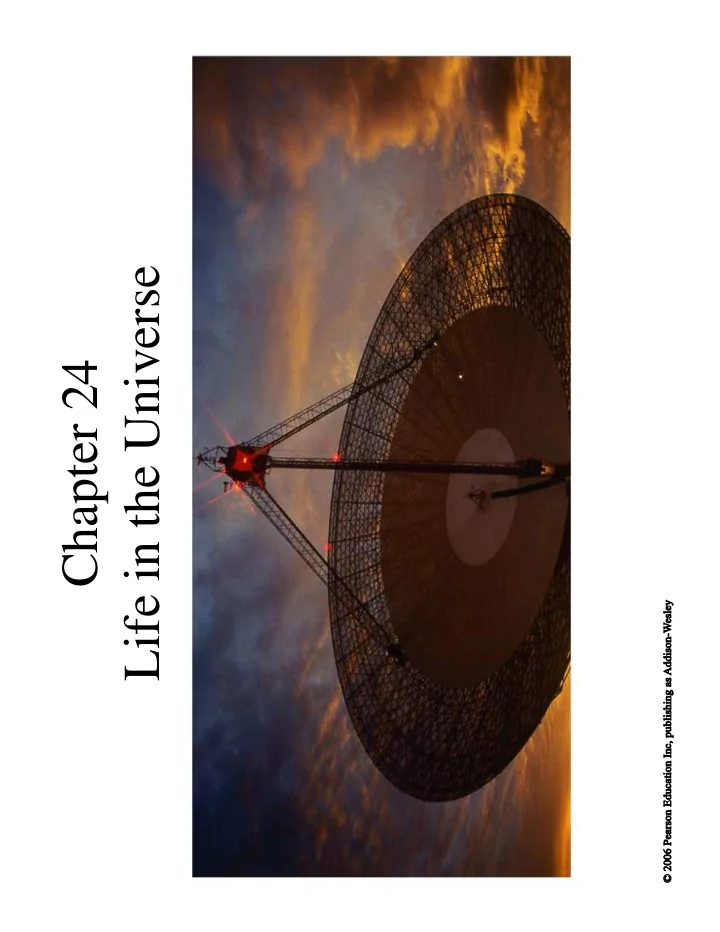
Chapter 24 Life in the Universe
SLIDE 2 24.1 Life on Earth
Our goals for learning
- When did life arise on Earth?
- How did life arise on Earth?
- What are the necessities of life?
SLIDE 3
When did life arise on Earth?
SLIDE 4 Earliest Life Forms
- Life probably arose on Earth more than 3.85
billion years ago, shortly after the end of heavy bombardment
- Evidence comes from fossils, carbon
isotopes.
SLIDE 5 Fossils in Sedimentary Rock
- relative ages: deeper layers formed earlier.
- absolute ages: radiometric dating
SLIDE 6 Fossils in Sedimentary Rock
- Rock layers of Grand Canyon record 2
billion years of Earth’s history
SLIDE 7 Earliest Fossils
that bacteria-like
present over 3.5 billion years ago
evidence pushes
more than 3.85 billion years ago
SLIDE 8
The Geological Time Scale
SLIDE 9
How did life arise on Earth?
SLIDE 10 Origin of Life on Earth
- Life evolves through time.
- All life on Earth shares a common ancestry.
- We may never know exactly how the first
- rganism arose, but laboratory experiments
suggest plausible scenarios.
SLIDE 11 The Theory of Evolution
- The fossil record shows that
evolution has occurred through time.
- Darwin’s theory tells us HOW
evolution occurs: through natural selection.
- Theory supported by discovery
- f DNA: evolution proceeds
through mutations.
SLIDE 12 Tree of Life
relationships has led biologists to discover this new “tree of life.”
a small part of the tree.
characteristics of common ancestor.
SLIDE 13
- These genetic studies suggest that the earliest life on
Earth may have resembled the bacteria today found near deep ocean volcanic vents (black smokers) and geothermal hot springs .
SLIDE 14 Laboratory Experiments
experiment (and more recent experiments) show that building blocks
easily and spontaneously under conditions
SLIDE 15
Microscopic, enclosed membranes or “pre-cells” have been created in the lab.
SLIDE 16
Chemicals to Life?
SLIDE 17 Could life have migrated to Earth?
- Venus, Earth, Mars have exchanged tons
- f rock (blasted into orbit by impacts)
- Some microbes can survive years in
space...
SLIDE 18 Brief History of Life
- 4.4 billion years - early oceans form
- 3.5 billion years - cyanobacteria start releasing
- xygen.
- 2.0 billion years - oxygen begins building up in
atmosphere
- 540-500 million years - Cambrian Explosion
- 225-65 million years - dinosaurs and small
mammals (dinosaurs ruled)
- Few million years - earliest hominids
SLIDE 19 Origin of Oxygen
paved the way for more complicated life forms by releasing oxygen into atmosphere via photosynthesis
SLIDE 20
What are the necessities of life?
SLIDE 21 Necessities for Life
- Nutrient source
- Energy (sunlight, chemical reactions,
internal heat)
- Liquid water (or possibly some other liquid)
Hardest to find
SLIDE 22 What have we learned?
- When did life arise on Earth?
– Life arose at least 3.85 billion years ago, shortly after end of heavy bombardment
- How did life arise on Earth?
– Life evolved from a common organism through natural selection, but we do not yet know the origin of the first organism
- What are the necessities of life?
– Nutrients, energy, and liquid water
SLIDE 23 24.2 Life in the Solar System
Our goals for learning
- Could there be life on Mars?
- Could there be life on Europa or other jovian
moons?
SLIDE 24
Could there be life on Mars?
SLIDE 25 Searches for Life on Mars
- Mars had liquid water in the distant past
- Still has subsurface ice; possibly subsurface
water near sources of volcanic heat.
SLIDE 26
In 2004, NASA Spirit and Opportunity Rovers sent home new mineral evidence of past liquid water on Mars.
SLIDE 27 The Martian Meteorite debate
composition indicates
- rigin on Mars.
- 1984: meteorite ALH84001 found in Antarctica
- 13,000 years ago: fell to Earth in Antarctica
- 16 million years ago: blasted from surface of Mars
- 4.5 billion years ago: rock formed on Mars
SLIDE 28
- Does the meteorite contain fossil evidence
- f life on Mars?
… most scientists not yet convinced
SLIDE 29 Could there be life on Europa or
SLIDE 30
- Ganymede, Callisto also show some evidence for
subsurface oceans.
- Relatively little energy available for life, but
still…
- Intriguing prospect of THREE potential homes for
life around Jupiter alone…
Ganymede Callisto
SLIDE 31 Titan
- Surface too cold for liquid water (but deep underground?)
- Liquid ethane/methane on surface
SLIDE 32 What have we learned?
- Could there be life on Mars?
– Evidence for liquid water in past suggests that life was once possible on Mars
- Could there be life on Europa or other
jovian moons?
– Jovian moons are cold but some show evidence for subsurface water and other liquids
SLIDE 33 24.3 Life Around Other Stars
Our goals for learning
- Are habitable planets likely?
- Are Earth-like planets rare or common?
SLIDE 34
Are habitable planets likely?
SLIDE 35 Habitable Planets
Definition: A habitable world contains the basic necessities for life as we know it, including liquid water.
- It does not necessarily have life.
SLIDE 36 Constraints on star systems: 1) Old enough to allow time for evolution (rules
2) Need to have stable orbits (might rule out binary/multiple star systems - 50%) 3) Size of “habitable zone”: region in which a planet of the right size could have liquid water
Even so… billions of stars in the Milky Way seem at least to offer the possibility of habitable worlds.
SLIDE 37
The more massive the star, the larger the habitable zone — higher probability of a planet in this zone.
SLIDE 38 Finding them will be hard
Recall our scale model solar system:
- Looking for an Earthlike planet around a
nearby star is like standing on the East Coast of the United States and looking for a pinhead on the West Coast — with a VERY bright grapefruit nearby.
- But new technologies should soon show the
way…
SLIDE 39
- Kepler (2007 launch) will
monitor 100,000 stars for transit events for 4 years. Later: SIM (2009?), TPF (2015?): interferometers to
images of Earth-size planets.
SLIDE 40 Spectral Signatures of Life
Earth Venus Mars
SLIDE 41
Are Earth-like planets rare or common?
SLIDE 42 Elements and Habitability
that proportions of heavy elements need to be just right for formation of habitable planets
planets are restricted to a galactic habitable zone
SLIDE 43 Impacts and Habitability
that Jupiter-like planets are necessary to reduce rate of impacts
planets are restricted to star systems with Jupiter-like planets
SLIDE 44 Climate and Habitability
that plate tectonics and/or a large Moon are necessary to keep the climate of an Earth-like planet stable enough for life
SLIDE 45
The Bottom Line
We don’t yet know how important or negligible these concerns are.
SLIDE 46 What have we learned?
- Are habitable planets likely?
– Billions stars have sizable habitable zones, but we don’t yet know how many have terrestrial planets in those zones
- Are Earth-like planets rare or common?
– We don’t yet know because we are still trying to understand all the factors that make Earth suitable for life
SLIDE 47 24.4 The Search for Extraterrestrial Intelligence
Our goals for learning
- How many civilizations are out there?
- How does SETI work?
SLIDE 48
How many civilizations are out there?
SLIDE 49
The Drake Equation
Number of civilizations with whom we could potentially communicate = NHP × flife × fciv × fnow NHP = total # of habitable planets in galaxy flife = fraction of habitable planets with life fciv = fraction of life-bearing planets w/ civilization at some time fnow = fraction of civilizations around now.
SLIDE 50
We do not know the values for the Drake Equation NHP : probably billions. flife : ??? Hard to say (near 0 or near 1) fciv : ??? It took 4 billion years on Earth fnow : ??? Can civilizations survive long-term?
SLIDE 51 Are we “off the chart” smart?
comparatively large brains
level of intelligence is improbably high?
SLIDE 52
How does SETI work?
SLIDE 53
SETI experiments look for deliberate signals from E.T.
SLIDE 54
We’ve even sent a few signals ourselves… Earth to globular cluster M13: Hoping we’ll hear back in about 42,000 years!
SLIDE 55
Your computer can help! SETI @ Home: a screensaver with a purpose.
SLIDE 56 What have we learned?
- How many civilizations are out there?
– We don’t know, but the Drake equation gives us a framework for thinking about the question
– Some telescopes are looking for deliberate communications from other worlds
SLIDE 57 24.5 Interstellar Travel and Its Implications to Civilization
Our goals for learning
- How difficult is interstellar travel?
- Where are the aliens?
SLIDE 58
How difficult is interstellar travel?
SLIDE 59 Current Spacecraft
- Current spacecraft travel at <1/10,000 c;
100,000 years to the nearest stars.
Pioneer plaque Voyager record
SLIDE 60 Difficulties of Interstellar Travel
- Far more efficient engines are needed
- Energy requirements are enormous
- Ordinary interstellar particles become like cosmic rays
- Social complications of time dilation
SLIDE 61
Where are the aliens?
SLIDE 62 Fermi’s Paradox
- Plausible arguments suggest that civilizations
should be common, for example:
- Even if only 1 in 1 million stars gets a civilization
at some time ⇒ 100,000 civilizations
- So why we haven’t we detected them?
SLIDE 63 Possible solutions to the paradox
1) We are alone: life/civilizations much rarer than we might have guessed.
- Our own planet/civilization looks all the more
precious…
SLIDE 64 2) Civilizations are common but interstellar travel is not. Perhaps because:
- Interstellar travel more difficult than we think.
- Desire to explore is rare.
- Civilizations destroy themselves before achieving
interstellar travel
These are all possibilities, but not very appealing…
Possible solutions to the paradox
SLIDE 65
3) There IS a galactic civilization… … and some day we’ll meet them…
Possible solutions to the paradox
SLIDE 66 What have we learned?
- How difficult is interstellar travel?
– Interstellar travel remains well beyond our current capabilities and poses enormous diffculties
– Plausible arguments suggest that if interstellar civilizations are common then at least one of them should have colonized the rest of the galaxy – Are we alone? Has there been no colonization? Are the colonists hiding?