Limits involving ln( x ) We can use the rules of logarithms given - - PowerPoint PPT Presentation

limits involving ln x
SMART_READER_LITE
LIVE PREVIEW

Limits involving ln( x ) We can use the rules of logarithms given - - PowerPoint PPT Presentation

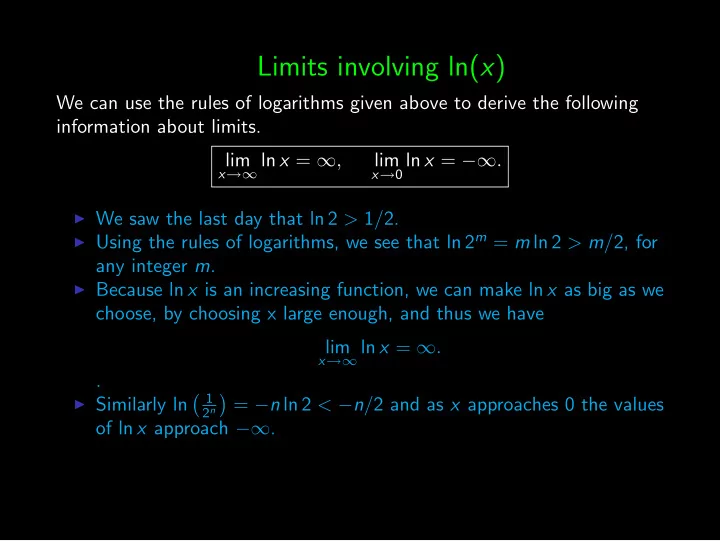
Limits involving ln( x ) We can use the rules of logarithms given above to derive the following information about limits. x ln x = , lim x 0 ln x = . lim We saw the last day that ln 2 > 1 / 2. Using the rules of


slide-1
SLIDE 1

Limits involving ln(x)

We can use the rules of logarithms given above to derive the following information about limits. lim

x→∞ ln x = ∞,

lim

x→0 ln x = −∞. ◮ We saw the last day that ln 2 > 1/2. ◮ Using the rules of logarithms, we see that ln 2m = m ln 2 > m/2, for

any integer m.

◮ Because ln x is an increasing function, we can make ln x as big as we

choose, by choosing x large enough, and thus we have lim

x→∞ ln x = ∞.

.

◮ Similarly ln

1

2n

  • = −n ln 2 < −n/2 and as x approaches 0 the values
  • f ln x approach −∞.
slide-2
SLIDE 2

Example

Find the limit limx→∞ ln(

1 x2+1). ◮ As x → ∞, we have 1 x2+1 → 0 ◮ Letting u = 1 x2+1, we have

lim

x→∞ ln(

1 x2 + 1) = lim

u→0 ln(u) = −∞.

slide-3
SLIDE 3

Extending the antiderivative of 1/x

We can extend our antiderivative of 1/x( the natural logarithm function) to a function with a larger domain by composing ln x with the absolute value function |x|. . We have : ln |x| =

  • ln x

x > 0 ln(−x) x < 0 This is an even function with graph We have ln|x| is also an antiderivative of 1/x with a larger domain than ln(x). d dx (ln |x|) = 1 x and 1 x dx = ln |x| + C

slide-4
SLIDE 4

Using Chain Rule for Differentiation

d dx (ln |x|) = 1 x and d dx (ln |g(x)|) = g ′(x) g(x)

◮ Example 1: Differentiate ln | sin x|. ◮ Using the chain rule, we have

d dx ln | sin x| = 1 (sin x) d dx sin x

= cos x sin x

slide-5
SLIDE 5

Using Chain Rule for Differentiation : Example 2

Differentiate ln |

3

√ x − 1|.

◮ We can simplify this to finding d dx

  • 1

3 ln |x − 1|

  • , since

ln |

3

√x − 1| = ln |x − 1|1/3

d dx 1 3 ln |x − 1| = 1 3 1 (x − 1) d dx (x − 1) = 1 3(x − 1)

slide-6
SLIDE 6

Using Substitution

Reversing our rules of differentiation above, we get: 1 x dx = ln |x| + C and g ′(x) g(x) dx = ln |g(x)| + C

◮ Example Find the integral

  • x

3−x2 dx ◮ Using substitution, we let u = 3 − x2.

du = −2x dx, x dx = du −2,

  • x

3 − x2 dx =

  • 1

−2(u) du

= −1 2 ln |u| + C = −1 2 ln |3 − x2| + C