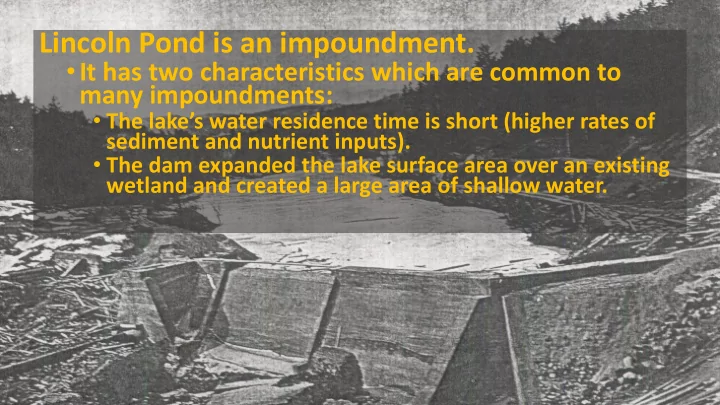
SLIDE 1 Lincoln Pond is an impoundment.
- It has two characteristics which are common to
many impoundments:
- The lake’s water residence time is short (higher rates of
sediment and nutrient inputs).
- The dam expanded the lake surface area over an existing
wetland and created a large area of shallow water.
SLIDE 2
1895 Today
SLIDE 3
The dam created a large shallow area ideal for the growth of aquatic vegetation.
SLIDE 4
Start with the circa. mid-1970’s (?) Technical Report written for Lincoln Pond…….
SLIDE 5
The most troublesome aquatic plants found in Lincoln Pond are…Large- leaf pondweed, American elodea, and waterlilies. 42% said aquatic vegetation was a problem, 42% said there was no problem.
SLIDE 6
Excessive amounts of nutrients have caused an increase in the growth of aquatic vegetation. Therefore, decreasing the nutrient supply will have a control effect on the growth of aquatic vegetation.
Onto CSLAP (2004)
SLIDE 7
- Reduce or eliminate the use of fertilizers,
- Plant a rain garden or maintain natural vegetative buffers,
- Keep animal waste away from surface water and drainage ditches,
- Maintain a band of dense shoreline vegetation to discourage geese and to
stabilize the shoreline,
- Work with highway departments to ensure rapid stabilization of roadside
ditches (hydroseed?),
- Support BMP’s for forestry.
- Maintain an effective septic system
- have the tank pumped,
- have the system inspected by a professional,
- perform upgrades as necessary.
Wh What you can do today y (t (to act on previousl sly y given advice)… )….. ..
SLIDE 8
ECSWCD has hosted rain barrel and rain garden presentations at the Elizabethtown Fish and Game Club and at the Essex County Fair.
SLIDE 9
Maintain a woody vegetative buffer along the shoreline.
Grass lawns lack a deep root system, which is essential to a stable shoreline. A combination of waves and weather will begin to eat away at the lawn, causing it to break apart and crumble into the water.
Wh Why y it t matter ers…
SLIDE 10 Percent of Precipitation Converted to Runoff
34 2 3 0.2 5 10 15 20 25 30 35 Lawn Woods
Percent of Precipitation Maximum Average
Wh Why it t matters…..
SLIDE 11 Comparison of Total Phosphorus at a Shoreline Site in Northern Wisconsin
0.1 0.03 0.082 0.00048 0.02 0.04 0.06 0.08 0.1 Lawn Woods
Pounds per Acre / Year
Groundwater Surface Runoff
170 acres of forest 1 acre of lawn.
Wh Why it t matters…..
SLIDE 12
Control erosion from roads, driveways, steep slopes, and forestry activities.
Wh Why it t matters…..
SLIDE 13 1 2 3 4 5 6 7 8 9 10 11 12 13 14 15 16 17
EWM Large-leaf Nitella
2015 APIPP Plant Survey…..17 Plant Beds Found; 8 had EWM abundance
- f at least 25% cover while 4 had EWM abundance of at least 50% cover.
Abundant >50% Common 25-50% Present 15-25% Occasional 5-15% Rare <5%
SLIDE 14
- 124.8 acres, or 19.3% of the lake surface),
- The most abundant plants were EWM, Large-leaf pondweed, and Nitella,
- Recall that the 1970’s report identified Large-leaf pondweed as a nuisance,
- Except for small patches at sites 15 and 16 all sites having dense EWM are in area
- f a flooded wetland.
2015 APIPP Plant Survey 2 1 10 11 9 1 15 16
SLIDE 15 The only management to date(?):
University stocked 40,000 Acentria caterpillars in a one acre area to see if they could control Eurasian watermilfoil.
- The experiment failed to produce
the desired results.
- Pan fish were implicated in the
elimination of Acentria.
SLIDE 16
- Think about what it means to engage management
BEFORE you decide to engage,
- Have an honest conversation regarding exactly what
the current impacts are, where the impacts are
- ccurring, and how long the impacts last,
- Decide on a budget (and be honest with yourself
about that budget).
Ne Next Steps???
SLIDE 17 Remember:
- It is Expensive,
- It will take A LOT of time and you will either pay a professional to do it
all or you will be committing A LOT of volunteer time (and volunteer burnout is a real concern),
- Once begun it must continue or progress will be quickly lost,
- There will most likely be “winners” and “losers”; it is unrealistic to
expect that you will please everyone,
- Historic information suggests that even if you control EWM there will
still be vegetative growth which some may find impairing,
Ne Next Steps???
SLIDE 18 President of the lake association (2018):
“… there has there been a discussion regarding ongoing costs, and whether there is realistic expectation that the cost of control is going to be reduced because of the success in controlling the invasive.”
Wh Why y bri ring g up costs ts?
Loon Lake (586 acre lake - 240 acre littoral zone) “How are things going?”
- 17 years of effort
- $632,000 invested ($453,000 in past 5 years),
- “We’re not sure if we’re making progress or not.”
SLIDE 19 $- $100,000 $200,000 $300,000 $400,000 $500,000 $600,000 $700,000
2005 2006 2007 2008 2009 2010 2011 2012 2013 2014 2015 2016 2017 2018
Annual Cost Cumulative Cost Anticipated Post Herbicide Treatment Cost
Rising Control Costs for Loon Lake
2013 Herbicide Treatment
“…2016 effort was
inadequate in full lake-wide management considering the new growth areas, area
and the inability to hit lower priority sites….”
SLIDE 20 Re Regardless…Get Inv nvolved and Stay Informed….
Assemble a dedicated group
are willing to monitoring for new AIS. Report suspicious plants or animals ASAP.
SLIDE 21
Re Regardless…Get Inv nvolved and Stay Informed….
Stay involved with CSLAP. Join the Adirondack Lakes Alliance and / or NYSFOLA. Attend workshops, trainings, conferences.
SLIDE 22
Re Regardless…. Maintain a strong Lake Association
SLIDE 23
- Seek the input of a professional CLM or Lake Manager
- Interview
- Be prepared to discuss costs (but not necessarily your budget),
- Ask what reasonable outcomes can be expected for different cost
levels,
- Get an expected timeline for reasonable goals,
- Get references and take the time to tour those waterbodies and
talk to the lake association,
Only Only the hen n if if you u do do de decide ide to mana nage…
SLIDE 24
Tw Two potential funding opportunities
SLIDE 25 An And (finally) some me ma manageme ment activities:
Management in the Park has included:
- Draw-downs (a few lakes)
- Triploid Grass Carp (a few lakes)
- Hand Harvesting and Benthic Barriers (dozens of lakes)
- Herbicide (only two, one-time only applications approved in last
decade)
- Mechanical Harvester (one lake)
- Do-nothing (many lakes)
Remember – Every method of control has an impact and what may work or be appropriate for one lake may not work for another.
SLIDE 26
Lake Drawdown
SLIDE 27
Hadlock Pond Mechanical Harvester Program Mechanical Harvester Collected 51,000 Pounds Fragment Collectors Collected 14,000 Pounds
Mechanical Harvester
SLIDE 28
Hand and Diver Assisted Suction Harvesting (DASH)
SLIDE 29
Benthic Barriers
SLIDE 30
Herbicides
SLIDE 31 An And L Lastly, w wher ere t e ther ere’ e’s m managem emen ent t ther ere’ e’s p per ermitting
- Management of Invasive Species requires permits
- Benthic Barriers – APA and probably DEC
- Herbicides – APA and DEC
- Mechanical Harvester – APA
- Hand Harvesting – APA
- DASH – APA and possibly DEC
- Draw Down – APA and DEC
Permitting authorities must follow the law governing approvability and must make specific legal findings. This takes time and complex projects or projects which have the potential to do a lot of harm typically require detailed studies/analyses.