
SLIDE 1
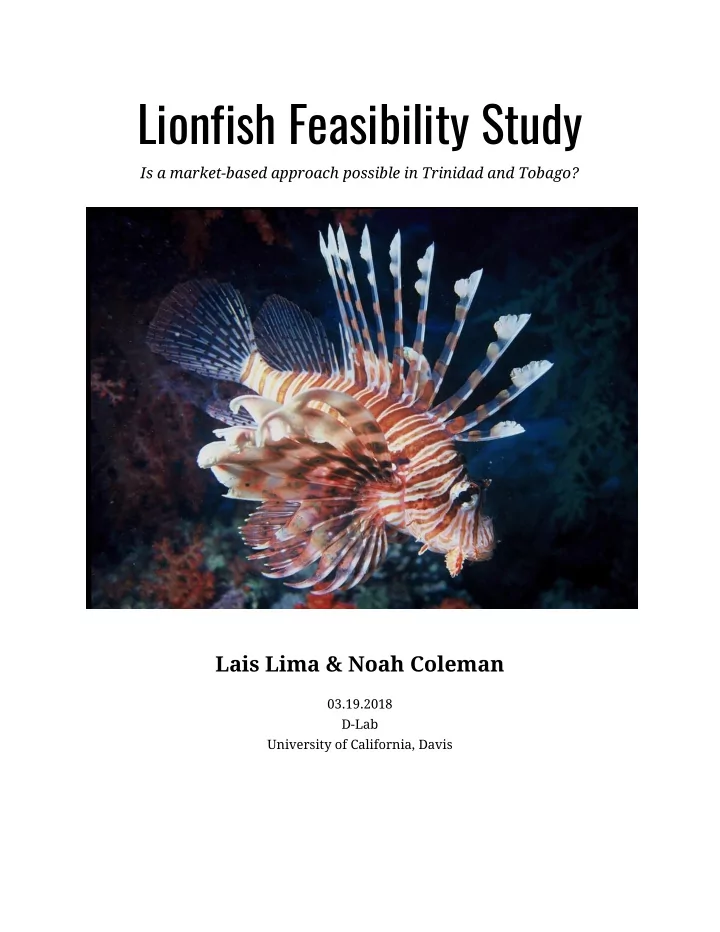
Lionfish Feasibility Study
Is a market-based approach possible in Trinidad and Tobago?
Lais Lima & Noah Coleman
03.19.2018 D-Lab University of California, Davis
Lionfish Feasibility Study Is a market-based approach possible in - - PDF document
Lionfish Feasibility Study Is a market-based approach possible in Trinidad and Tobago? Lais Lima & Noah Coleman 03.19.2018 D-Lab University of California, Davis TABLE OF CONTENTS EXECUTIVE SUMMARY 2 INTRODUCTION 2 SWOT ANALYSIS 4
Is a market-based approach possible in Trinidad and Tobago?
Lais Lima & Noah Coleman
03.19.2018 D-Lab University of California, Davis
TABLE OF CONTENTS EXECUTIVE SUMMARY 2 INTRODUCTION 2 SWOT ANALYSIS 4 POLICY IDENTIFICATION 5 Existing Policy 5 LOGICAL FRAMEWORK ANALYSIS 7 APPENDICES 15 APPENDIX A: Going Forward: Determining Whether “Bake and Shark” Actually Contains Shark 15 APPENDIX B: Policy Identification Tool 16 APPENDIX C: Panel Reviewer Comments & Questions 18 APPENDIX D: Example of lionfish traps used in Bermuda 18 1
EXECUTIVE SUMMARY
The lionfish (Pterois volitans) is an invasive species in the Caribbean which poses a significant environmental, economic, and cultural threat to the nation Trinidad and
problem using the four lenses of sustainability (Environment, Finance, Culture/Social, Technology). The study was requested by Kahlil Hassanali from our partner organization in Trinidad and Tobago, the Institute of Marine Affairs. We applied three analytical tools (SWOT analysis, Policy Identification, Logical Framework model) to evaluate the project goals and the relevant policy and corresponding implications, and to propose a feasible project framework and future directions. Although
results indicate that a market-based approach of the lionfish problem is not feasible to be immediately implemented, we recommend specific actions towards lionfish management that can increase the feasibility of this proposal in the near future. Overall, a lionfish fishery in conjunction with legislation adequacies need to be developed to supply a future market. Lionfish traps are key for the success of this project and they can be developed in partnership with UC DAVIS D-Lab. Finally, we suggest our client to incorporate the present feasibility study to the Trinidad and Tobago Lionfish Management Plan, suggesting the marketing of lionfish as a potential profitable form of population control.
INTRODUCTION
Background: The invasion of lionfish (Pterois volitans) is considered one of the greatest environmental problems in the Caribbean, particularly in coral reef ecosystems (Morris 2
et al. 2009, GCFI Lionfish Workgroup, 2014). Lionfish is quickly becoming the most abundant top-level predators in reefs throughout the Caribbean, representing up to 40%
This predator species has high consumption rates of both adult and larvae of native fish, leading to severe declines in local fish populations and loss of diversity. Lionfish fishing targeted for human consumption is a potential cost-effective management solution and has been adopted in countries like the Bahamas, Jamaica, Belize and Bermuda. Stock assessment tools and metrics also have been developed to evaluate the cost and benefits
the invasion, such as decline in recruitment of native fish stocks (Johnston et al. 2015) A market-based solution for the lionfish problem in the Caribbean seems to be promising (Chapman et al. 2016). A domestic demand is growing for personal consumption and for commercial purposes when the local population appreciates the taste and is also overall aware of the lionfish problem. More importantly, the fishermen community can be receptive to livelihood diversification and consider the lionfish a potential resource. Culling lionfish via spearfishing has been the most popular method of lionfish management efforts, throughout the Caribbean. Spearfishing lionfish is advantageous because it causes insignificant harm to the coral reefs and non-targeted fish species. This method can be very effective to reduce/control lionfish populations, especially when integrated to citizen science initiatives involving derbies and tourism activities (e.g. SCUBA diving) (Chapman et al. 2016). However, spearfishing lionfish may not be the ideal method for maintaining a substantial and steady supply of lionfish meat. Spearfishing is depth limited (~18m) and requires technical skills in freediving and/or SCUBA diving. Furthermore, given that the lionfish thrives in all major marine habitat 3
and substrate types, and has been recorded from 0 m to depths of 300 m, addressing the lionfish invasion must involve a comprehensive approach involving more than simply spearfishing, the current method of extraction (Bogdanoff et al., 2014). Therefore, with an increasing interest in developing fisheries for lionfish, applying alternative methods that do not rely on spearfishing is key. Project Brief: Our original project brief entitled Getting over the BS (Bake and Shark) – From Bake and Shark to Bake and Lionfish outlined a three-pronged approach in the project problem statement. These three parts included Developing a Lionfish Fishery, conducting and economic feasibility analysis and connecting fishers to markets, and finally, a public education/outreach/awareness component. The study was requested by client Kahlil Hassanali from our partner organization in Trinidad and Tobago, the Institute of Marine Affairs (IMA). Project Development: Through further dialogue with our client we agreed that for the scope of our feasibility study and his project, rather than focus on preserving endangered shark populations by reducing shark consumption, this project would focus more on lionfish management via a market-based approach. After conducting a literature review we began to focus on three analytical tools to help assess the Strengths, Weaknesses, Opportunities, and Threats to the project through a SWOT analysis, the relevant policy and corresponding implications through a Policy Identification tool, and finally, the next steps in the project through a Logical Framework model. 4
SWOT ANALYSIS
We identified the main Strengths, Weaknesses, Opportunities and Threats (SWOT analysis) of a market-based approach for the lionfish problem in T&T. Overall, IMA has the Green Fund project as its main strength since it resulted in a sound foundation for a future market for lionfish. However, several weaknesses are impeding a lionfish fishery to be developed, which will be addressed by a log-frame analysis. An increasing for sustainable seafood is a great opportunity for the development of a lionfish market. Also, many of the weaknesses can be addressed by partnerships with the tourism and educational sectors. Two of the main threats to this proposal are the relatively small spearfishing community in T&T to supply the market and the fact that environmental and fisheries goals can be harmful to each other.
STRENGTHS
IMA’s:
Fund project
WEAKNESSES
population distribution is preliminary
access the resource
lionfish catch (e.g. traps)
5
OPPORTUNITIES
seafood: niche for lionfish meat Potential partnerships:
tourism boats
universities
THREATS
primarily fish offshore
stock that you aim to deplete
POLICY IDENTIFICATION
Existing Policy The republic
Trinidad and Tobago does have policy in place which demonstrates a governmental commitment to preventing the introduction of invasive species as well as controlling and managing existing or potential Invasive Alien Species (Hosein, 2011). This policy further stipulates that when these species pose a threat to biodiversity, food security, natural resources, or economic development, the government will take a proactive stance. More specifically this response strategy will include awareness campaigns, stakeholder meetings, and the rigorous monitoring of points of entry. The Environmental Management Authority (EMA) has a critical role to play in the development and enforcement of such a policy. According to the Environmental Management Authority website, the EMA is currently involved in the development of “The Lionfish National Management and Response Plan for Trinidad and Tobago” (EMA, 2013). This document, once completed and made public, will determine the extent to which a project initiated by the Institute of Marine Affairs will be able to achieve its goals 6
(see appendix B). Nevertheless, Trinidad and Tobago does not currently have a publicly available Lionfish prevention or management plan. Such plans not only exist but are found throughout the Caribbean. Although an ad-hoc committee was formed in 2012 to tackle the issue of invasive lionfish control and was responsible for developing a National Invasive Lionfish Prevention and Management plan, no such plan has yet been published (Invasive Control Adhoc Committee, 2014). This plan could serve as an excellent resource in the further development of a more specific strategic management plan for lionfish within Trinidad and Tobago. Fortunately, Trindad and Tobago and look to the example of other Caribbean nations which have already created lionfish management plans to then create its own management plan. Graham and Fanning surveyed the lionfish management plans of eight nations within the Caribbean using the US Environmental Protection Agency Aquatic Invasive Species framework and factoring in climate change. Their observations provide valuable insights into how Trinidad and Tobago could continue its development
and more directly addressing challenges. Early Detection and Rapid Response (EDRR) is an important component in the US EPA’s Aquatic Invasive Species framework which is lacking in most of the lionfish management plans of the surveyed nations (Graham & Fanning, 2017). Restoration of marine ecosystems is another key component to the lionfish management plans. Unfortunately, many Caribbean nations lack adequate data on their own marine ecosystems and species distributions (Graham & Fanning, 2017). A management plan for the lionfish must also take into consideration how changing 7
climatic conditions impact the sensitive marine ecosystems and particularly the reef systems (Graham & Fanning, 2017). A plan which is adaptable to the changing weather patterns will increase the likelihood of successful lionfish management. Trinidad and Tobago will need to develop a robust data collection and management system. Multiple Caribbean nations have developed monitoring strategies for lionfish. However, it is imperative that through the monitoring process, the data which is collected is managed and continuously updated. In terms of data management, the US Virgin Islands’ lionfish management plan serves as a good example for Trinidad and Tobago. According to Graham and Fanning, their plan includes more specifically
impacts, effectiveness of removal and examining the local and regional scientific research with observational data and by concentrating the collection of removal and sighting data into one shared database” (Graham & Fanning, 2017). Unfortunately, the prevention of lionfish spread to Trinidad and Tobago is no longer an option. Rather, the costlier processes of monitoring and proactively responding are the most important tasks for this twin island nation. A strong policy framework will directly impact the nation's ability to address the invasive lionfish predicament in a manner which is timely, climate-sensitive, sustainable, and effective.
LOGICAL FRAMEWORK ANALYSIS
This log-frame was designed for a 5-year project proposal that addresses the main weaknesses identified by the SWOT analysis. We defined six objectives with specific
8
with D-Lab at UC DAVIS. D-Lab UC Davis is an International Development Innovation Network (IDIN) academic partner. IDIN builds a diverse, global network of innovators to design, develop, and disseminate low-cost technologies. Also, this log-frame considers the scope of IMA and the activities that are already being conducted by the institute. For instance, as IMA conducts monitoring surveys twice a year, we suggest that the lionfish trap deployment and test to be incorporated to the fieldwork plan. By adapting and expanding the current surveys the client will optimize the current budget to fit the
to be used in lionfish stock assessment to scale up the lionfish catch strategies to be able to supply a future market. Log-frame analysis Project Goal: Develop a supply chain for lionfish meat Objectives: 1 Identify lionfish hotspots and monitor populations The aggregative behavior of lionfish makes the success of a lionfish fishery highly dependent on identifying and monitoring lionfish “hotspots”. IMA has a successful research plan that was developed during the lionfish management Green Fund project, which is a great strength identified in the SWOT analysis. We suggest the continuation of the surveys targeting data to be used in a lionfish stock assessment. Partnerships with educational institutions to bring students to assist with the data collection is an
project. 9
Outputs Indicators Target Value Tools Frequency of Data Collection 1- Collect data for a lionfish stock assessment and monitor populations Lionfish distribution maps and population structure 10 sites covering both islands Continuation of the Green fund project and surveys as conducted in Alemu et al. 2016 Twice a year (Spring/Fall) along the project 2 Characterize addressable market and stock As scientific data is collected, both the stock and the market should be characterized by quantitative analyses. An
here is to partner with undergraduate and graduate programs from related areas such as Economics, Environmental Engineering, Fisheries Biology, Sociology, to work on the suggested
mentorship and expect the deliverables from student at low or no cost. Outputs Indicators Target Value Tools Frequency of Data Collection 1- Lionfish stock assessment and a cost analysis of the lionfish invasion and lionfish control efforts. Accessible lionfish biomass, annual fillet production in metric tonnes (t) Two reports/scien tific manuscripts Stock assessment tools and metrics developed by Johnston et al. (2015) year 1 and 2 2- Characterize addressable market Consumer profile and market
report/scient Continuation of the Green fund project year 1 and 2 10
analysis ific manuscript and surveys as conducted in Chapman et al. 2016 3 Design and test lionfish traps This objective was planned to be achieved in partnership with D-Lab at UC DAVIS. The design of a lionfish trap will be conducted over the 2018 Spring quarter and two prototypes will be delivered to the client by June 2018. We propose the prototype testing in T&T reefs to be incorporated to the IMA biannual monitoring surveys. Outputs Indicators Target Value Tools Frequency of Data Collection 1- Design lionfish trap prototypes Lionfish trap prototypes Two prototypes Product design at D-LAB II/UC DAVIS UC DAVIS Spring quarter 2018 2- Test lionfish trap prototypes Trap with maximum lionfish catch and minimum bycatch Trap
lionfish catch Field deployment - incorporate to
Twice a year (Spring/Fall) 4 Pilot study: Recruit and train fishermen to use lionfish traps Following the prototype testing, a pilot study involving local fishermen is a key 11
the existing local and small-scale fisheries, ideally involving artisanal fishers
be a replacement of their current fishing methods and targeted species. Instead, IMA should be offering them a complementary source of seafood and, potentially income. Environmental and sociological issues involving fishermen communities need to be carefully assessed before the implementation of this pilot study. Other governmental agencies must be involved. This pilot study could also be conducted in partnership with undergraduate and/or graduate programs. Manufacturing traps could either involve the participants or hire the services of a local company. Funding should be sought specifically for this pilot study. Outputs Indicators Target Value Tools Frequency of Data Collection 1 - Lionfish handling training Workshop One workshop; ~10 participants Continuation of the Green fund project
Once on year 2 2- Lionfish trap deployment Training on trap usage One workshop; ~10 participants Adapted from the Green fund project training workshops Once on year 2 3 - Lionfish trap production Lionfish traps 30 traps Local manufacturing Year 2 and 3 12
5 Evaluation and revision The outcomes of the pilot study should be carefully evaluated and revised. This analysis could be supported by undergraduate and/or graduate programs. We suggest
Ocean Sciences to ask for the assessment tools that have been used in their lionfish trap
strongly recommended. Outputs Indicators Target Value Tools Frequency of Data Collection 1- Analysis of data collected Average lionfish caught per trap; analysis of bycatch Two reports/scien tific manuscripts As advised by the Bermuda Lionfish Task Force and Bermuda Institute
year 3 and 4 2- Analysis of surveys and training Consumer profile and market analysis
report/scient ific manuscript Evaluation of participants and instructors year 3 and 4 6 Scaling up After the evaluation and revision of the pilot study, a feasibility study of the implementation of lionfish traps in T&T is necessary to define the future directions of 13
this management tool. This analysis could be supported by undergraduate and/or graduate programs. Outputs Indicators Target Value Tools Frequency of Data Collection 1- Implementation of lionfish traps at a larger scale Feasibility study using all data generated by the project One feasibility study Feasibility study of the use of lionfish traps to supply a market for lionfish meat Year 5 CONCLUSION AND RECOMMENDATIONS The main conclusion of this feasibility study is that a market-based approach of the lionfish problem is currently not feasible, but it can be soon (5-7 years) if specific actions towards lionfish management are adopted. The SWOT analysis showed that a lionfish fishery needs to be developed to supply a future market. More information needs to be gathered regarding willingness to pay, lionfish densities at hotspots, how many fish fisherman can catch, how many fishermen can be supported by this niche
related to fisheries and lionfish management (See “Going forward” section of Appendix B). To increase the feasibility of a future market of lionfish meat, our log-frame analysis proposed a five-year project with specific objectives and outputs to develop a lionfish supply chain. Lionfish traps are key for the success of this project and they can be 14
developed in partnership with UC DAVIS D-Lab (see trap examples in Appendix D) . Other suggested partnerships with tourism, educational and governmental agencies may reduce the costs of the project and achieve the deliverables necessary for implementing a lionfish fishery. Finally, we suggest our client to incorporate the present feasibility study to the Trinidad and Tobago Lionfish Management Plan, suggesting the marketing of lionfish as a potential profitable form of population control. Literature Cited
Alemu I., J. B. (2016). The status and management of the lionfish, Pterois sp. in Trinidad and
https://doi.org/10.1016/j.marpolbul.2016.05.042 Bogdanoff, A. K., Akins, J. L., Morris, J. A. J., & 2013 GCFI Lionfish Workgroup. (2014). Invasive Lionfish in the Marketplace: Challenges and Opportunities. Retrieved from http://www.reefresilience.org/article-summaries/invasive-lionfish-in-the-marketplace-ch allenges-and-opportunities/ Chapman, J.K., Anderson, L.G., Gough, C.L. 2015 Lionfish control in areas inaccessible to fishers: counting and culling with the help of conservation volunteers. Lionfish Management Workshop, Gulf and Caribbean Fisheries Institute Meeting, 12 November
http://www.car-spaw-rac.org/IMG/pdf/6-abstract_chapman_science_counting_and_culling .pdf Chapman, J.K., Anderson, L.G., Gough, C.L. and Harris, A.R., 2016. Working up an appetite for lionfish: a market-based approach to manage the invasion of Pterois volitans in Belize. Marine Policy, 73, pp.256-262. Davis, A. 2016. The Consumption of Lionfish as a Control of an Invasive Species in Bermuda. Undergraduate Honor Thesis, University of Colorado, Boulder, 62pp. Retrieved from https://scholar.colorado.edu/honr_theses/1045/
15
http://www.ema.co.tt/new/index.php/lionfish Gleason, J. and Gullick, H. 2014. Bermuda Lionfish Control Plan Version 6. Bermuda Lionfish Taskforce, 60pp Graham, R. E., & Fanning, L. M. (2017). A comparison of eight country plans for the Invasive Indo-Pacific Lionfish in the Wider Caribbean. Global Ecology and Conservation, 12, 253–262. https://doi.org/10.1016/j.gecco.2017.12.001 Green, S. J., & Côté, I. M. (2009). Record densities of Indo-Pacific lionfish on Bahamian coral
Green, S. J., Akins, J. L., Maljković, A., & Côté, I. M. (2012). Invasive Lionfish Drive Atlantic Coral Reef Fish Declines. PLOS ONE, 7(3), e32596. https://doi.org/10.1371/journal.pone.0032596 Hosein, F. (2011, November). National Invasive Alien Species Strategy for Trinidad and
http://www.ciasnet.org/wp-content/uploads/2014/06/Draft-TT-NatInvasiveSpeciesStrat egy.pdf Invasive Control Adhoc Committee. (2014, October 1). National Invasive Lionfish Prevention and Management Plan. Retrieved January 28, 2018, from https://www.anstaskforce.gov/Meetings/2014_November/LionfishPlan_102014_Final_Dr aft.pdf Johnston, M.W., Purkis, S.J. and Dodge, R.E. 2015. Measuring Bahamian lionfish impacts to marine ecological services using habitat equivalency analysis. Marine Biology (2015) 162: 0. Morris, J.A., Jr., and P.E. Whitfield. 2009. Biology, Ecology, Control and Management of the Invasive Indo-Pacific Lionfish: An Updated Integrated Assessment. NOAA Technical Memorandum NOS NCCOS 99. 57 pp. Pitt, J. 2015. A lionfish trap for use in Bermuda, with potential applications elsewhere. Lionfish Management Workshop, Gulf and Caribbean Fisheries Institute Meeting, 12 November 2015. Retrieved from http://www.car-spaw-rac.org/IMG/pdf/12_joanna_lionfish_trapping_for_gcfi_workshop_2.
16
APPENDICES
APPENDIX A: Going Forward: Determining Whether “Bake and Shark” Actually Contains Shark There is speculation as to whether the traditional Trinidadian dish of “Bake and Shark” actually contains shark. In order to ascertain whether or not this is the case, a number of approaches might be taken including but not limited to:
i. UTT - ECIAF or Valsayn campuses with Food Science labs ii. UWI - St. Augustine Food science and technology within the Engineering iii. Analytical Technologies Ltd (http://www.atltt.com/services/food/)
i. Fumière, O. et al. (2006) Effective PCR detection of animal species in highly processed animal byproducts and compound feeds. Anal. Bioanal. Chem. 385, 1045–54. ii. Cammà, C. et al. (2012) Development and validation of fast Real-Time PCR assays for species identification in raw and cooked meat mixtures. Food Control 23, 400-404.
i. monitors all aspects of the importation, manufacture, storage, distribution, sale, fraud and deception in labelling and marketing, and disposal of food and drugs
i. Working with Quality assurance/food safety managers/supervisors/consultants/officers from the UTT food science B.S. program.
how to address them
i. M.Sc. in Agri Food Safety and Quality Assurance
17
focusing on Graduate Studies, Research and Innovation APPENDIX B: Policy Identification Tool Does Policy have any relevance here?
Does any Relevant policy exist?
the Lionfish/shark ○ National Biodiversity Strategy and Action Plan (2001) ■ Its purpose is to plan for the conservation and sustainable use of the country’s biodiversity within the context of its socio-economic development programmes. The Lionfish invasion and its feeding habits have direct implications for the conservation and sustainable use of the country’s biodiversity, and addressing this challenge could provide jobs and allow for socio-economic mobility. ■ http://www.ema.co.tt/new/images/policies/biodiversity_stat/tt-nbsap-01-p1
○ National Tourism Policy (2010) ■ The Government recognizes that the environment is an important resource base for tourism. As such, this document stipulates that tourism must be developed with natural and cultural treasures in mind. Lionfish clearly poses a threat to some of the natural treasures of TT. ■ https://www.ema.co.tt/new/images/policies/tourism_policy.pdf ○ Draft Fisheries management Bill (2011) ■ Once enforced this Bill will involve the Minister of agriculture calling for the preparation of Fisheries Management Plans to promote the conservation, management, development and long-term sustainability of fisheries in Trinidad and Tobago. Once enacted, this bill’s management plans, by necessity, will address the lionfish invasion. ■ http://www.cftdi.edu.tt/pdf/Draft_Fisheries_Management_Bill_2011_Versio n.pdf ○ Lionfish Management and Response Plan (2012-unpublished) ■ The primary goal of this Plan is to manage and control lionfish populations in local waters with the aim of minimizing ecological and economic impacts and risks to human health. ■ This initiative is modeled after the National Invasive Lionfish Prevention and Management plan, published in 2014, which serves as a comprehensive framework for Caribbean nations looking to develop their
■ https://www.anstaskforce.gov/Meetings/2014_May/NILPMP_5_2014_Fina l_Draft.pdf 18
○ National Invasive Alien Species Strategy for Trinidad and Tobago (2014) ■ This strategic document outlines the nation’s commitment to preventing introduction of Alien Invasive Species. The Lionfish, just such a species, must be further recognized within this strategy. The intended outcome of this document is the improved management of the potential and existing Alien Invasive Species and this therefore both preventative and curative. ■ No enforcement body, unclear as to whether this falls under the jurisdiction of the fisheries officers, environmental management officers,
○ National food Production Action Plan (2012-2015) ■ Fish production from fisheries is between 13-15,000 tonnes/year. The plan maintains that aggressive management of non-traditional species can help sustain production. With more research, Lionfish could potentially fulfill this role of a non-traditional species. ■ http://www.agriculture.gov.tt/pdf/National%20Food%20Production%20Acti
○ Other relevant policies/Plans/Strategic documents: ■ Fisheries Act (1916)
specificity ○ Policy updates have related primarily to turtle protection ○ No current regulations on pot fishing ■ Comprehensive Economic Development Plan for Tobago ■ National Environment Policy (2005) ■ National Protected Areas Policy (2011) ■ Strategic Action Programme for the Sustainable Management of the Shared Living Marine Resources of the Caribbean and North Brazil Shelf Large Marine Ecosystems (CLME SAP) ■ Draft national Spatial Development Strategy for TT (2013) ■ CARICOM Common Fisheries Policy ■ The Integrated Coastal Zone Management (ICZM) program seeks to promote awareness/encourage sustainable management ○ Going forward ■ Key Decision makers like Minister of Agriculture Clarence Rambharat must be made aware of the pressing nature of the Lionfish invasion and how this challenge is already contextualized within multiple existing policies.
more compelling arguments for why the Lionfish challenge must be tackled with governmental support. ■ Definition of jurisdiction and responsibility is needed. According to the State of the Marine Environment Report (2016), there exists a large number of agencies with responsibilities for coastal and marine 19
insights into the governmental lionfish management plans as well as this lionfish project. This lack of clarity results in:
and marine management (Environmental Management Officers, Fisheries Officers)
pass off responsibility to other organizations which may or may not be able to address the needs with
APPENDIX C: Panel Reviewer Comments & Questions 1. A further explanation of why trap development is preferred above spearfishing could be helpful for the audience. 2. Are tourists amenable to eating lionfish, do the like the meat? 3. Are there teeth to the policies? 4. Can we supply the market/ Given the environmental impacts, what might a call to action look like? APPENDIX D: Example of lionfish traps used in Bermuda Source: the Bermuda lionfish trap project: http://www.car-spaw-rac.org/IMG/pdf/12_joanna_lionfish_trapping_for_gcfi_workshop_2. pdf 20
21