Liq = ef Xals de Tie lines, e.g., b-c, d-f, g-h: 1340C: liq=g: - - PowerPoint PPT Presentation

liq ef xals de
SMART_READER_LITE
LIVE PREVIEW

Liq = ef Xals de Tie lines, e.g., b-c, d-f, g-h: 1340C: liq=g: - - PowerPoint PPT Presentation

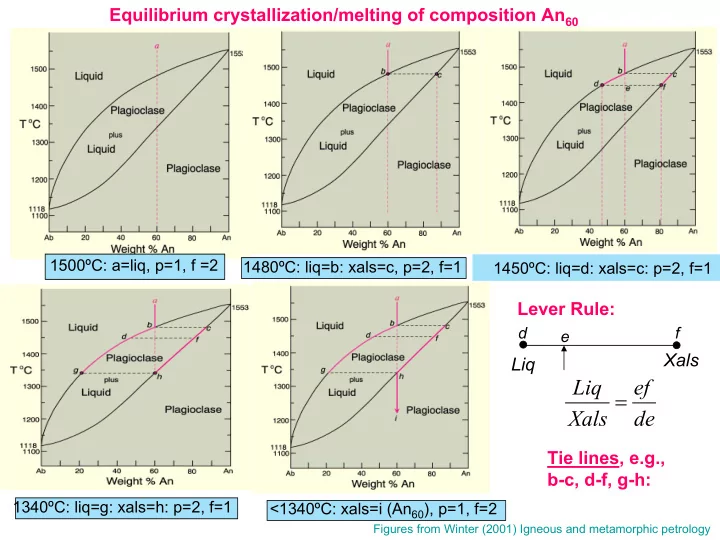
Equilibrium crystallization/melting of composition An 60 1500C: a=liq, p=1, f =2 1480C: liq=b: xals=c, p=2, f=1 1450C: liq=d: xals=c: p=2, f=1 Lever Rule: d f e Xals Liq Liq = ef Xals de Tie lines, e.g., b-c, d-f, g-h: 1340C:


slide-1
SLIDE 1

Equilibrium crystallization/melting of composition An60

1500ºC: a=liq, p=1, f =2 1480ºC: liq=b: xals=c, p=2, f=1 1450ºC: liq=d: xals=c: p=2, f=1 1340ºC: liq=g: xals=h: p=2, f=1 <1340ºC: xals=i (An60), p=1, f=2

Tie lines, e.g., b-c, d-f, g-h: Lever Rule: Liq Xals

d e f

de ef Xals Liq =

Figures from Winter (2001) Igneous and metamorphic petrology

slide-2
SLIDE 2

Fractional crystallization/melting of composition An60

With fractional crystallization of bulk compn a, first crystals have compn c. Crystals are removed from system as soon as they form so are not present to react with liquid. The liquid will fractionate to pure albite compn and the total range of plagioclase crystals will be from c to pure Ab. With fractional melting of compn i, the first liquid to form will have compn g. Each fraction of melt produced is removed from the system so the solid assemblage changes compn from h to pure An and the liquid fractions range from g to pure

  • An. Mean compn of liquid is a

Figures from Winter (2001) Igneous and metamorphic petrology

slide-3
SLIDE 3

Binary systems with an intermediate compound

1400 1600 1800 1000 1200 20 40 60 80 100

L Cr + L Tr + L Ab + Tr Ne + Ab Ab + L Ne + L

T(ºC)

Ne Ab SiO2

1118 1062 1068

Meta- stable a b c d b c d

Peritectic system: intermediate

compound (En) melts incongruently

“Double eutectic” system: Intermediate

compound (Ab) melts congruently Melting reaction:

En ↔ Fo + Liq

Melting reaction:

Ab ↔ Liq Discuss: Equilibrium/fractional crystallization/melting Discuss: Isobaric univariant and invariant equilibria

Figure from Winter (2001) Igneous and metamorphic petrology

slide-4
SLIDE 4

c c d d i i k k m m Fo Fo En En 1557 1557

What happens in the vicinity

  • f the peritectic point?

Fo – SiO2 system (cont.)

Effect of pressure on the Fo + En + Liquid equilibrium

Cooling: at 1557ºC, Liquid i reacts with Fo to form En Heating: At 1557ºC, En crystals melt to give Fo + liquid i

  • 1. Liquidus and solidus temperatures increase
  • 2. Peritectic reaction becomes a eutectic reaction

Does this have any application in nature?

Figures from Winter (2001) Igneous and metamorphic petrology

slide-5
SLIDE 5
  • A. Photomicrograph of olivine with a rim of

Orthopyroxene (crossed polars)

  • B. Same grain with slide rotated until
  • livine is at extinction position to make

the opx rim more visible This is a common petrographic feature

  • f basalts crystallized under low

pressure but it may not occur at higher pressures

slide-6
SLIDE 6

Binary systems (cont.) : Ab (NaAlSi3O8)-Or (KAlSi3O8): Example of an azeotropic system with minimum in the solidus and liquidus and a solvus

Note:

  • 1. Minimum in liquidus and solidus

loops at Xm = 0.34. Common horiz tangent to both lines at this point.

  • 2. Region marked “Afss” shows

complete solid solution from Or to

  • Ab. Do we see this in nature?
  • 3. In region underneath solvus two

feldspars coexist, each showing limited solid solution.

  • 4. As temperature decreases, the

two feldspars become increasingly separated in composition.

  • 5. At the liquidus the Or-rich part of

the diagram is metastable because Orthoclase melts incongruently to Leucite

  • 6. What are perthites?

Consider cooling of composition a P = 1 atm

L L + Afss Xm = 0.34 Afss Abss + Orss Xc = 0.33

500 1100 900 700 Ab Or 20 40 60 80 T(ºC)

metastable

Wt % Or

a

slide-7
SLIDE 7

Ab-Or system at 5 kilobars with excess H2O, i.e, PH2O = 5 kb

Note:

  • 1. This is actually a 3 component
  • system. Why?

Discuss the cooling of composition a from above the V-saturated liquidus (T>800ºC).

  • 2. What are the phases that coexist at

701ºC? What is the variance of the system at this temperature?

  • 3. Why is the eutectic temperature

much lower than in the “dry” system?

  • 4. How does the equilibria in

this system help to explain 2- feldspar granites.

900 800 700 600 500

Ab

20 40 60 80

Or

L + V Ab+L+V Sa+L+V Sass+V Abss+V Abss+Sass+V

701

a Wt % Or

H2O is also a component along with Ab and Or. This figure is a projection of the V-saturated equilibria from H2O. Phases: Abss, Sass, L, V f = 3-4+1 =0 (Isobaric invariant) Effect of H2O on silica-rich melts is pronounced

After Morse (1970) Journal of Petrology

slide-8
SLIDE 8

c a

(001) (100) Plane // (010)

cleavage

perthite

Sketch showing the orientation of perthitic lamellae of albite in a K- feldspar host

TEM image of albite lamellae (showing polysynthetic twinning) in a K-feldspar host Optical photomicrograph of wispy albite lamellae in a microcline host