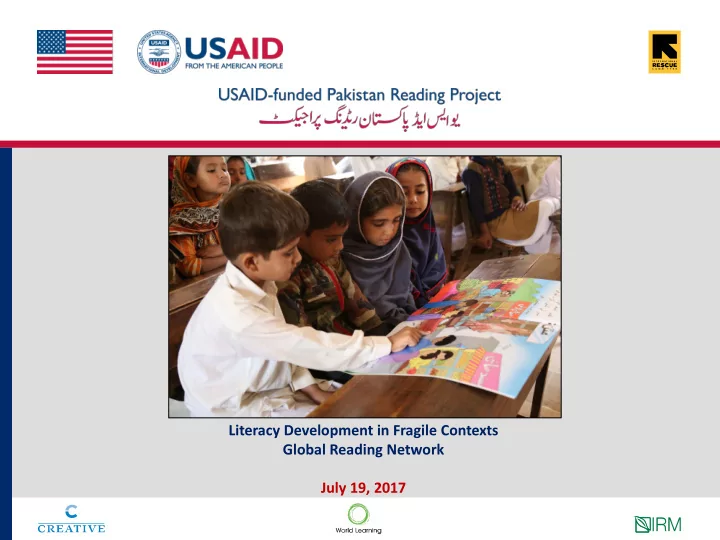
SLIDE 1
Literacy Development in Fragile Contexts Global Reading Network July 19, 2017
SLIDE 2
Agenda
▪ Mitigating effects of adversity ▪ Pakistani context ▪ Overview of Pakistan Reading Project ▪ PRP program implementation in depth look: Materials development ▪ Challenges and lessons learned ▪ PRP successes ▪ Further Research
SLIDE 3
Learning to read in a healing classroom
Sense of Safety Sense of Control Sense of Belonging Relationships with Peers Feelings of Self Confidence Personal Attachments Intellectual Stimulation
SLIDE 4
Pakistan: Fragility Footprint Geo-political conditions Gender Equity Literacy Landscape
SLIDE 5 Pakistan: Student Reading Achievement Data
The national-level data of the Annual Status of Education Report (ASER) – 2013 shows that, on average, 40 percent
- f third grade public school children in Pakistan cannot read a sentence in Urdu.
Pakistan Reading Project 2015 EGRA baseline data results demonstrate high percentages of zero scores in ORF and low percentage of correct letter sound knowledge:
SLIDE 6
Key Targets
1.3 million grade 1 and 2 students 23,800 teachers 3,161 scholarships
Award Period
June 28, 2013 to June 27, 2018
Total Estimated USAID Amount
$165 M
Provincial Offices=7
District Offices= 38 Total PRP Staff= 665
SLIDE 7
Pakistan Reading Project Overview
▪ Improved Classroom Learning Environment for Reading ▪ Improved Policies and Systems for Reading ▪ Community Based Support for Reading ▪ Gender ▪ Monitoring, Evaluation & Learning
SLIDE 8
Overall Program Achievements 114,895
School Supports Visits
28
Policies
446,023
Students
3,161
Scholarships
15,535
Teachers
3,988,989
Teaching Learning Materials
30
Grants
SLIDE 9 PRP: Contributing to improved reading skills of students
2.8% 20.8% 26.5% 17.1% 23.4% 42.2% 0.1% 14.8% 15.6% 16.2% 16.0% 30.5% 0% 5% 10% 15% 20% 25% 30% 35% 40% 45% Orientation to Print Phonemic Awareness Letter Sound Fluency Familiar Word Oral Reading Fluency Reading Comprehension
Urdu Percentage of Grade 2 Students in Cohort 1 Students with Zero Scores from Baseline to Endline
Baseline Endline
SLIDE 10
Teaching Learning Materials (TLM)
Grade 1 and 2 TLM in Urdu, Sindhi, Pashto
Teacher Package
Daily lesson plans, flash cards, syllable charts, big books, leveled readers
Student Package
Student workbook
Classroom based formative assessments
SLIDE 11
SLIDE 12 Challenges and Lessons Learned
Material development process Security Governance systems Gender Equity Capacity building Classroom Context
SLIDE 13
Successes
Quality reading materials and training Reading Policies Community Engagement Valorizing mother tongue Promoting equitable representation Print-rich environment Fostering safe and healing classroom practices
SLIDE 14
Further Research ▪ Building body of evidence for fragile states ▪ Evaluating programs at scale ▪ Considering program impact on both academic skills and social emotional well being
SLIDE 15
Questions?
SLIDE 16
Thank you!
SLIDE 17 Resources
International Network for Education in Emergencies: Conflict Sensitive Education Pack on the INEE website at ineesite.org/education-fragility/conflict-sensitive-educatio. International Rescue Committee. (2013). Learning to Read in Healing Classrooms. New York City: IRC. International Rescue Committee. (2016). Safe and Healing Learning Spaces. New York City: IRC. National Education Management Information System Academy of Educational Planning and Management Ministry of Federal Education and Professional Training, Government of Pakistan. (2017) Pakistan Education Statistics 2015-16. Islamabad. NEMIS-AEPAM
- USAID. (2012). Pakistan Gender Analysis and Gender Assessment of Stabilization Programming.
Washington, D.C.: USAID.
- USAID. (2014). Literacy Education in Crisis Contexts. Washington, D.C.: USAID.
- USAID. (2014 ). Identifying Reading Barriers in Pakistan. Washington, D.C: USAID.
Pakistan Education Statistics
- USAID. (2015). Rapid Education and Risk Analysis. Washington, D.C: USAID.
- USAID. (2017) Landscape Report on Early Grade Literacy. Washington, D.C.: USAID.
SLIDE 18