
SLIDE 1
Littoral Characterisation of West Mainland Orkney: the Relationship - - PowerPoint PPT Presentation
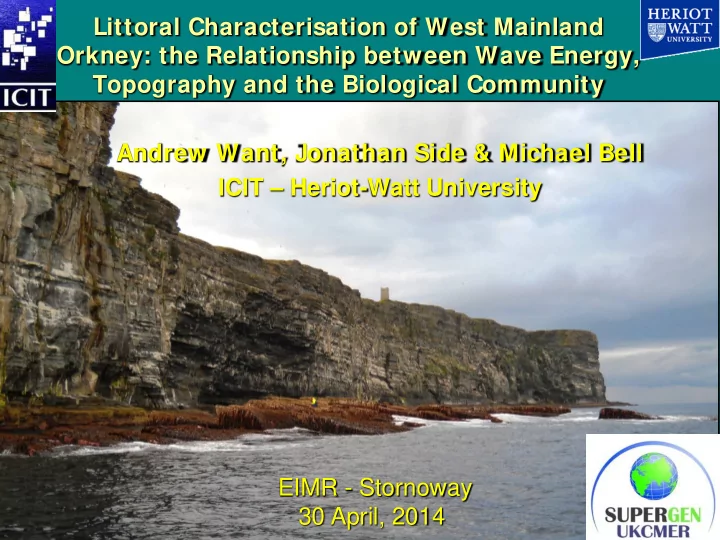
Littoral Characterisation of West Mainland Orkney: the Relationship between Wave Energy, Topography and the Biological Community Andrew Want, Jonathan Side & Michael Bell ICIT Heriot-Watt University EIMR - Stornoway 30 April, 2014 West
I CI T Heriot Watt Littoral Sites MNCR JNCC Littoral Sites (1995 & 1997)
Aquamarine Oyster at Billia Croo
Sampling site – June 2013
Crustacea Rhodophyta Chthamalus montagui Callithamnion sp. Chthamalus stellatus Ceramium sp. Semibalanus balanoides Chondrus crispus Corallina officinalis Mollusca Dumontia cortorta Calliostoma zizyphinum Lomentaria articulata Gibbula cineraria Mastocarpus stellatus Gibbula umbilicalis Osmundea hybrida Littorinidae Osmundea pinnatifida Mytilus edulis Palmaria palmata Nucella lapillus Polysiphonia sp. Patella ulyssiponensis Porphyra umbilicalis Patella vulgata Tectura testudinalis Phaeophyceae Alaria esculenta Cnidaria Ascophyllum nodosum Actinia equina Fucus distichus anceps Urticina felina Fucus serratus Fucus spiralis f. nanus Porifera Fucus vesiculosus f. linearis Halichondria panicea Halidrys siliquosa Himanthalia elongata Chlorophyta Laminaria digitata Cladophora sp. Laminaria hyperborea Ulva intestinalis Leathesia difformis Ulva lactuca Pelvetia canaliculata Scytosiphon lomentaria
Barnacles Ex: ≥500 per 0.01 m2, ≥5 cm–2
S: 300–499 per 0.01 m2, 3–4 cm–2 A: 100–299 per 0.01 m2, 1–2 cm–2 C: 10–99 0.01 m–2 F: 1–9 per 0.01 m2 O: 1–99 m–2 R: < 1 m–2
Patella spp. ≥10 mm,
Lit it t orin ina lit lit t orea (j u j uvenile iles & adult lt s), L. . m ar ariae ae/ obt bt usa sat a ( (adu dult s) s)
Ex: ≥20 per 0.1 m2
S: 10–19 per 0.1 m2 A: 5–9 per 0.1 m2 C: 1–4 per 0.1 m2 F: 5–9 m–2 O: 1–4 m–2 R: < 1 m–2 Lit it t orin ina ‘saxat ilis ilis ’, Pat at ella a < 10 m m , L. L.m ar ariae ae/ obt usat at a a j uv. v.
Ex: ≥50 per 0.1 m2
S: 20–49 per 0.1 m2 A: 10–19 per 0.1 m2 C: 5–9 per 0.1 m2 F: 1–4 per 0.1 m2 O: 1–9 m–2 R: < 1 m–2 Nucel ella lapi pillus s (> 3 m m ), Gibbu bbula spp. spp.
Ex: ≥10 per 0.1 m2
S: 5–9 0.1 m–2 A: 1–4 0.1 m–2 C: 5–9 m–2, sometimes more F: 1–4 m–2, locally sometimes more O: < 1 m–2, locally sometimes more R: Always < 1 m–2 Myt ilu ilus edulis lis
Ex: ≥80% cover
S: 50–79% cover A: 20–49% cover C: 5–19% cover
F: Small patches, 5%; ≥10 small ind. per 0.1 m2; ≥1 large
O: 1–9 small ind. per 0.1 m2: 1–9 large ind. m–2; no patches except small ind. in crevices R: < 1 m–2 Pom at ocer eros s sp. sp.
A: ≥50 tubes per 0.01 m2
C: 1–49 tubes per 0.01 m2 F: 1–9 tubes per 0.1 m2 O: 1–9 tubes m2 R: < 1 tube m–2
Spirorbinidae A: ≥5 cm–2 on appropriate substrata; > 100 per 0.01 m2
generally
C: Patches of ≥5 cm–2; 1–100 per 0.1 m2 generally
F: Widely scattered small groups; 1–9 per 0.1 m2 generally O: Widely scattered small groups; < 1 per 0.1 m2 generally R: < 1 m–1
Sponges, hydroids, bryozoa A: Present on ≥20% of suitable surfaces
C: Present on 5–19% of suitable surfaces F: Scattered patches; < 5% cover O: Small patch or single sprig in 0.1 m2 R: < 1 patch over strip; 1 small patch or sprig per 0.1 m2
Lichens, lithothamnia
Ex: More than 80% cover 6 S 50–79% cover A: 20–49% cover C: 1–19% cover F: Large scattered patches O: Widely scattered patches all small R: Only 1 or 2 patches
Algae
Ex: > 90% cover S: 60–89% cover A: 30–59% cover C: 5–29% cover F: < 5% cover, zone still apparent O: Scattered plants, zone indistinct R: Only 1 or 2 plants
Abundance scales used for intertidal organisms, after Crisp & Southward (1958) modified by Hiscock (1981). Ex: extremely abundant; S: super abundant; A: abundant; C: common; F: frequent; O: occasional; R: rare. Organisms not seen during a 45 minute site visit despite searching were recorded as N: absent
Adapted from Burrows et al. 2008
Rocky Shore Sites n Nucella
Alaria Laminaria Orkney – More Energetic 6 5.2 5.7 0.7 Orkney – Less Energetic 6 2.8 0.7 4.2 3.7 5.2 Lewis – NW orientation 6 3.7 4.2 2.8 4.3 Lewis – NE orientation 1* 1 6
*Stathanais, Port Nis only
Rocky Shore Sites n
Orkney – More Energetic 6 90 Orkney – Less Energetic 6 63 Lewis – NW orientation 6 31 Lewis – NE orientation 1* 95
**% of total Patella
Rocky Shore Sites n Nucella
Alaria Laminaria Orkney – More Energetic 6 5.2 5.7 0.7 Orkney – Less Energetic 6 2.8 0.7 4.2 3.7 5.2 Lewis – NW orientation 6 3.7 4.2 2.8 4.3 Lewis – NE orientation 1* 1 6
*Stathanais, Port Nis only
Rocky Shore Sites n
Orkney – More Energetic 6 90 Orkney – Less Energetic 6 63 Lewis – NW orientation 6 31 Lewis – NE orientation 1* 95
**% of total Patella
Rocky Shore Sites n Nucella
Alaria Laminaria Orkney – More Energetic 6 5.2 5.7 0.7 Orkney – Less Energetic 6 2.8 0.7 4.2 3.7 5.2 Lewis – NW orientation 6 3.7 4.2 2.8 4.3 Lewis – NE orientation 1* 1 6
*Stathanais, Port Nis only
Rocky Shore Sites n
Orkney – More Energetic 6 90 Orkney – Less Energetic 6 63 Lewis – NW orientation 6 31 Lewis – NE orientation 1* 95
**% of total Patella
Rocky Shore Sites n Nucella
Alaria Laminaria Orkney – More Energetic 6 5.2 5.7 0.7 Orkney – Less Energetic 6 2.8 0.7 4.2 3.7 5.2 Lewis – NW orientation 6 3.7 4.2 2.8 4.3 Lewis – NE orientation 1* 1 6
*Stathanais, Port Nis only
Rocky Shore Sites n
Orkney – More Energetic 6 90 Orkney – Less Energetic 6 63 Lewis – NW orientation 6 31 Lewis – NE orientation 1* 95
**% of total Patella
Alaria Mytilus Verrucaria Patella F. distichus anceps Semibalanus Palmaria Porphyra Chthamalus
Illustrations: Anne Bignall
12°
Corallina Palmaria Himanthalia
Mastocarpus Mytilus L. digitata
Patella Nucella Semibalanus
Porphyra Verrucaria
Illustrations: Anne Bignall
5°
Depth (metres)
Bathymetric data courtesy of The Crown Estate
Terobuoy – Bob Beharie
Wave-action measurements, 1 March to 12 August 2010, given in mass loss per immersed hour showing three discrete energetic events over this period. At higher levels of offshore Hm0, a significant difference is found between the shoreline wave action at the two sites.
From: Want, Beharie, Bell and Side (2014). In: Humanity and the Sea: Marine Renewable Energy Technology and Environmental Interactions.
nearshore waters;
associated biological communities which may augment our ability to predict impacts following energy extraction;
topographic indices;
differences in the rocky shore littoral community along West Mainland Orkney;
complicated;
lower shore slope in wave energy dissipation, organisms associated with relatively lower exposure can survive;
extraction to have profound effects on the littoral community and would recommend sublittoral studies to monitor environmental impacts of wave energy extraction.
Pelamis below Black Craig
Environmental Variable PC1 PC2 PC3 Slope + Complexity Openness
Site Bearing – x Site Bearing - y (+) Aspect - x + Aspect - y Exposure + + +
R2 (%) 43.1 44.5 32.7 Stepwise Regression: Flora v Environmental Variables Principal Component Analysis: Flora Species PC1 PC2 PC3 Fucus distichus anceps + +
+
Mastocarpus stellatus Palmaria palmata + Corallina officinalis
Alaria esculenta +
+ Porphyra umbilicalis Cladophora spp. Ulva intestinalis + PCA Proportion (%) 29.4 14.0 11.0
Stepwise Regression: Fauna v Environmental Variables Species PC1 PC2 PC3 Barnacle +
+ + Mytilus edulis + Nucella lapillus +
+
47.1 24.4 12.3 Principal Component Analysis: Fauna Environmental Variable PC1 PC2 PC3 Slope
(+) Openness + + Site Bearing – x Site Bearing - y (+) Aspect - x Aspect - y
Exposure + +
R2 (%) 41.4 38.9 39.6