
SLIDE 1
18TH INTERNATIONAL CONFERENCE ON COMPOSITE MATERIALS
- 1. Introduction
Composites, which contain particles or short-fibers in a ductile matrix have already used or have the potential as engineering material because of their good formability and machinability as well as improved mechanical properties. In the composites, a variety of damage modes such as fracture of reinforcements, interfacial debonding between reinforcements and matrix, and cracking in matrix develop from early stage of deformation under monotonic or cyclic loads.[1-4] The observed damage modes depend on the combination of the mechanical properties of the constituents and the in- situ interfacial strength between them. In order to extend the application of the composites and to develop a new composite system, an understanding
- f the micromechanism of damage process in the
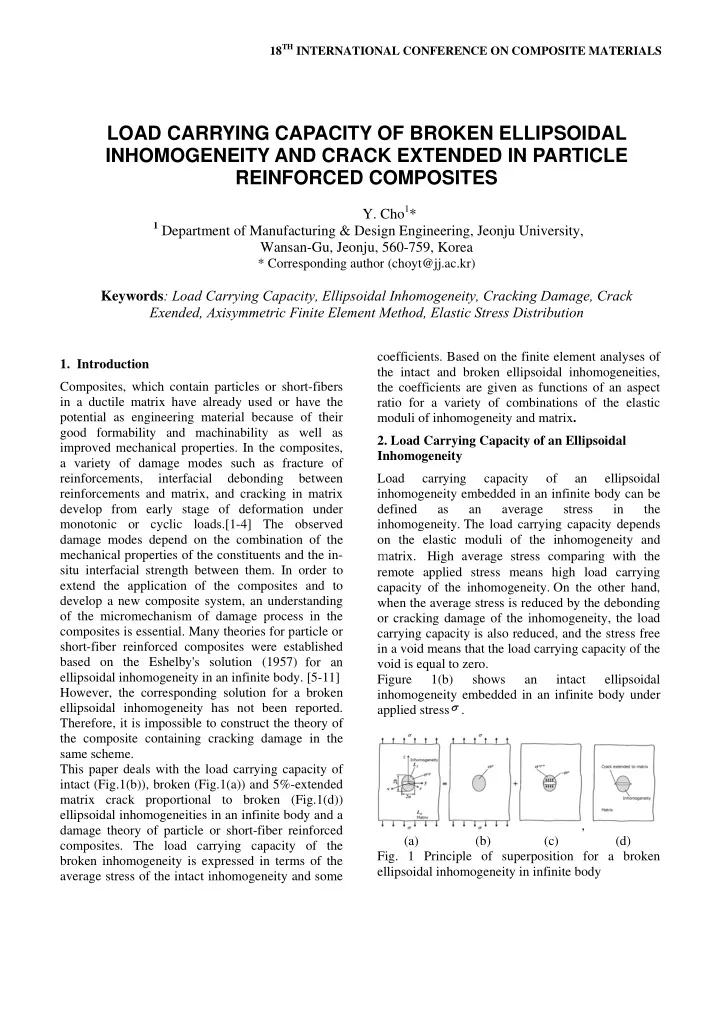
composites is essential. Many theories for particle or short-fiber reinforced composites were established based on the Eshelby's solution (1957) for an ellipsoidal inhomogeneity in an infinite body. [5-11] However, the corresponding solution for a broken ellipsoidal inhomogeneity has not been reported. Therefore, it is impossible to construct the theory of the composite containing cracking damage in the same scheme. This paper deals with the load carrying capacity of intact (Fig.1(b)), broken (Fig.1(a)) and 5%-extended matrix crack proportional to broken (Fig.1(d)) ellipsoidal inhomogeneities in an infinite body and a damage theory of particle or short-fiber reinforced
- composites. The load carrying capacity of the
broken inhomogeneity is expressed in terms of the average stress of the intact inhomogeneity and some
- coefficients. Based on the finite element analyses of
the intact and broken ellipsoidal inhomogeneities, the coefficients are given as functions of an aspect ratio for a variety of combinations of the elastic moduli of inhomogeneity and matrix.
- 2. Load Carrying Capacity of an Ellipsoidal
Inhomogeneity Load carrying capacity
- f
an ellipsoidal inhomogeneity embedded in an infinite body can be defined as an average stress in the
- inhomogeneity. The load carrying capacity depends
- n the elastic moduli of the inhomogeneity and
- matrix. High average stress comparing with the
remote applied stress means high load carrying capacity of the inhomogeneity. On the other hand, when the average stress is reduced by the debonding
- r cracking damage of the inhomogeneity, the load
carrying capacity is also reduced, and the stress free in a void means that the load carrying capacity of the void is equal to zero. Figure 1(b) shows an intact ellipsoidal inhomogeneity embedded in an infinite body under applied stressσ . , (a) (b) (c) (d)
- Fig. 1 Principle of superposition for a broken
ellipsoidal inhomogeneity in infinite body
LOAD CARRYING CAPACITY OF BROKEN ELLIPSOIDAL INHOMOGENEITY AND CRACK EXTENDED IN PARTICLE REINFORCED COMPOSITES
- Y. Cho1*