LOCAL DECAY IN NON-RELATIVISTIC QED T. CHEN, J. FAUPIN, J. FR - - PDF document

local decay in non relativistic qed
SMART_READER_LITE
LIVE PREVIEW

LOCAL DECAY IN NON-RELATIVISTIC QED T. CHEN, J. FAUPIN, J. FR - - PDF document

LOCAL DECAY IN NON-RELATIVISTIC QED T. CHEN, J. FAUPIN, J. FR OHLICH, AND I. M. SIGAL Abstract. We prove the limiting absorption principle for a dressed electron at a fixed total momentum in the standard model of non-relativistic quantum elec-


slide-1
SLIDE 1

LOCAL DECAY IN NON-RELATIVISTIC QED

  • T. CHEN, J. FAUPIN, J. FR¨

OHLICH, AND I. M. SIGAL

  • Abstract. We prove the limiting absorption principle for a dressed electron at

a fixed total momentum in the standard model of non-relativistic quantum elec-

  • trodynamics. Our proof is based on an application of the smooth Feshbach-Schur

map in conjunction with Mourre’s theory.

  • 1. Introduction

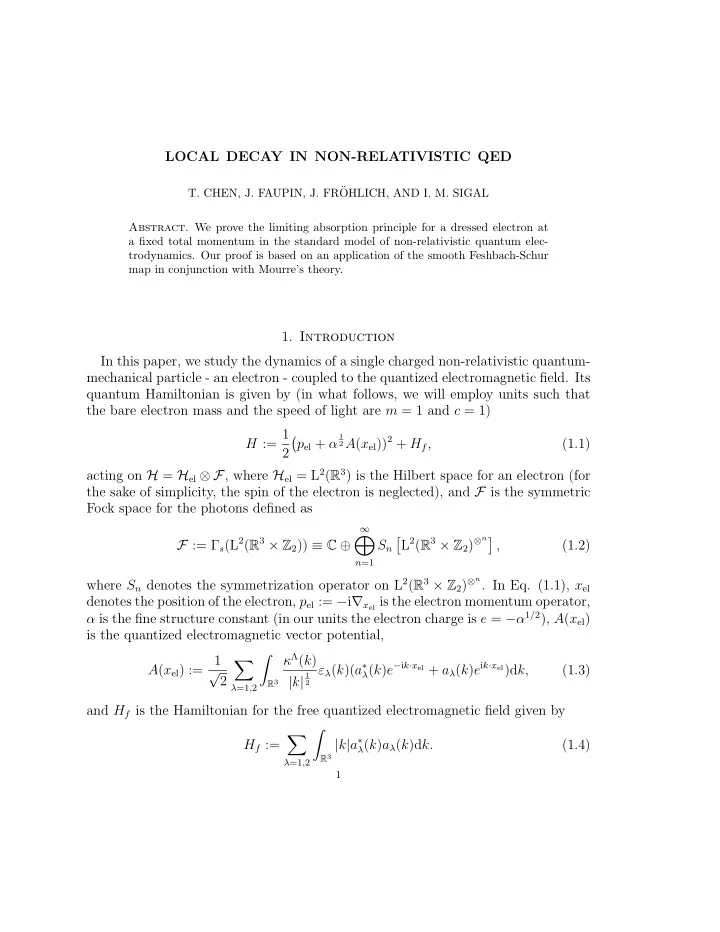
In this paper, we study the dynamics of a single charged non-relativistic quantum- mechanical particle - an electron - coupled to the quantized electromagnetic field. Its quantum Hamiltonian is given by (in what follows, we will employ units such that the bare electron mass and the speed of light are m = 1 and c = 1) H := 1 2

  • pel + α

1 2A(xel))2 + Hf,

(1.1) acting on H = Hel ⊗ F, where Hel = L2(R3) is the Hilbert space for an electron (for the sake of simplicity, the spin of the electron is neglected), and F is the symmetric Fock space for the photons defined as F := Γs(L2(R3 × Z2)) ≡ C ⊕

  • n=1

Sn

  • L2(R3 × Z2)⊗n

, (1.2) where Sn denotes the symmetrization operator on L2(R3 × Z2)⊗n. In Eq. (1.1), xel denotes the position of the electron, pel := −i∇xel is the electron momentum operator, α is the fine structure constant (in our units the electron charge is e = −α1/2), A(xel) is the quantized electromagnetic vector potential, A(xel) := 1 √ 2

  • λ=1,2
  • R3

κΛ(k) |k|

1 2 ελ(k)(a∗

λ(k)e−ik·xel + aλ(k)eik·xel)dk,

(1.3) and Hf is the Hamiltonian for the free quantized electromagnetic field given by Hf :=

  • λ=1,2
  • R3 |k|a∗

λ(k)aλ(k)dk.

(1.4)

1

slide-2
SLIDE 2

2

  • T. CHEN, J. FAUPIN, J. FR¨

OHLICH, AND I. M. SIGAL

The photon creation- and annihilation operators, a∗

λ(k), aλ(k), are operator-valued

distributions on F obeying the canonical commutation relations [a#

λ (k), a# λ′(k′)] = 0,

[aλ(k), a∗

λ′(k′)] = δλλ′δ(k − k′),

(1.5) where a# stands for a∗ or a; ελ(k), λ = 1, 2, are normalized polarization vectors, i.e., vector fields orthogonal to one another and to k (we assume, in addition, that ελ(k) = ελ(k/|k|), so that (k ·∇kελ)(k) = 0), and κΛ is an ultraviolet cutoff function, chosen such that κΛ ∈ C∞

0 ({k, |k| ≤ Λ}; [0, 1]) and κΛ = 1 on {k, |k| ≤ 3Λ/4}.

(1.6) There is no external potential acting on the electron. It can, however, absorb and emit photons, (i.e., field quanta of the electromagnetic field), which dramatically affects its dynamical properties. This is the simplest system of quantum electrody-

  • namics. In the present paper, we take an important step towards understanding the

dynamics of this system: We exhibit a local decay property saying, roughly speak- ing, that the probability of finding all photons within a ball of an arbitrary radius R < ∞ centered at the position, xel, of the electron tends to 0, as time t tends to ∞. In other words, asymptotically, as time t tends to ∞, the distance between some photons and the electron tends to ∞, and the electron relaxes into a “lowest-energy state”. The above result is proven for an arbitrary initial state of the system, assuming

  • nly that its maximal total momentum has a magnitude smaller than pc < mc = 1;

(recall that m = 1 and c = 1). In the following, we set pc = 1/40, but we expect our result to hold for any value of pc smaller than 1. The physical origin of the restriction

  • n the total momentum will be described below.

It has long been expected and has recently been proven that an electron coupled to the quantized electromagnetic field is an “infra-particle”: The infimum, E(P), of the spectrum of the Hamiltonian at total momentum P is not an eigenvalue, except when P = 0. (This result is sometimes referred to as “infrared catastrophe”. Precise notions will be given later in this introduction.) However, there is an “infrared rep- resentation” of the canonical commutation relations of the electromagnetic field that is disjoint from the Fock representation and such that the corresponding representa- tion space contains an eigenvector associated to inf σ(H|P); see [Fr2, Pi, CF, CFP2]. This suggests that if we prepare the system, at some initial time t(= 0), in an ar- bitrary state described by a vector in the tensor product of the one-electron Hilbert space and the photon Fock space, whose maximal total momentum has a magnitude strictly smaller than mc = 1, and then study the time evolution of this vector we will find that the probability of finding photons within a ball of an arbitrary radius R < ∞ centered at the position, xel, of the electron tends to 0, as time t tends to ∞.

slide-3
SLIDE 3

LOCAL DECAY IN NON-RELATIVISTIC QED 3

This intuitive picture is expressed in precise language in terms of the local decay property, which is formulated as

  • (dΓ(xph − xel) + 1)−s e−itH g(H, Ptot)Φ
  • ≤ C t−(s− 1

2 ) ,

(1.7) with a := √ a2 + 1. Here dΓ(b) denotes the usual (Lie-algebra) second quantization

  • f an operator b acting on L2(R3 × Z2), xph denotes the photon “position” operator,

xph = i∇k, acting on L2(R3 × Z2), Ptot := pel + Pf is the total momentum operator, where the field momentum, Pf, is given by Pf :=

  • λ=1,2
  • R3 ka∗

λ(k)a(k)dk,

(1.8) g is an arbitrary smooth function compactly supported on the set Ma.c. := {(λ, P) ∈ R × S | λ > E(P)} , (1.9) where S := {P ∈ R3| |P| < pc}, and Φ ranges over a certain dense set in H. (Inequality (1.7) states that photons move out of any bounded domain around the electron with probability one, as time tends to infinity.) This is one of the key results

  • f this paper. Another related consequence of our analysis is that the spectrum of

the Hamiltonian of the system at total momentum P different from 0, with |P| < pc, is purely absolutely continuous. One expects, in fact, that, asymptotically, as time t tends to ∞, the system ap- proaches a scattering state describing an electron and an outgoing cloud of infinitely many freely moving photons of finite total energy, with the spatial separation be- tween the electron and the photon cloud diverging linearly in t; (Compton scattering, see [CFP1]). The system studied in this paper is translation invariant, in the sense that H commutes with the total momentum operator Ptot = pel + Pf. This implies that H admits a “fiber decomposition” UHU −1 = ⊕

R3 H(P)dP,

(1.10)

  • ver the spectrum of Ptot.

The r.h.s.

  • f (1.10) acts on the direct integral

˜ H := ⊕

R3 HPdP, with fibers HP ∼

= F, (i.e ˜ H = L2(R3, dP; F)), the fiber opera- tors H(P), P ∈ R3, are self-adjoint operators on the spaces HP, and U is the unitary

  • perator

(UΨ)(P) :=

  • R3 ei(P−Pf)·yΨ(y)dy.

(1.11) It maps the state space H = Hel ⊗ F onto the direct integral ˜ H = ⊕

R3 HPdP. (The

inverse is given by (U −1Φ)(xel) =

  • R3 e−ixel·(P−Pf)Φ(P)dP.)
slide-4
SLIDE 4

4

  • T. CHEN, J. FAUPIN, J. FR¨

OHLICH, AND I. M. SIGAL

The quantity E(P) mentioned above is defined as E(P) := inf σ(H(P)). It is the energy of a dressed one-particle state of momentum P, provided |P| is small enough. Its regularity, which turns out to be essential in our analysis, has been investigated in [Ch, BCFS2, CFP2, FP]. In [AFGG], related results for a model of a dressed non-relativistic electron in a magnetic field are established. For the uncoupled system, α = 0, at total momentum P, E(P) = P 2/2 is an eigenvalue of the Hamiltonian H(P). For |P| smaller than or equal to mc = 1, it is at the bottom of the spectrum of H(P). But if |P| > 1 the bottom of the spectrum

  • f the Hamiltonian of the uncoupled system at total momentum P reaches down to

|P| − 1/2, which is strictly smaller than P 2/2, and hence the eigenvalue P 2/2 is embedded in the continuous spectrum; see Figure 1, below. In this range of momenta, the charged particle may propagate faster than the speed of light and, hence, it emits Cerenkov radiation. Thus, one expects the dynamics of the system to be quite different depending on whether |P| < 1 or |P| > 1. This is the physical origin of our restriction on the total momentum (|P| ≤ pc < 1) which appeared above.

P 1 E(P)

Figure 1. The map E(P) = inf σ(H(P)), for α = 0: If |P| ≤ 1, E(P) = P 2/2 ∈ σpp(H(P)), If |P| > 1, E(P) = |P| − 1/2 / ∈ σpp(H(P)). We will analyze the spectra of the fiber Hamiltonians H(P) at a fixed total mo- mentum P ∈ R3, with |P| ≤ pc. We prove the limiting absorption principle (LAP) for H(P), for α1/2 small enough and |P| ≤ pc. As a consequence, we obtain local decay estimates and absolute continuity of the spectrum of H(P) in the interval (E(P), +∞). (In an appendix, we explain how to modify the proof given in this paper to arrive at a LAP for electrons bound to static nuclei and linearly coupled

slide-5
SLIDE 5

LOCAL DECAY IN NON-RELATIVISTIC QED 5

to the radiation field.) Our method can be also easily adapted to the P-fibers of particle systems, like atoms and molecules (see, e.g., [LMS]). If such a system, in the center-of-mass frame, has a ground state at the bottom of its spectrum, then of course the approach simplifies considerably and becomes similar to the one outlined in Appendix C. Our proof of the LAP is based on an application of the isospectral smooth Feshbach- Schur map introduced in [BCFS1]; see also [GH, FGS3]. This map depends on the choice of an unperturbed Hamiltonian. An important and new point in our analysis is to choose an unperturbed Hamiltonian obtained by decoupling the low- energy photons from the electron; (a similar idea was suggested independently by M. Griesemer [Gr]; such Hamiltonians were used previously, but in a different context, in, e.g., [BFP, FGS1, FP].) We combine the Feshbach-Schur map with Mourre’s theory (see [Mo, PSS, ABG, HS]). Our proofs incorporate many important earlier ideas, methods and results; (especially from [BCFS1, GH, FGS1, FP]). To compare

  • ur approach with that of [FGS1, FGS2], we apply it in Appendix C to the Nelson

model involving bound particles linearly coupled to the quantized radiation field. We emphasize that our methods are well adapted to coping with the infrared singularity

  • f the form factor in the interaction Hamiltonian.

If one attempted to establish local decay for the Hamiltonian in (1.1) directly, i.e., without using the fiber decomposition (1.10), one would face a major difficulty: One would have to deal with a continuum of thresholds, E(P), potentially leading to extremely slow decay. For the standard model of charged non-relativistic particles bound to a static nucleus and interacting with the quantized electromagnetic field, a LAP just above the ground state energy has been recently proven in [FGS1] and [FGS3]. The proof in [FGS1] is based on an infrared decomposition of the photon Fock space: In order to establish a LAP in an interval located at a distance σ from the bottom of the spectrum, the initial Hamiltonian is approximated by an infrared-cutoff Hamiltonian (which is obtained by turning off the interaction between the charged particles and photons of energies smaller than σ). The Mourre estimate is then established in a perturbative way. A feature of the infrared-cutoff Hamiltonian, which the method of [FGS1] is based upon, is that only the free-field energy operator affects the low-energy photons. The proof in [FGS3] is based on a spectral renormalization group analysis; (see [BFS, BCFS1, FGS2]) and could possibly be adapted to our context. However, the proof we present in the following is significantly simpler, in that we require only

  • ne application of the smooth Feshbach-Schur map, whereas renormalization group

methods are based on an iteration of this map. While progress on understanding the standard model of charged non-relativistic particles bound to static nuclei and interacting with the quantized electromagnetic

slide-6
SLIDE 6

6

  • T. CHEN, J. FAUPIN, J. FR¨

OHLICH, AND I. M. SIGAL

field has been fairly robust, our understanding of free electrons coupled to the quan- tized electromagnetic field has emerged rather slowly and has always come at the price of very involved and lengthy arguments. Many techniques that work beauti- fully for the former (see, e.g., the extensive literature on existence of ground states) are hitting upon walls in the latter case. To begin with, an important ingredient in various proofs, including the one in [FGS1], namely the use of a unitary Pauli- Fierz transformation (combined with exponential decay of states bound to nuclei in the position variables of the electrons), is not available in the free-electron model. Furthermore, the important feature that, after an infrared cutoff has been imposed,

  • nly the free-field energy operator determines the dynamics of the low energy pho-

tons, is no longer true in our model. More precisely, a term coupling the low- and high-energy photons appears in the infrared cutoff Hamiltonian (see (1.30) and the discussion after it), so that the methods in [FGS1] do not apply directly. Main results We now state our main results and outline the strategy of our proof. Whenever the readers meet an unfamiliar notation they are encouraged to consult Appendix D. We prove a limiting absorption principle for H(P) in an energy interval just above E(P) = inf σ(H(P)), for |P| ≤ pc, where 0 < pc < 1. In this paper we choose pc = 1/40, and we do not attempt to find an optimal estimate on pc. The main result of this paper can be formulated as follows: For an interval J ⊆ R, we set J± :=

  • z ∈ C, Rez ∈ J, 0 < ±Imz ≤ 1
  • . Since the operator dΓ(xph − xel)

is translationally invariant (it commutes with Ptot), it is represented as the fiber integral, UdΓ(xph − xel)U −1 = ⊕

R3 dΓ(y)dP,

(1.12) where y := i∇k is the “position” operator of the photon, but now relative to the electron position. (To distinguish it from the original photon “position” operator xph = i∇k, we use the symbol y.) We have Theorem 1.1. There exists an α0 > 0 such that, for any |P| ≤ pc ( = 1/40), 0 ≤ α ≤ α0, 1/2 < s ≤ 1, and any compact interval J ⊂ (E(P), ∞), we have that sup

z∈J±

  • (dΓ(y) + 1)−s

H(P) − z −1(dΓ(y) + 1)−s ≤ C, (1.13) where C is a constant depending on J and s. Moreover, the map J ∋ λ → (dΓ(y) + 1)−s H(P) − λ ± i0+−1(dΓ(y) + 1)−s ∈ B(H) (1.14) is uniformly H¨

  • lder continuous in λ of order s − 1/2.
slide-7
SLIDE 7

LOCAL DECAY IN NON-RELATIVISTIC QED 7

This theorem follows from Corollaries 2.3 and 5.4 below. Our proof will show that, if dist(E(P), J) = σ then the constant C in (1.13) is bounded by O(σ−1). Finding an optimal upper bound on C with respect to σ is beyond the scope of this paper. As a consequence of Theorem 1.1, we have the following Corollary 1.2. There exists α0 > 0 such that for any |P| ≤ pc and 0 ≤ α ≤ α0, the spectrum of H(P) is purely absolutely continuous in the interval (E(P), +∞). Physical interpretation of our results We describe a consequence of Theorem 1.1 pointing to a key physical property of the

  • system. We consider an initial state consisting of a dressed electron together with a

cloud of photons located in a finite ball centered at the position of the electron. Corollary 1.3. Recall that S = {P ∈ R3| |P| < pc}, and let Φ ∈ H = Hel ⊗ F denote an arbitrary state such that UΦ = ⊕

S Φ(P)dP and

(dΓ(y) + 1)s Φ(P) < ∞ , (1.15) for some 1/2 < s ≤ 1 and for all P ∈ S. Then our system has the local decay property (1.7).

  • Proof. Let Φg := g(H, Ptot) Φ . The state UΦg ∈

R3 HPdP can be written as

UΦg = Ug(H, Ptot)Φ = ⊕

S

g(H(P), P) Φ(P) dP. (1.16) We note that Ue−itHΦg = lim

ε→0

1 2iπ

  • S

dP

  • dλ f(λ, P) e−itλIm

1 H(P) − λ − iεΦ(P) , (1.17) so that

  • (dΓ(xph − xel) + 1)−s e−itH Φg
  • =

sup

Φ′=1

  • lim

ε→0

  • S

dP

  • dλ e−itλ f(λ, P)
  • Φ′ , (dΓ(y) + 1)−sIm

1 H(P) − λ − iεΦ(P)

  • .

(1.18) Since g(λ, P) is supported on the set {λ > E(P)}, Theorem 1.1 implies that the scalar product · · · in (1.18) is (s − 1

2)-H¨

  • lder continuous in λ, for any choice of Φ′, and

for a H¨

  • lder constant independent of Φ′, because

Φ(P) := (dΓ(y) + 1)sΦ(P) ∈ F. The Fourier transform h(t) =

  • eitλh(λ)dλ of an (s − 1

2)-H¨

  • lder continuous function

h(λ) satisfies | h(t)| ≤ Ct−(s−1/2). Thus, (1.7) follows.

slide-8
SLIDE 8

8

  • T. CHEN, J. FAUPIN, J. FR¨

OHLICH, AND I. M. SIGAL

This corollary implies that photons that are not permanently bound to the dressed electron move out of any bounded domain around the dressed electron with proba- bility one, as time tends to ∞. We consider an observable A, given by a selfadjoint operator on H which we assume to satisfy (dΓ(xph − xel) + 1)sA(dΓ(xph − xel) + 1)s < ∞ , (1.19) Then, lim

t→0

  • Φg , eitH A e−itH Φg
  • = 0 .

(1.20) Indeed, we have

  • e−itHΦg , A e−itHΦg
  • ≤ (dΓ(xph − xel) + 1)sA(dΓ(xph − xel) + 1)s

× (dΓ(xph − xel) + 1)−s e−itH Φg 2 ≤ C t−2(s− 1

2 ).

(1.21) More generally, we expect the following picture to hold true. We assume that h ∈ C∞((−∞, Ec) × S), where Ec = E(P) with |P| = pc, and consider the state Φh := h(H, Ptot) Φ where Φ ∈ H is as in Corollary 1.3. Let A = U −1 ⊕ APdPU denote a bounded translation invariant observable. Then, we expect that lim

t→∞

  • e−itHΦh , A e−itHΦh
  • =
  • S

dµΦh(P)

  • ΨP , AP ΨP
  • ,

(1.22) where supp{dµΦh} ⊆ S. Here, ΨP , ( · ) ΨP denotes an expectation in the general- ized ground state of the fiber Hamiltonian H(P). This describes the relaxation of the state Φh to the mass shell, asymptotically as t → ∞, under emission of photons that disperse to spatial infinity. (Note that, for P = 0, ΨP does not belong to the Fock space, but to a Hilbert space carrying an infrared representation of the canonical commutation relations.) We end this discussion by presenting the explicit expression for the fiber Hamiltoni- ans H(P). Using (1.10) and (1.11) and using that A(xel)eixel·(P−Pf) = eixel·(P−Pf)A(0), we compute H(U −1Φ)(xel) =

  • R3 eixel·(P−Pf)H(P)Φ(P)dP, where H(P) is given ex-

plicitly by H(P) = 1 2

  • P − Pf + α

1 2A

2 + Hf, (1.23) with A := A(0) = 1 √ 2

  • λ=1,2
  • R3

κΛ(k) |k|

1 2 ελ(k)(a∗

λ(k) + aλ(k))dk.

(1.24)

slide-9
SLIDE 9

LOCAL DECAY IN NON-RELATIVISTIC QED 9

Strategy of the proof of Theorem 1.1 First, we prove an easy part - a LAP in any compact interval J ⊂ (E(P), ∞) with the property that inf J ≥ E(P) + C0α1/2, where C0 is a sufficiently large, positive constant (Section 2). This follows from a Mourre estimate of the form 1J(H(P))[H(P), iB]1J(H(P)) ≥ c1J(H(P)), (1.25) where B is the generator of dilatations on Fock space (see Equation (2.1)) and c is

  • positive. Using the assumption that inf J ≥ E(P) + C0α1/2 and standard estimates,

Equation (1.25) can be proven in a straightforward way. A considerably more difficult task is to prove a limiting absorption principle near E(P). We use a theorem due to [FGS3] (see Theorem B.2 in Appendix B of the present paper), which essentially says that one can derive a LAP for H(P) from a LAP for an operator resulting from applying a smooth Feshbach-Schur map to H(P). We explain these points in detail. Our construction of the smooth Feshbach-Schur map is based on a low-energy decomposition of the Hamiltonian H(P): H(P) = Hσ(P) + Uσ(P), (1.26) where σ ≥ 0, Uσ(P) is defined by this equation and the infrared cutoff Hamiltonian Hσ(P), σ ≥ 0, is given by Hσ(P) := 1 2(P − Pf + α

1 2Aσ)2 + Hf,

(1.27) for every P ∈ R3, with Aσ := 1 √ 2

  • λ=1,2
  • {|k|≥σ}

κΛ(k) |k|

1 2 ελ(k)(a∗

λ(k) + aλ(k))dk,

(1.28) (see Section 3). Note that Hσ(P) is defined by decoupling photons of energy less than σ from the electron. Such a decomposition was used previously in the analysis

  • f non-relativistic QED; (see, e.g., [BFP, FGS1]).

Next we use the fact that the Hilbert space F is isometrically isomorphic to Fσ⊗Fσ where Fσ := Γs(L2({(k, λ), |k| ≥ σ})) and Fσ := Γs(L2({(k, λ), |k| ≤ σ})). Below we will use this representation without always mentioning it. The operator Hσ(P) leaves invariant the Fock space Fσ of photons of energies larger than σ, and its restriction to Fσ, Kσ(P) := Hσ(P)|Fσ, (1.29) has a gap of order O(σ) in its spectrum above the ground state energy. Moreover, in Fσ ⊗ Fσ, Hσ(P) decomposes as Hσ(P) = Kσ(P) ⊗ 1 + 1 ⊗ 1 2P 2

f + Hf

  • − ∇Kσ(P) ⊗ Pf,

(1.30)

slide-10
SLIDE 10

10

  • T. CHEN, J. FAUPIN, J. FR¨

OHLICH, AND I. M. SIGAL

where ∇Kσ(P) := P − Pf + α1/2Aσ. The central difficulty in our analysis comes from the presence of the last term in (1.30), which couples the low- and high-energy

  • photons. This is the main reason why we are not able to prove a Mourre estimate

for H(P) near E(P) by using a suitable σ-dependent conjugate operator (as is done in [FGS1]). To circumvent this difficulty, we apply the Feshbach-Schur map. We use the projection, Pσ(P), onto the ground state of Kσ(P) in order to construct a smooth Feshbach-Schur map Fχ, where χ = Pσ(P) ⊗ χσ

f(Hf), with χσ f(Hf) a

smoothed “projection” onto the spectral subspace Hf ≤ σ; (see Section 4). This map projects out the degrees of freedom corresponding to photons of energies larger than σ. The resulting operator F(λ) := Fχ(H(P) − λ), where λ is the spectral parameter, is of the form F(λ) =Kσ(P) ⊗ 1 + 1 ⊗ 1 2P 2

f + Hf

  • − ∇Eσ(P) ⊗ Pf − λ + W,

(1.31) where Eσ(P) := inf σ(Hσ(P)) and W is defined by this relation. We notice that, due to the last term in (1.30), the unperturbed operator chosen to construct F(λ) cannot be Hσ(P). Instead we choose the following operator: Tσ(P) = Kσ(P) ⊗ 1 + 1 ⊗ 1 2P 2

f + Hf

  • − ∇Eσ(P) ⊗ Pf.

(1.32) Thanks to the uniform regularity of Eσ(P) with respect to P (see Proposition 3.1) and using the Feynman-Hellman formula (see Lemma 5.6), we see that the difference Hσ(P) − Tσ(P) is small in an appropriate sense. In particular, the operator W in (1.31) can be estimated to be O(α1/2σ). Next, in order to obtain a LAP for F(λ), we use again Mourre’s theory, choosing a conjugate operator Bσ defined as the generator of dilatations with a cutoff in the photon momentum variable, Bσ :=

  • λ=1,2
  • R3 a∗

λ(k)κσ(k)bκσ(k)aλ(k)dk,

(1.33) with κσ(k) a cutoff in the photon momentum variable, see (1.6), and b := i

2(k · ∇k +

∇k · k) the generator of dilatations; (see Section 5). Let λ be in the interval J<

σ := [E(P) + 11ρσ/128, E(P) + 13ρσ/128],

(1.34) where σ satisfies σ ≤ C′

0α1/2 for some fixed, sufficiently large positive constant

C′

0 ≥ C0, and ρσ is the size of the gap above Eσ(P) in the spectrum of Kσ(P).

The Mourre estimate for F(λ), on the spectral interval ∆σ = [−ρσ/128, ρσ/128], is established as follows. By energy localization and the facts that the operator Kσ(P) commutes with Bσ and that |∇Eσ(P)| ≤ |P| + Cα ≤ 1/4, for |P| ≤ 1/40 and α sufficiently small, the commutator of the “unperturbed” part in F(λ) with Bσ yields a positive term of order O(σ). This and the fact that the commutator with the

slide-11
SLIDE 11

LOCAL DECAY IN NON-RELATIVISTIC QED 11

“perturbation” W is of order O(α1/2σ) lead to the Mourre estimate and, therefore, to the LAP for F(λ). Once the LAP is established for F(λ), it is transferred by the theorem of [FGS3] mentioned above (see Theorem B.2 in the present paper), to the

  • riginal Hamiltonian H(P) on the interval J<

σ . Finally, we use that the intervals J> σ

in (1.34) with σ ≤ C′

0α1/2 cover the interval (E(P), C0α1/2].

Organization of the paper Our paper is organized as follows. In the next section, we prove the LAP for H(P)

  • utside a certain neighborhood of E(P) = inf σ(H(P)). Section 3 is concerned with

the approximation of H(P) by the infrared cutoff Hamiltonian Hσ(P). In Section 4, we prove the existence of the Feshbach-Schur operator F(λ) mentioned above. We establish the Mourre estimate for F(λ) in Section 5, from which we deduce the LAP for H(P) near E(P). In Appendix A, we collect some technical estimates used in Sections 4 and 5. Appendix B recalls the definition of the smooth Feshbach-Schur map and some of its main properties. In Appendix C, we briefly explain how to adapt the methods used in this paper to a model of bound non-relativistic electrons coupled to the radiation field. Finally, for the convenience of the reader, a list of notations used in this paper is contained in Appendix D. Throughout the paper, C, C′, C′′ denote positive constants that may vary from one line to another. Acknowledgements J.Fr. and I.M.S. are grateful to Marcel Griesemer for all he has taught them in the course of joint work on [FGS1]. The ideas of this paper are fundamental for the present paper. We also thank Alessandro Pizzo for sharing his important insights with us; (see [CFP2, FP]). J.Fa., I.M.S., and T.C. are grateful to J.Fr. for hospitality at ETH Z¨

  • urich. T.C. thanks I.M.S. for hospitality at the University of Toronto. The

authors acknowledge the support of the Oberwolfach Institute. Part of this work was done during I.M.S.’s stay at the IAS, Princeton. The research of I.M.S. has been supported by NSERC under Grant NA 7901. T.C. has been supported by the NSF under grant DMS-070403/DMS-0940145.

  • 2. Limiting absorption principle outside a neighborhood of the

ground state energy In this section we shall prove Theorem 1.1 for any interval J of the form J = J>

σ := E(P) + [σ, 2σ],

where the parameter σ is chosen to satisfy σ ≥ C0α

1 2, for some fixed positive constant

  • C0. Our proof is based on the standard Mourre theory ([Mo]), the conjugate operator
slide-12
SLIDE 12

12

  • T. CHEN, J. FAUPIN, J. FR¨

OHLICH, AND I. M. SIGAL

B being chosen as the generator of dilatations on F, i.e., B := dΓ(b), with b := i 2(k · ∇k + ∇k · k). (2.1) One can verify that [Hf, iB] = Hf, (2.2) in the sense of quadratic forms on D(Hf) ∩ D(B), and that, for j ∈ {1, 2, 3}, [dΓ(kj), iB] = dΓ(kj), (2.3) in the sense of quadratic forms on D(dΓ(kj)) ∩ D(B). Likewise, for any f ∈ D(b), [Φ(f), iB] = −Φ(ibf) (2.4) in the sense of quadratic forms on D(Φ(f)) ∩ D(B). Here Φ(h) := 1 √ 2(a∗(h) + a(h)), (2.5) where, as usual, for any h ∈ L2(R3 × Z2), we set a∗(h) :=

  • λ=1,2
  • R3 h(k, λ)a∗

λ(k)dk,

a(h) :=

  • λ=1,2
  • R3

¯ h(k, λ)aλ(k)dk, (2.6) so that A = Φ(h), h(k, λ) := κΛ(k) |k|

1 2 ελ(k).

(2.7) We recall that our choice of the polarization vectors ελ(k) implies that k·∇kελ(k) = 0. Theorem 2.1. There exist constants α0 > 0 and C0 > 0 such that, for all |P| ≤ pc, 0 ≤ α ≤ α0 and σ ≥ C0α1/2, 1J>

σ (H(P))[H(P), iB]1J> σ (H(P)) ≥ σ

2 1J>

σ (H(P)).

(2.8)

  • Proof. Note that H(P) can be written as

H(P) =1 2P 2 + 1 2P 2

f + Hf − P · Pf + α

1 2P · Φ(h)

− α

1 2

2

  • Φ(h) · Pf + Pf · Φ(h)
  • + α

2 Φ(h)2. (2.9) It follows from (2.2), (2.3) and (2.4) that [H(P), iB] = − 1 2

  • P − Pf + α

1 2Φ(h)

  • ·
  • Pf + α

1 2Φ(ibh)

  • − 1

2

  • Pf + α

1 2Φ(ibh)

  • ·
  • P − Pf + α

1 2Φ(h)

  • + Hf,

(2.10)

slide-13
SLIDE 13

LOCAL DECAY IN NON-RELATIVISTIC QED 13

in the sense of quadratic forms on D(H(P))∩D(B). Since D(H(P)) = D(P 2

f /2+Hf),

  • ne can check, in the same way as in [FGS1, Proposition 9], that for all t ∈ R,

eitBD(H(P)) ⊂ D(H(P)). (2.11) Hence D(H(P)) ∩ D(B) is a core for H(P) and (2.10) extends by continuity to an identity between quadratic forms on D(H(P)). Now, by (2.9), we get [H(P), iB] ≥H(P) − 1 2P 2 − α

1 2P ·

  • Φ(h) + Φ(ibh)
  • − α

2 Φ(h)2 + α

1 2

2

  • Φ(ibh) · (Pf − α

1 2Φ(h)) + (Pf − α 1 2Φ(h)) · Φ(ibh)

  • .

(2.12) Multiplying both sides of Inequality (2.12) by 1J>

σ (H(P)), using in particular that

Pf, Φ(h) and Φ(ibh) are H(P)-bounded, this yields 1J>

σ (H(P))[H(P), iB]1J> σ (H(P)) ≥

  • E(P) − 1

2P 2 + σ − Cα

1 2

1J>

σ (H(P)).

(2.13) Since |E(P) − P 2/2| ≤ C′α (see Proposition 3.1), we obtain 1J>

σ (H(P))[H(P), iB]1J> σ (H(P)) ≥

  • σ − C′′α

1 2

1J>

σ (H(P))

≥ σ 2 1J>

σ (H(P)),

(2.14) provided that σ ≥ C0α1/2, the constant C0 being chosen sufficiently large.

  • Corollary 2.2. There exists α0 > 0 such that, for any |P| ≤ pc, 0 ≤ α ≤ α0 and

1/2 < s ≤ 1, and for any compact interval J ⊂ [E(P) + C0α1/2, ∞), sup

z∈J±

  • B−s

H(P) − z −1B−s < ∞. (2.15) Here C0 > 0 is given by Theorem 2.1. Moreover, the map J ∋ λ → B−s H(P) − λ ± i0+]−1B−s ∈ B(H) (2.16) is uniformly H¨

  • lder continuous in λ of order s − 1/2.
  • Proof. Using the well-known conjugate operator method (see [Mo], [ABG]), it suffices

to show that H(P) ∈ C2(B). Since (2.11) holds, in order to obtain the C2-property of H(P) with respect to B, it is sufficient to verify that [H(P), iB] and [[H(P), iB], iB] extend to H(P)-bounded operators. This follows easily from the expression of the commutator of H(P) with iB, Equation (2.10), and by computing similarly the double commutator [[H(P), iB], iB].

  • Corollary 2.3. Under the conditions of Corollary 2.2,

sup

z∈J±

  • (dΓ(y) + 1)−s

H(P) − z −1(dΓ(y) + 1)−s < ∞, (2.17)

slide-14
SLIDE 14

14

  • T. CHEN, J. FAUPIN, J. FR¨

OHLICH, AND I. M. SIGAL

and the map J ∋ λ → (dΓ(y) + 1)−s H(P) − λ ± i0 −1(dΓ(y) + 1)−s ∈ B(H) (2.18) is uniformly H¨

  • lder continuous in λ of order s − 1/2.
  • Proof. Let φ ∈ C∞

0 (R; [0, 1]) be such that φ = 1 on a neighborhood of J.

Let ¯ φ = 1 − φ. It follows from the spectral theorem that sup

z∈J±

  • ¯

φ(H(P))

  • H(P) − z

−1 < ∞. (2.19) Therefore, to establish (2.17), it suffices to prove that sup

z∈J±

  • (dΓ(y) + 1)−sφ(H(P))
  • H(P) − z

−1(dΓ(y) + 1)−s < ∞. (2.20) Let us show that

  • (dΓ(y) + 1)−1φ(H(P))B
  • < ∞.

(2.21) Since [H(P), iB] extends to an H(P)-bounded operator (see (2.10)), an easy appli- cation of the Helffer-Sj¨

  • strand functional calculus shows that [φ(H(P)), iB] extends

to a bounded operator on F. Moreover, considering the restriction of the operator below to all n-particles subspaces of the Fock space, one verifies that

  • (dΓ(y) + 1)−1B(Hf + 1)−1

< ∞. (2.22) Since Hf is relatively bounded with respect to H(P), it follows that (dΓ(y) + 1)−1Bφ(H(P)) extends to a bounded operator on F. Hence, writing (dΓ(y) + 1)−1φ(H(P))B = (dΓ(y) + 1)−1[φ(H(P)), B] + (dΓ(y) + 1)−1Bφ(H(P)), (2.23) this proves (2.21). Now, using an interpolation argument, (2.21) implies that

  • (dΓ(y) + 1)−sφ(H(P))Bs

< ∞, (2.24) for any 0 ≤ s ≤ 1. Likewise, if ˜ φ ∈ C∞

0 (R; [0, 1]) is such that ˜

φφ = φ, we have that

  • Bs ˜

φ(H(P))(dΓ(y) + 1)−s < ∞. (2.25) Combining Corollary 2.2 with (2.24) and (2.25), we obtain (2.20), which concludes the proof of (2.17). The H¨

  • lder continuity stated in (2.18) follows similarly.
  • Henceforth and throughout the remainder of this paper, we assume that

σ ≤ C′

1 2,

(2.26) where C′

0 is a positive constant such that C′ 0 ≥ C0 (here C0 is given by Theorem

2.1).

slide-15
SLIDE 15

LOCAL DECAY IN NON-RELATIVISTIC QED 15

  • 3. Low energy decomposition

With this section we begin our proof of the LAP in a neighborhood of E(P). Recall the infrared cutoff Hamiltonian Hσ(P) we defined for σ ≥ 0, Hσ(P) := 1 2(P − Pf + α

1 2Aσ)2 + Hf,

(3.1) where Aσ := Φ(hσ), hσ(k, λ) := κΛ

σ(k)

|k|

1 2 ελ(k),

(3.2) and κΛ

σ(k) := 1{|k|≥σ}(k)κΛ(k).

(3.3) Note that H0(P) = H(P). Let Eσ(P) := inf σ(Hσ(P)). (3.4) For σ = 0 we set E(P) := E0(P). Let Fσ := Γs(L2({(k, λ), |k| ≥ σ})) and Kσ(P) := Hσ(P)|Fσ. (3.5) Let Gap(H) be defined by Gap(H) := inf{σ(H)\{E(H)}}−E(H), where E(H) := inf{σ(H)}, for any self-adjoint and semi-bounded operator H. The following propo- sition is proven in [Ch, BCFS2, CFP2, FP]. Proposition 3.1. There exists α0 > 0 such that, for all 0 ≤ α ≤ α0, the following properties hold: 1) For all σ > 0 and |P| ≤ pc, Gap(Kσ(P)) ≥ ρσ, for some 0 < ρ < 1. (3.6) Moreover inf σ(Kσ(P)) = Eσ(P) is a non-degenerate (isolated) eigenvalue of Kσ(P). 2) For all σ ≥ 0 and |P| ≤ pc,

  • Eσ(P) − E(P)
  • ≤ Cασ,

(3.7) where C is a positive constant independent of σ. 3) For all σ > 0, the map P → Eσ(P) is twice continuously differentiable on {P ∈ R3, |P| ≤ pc} and satisfies

  • Eσ(P) − P 2

2

  • ≤ Cα,
  • ∇Eσ(P) − P
  • ≤ Cα,

(3.8)

  • ∇Eσ(P) − ∇Eσ(P ′)
  • ≤ C|P − P ′|,

for all |P|, |P ′| ≤ pc, (3.9) where C is a positive constant independent of σ.

slide-16
SLIDE 16

16

  • T. CHEN, J. FAUPIN, J. FR¨

OHLICH, AND I. M. SIGAL

4) For all σ ≥ 0, |P| ≤ pc and k ∈ R3, Eσ(P − k) ≥ Eσ(P) − 1 3|k|. (3.10) We fix P ∈ R3 and, to simplify notations, we drop, from now on, the dependence

  • n P everywhere unless some confusion may arise. Note that the Hilbert space F is

isometric to Fσ ⊗ Fσ where Fσ := Γs(L2({(k, λ), |k| ≤ σ})). In this representation, we have that Hσ = Kσ ⊗ 1 + 1 ⊗ 1 2P 2

f + Hf

  • − ∇Kσ ⊗ Pf,

(3.11) where we use (with obvious abuse of notation) that Pf = Pf ⊗ 1 + 1 ⊗ Pf, Hf = Hf ⊗ 1 + 1 ⊗ Hf and Aσ = Aσ ⊗ 1, and where we use the notation ∇Kσ := ∇Hσ|Fσ, with ∇Hσ := P − Pf + α

1 2Aσ.

(3.12) In conclusion of this section we mention the decomposition H = Hσ + Uσ, (3.13) where Uσ := α

1 2∇Kσ ⊗ Aσ − α 1 2

2 1 ⊗

  • Aσ · Pf + Pf · Aσ

+ α 2 1 ⊗ (Aσ)2, (3.14) and Aσ := Φ(hσ), hσ(k, λ) := h(k, λ) − hσ(k, λ) = 1{|k|≤σ}(k) |k|

1 2

ελ(k). (3.15)

  • 4. Feshbach-Schur operator

In this section we use the “smooth Feshbach-Schur map”, Fχ, introduced in [BCFS1] to map the operators H − λ onto more tractable operators. Define χσ

f := χσ f(Hf) ≡ κρσ(Hf),

¯ χσ

f :=

  • 1 − (χσ

f)2,

(4.1) with κρσ as defined in (1.6), ρ the same as in (3.6), and χ := Pσ ⊗ χσ

f,

¯ χ := Pσ ⊗ ¯ χσ

f + ¯

Pσ ⊗ 1, (4.2) where Pσ := 1{Eσ}(Kσ) and ¯ Pσ := 1 − Pσ. (4.3) Note that χ2 + ¯ χ2 = 1 and [χ, ¯ χ] = 0. To define the smooth Feshbach-Schur map Fχ for H − λ, we have to choose an “unperturbed” operator - we call it T - around which we construct our perturbation theory (see Appendix B). It is tempting to choose it as T = Hσ − λ. However this choice is not suitable, since, due to the term −∇Kσ ⊗Pf in Hσ (see Equation (3.11)), the commutator [Hσ, χ] does not vanish; (hence Hypothesis (1) of Appendix B is not

slide-17
SLIDE 17

LOCAL DECAY IN NON-RELATIVISTIC QED 17

satisfied). Another choice would be T = Hσ + ∇Kσ ⊗ Pf − λ. However, as far as the Mourre estimate of Section 5 is concerned, this choice does not work either, since it gives rise to “perturbation” terms of order O(σ) in Fχ(H −λ), that is the same order as the leading order terms in Fχ(H − λ). To circumvent this difficulty, we set Tσ := Hσ + (∇Kσ − ∇Eσ) ⊗ Pf, that is Tσ = Kσ ⊗ 1 + 1 ⊗ 1 2P 2

f + Hf

  • − ∇Eσ ⊗ Pf.

(4.4) Notice that [χ, Tσ] = 0, and that H = Tσ + Wσ, where Wσ := Uσ − (∇Kσ − ∇Eσ) ⊗ Pf. (4.5) Using the Feynman-Hellman formula, we shall see in the following that the term (∇Kσ − ∇Eσ) ⊗ Pf can indeed be treated as a perturbation, and leads to terms of

  • rder O(α1/2σ) in Fχ(H − λ); (see Lemmata 5.6, 5.7 and 5.8).

On operators of the form H − λ we introduce the Feshbach-Schur map (see Ap- pendix B): Fχ(H − λ) = Tσ − λ + χWσχ − χWσ ¯ χ

χ − λ

−1 ¯ χWσχ, (4.6) where (cf. Appendix B) H¯

χ := Tσ + ¯

χWσ ¯ χ. (4.7) This family is well-defined as follows from the fact that the operators χWσ and Wσχ are bounded and from Proposition 4.1 below. The Feynman-Hellman formula says that Pσ∇KσPσ = ∇EσPσ and hence χWσχ = χUσχ. Thus Equations (4.4) and (4.6) imply Fχ(H − λ) =Kσ ⊗ 1 + 1 ⊗ 1 2P 2

f + Hf

  • − ∇Eσ ⊗ Pf − λ

+ χUσχ − χWσ ¯ χ

χ − λ

−1 ¯ χWσχ. (4.8) Proposition 4.1. For any C0 > 0, there exists α0 > 0 such that, for all |P| ≤ pc, 0 ≤ α ≤ α0 and 0 < σ ≤ C0α1/2, for all λ ≤ Eσ +ρσ/4, H¯

χ −λ is bounded invertible

  • n Ran(¯

χ) and

  • ¯

χ

χ − λ

−1 ¯ χ

  • ≤ Cσ−1,

(4.9)

  • ¯

χ

χ − λ

−1 ¯ χWσχ

  • ≤ C.

(4.10)

  • Proof. By (4.5), the perturbation Wσ consists of two terms. As a first step in the

proof of Proposition 4.1, we focus on the term (∇Kσ −∇Eσ)⊗Pf, which is analyzed in the following lemma.

slide-18
SLIDE 18

18

  • T. CHEN, J. FAUPIN, J. FR¨

OHLICH, AND I. M. SIGAL

Lemma 4.2. Let H1

¯ χ := Tσ − ¯

χ(∇Kσ − ∇Eσ) ⊗ Pf ¯ χ . (4.11) For any C0 > 0, there exists α0 > 0 such that, for all |P| ≤ pc, 0 ≤ α ≤ α0 and 0 < σ ≤ C0α1/2, for all λ ≤ Eσ + ρσ/4, H1

¯ χ − λ is bounded invertible on Ran(¯

χ) and

  • ¯

χ

  • H1

¯ χ − λ

−1 ¯ χ

  • ≤ Cσ−1,

(4.12)

  • ¯

χ

  • H1

¯ χ − λ

−1 ¯ χ(∇Kσ − ∇Eσ) ⊗ Pfχ

  • ≤ C.

(4.13)

  • Proof. Let Φ = ¯

χΨ ∈ D(Hσ) ∩ Ran(¯ χ), Φ = 1. Let us first prove that (Φ, HσΦ) ≥ Eσ + 3 8ρσ. (4.14) We decompose (Φ, HσΦ) = (Φ, Hσ(1 ⊗ 1Hf≤3ρσ/4)Φ) + (Φ, Hσ(1 ⊗ 1Hf≥3ρσ/4)Φ), (4.15) and use that Φ = ¯ χΨ = ( ¯ Pσ ⊗ 1)Ψ + (Pσ ⊗ ¯ χσ

f)Ψ. Using Lemma A.4 and the fact

that 1Hf≤3ρσ/4 ¯ χσ

f = 0, we obtain that

(Φ, Hσ(1 ⊗ 1Hf≤3ρσ/4)Φ) ≥ (1 − 3 4ρσ)(Φ, Kσ ⊗ 1(1 ⊗ 1Hf≤3ρσ/4)Φ) = (1 − 3 4ρσ)(( ¯ Pσ ⊗ 1)Ψ, Kσ ⊗ 1( ¯ Pσ ⊗ 1Hf≤3ρσ/4)Ψ). (4.16) Since, by Proposition 3.1, ¯ PσKσ ¯ Pσ ≥ Eσ + ρσ, this implies that (Φ, Hσ(1 ⊗ 1Hf≤3ρσ/4)Φ) ≥ (1 − 3 4ρσ)(Eσ + ρσ)(Φ, (1 ⊗ 1Hf≤3ρσ/4)Φ) ≥ (Eσ + 3 8ρσ)(Φ, (1 ⊗ 1Hf≤3ρσ/4)Φ). (4.17) Note that in the last inequality we used that, by Proposition 3.1, Eσ ≤ 1/100 for |P| ≤ 1/40 and α sufficiently small. The second term on the right-hand side of (4.15) is estimated with the help of Lemma A.3, which gives: (Φ, Hσ(1 ⊗ 1Hf≥3ρσ/4)Φ) ≥ Eσ + 1 2(Φ, (1 ⊗ Hf)(1 ⊗ 1Hf≥3ρσ/4)Φ) ≥ (Eσ + 3 8ρσ)(Φ, (1 ⊗ 1Hf≥3ρσ/4)Φ). (4.18) Hence (4.14) is proven.

slide-19
SLIDE 19

LOCAL DECAY IN NON-RELATIVISTIC QED 19

From the definition of H1

¯ χ, we infer that

H1

¯ χ =Hσ + (∇Kσ − ∇Eσ) ⊗ Pf − ¯

χ(∇Kσ − ∇Eσ) ⊗ Pf ¯ χ =Hσ +

  • Pσ ⊗ (¯

χσ

f − 1)

  • ∇Kσ ⊗ Pf

¯ Pσ ⊗ 1

  • +

¯ Pσ ⊗ 1

  • ∇Kσ ⊗ Pf
  • Pσ ⊗ (¯

χσ

f − 1)

  • (4.19)

where we used that ¯ χ = Pσ ⊗ (¯ χσ

f − 1) + 1 ⊗ 1, and

  • 1 ⊗ 1
  • (∇Kσ − ∇Eσ) ⊗ Pf
  • Pσ ⊗ (¯

χσ

f − 1)

  • =

¯ Pσ ⊗ 1

  • ∇Kσ ⊗ Pf
  • Pσ ⊗ (¯

χσ

f − 1)

  • .

(4.20) Equation (4.20) follows from the Feynman-Hellman formula, Pσ∇KσPσ = ∇EσPσ, and orthogonality, Pσ ¯ Pσ = 0. By Proposition 3.1, for |P| ≤ pc = 1/40 and α sufficiently small,

  • ∇KσPσ
  • 2 ≤ 2Eσ ≤ P 2 + Cα ≤

1 362. (4.21) Thus, when combined with Pf(¯ χσ

f − 1) ≤ 2Hf(¯

χσ

f − 1) ≤ 2ρσ

(4.22) and (4.14), Equations (4.19)–(4.21) imply that (Φ, H1

¯ χΦ) ≥ Eσ + (3

8 − 1 9)ρσ = Eσ + 19 72ρσ, (4.23) provided that α is sufficiently small. This implies that H1

¯ χ − λ is bounded invertible

for any λ ≤ Eσ + ρσ/4, and leads to (4.12). To obtain (4.13), it suffices to combine (4.12) with (4.21) and the fact that Pfχσ

f ≤ Cσ.

  • We now return to the proof of Proposition 4.1. Using the operator H1

¯ χ introduced

in the statement of Lemma 4.2, we have that H¯

χ = H1 ¯ χ + ¯

χUσ ¯ χ. (4.24) Consider the Neumann series ¯ χ

χ − λ

−1 ¯ χ = ¯ χ

  • H1

¯ χ − λ

−1

n≥0

  • − ¯

χUσ ¯ χ

  • H1

¯ χ − λ

−1n ¯ χ. (4.25) We claim that

  • H1

¯ χ − λ

− 1

2 ¯

χUσ ¯ χ

  • H1

¯ χ − λ

− 1

2 ¯

χ

  • ≤ Cα

1 2.

(4.26) Indeed, inserting the expression (3.14) of Uσ into the left-hand side of (4.26), we

  • btain three terms: The first one is given by
  • α

1 2

H1

¯ χ − λ

− 1

2 ¯

χ∇Kσ ⊗ Aσ ¯ χ

  • H1

¯ χ − λ

− 1

2 ¯

χ

  • .

(4.27)

slide-20
SLIDE 20

20

  • T. CHEN, J. FAUPIN, J. FR¨

OHLICH, AND I. M. SIGAL

It follows from Lemmata A.1, A.3 and 4.2 that

  • (1 ⊗ a(hσ))¯

χ

  • H1

¯ χ − λ

− 1

2 ¯

χ

  • ≤ Cσ

1 2.

(4.28) Using in addition that, by Lemma 4.2,

  • (∇Kσ ⊗ 1)¯

χ

  • H1

¯ χ − λ

− 1

2 ¯

χ

  • ≤ Cσ− 1

2,

(4.29) we get (4.27) ≤ Cα1/2. The second and third terms from (3.14) are estimated similarly, which leads to (4.26). Together with (4.12) from Lemma 4.2, this implies that, for any n ∈ N,

  • ¯

χ

  • H1

¯ χ − λ

−1 − ¯ χUσ ¯ χ

  • H1

¯ χ − λ

−1n ¯ χ

  • ≤ Cσ−1(C′α

1 2)n.

(4.30) Hence, for α sufficiently small, the right-hand-side of (4.25) is convergent and (4.9)

  • holds. Estimate (4.10) follows similarly.
  • 5. Mourre estimate for the Feshbach-Schur operator

In this section we shall prove Theorem 1.1 in the case where J = J<

σ := [E(P) + 11ρσ/128, E(P) + 13ρσ/128],

and σ is such that σ ≤ C0α1/2. We shall begin with proving a limiting absorption principle for the Feshbach-Schur operator F(λ) := Fχ(H − λ)|Ran(Pσ⊗1), (5.1) defined in (4.6), Section 4. Note that the operator F(λ) is self-adjoint ∀λ ∈ J<

σ .

Here the parameter λ shall be fixed such that λ ∈ J<

σ and we shall prove a LAP for

F(λ) on the interval ∆σ defined in this section by ∆σ = [−ρσ/128, ρσ/128]. (5.2) Then we shall deduce a limiting absorption principle for H near the ground state energy E by applying Theorem B.2. We begin with showing the Mourre estimate for F(λ), λ ∈ J<

σ .

Recall that κσ denotes a function in C∞

0 ({k, |k| ≤ σ}; [0, 1]) such that κσ = 1 on

{k, |k| ≤ 3σ/4}. The conjugate operator we shall use in this section is the operator Bσ, defined by: Bσ = dΓ(bσ), with bσ = κσbκσ. (5.3) Clearly, Bσ acts on the second component of the tensor product Fσ ⊗ Fσ. The main theorem of this section is:

slide-21
SLIDE 21

LOCAL DECAY IN NON-RELATIVISTIC QED 21

Theorem 5.1. For any C0 > 0, there exists α0 > 0 such that, for all |P| ≤ pc, 0 ≤ α ≤ α0, 0 < σ ≤ C0α1/2, and λ ∈ J<

σ ,

1∆σ(F(λ))[F(λ), iBσ]1∆σ(F(λ)) ≥ ρσ 1281∆σ(F(λ)). (5.4) Before proceeding to the proof of this theorem we draw the desired conclusions from it. Proposition 5.2. For any C0 > 0, there exists α0 > 0 such that, for any |P| ≤ pc, 0 ≤ α ≤ α0, 0 < σ ≤ C0α1/2, 1/2 < s ≤ 1, and λ ∈ J<

σ ,

sup

z∈(∆σ)±

  • Bσ−s

F(λ) − z −1Bσ−s < ∞. (5.5) Here (∆σ)± = {z ∈ C, Rez ∈ [−ρσ/128, ρσ/128], 0 < ±Imz ≤ 1}. Moreover, the map J<

σ × ∆σ ∋ (λ, µ) → Bσ−s

F(λ) − µ ± i0+−1Bσ−s ∈ B(H) (5.6) is uniformly H¨

  • lder continuous in (λ, µ) of order s − 1/2.
  • Proof. It follows from Equations (4.4) and (4.6) that

F(λ) =1 ⊗ 1 2P 2

f + Hf

  • − ∇Eσ ⊗ Pf + Eσ − λ,

+ χWσχ − χWσ ¯ χ

χ − λ

−1 ¯ χWσχ. (5.7) By standard Mourre theory (see for instance [ABG]) and in view of Theorem 5.1, the limiting absorption principle (5.5) and the H¨

  • lder continuity in µ follow from

the fact that F(λ) ∈ C2(Bσ). Since χWσ and Wσχ are bounded operators, it follows that D(F(λ)) = D(1 ⊗ (1

2P 2 f + Hf)), and, using the method of [FGS1, Proposition

9], one verifies that eitBσD(1 ⊗ (1 2P 2

f + Hf)) ⊂ D(1 ⊗ (1

2P 2

f + Hf)),

(5.8) for all t ∈ R. Hence it suffices to show that [F(λ), iBσ] and [[F(λ), iBσ], iBσ] are bounded with respect to 1 ⊗ (1

2P 2 f + Hf), which follows easily from the expressions

  • f the commutators; (see, in particular, the proofs of Lemmata 5.5 and 5.8).

Now, for λ, λ′ ∈ J<

σ , we have

F(λ) − F(λ′) = (λ′ − λ)

  • Pσ ⊗ 1 + χWσ ¯

χ

χ − λ

−1 H¯

χ − λ′−1 ¯

χWσχ

  • .

(5.9) Equation (4.10) in the statement of Proposition 4.1 implies that

  • χWσ ¯

χ

χ − λ

−1 H¯

χ − λ′−1 ¯

χWσχ

  • ≤ C,

(5.10) where C is independent of λ and λ′. Thus, the H¨

  • lder continuity in (λ, µ) stated

in (5.6) follows again by standard arguments of Mourre theory (see [PSS, AHS, HS]).

slide-22
SLIDE 22

22

  • T. CHEN, J. FAUPIN, J. FR¨

OHLICH, AND I. M. SIGAL

This proposition and Theorem B.2 imply the following Corollary 5.3. For any C0 > 0, there exists α0 > 0 such that, for any |P| ≤ pc, 0 ≤ α ≤ α0, 0 < σ ≤ C0α1/2 and 1/2 < s ≤ 1, sup

z∈(J<

σ )±

  • Bσ−s

H(P) − z −1Bσ−s < ∞, (5.11) where (J<

σ )± = {z ∈ C, Rez ∈ [E(P)+11ρσ/128, E(P)+13ρσ/128], 0 < ±Imz ≤ 1}.

Moreover, the map [E(P)+11ρσ 128 , E(P)+13ρσ 128 ] ∋ λ → Bσ−s H(P)−λ±i0+−1Bσ−s ∈ B(H) (5.12) is uniformly H¨

  • lder continuous in λ of order s − 1/2.

By arguments similar to ones used in the proof of Corollary 2.3, Corollary 5.3 implies the following result. Corollary 5.4. Under the conditions of Corollary 5.3, for any compact interval J ⊂ (E(P), C0α

1 2],

sup

z∈J±

  • (dΓ(y) + 1)−s

H(P) − z −1(dΓ(y) + 1)−s < ∞, (5.13) and the map J ∋ λ → (dΓ(y) + 1)−s H(P) − λ ± i0+−1(dΓ(y) + 1)−s ∈ B(H) (5.14) is uniformly H¨

  • lder continuous in λ of order s − 1/2.

Now we proceed to the proof of Theorem 5.1. It will be divided into a sequence

  • f Lemmata. In what follows we often do not display the argument λ. First, let us

write F = F0 + W1 + W2, (5.15) where F0 := 1 ⊗ 1 2P 2

f + Hf

  • − ∇Eσ ⊗ Pf + Eσ − λ,

(5.16) W1 := χUσχ, (= χWσχ by Feynman-Hellman; see above) (5.17) W2 := −χWσ ¯ χ

χ − λ

−1 ¯ χWσχ. (5.18) Let us begin by estimating [F0, iBσ] from below on the range of 1⊗1Hf≤δρσ, for some suitably chosen δ > 0.

slide-23
SLIDE 23

LOCAL DECAY IN NON-RELATIVISTIC QED 23

Lemma 5.5. Let |P| ≤ pc and δ > 0 be such that δρσ < 3σ/4. Then on Ran(1 ⊗ 1Hf≤δρσ),

  • F0, iBσ

≥ 1 2(1 ⊗ Hf) − Cσ2, (5.19) where C is a positive constant.

  • Proof. We have that

[Hf, iBσ] = dΓ(κσ(k)2|k|), [Pf, iBσ] = dΓ(κσ(k)2k). (5.20) Therefore,

  • F0, iBσ

= 1 ⊗ (Pf · dΓ(κσ(k)2k) + dΓ(κσ(k)2|k|)) − ∇Eσ ⊗ dΓ(κσ(k)2k). (5.21) For j = 1, 2, 3, we have ±dΓ(κσ(k)2kj) ≤ dΓ(κσ(k)2|k|) ≤ 1 ⊗ Hf, (5.22) so that ∇Eσ ⊗ dΓ(κσ(k)2k) ≥ −(

  • j

|(∇Eσ)j|)dΓ(κσ(k)2|k|) ≥ −2|∇Eσ|dΓ(κσ(k)2|k|). (5.23) Moreover, using again (5.22), it can easily be checked that 1 ⊗

  • Pf · dΓ(κσ(k)2k)1Hf≤δρσ
  • ≥ −Cσ2.

(5.24) Hence Equations (5.21), (5.23) and (5.24) yield

  • F0, iBσ

(1 ⊗ 1Hf≤δρσ) ≥ (1 − 2|∇Eσ|)(1 ⊗ dΓ(κσ(k)2|k|))(1 ⊗ 1Hf≤δρσ) − Cσ2(1 ⊗ 1Hf≤δρσ) ≥ 1 2(1 ⊗ dΓ(κσ(k)2|k|))(1 ⊗ 1Hf≤δρσ) − Cσ2(1 ⊗ 1Hf≤δρσ). (5.25) In the second inequality we used that, by Proposition 3.1, |∇Eσ| ≤ |P| + Cα

1 2 ≤ 1/4

for |P| ≤ 1/40 and α sufficiently small. To conclude the proof of the lemma, it remains to justify that the operator dΓ(κσ(k)2|k|) in (5.25) can be replaced by Hf. To this end, we define Hσ

f,3σ/4 =

  • λ=1,2
  • 3σ/4≤|k|≤σ

|k|a∗

λ(k)aλ(k)dk,

N σ

3σ/4 =

  • λ=1,2
  • 3σ/4≤|k|≤σ

a∗

λ(k)aλ(k)dk,

(5.26)

slide-24
SLIDE 24

24

  • T. CHEN, J. FAUPIN, J. FR¨

OHLICH, AND I. M. SIGAL

and P σ

3σ/4 = 1{0}(Hσ f,3σ/4), ¯

P σ

3σ/4 = 1 − P σ 3σ/4. Then we have that

(1 ⊗ Hf) ¯ P σ

3σ/4 ≥ Hσ f,3σ/4 ¯

P σ

3σ/4 ≥ 3σ

4 N σ

3σ/4 ¯

P σ

3σ/4 ≥ 3σ

4 ¯ P σ

3σ/4.

(5.27) Therefore, since 1 ⊗ Hf commutes with P σ

3σ/4, we get

δρσ ¯ P σ

3σ/4(1 ⊗ 1Hf≤δρσ) ≥ (1 ⊗ Hf) ¯

P σ

3σ/4(1 ⊗ 1Hf≤δρσ)

≥ 3σ 4 ¯ P σ

3σ/4(1 ⊗ 1Hf≤δρσ)

(5.28) and since δρσ < 3σ/4 by assumption, this implies (1 ⊗ 1Hf≤δρσ) = P σ

3σ/4(1 ⊗ 1Hf≤δρσ).

(5.29) Since κσ(k) = 1 for any |k| ≤ 3σ/4, we obtain that

  • 1 ⊗ dΓ(κσ(k)2|k|)
  • P σ

3σ/4 = (1 ⊗ Hf)P σ 3σ/4.

(5.30) We conclude the proof using (5.25), (5.29), (5.30), and the fact that 1 ⊗ dΓ(κσ(k)2|k|) ≥

  • 1 ⊗ dΓ(κσ(k)2|k|)
  • P σ

3σ/4.

(5.31)

  • The following lemma is an important ingredient in showing Theorem 5.1. It jus-

tifies the fact that one can consider the term (∇Kσ − ∇Eσ) ⊗ Pf in Wσ as a small perturbation. The idea of its proof is due to [AFGG], and is based on the C2- regularity of the map P → Eσ(P) uniformly in σ, established in [Ch] and [FP] (see more precisely inequality (3.9) in Proposition 3.1). Let (ej, j = 1, 2, 3) be the canonical orthonormal basis of R3. For any y ∈ R3, we set yj = y · ej. Lemma 5.6. For any C0 > 0, there exists α0 > 0 such that, for all |P| ≤ pc, 0 ≤ α ≤ α0, 0 < σ ≤ C0α1/2, λ ∈ J<

σ , j ∈ {1, 2, 3}, and 0 < δ ≪ 1,

χ − λ

− 1

2 ¯

χ

  • (∇Kσ − ∇Eσ)jPσ
  • ⊗ 1Hf≤δ
  • ≤ C
  • 1 + δ

1 2σ− 1 2

. (5.32)

  • Proof. For any u > 0, we can write

(∇Kσ)j = 1 u

  • Kσ(P + uej) − Kσ(P)
  • − u

2. (5.33) Using that Kσ(P)Pσ = Eσ(P)Pσ, this implies (∇Kσ − ∇Eσ)jPσ =1 u(Kσ(P + uej) − Eσ(P + uej))Pσ + 1 u(Eσ(P + uej) − Eσ(P)) − (∇Eσ)j − u 2

  • Pσ.

(5.34)

slide-25
SLIDE 25

LOCAL DECAY IN NON-RELATIVISTIC QED 25

By Proposition 3.1,

  • 1

u(Eσ(P + uej) − Eσ(P)) − (∇Eσ)j

  • ≤ Cu,

(5.35) where C is independent of σ. Consequently, it follows from the Feynman-Hellman formula, Pσ(∇Kσ)jPσ = (∇Eσ)jPσ, together with Equation (5.33) that, for any Φ ∈ Ran(Pσ), Φ = 1,

  • (Kσ(P + uej) − Eσ(P + uej))

1 2Φ

  • 2

=

  • Φ, (Kσ(P + uej) − Eσ(P + uej))Φ
  • =
  • Φ, (Kσ(P) + u(∇Kσ)j + u2

2 − Eσ(P + uej))Φ

  • = Eσ(P) − Eσ(P + uej) + u(∇Eσ)j + u2

2 ≤ Cu2. (5.36) From (5.34), we obtain that (∇Kσ − ∇Eσ)jPσ = (Kσ(P + uej) − Eσ(P + uej))

1 2B1 + B2,

(5.37) where B1 := 1 u(Kσ(P + uej) − Eσ(P + uej))

1 2Pσ,

(5.38) B2 := 1 u(Eσ(P + uej) − Eσ(P)) − (∇Eσ)j − u 2

  • Pσ.

(5.39) By (5.36) and (5.35), the operators B1, B2 are bounded and satisfy B1 ≤ C, B2 ≤ Cu. (5.40) Thus, choosing u ≤ σ, the lemma will follow if we show that

  • ¯

χ

χ − λ

− 1

2 ¯

χ(Kσ(P + uej) − Eσ(P + uej))

1 2 ⊗ 1Hf≤δ

  • 2

≤ Cδσ−1. (5.41) Let us prove (5.41). To simplify notations, we set ¯ χ≤δ := (1 ⊗ 1Hf≤δ)¯ χ (5.42) Let Φ ∈ Ran(¯ χ), Φ = 1. Since

  • H1

¯ χ − λ

χ − λ

−1 ¯ χ

  • ≤ C,

(5.43) (see the proof of Proposition 4.1), it suffices to estimate

  • Φ, ¯

χ

  • H1

¯ χ − λ

− 1

2 ¯

χ≤δ

  • (Kσ(P + uej) − Eσ(P + uej)) ⊗ 1
  • ¯

χ≤δ

  • H1

¯ χ − λ

− 1

2 ¯

χΦ

  • . (5.44)
slide-26
SLIDE 26

26

  • T. CHEN, J. FAUPIN, J. FR¨

OHLICH, AND I. M. SIGAL

Using that

  • ¯

χ

  • H1

¯ χ − λ

− 1

2 ¯

χ

  • (∇Kσ − ∇Eσ) ⊗ 1
  • ¯

χ

  • H1

¯ χ − λ

− 1

2 ¯

χ

  • ≤ Cσ−1,

(5.45) and since 0 < u ≤ σ, we get (5.44) ≤

  • Φ, ¯

χ

  • H1

¯ χ−λ

− 1

2 ¯

χ≤δ

  • (Kσ(P)−Eσ(P))⊗1
  • ¯

χ≤δ

  • H1

¯ χ−λ

− 1

2 ¯

χΦ

  • +C. (5.46)

Next, by Lemma A.4, ¯ χ≤δ

  • (Kσ(P) − Eσ(P)) ⊗ 1
  • ¯

χ≤δ ≤ 1 1 − δ ¯ χ≤δ

  • Hσ(P) − Eσ(P)
  • + 4δEσ
  • ¯

χ≤δ. (5.47) Using the expression (4.19) of H1

¯ χ, we conclude from (5.47) that

¯ χ≤δ

  • (Kσ(P) − Eσ(P)) ⊗ 1
  • ¯

χ≤δ ≤ ¯ χ≤δ

  • H1

¯ χ(P) − Eσ(P)

  • + C(σ + δ)
  • ¯

χ≤δ. (5.48) The statement of the lemma follows from (5.46), (5.48) and Lemma 4.2.

  • In the following lemma, we prove that the “perturbation” operators W1, W2 in

(5.17)–(5.18) are of order O(α1/2σ). Lemma 5.7. For any C0 > 0, there exists α0 > 0 such that, for all |P| ≤ pc, 0 ≤ α ≤ α0, 0 < σ ≤ C0α1/2, and λ ∈ J<

σ ,

  • Wi
  • ≤ Cα

1 2σ, i = 1, 2,

(5.49) where W1 and W2 are as in (5.17), (5.18).

  • Proof. Let us first prove (5.49) for i = 1.

Equation (3.14) combined with the Feynman-Hellman formula gives χUσχ =α

1 2

∇EσPσ

  • χσ

fAσχσ f

  • − α

1 2

2 Pσ ⊗

  • χσ

f

  • Pf · Aσ + Aσ · Pf
  • χσ

f

  • + α

2 Pσ ⊗

  • χσ

f(Aσ)2χσ f

  • .

(5.50) It follows from Lemma A.1 that

  • Aσχσ

f

  • ≤ Cσ

1 2

[Hf + σ]

1 2χσ

f

  • ≤ C′σ,

(5.51)

  • (Aσ · Pf)χσ

f

  • ≤ Cσ

1 2

[Hf + σ]

1 2|Pf|χσ

f

  • ≤ C′σ2.

(5.52) Therefore (5.49) for i = 1 follows. To prove (5.49) for i = 2 it suffices to show that for λ ∈ J<

σ ,

χ − λ

− 1

2 ¯

χWσχ

  • ≤ Cα

1 4σ 1 2.

(5.53)

slide-27
SLIDE 27

LOCAL DECAY IN NON-RELATIVISTIC QED 27

By Equations (3.14) and (4.5), Wσχ =α

1 2

∇KσPσ

  • Aσχσ

f

  • (5.54)

− α

1 2

2 Pσ ⊗

  • Pf · Aσ + Aσ · Pf
  • χσ

f

  • (5.55)

+ α 2 Pσ ⊗

  • (Aσ)2χσ

f

  • (5.56)

  • ∇Kσ − ∇Eσ
  • Pfχσ

f

  • .

(5.57) We insert this expression into (5.53) and estimate each term separately. First, it follows from Proposition 4.1 and Estimate (5.51) that

χ − λ

− 1

2 ¯

χ(5.54)

  • ≤ Cα

1 2σ 1 2.

(5.58) Similarly, Lemma A.2 combined with Proposition 4.1 and (5.51)–(5.52) implies

χ − λ

− 1

2 ¯

χ

  • (5.55) + (5.56)
  • ≤ Cα

1 2σ 3 2.

(5.59) Finally the contribution from (5.57) is estimated thanks to Lemma 5.6: Using (5.32) with δ = ρσ, we get, for j ∈ {1, 2, 3},

χ − λ

− 1

2 ¯

χ

  • ∇Kσ − ∇Eσ
  • jPσ
  • ⊗ 1Hf≤ρσ
  • ≤ C.

(5.60) Together with (Pf)jχσ

f ≤ Cσ, this yields

χ − λ

− 1

2 ¯

χ(5.57)

  • ≤ Cσ ≤ C′α

1 4σ 1 2.

(5.61) Estimates (5.58), (5.59) and (5.61) imply (5.53), so (5.49), i = 2, follows.

  • In the next lemma, we estimate the commutators [Wi, iBσ], i = 1, 2.

Lemma 5.8. For any C0 > 0, there exists α0 > 0 such that, for all |P| ≤ pc, 0 ≤ α ≤ α0, 0 < σ ≤ C0α1/2, and λ ∈ J<

σ

[Wi, iBσ] ≤ Cα

1 2σ, i = 1, 2,

(5.62) where W1 and W2 are as in (5.17), (5.18).

  • Proof. Using for instance the Helffer-Sj¨
  • strand functional calculus, the following

identities follow straightforwardly from (5.20): [χ, iBσ] = Pσ ⊗

  • dΓ(κσ(k)2|k|)(χσ

f)′(Hf)

  • ,

(5.63) [¯ χ, iBσ] = Pσ ⊗

  • dΓ(κσ(k)2|k|)(¯

χσ

f)′(Hf)

  • .

(5.64) Furthermore, [Aσ, iBσ] = −Φ(ibσhσ). (5.65)

slide-28
SLIDE 28

28

  • T. CHEN, J. FAUPIN, J. FR¨

OHLICH, AND I. M. SIGAL

We first prove (5.62) for i = 1. We have that [W1, iBσ] = [χ, iBσ]Uσχ + χ[Uσ, iBσ]χ + χUσ[χ, iBσ]. (5.66) As in the proof of (5.49), i = 1, in Lemma 5.7, we obtain, using (5.63), that

  • [χ, iBσ]Uσχ
  • =
  • χUσ[χ, iBσ]
  • ≤ Cα

1 2σ.

(5.67) It follows from (3.14), (5.20) and (5.65) that [Uσ, iBσ] = − α

1 2∇Kσ ⊗ Φ(ibσhσ) + α 1 2

2 1 ⊗

  • Φ(ibσhσ) · Pf + Pf · Φ(ibσhσ)
  • − α

1 2

2 1 ⊗

  • Φ(hσ) · dΓ(κσ(k)2k) + dΓ(κσ(k)2k) · Φ(hσ)
  • − α

2 1 ⊗

  • Φ(hσ) · Φ(ibσhσ) + Φ(ibσhσ) · Φ(hσ)
  • .

(5.68) Arguing as in the proof of (5.49), i = 1, in Lemma 5.7, we then obtain

  • χ[Uσ, iBσ]χ
  • ≤ Cα

1 2σ.

(5.69) Hence (5.62), i = 1, is proven. In order to prove (5.62), i = 2, let us decompose [W2, iBσ] = − [χ, iBσ]Wσ ¯ χ

χ − λ

−1 ¯ χWσχ + h.c. (5.70) − χ[Wσ, iBσ]¯ χ

χ − λ

−1 ¯ χWσχ + h.c. (5.71) − χWσ[¯ χ, iBσ]

χ − λ

−1 ¯ χWσχ + h.c. (5.72) − χWσ ¯ χ

χ − λ

−1, iBσ ¯ χWσχ. (5.73) Using Equations (5.20), (5.63), (5.64) and (5.65) for the different commutators en- tering the terms (5.70), (5.71) and (5.72), one can check in the same way as in the proof of (5.49), i = 2, in Lemma 5.7 that

  • (5.70) + (5.71) + (5.72)
  • ≤ Cα

1 2σ.

(5.74)

slide-29
SLIDE 29

LOCAL DECAY IN NON-RELATIVISTIC QED 29

To conclude we need to estimate (5.73). We expand [H¯

χ − λ]−1 into the Neumann

series (4.25), which leads to

χ − λ

−1, iBσ = −

χ − λ

−1 H¯

χ, iBσ

χ − λ

−1 = −

  • H1

¯ χ − λ

−1

n≥0

  • − ¯

χUσ ¯ χ

  • H1

¯ χ − λ

−1n H¯

χ, iBσ

×

  • H1

¯ χ − λ

−1

n′≥0

  • − ¯

χUσ ¯ χ

  • H1

¯ χ − λ

−1n′ . (5.75) Inserting this series into (5.73) yields a sum of terms of the form χWσ ¯ χ

  • H1

¯ χ − λ

−1 ¯ χUσ ¯ χ

  • H1

¯ χ − λ

−1n H¯

χ, iBσ

×

  • H1

¯ χ − λ

−1 ¯ χUσ ¯ χ

  • H1

¯ χ − λ

−1n′ ¯ χWσχ, (5.76) where n, n′ ∈ N. To estimate (5.76), we notice that, by Lemma A.2, Wσχσ

f =

(1⊗1Hf≤3σ)Wσχσ

f, and likewise with Uσ replacing Wσ. Thus, since 1⊗Hf commutes

with H1

¯ χ, we conclude from (5.53) and (4.26) that

  • (5.76)
  • ≤ Cα

1 2σ

  • C′α

1 2n+n′

  • H1

¯ χ − λ

− 1

2(1 ⊗ 1Hf≤(2n+1)σ)

χ, iBσ

(1 ⊗ 1Hf≤(2n′+1)σ)

  • H1

¯ χ − λ

− 1

2

  • .

(5.77) Using identities (5.20) and (5.63)–(5.65), one can check that, for any γ ≥ 1,

χ, iBσ

(1 ⊗ 1Hf≤γσ)

  • ≤ Cγ2σ.

(5.78) This implies

  • (5.76)
  • ≤ Cα

1 2σ(n + n′ + 1)2

C′α

1 2n+n′

. (5.79) Summing over n, n′, we get that

  • (5.73)
  • ≤ Cα

1 2σ,

(5.80) for α small enough, which concludes the proof of (5.62), i = 2.

  • In the proof of Theorem 5.1, it will be convenient to replace F by an operator ˜

F, translated from F in such a way that the unperturbed part in ˜ F do not depend on the spectral parameter λ anymore. More precisely, let ˜ F := F + λ − Eσ. (5.81)

slide-30
SLIDE 30

30

  • T. CHEN, J. FAUPIN, J. FR¨

OHLICH, AND I. M. SIGAL

Then we have that ˜ F = ˜ F0 + W1 + W2, where ˜ F0 := F0 + λ − Eσ = 1 ⊗ 1 2P 2

f + Hf

  • − ∇Eσ ⊗ Pf,

(5.82) and W1, W2 are defined as in (5.17), (5.18). Lemma 5.9. For any C0 > 0, there exists α0 > 0 such that, for all |P| ≤ pc, 0 ≤ α ≤ α0, 0 < σ ≤ C0α1/2, and λ ∈ J<

σ ,

1∆σ(F) = 1∆σ(F)1∆′

σ( ˜

F), (5.83) where ∆′

σ := [ρσ/16, ρσ/8] and ∆σ is given in (5.2).

  • Proof. Since ˜

F is a translate of F, it is only necessary to check that ∆σ ⊆ ∆′

σ−λ+Eσ

for all λ ∈ J<

σ , or equivalently, that ∆σ ⊆ ∆′ σ − J< σ + Eσ in the sense of “sumsets”.

Using the definitions of ∆σ, ∆′

σ, J< σ , and the fact that |E−Eσ| ≤ Cασ by Proposition

3.1, one can verify that this is the case for α sufficiently small.

  • Let fσ ∈ C∞

0 (R; [0, 1]) be such that fσ = 1 on ∆′ σ = [ρσ/16, ρσ/8] and

supp(fσ) ⊂ [ 3 64ρσ, 9 64ρσ]. (5.84) Lemma 5.10. For any C0 > 0, there exists α0 > 0 such that, for all |P| ≤ pc, 0 ≤ α ≤ α0, 0 < σ ≤ C0α1/2, and λ ∈ J<

σ ,

  • fσ( ˜

F) − fσ( ˜ F0)

  • ≤ Cα

1 2.

(5.85)

  • Proof. Let ˜

fσ be an almost analytic extension of fσ obeying supp( ˜ fσ) ⊂

  • z ∈ C, Re(z) ∈ supp(fσ), |Im(z)| ≤ σ
  • ,

(5.86) ∂¯

z ˜

fσ(z) = 0 if Im(z) = 0, and

  • ∂ ˜

fσ ∂¯ z (z)

  • ≤ Cn

σ |y| σ n, (5.87) for any n ∈ N (see for instance [HS]). Here we used the notations z = x + iy, ∂ ∂¯ z = ∂ ∂x + i ∂ ∂y. (5.88) By the Helffer-Sj¨

  • strand functional calculus and the second resolvent equation,

fσ( ˜ F) − fσ( ˜ F0) = i 2π ∂ ˜ fσ ∂¯ z (z) ˜ F − z −1 ˜ F − ˜ F0 ˜ F0 − z −1dz ∧ d¯ z. (5.89) Lemma 5.7 implies

  • ˜

F − ˜ F0

  • =
  • F − F0
  • =
  • W1 + W2 ≤ Cα

1 2σ.

(5.90) The statement of the lemma then follows from (5.86)–(5.90).

slide-31
SLIDE 31

LOCAL DECAY IN NON-RELATIVISTIC QED 31

Lemma 5.10 will allow us to replace fσ( ˜ F) by fσ( ˜ F0) in our proof of Theorem 5.1. In view of Lemma 5.5, we shall also need to replace fσ( ˜ F0) by some function of Hf. This is the purpose of the following lemma. Lemma 5.11. For any C0 > 0, there exists α0 > 0 such that, for all |P| ≤ pc, 0 ≤ α ≤ α0, 0 < σ ≤ C0α1/2, and λ ∈ J<

σ ,

fσ( ˜ F0)(1 ⊗ 1 1

32 ρσ≤Hf≤ 1 4 ρσ) = fσ( ˜

F0). (5.91)

  • Proof. We recall that

˜ F0 = ˜ F0(Hf, Pf) = 1 ⊗ 1 2P 2

f + Hf

  • − ∇Eσ ⊗ Pf .

(5.92) The claim of the lemma is equivalent to the statement that whenever ˜ F0(X0, X) ∈ supp(fσ) with |X| ≤ X0, then X0 ∈ [ 1

32ρσ, 1 4ρσ].

Let [a, b] ≡ [ 3

64ρσ, 9 64ρσ] ⊃ supp(fσ). We assume that

a ≤ ˜ F(X0, X) = X0 + 1 2X2 − ∇Eσ · X ≤ b (5.93) with |X| ≤ X0. Clearly, this implies, on the one hand, that X0 − |∇Eσ|X0 ≤ ˜ F(X0, X) ≤ b (5.94) so that X0 ≤ (1 − |∇Eσ|)−1b, and, on the other hand, X0 + 1 2X2

0 + |∇Eσ|X0 ≥ ˜

F(X0, X) ≥ a (5.95) so that X0 ≥ (1 + |∇Eσ|)−1(a − 1

2(1 − |∇Eσ|)−2b2).

By Proposition 3.1, |∇Eσ| ≤ |P| + Cα ≤ 1/10 for |P| ≤ 1/40 and α sufficiently

  • small. Thus, one concludes that X0 ∈ [ 1

32ρσ, 1 4ρσ], as claimed.

  • We will also make use of the following easy lemma.

Lemma 5.12. For any C0 > 0, there exists α0 > 0 such that, for all |P| ≤ pc, 0 ≤ α ≤ α0, 0 < σ ≤ C0α1/2, and λ ∈ J<

σ , the operators [F, iBσ]fσ( ˜

F0) and [F, iBσ]fσ( ˜ F) are bounded on Ran(Pσ ⊗ 1) and satisfy

  • [F, iBσ]fσ( ˜

F0)

  • ≤ Cσ,
  • [F, iBσ]fσ( ˜

F)

  • ≤ Cσ.

(5.96)

  • Proof. The first bound in (5.96) is a consequence of Lemmata 5.8 and 5.11. Indeed,

using expression (5.21) for [F0, iBσ], we get

  • [F, iBσ]fσ( ˜

F0)

  • [F0, iBσ](1 ⊗ 1Hf≤ 1

4 ρσ)

  • +
  • [W1, iBσ]
  • +
  • [W2, iBσ]
  • ≤ Cσ.

(5.97)

slide-32
SLIDE 32

32

  • T. CHEN, J. FAUPIN, J. FR¨

OHLICH, AND I. M. SIGAL

Likewise, to prove the second bound in (5.96), it suffices to show that fσ( ˜ F) = (1 ⊗ 1Hf≤ρσ)fσ( ˜ F). (5.98) Since χσ

f1Hf≤ρσ = χσ f, and since ˜

F0 commutes with 1 ⊗ 1Hf≤ρσ, it follows that ˜ F commutes with 1 ⊗ 1Hf≤ρσ. By Lemma 5.7, ˜ F(1 ⊗ 1Hf≥ρσ) ≥ ˜ F0(1 ⊗ 1Hf≥ρσ) − Cα

1 2σ(1 ⊗ 1Hf≥ρσ).

(5.99) Using the fact that |∇Eσ| ≤ 1/8 for |P| ≤ 1/40 and α sufficiently small (see Propo- sition 3.1), we obtain ˜ F0(1 ⊗ 1Hf≥ρσ) =

  • 1 ⊗

1 2P 2

f + Hf

  • − ∇Eσ ⊗ Pf
  • (1 ⊗ 1Hf≥ρσ)

≥ (1 − 2|∇Eσ|)(1 ⊗ Hf)(1 ⊗ 1Hf≥ρσ) ≥ 3 4ρσ(1 ⊗ 1Hf≥2ρσ). (5.100) Hence, for α sufficiently small, ˜ F(1 ⊗ 1Hf≥ρσ) ≥ 1 2ρσ(1 ⊗ 1Hf≥ρσ). (5.101) Since supp(fσ) ⊂ [3ρσ/64, 9ρσ/64], it follows that (1 ⊗ 1Hf≥ρσ)fσ( ˜ F) = 0, which establishes (5.98) and concludes the proof.

  • Next, we turn to the proof of Theorem 5.1.

Recall that the intervals ∆σ, ∆′

σ

are given by ∆σ = [−ρσ/128, ρσ/128], ∆′

σ = [ρσ/16, ρσ/8], and that the function

fσ ∈ C∞

0 (R; [0, 1]) is such that fσ = 1 on ∆′ σ and supp(fσ) ⊂ [3ρσ/64, 9ρσ/64]. Let

us also recall the notations ˜ F = F + λ − Eσ, ˜ F0 = F0 + λ − Eσ. By Lemma 5.9, we have that 1∆σ(F)[F, iBσ]1∆σ(F) = 1∆σ(F)1∆′

σ( ˜

F)[F, iBσ]1∆′

σ( ˜

F)1∆σ(F) (5.102) = 1∆σ(F)1∆′

σ( ˜

F)fσ( ˜ F)[F, iBσ]fσ( ˜ F)1∆′

σ( ˜

F)1∆σ(F). (5.103) Next, we write fσ( ˜ F)[F, iBσ]fσ( ˜ F) = fσ( ˜ F0)[F, iBσ]fσ( ˜ F0) (5.104) + (fσ( ˜ F) − fσ( ˜ F0))[F, iBσ]fσ( ˜ F) + fσ( ˜ F0)[F, iBσ](fσ( ˜ F) − fσ( ˜ F0)). (5.105) Lemmata 5.10 and 5.12 imply (5.105) ≤ Cα

1 2σ.

(5.106)

slide-33
SLIDE 33

LOCAL DECAY IN NON-RELATIVISTIC QED 33

Using Lemmata 5.5, 5.8, 5.10 and 5.11, we estimate (5.104) from below as follows: fσ( ˜ F0)[F, iBσ]fσ( ˜ F0) ≥ fσ( ˜ F0)[F0, iBσ]fσ( ˜ F0) − Cα

1 2σfσ( ˜

F0)2 ≥ fσ( ˜ F0)[F0, iBσ](1 ⊗ 1 1

32 ρσ≤Hf≤ 1 4 ρσ)fσ( ˜

F0) − Cα

1 2σfσ( ˜

F0)2 ≥ 1 2fσ( ˜ F0)(1 ⊗ Hf)(1 ⊗ 1 1

32 ρσ≤Hf≤ 1 4 ρσ)fσ( ˜

F0) − C′α

1 2σfσ( ˜

F0)2 ≥ ρσ 64 fσ( ˜ F0)2 − C′α

1 2σfσ( ˜

F0)2 ≥ ρσ 64 fσ( ˜ F)2 − C′′α

1 2σ.

(5.107) Inequality (5.107) combined with (5.106) yield fσ( ˜ F)[F, iBσ]fσ( ˜ F) ≥ ρσ 64 fσ( ˜ F)2 − Cα

1 2σ

≥ ρσ 128fσ( ˜ F)2 − Cα

1 2σ

  • 1 − fσ( ˜

F)2 , (5.108) provided that α is sufficiently small. Multiplying both sides of (5.108) by 1∆′

σ( ˜

F) gives 1∆′

σ( ˜

F)[F, iBσ]1∆′

σ( ˜

F) ≥ ρσ 1281∆′

σ( ˜

F). (5.109) Inserting this into (5.102) and using Lemma 5.9 conclude the proof of the theorem.

  • Appendix A. Technical estimates

In this appendix we collect some estimates that were used in Sections 4 and 5. For f : R3 × Z2 → C and γ > 0, we define f γ(k, λ) = f(k, λ)1|k|≤γ. (A.1) Similarly we set Hγ

f =

  • λ=1,2
  • |k|≤γ

|k|a∗

λ(k)aλ(k)dk.

(A.2) We begin with two well-known lemmata; (see for instance [BFS] for a proof). Lemma A.1. For any f ∈ L2(R3 × Z2) such that |k|−1/2f ∈ L2(R3 × Z2), and any γ > 0, a(f γ)[Hγ

f + γ]−1/2 ≤ |k|− 1

2f γ,

(A.3) a∗(f γ)[Hγ

f + γ]−1/2 ≤ |k|− 1

2f γ + γ− 1 2f γ.

(A.4)

slide-34
SLIDE 34

34

  • T. CHEN, J. FAUPIN, J. FR¨

OHLICH, AND I. M. SIGAL

Lemma A.2. For any f ∈ L2(R3 × Z2), and any γ > 0, δ > 0, a(f γ)1Hγ

f ≤δ = 1Hγ f ≤δa(f γ)1Hγ f ≤δ

(A.5) a∗(f γ)1Hγ

f ≤δ = 1Hγ f ≤γ+δa∗(f γ)1Hγ f ≤δ

(A.6)

  • Proof. The statement of the lemma follows directly from the “pull-through formula”

a(k)g(Hγ

f ) = g(Hγ f + |k|)a(k),

(A.7) which holds for any bounded measurable function g : [0, ∞) → C, and any k ∈ R3, |k| ≤ γ.

  • In the following, the parameters α, σ and P are fixed with 0 ≤ α ≤ α0, where α0

is sufficiently small, 0 < σ ≤ C0α1/2, where C0 is a positive constant, and |P| ≤ pc = 1/40. We use the notations introduced in Section 3. Lemma A.3. For any c ≥ 1/2, we have that Kσ ⊗ 1 + 1 ⊗ 1 2P 2

f + cHf

  • − ∇Kσ ⊗ Pf ≥ Eσ.

(A.8) In particular, 1 ⊗ Hf ≤ 2(Hσ − Eσ). (A.9)

  • Proof. To simplify notations, we set

Hσ,c = Hσ,c(P) = Kσ ⊗ 1 + 1 ⊗ 1 2P 2

f + cHf

  • − ∇Kσ ⊗ Pf.

(A.10) Note that Hσ,c = 1 2

  • P − Pf − α

1 2Aσ

2 + Hf ⊗ 1 + c 1 ⊗ Hf = 1 2

  • ∇Hσ

2 + Hf ⊗ 1 + c 1 ⊗ Hf. (A.11) Let Φ ∈ D(Hσ,c), Φ = 1. We propose to show that (Φ, Hσ,cΦ) ≥ Eσ. (A.12) Since the number operator N σ =

λ=1,2

  • |k|≤σ a∗

λ(k)aλ(k)dk commutes with Hσ,c, in

  • rder to prove (A.12), it suffices to consider Φ ∈ D(Hσ,c) of the form Φ = Φ1 ⊗ Φ2

where Φ1 ∈ Fσ and Φ2 is an eigenstate of N σ|Fσ. Let us prove the following assertion by induction: (hn) For all Φ = Φ1 ⊗Φ2 ∈ D(Hσ,c) such that Φ1 = Φ2 = 1 and N σΦ2 = nΦ2, (A.12) holds.

slide-35
SLIDE 35

LOCAL DECAY IN NON-RELATIVISTIC QED 35

Since Hσ,c(Φ1 ⊗ Ω) = (KσΦ1) ⊗ Ω and since Eσ = inf σ(Kσ) (see Proposition 3.1), (h0) is obviously satisfied. Assume that (hn) holds and let Φ = Φ1 ⊗ Φ2 ∈ D(Hσ,c) with Φ1 = Φ2 = 1 and N σΦ2 = (n + 1)Φ2. Let us write Φ2

  • (k, λ), (k1, λ1), . . . , (kn, λn)
  • = Φ2(k, λ)
  • (k1, λ1), . . . , (kn, λn)
  • .

(A.13) One can compute (Φ, Hσ,cΦ) =

  • λ=1,2
  • |k|≤σ
  • Φ1 ⊗ Φ2(k, λ),

(Hσ,c(P − k) + c|k|)Φ1 ⊗ Φ2(k, λ)

  • dk.

(A.14) Next, it follows from (A.11) that

  • Φ1 ⊗ Φ2(k, λ), (Hσ,c(P − k) + c|k|)Φ1 ⊗ Φ2(k, λ)
  • =
  • Φ1 ⊗ Φ2(k, λ),
  • Hσ,c − k · ∇Hσ + k2

2 + c|k|

  • Φ1 ⊗ Φ2(k, λ)
  • .

(A.15) Using that k · ∇Hσ ≤ |k|/4 + |k|(∇Hσ)2 and that (∇Hσ)2 ≤ 2Hσ,c, we obtain that

  • Φ1 ⊗ Φ2(k, λ), (Hσ,c(P − k) + c|k|)Φ1 ⊗ Φ2(k, λ)
  • Φ1 ⊗ Φ2(k, λ),
  • Hσ,c − |k|(∇Hσ)2 + k2

2 + (c − 1 4)|k|

  • Φ1 ⊗ Φ2(k, λ)
  • Φ1 ⊗ Φ2(k, λ),
  • (1 − 2|k|)Hσ,c + (c − 1

4)|k|

  • Φ1 ⊗ Φ2(k, λ)
  • .

(A.16) Since by the induction hypothesis (Φ1⊗Φ2(k, λ), Hσ,cΦ1⊗Φ2(k, λ)) ≥ EσΦ2(k, λ)2, this implies

  • Φ1 ⊗ Φ2(k, λ), (Hσ,c(P − k) + |k|)Φ1 ⊗ Φ2(k, λ)
  • (1 − 2|k|)Eσ + (c − 1

4)|k|

  • Φ2(k, λ)2

  • Eσ + |k|(c − 1

4 − 2Eσ)

  • Φ2(k, λ)2.

(A.17) By Rayleigh-Ritz (see Proposition 3.1), Eσ ≤ 1 2P 2 + Cα ≤ 1 100 (A.18) for α sufficiently small and |P| ≤ 1/40, so that, in particular, c − 1/4 − 2Eσ ≥ 0; (recall that c ≥ 1/2). Therefore (hn+1) holds, and hence (A.12) is proven.

slide-36
SLIDE 36

36

  • T. CHEN, J. FAUPIN, J. FR¨

OHLICH, AND I. M. SIGAL

To prove (A.9), it suffices to write, using (A.8) with c = 1/2, Hσ = Kσ ⊗ 1 + 1 ⊗ 1 2P 2

f + 1

2Hf

  • − ∇Kσ ⊗ Pf + 1

2

  • 1 ⊗ Hf
  • ≥ Eσ + 1

2

  • 1 ⊗ Hf
  • .

(A.19)

  • Lemma A.4. Let 0 < δ < 1. Then

Hσ(1 ⊗ 1Hf≤δ) ≥ (1 − δ)

  • Kσ ⊗ 1
  • (1 ⊗ 1Hf≤δ).

(A.20)

  • Proof. Note that 1 ⊗ 1Hf≤δ commutes both with Hσ and Kσ ⊗ 1. In addition, since

the number operator N σ also commutes with Hσ and Kσ ⊗ 1, it suffices to prove (A.20) on states Φ ∈ D(Hσ) of the form Φ = Φ1 ⊗ Φ2 with Φ1 = Φ2 = 1, Φ1 ∈ D(Kσ), and Φ2 ∈ Ran(1Hf≤δ) is an eigenstate of N σ|Fσ. For such a vector Φ, we have

  • Φ, HσΦ
  • =
  • Φ1, KσΦ1
  • +
  • Φ2, (1

2P 2

f + Hf)Φ2

  • Φ1, ∇KσΦ1
  • Φ2, PfΦ2
  • .

(A.21) One can check that

  • Φ1, ∇KσΦ1
  • Φ1, (∇Kσ)2Φ1

1/2, (A.22)

  • Φ2, PfΦ2
  • Φ2, HfΦ2
  • ,

(A.23) and hence

  • Φ1, ∇KσΦ1
  • Φ2, PfΦ2
  • ≤ 1

2

  • Φ1, (∇Kσ)2Φ1
  • Φ2, HfΦ2
  • + 1

2

  • Φ2, HfΦ2
  • .

(A.24) Inserting this into (A.21) and using that (∇Kσ)2 ≤ 2Kσ, we obtain

  • Φ, HσΦ
  • Φ1, KσΦ1
  • + 1

2

  • Φ2, HfΦ2
  • − 1

2

  • Φ1, (∇Kσ)2Φ1
  • Φ2, HfΦ2
  • Φ1, KσΦ1
  • − δ
  • Φ1, 1

2(∇Kσ)2Φ1

  • ≥ (1 − δ)
  • Φ1, KσΦ1
  • ,

(A.25) which concludes the proof.

slide-37
SLIDE 37

LOCAL DECAY IN NON-RELATIVISTIC QED 37

Appendix B. The smooth Feshbach-Schur map In this appendix we recall the definition and some of the main properties of the smooth Feshbach-Schur map introduced in [BCFS1]. The version we present uses aspects developed in [GH] and [FGS3]. Let H be a separable Hilbert space. Let χ, ¯ χ be nonzero bounded operators on H, such that [χ, ¯ χ] = 0 and χ2 + ¯ χ2 = 1. Let H and T be two closed operators on H such that D(H) = D(T). Define W = H − T on D(T) and Hχ = T + χWχ, H¯

χ = T + ¯

χW ¯ χ (B.1) We make the following hypotheses: (1) χT ⊂ Tχ and ¯ χT ⊂ T ¯ χ. (2) T, H¯

χ : D(T) ∩ Ran(¯

χ) → Ran(¯ χ) are bijections with bounded inverses. (3) Wχ and χW extend to bounded operators on H. Given the above assumptions, the (smooth) Feshbach-Schur map Fχ(H) is defined by Fχ(H) = Hχ − χW ¯ χH−1

¯ χ ¯

χWχ. (B.2) Note that Fχ(H) is well-defined on D(T). If Hypotheses (1),(2),(3) above are satis- fied, we say that H is in the domain of Fχ. In addition, we consider the two auxiliary bounded operators Qχ(H) and Q#

χ (H) defined by

Qχ(H) = χ − ¯ χH−1

¯ χ ¯

χWχ, Q#

χ (H) = χ − χW ¯

χH−1

¯ χ ¯

χ. (B.3) It follows from [BCFS1, GH, FGS3] that the smooth Feshbach-Schur map Fχ is isospectral in the following sense: Theorem B.1. Let H, T, χ, ¯ χ be as above. Then the following holds: (i) Let V be a subspace such that Ranχ ⊂ V ⊂ H, T : D(T) ∩ V → V and ¯ χT −1 ¯ χV ⊂ V . Then H : D(T) → H is bounded invertible if and only if Fχ(H) : D(T) ∩ V → V is bounded invertible, and we have H−1 = Qχ(H)Fχ(H)−1Q#

χ (H) + ¯

χH−1

¯ χ ¯

χ, (B.4) Fχ(H)−1 = χH−1χ + ¯ χT −1 ¯ χ. (B.5) (ii) If φ ∈ H\{0} solves Hφ = 0 then ψ := χφ ∈ Ranχ\{0} solves Fχ(H) ψ = 0. (iii) If ψ ∈ Ran χ \ {0} solves Fχ(H) ψ = 0 then φ := Qχ(H)ψ ∈ H \ {0} solves Hφ = 0. (iv) The multiplicity of the spectral value {0} is conserved in the sense that dim KerH = dim KerFχ(H). (B.6)

slide-38
SLIDE 38

38

  • T. CHEN, J. FAUPIN, J. FR¨

OHLICH, AND I. M. SIGAL

Next, we recall a result given in [FGS3] showing that a LAP for H can be deduced from a corresponding LAP for Fχ(H − λ), for suitably chosen λ’s. Notice that, in [FGS3], Fχ(H −λ) is considered as an operator on H, whereas its restriction to some closed subspace V is considered here. However, the the following theorem can be proven is the same way. For the convenience of the reader, we recall the proof. Theorem B.2. Let H, T, χ, ¯ χ be as above. Let ∆ be an open interval in R. Let V be a closed subspace of H satisfying the assumptions of Theorem B.1(i). Let B a self-adjoint operator on H such that B : D(B) ∩ V → V and [B ± i]−1V ⊂ V . Assume that ∀λ ∈ ∆, [Aλ, B] extends to a bounded operator, (B.7) where Aλ stands for one of the operators Aλ = χ, χ, χW, Wχ, ¯ χ[H¯

χ − λ]−1 ¯

χ. If H − λ is in the domain of Fχ, then for any ν ≥ 0 and 0 < s ≤ 1, λ → B−s(Fχ(H − λ) − i0)−1B−s ∈ Cν(∆; B(V )) implies that λ → B−s(H − λ − i0)−1B−s ∈ Cν(∆; B(H)). (B.8)

  • Proof. It follows form Equation (B.4) with H replaced by H − λ − iε that

[H − λ − iε]−1 =Qχ(H − λ − iε)Fχ(H − λ − iε)−1Q#

χ (H − λ − iε)

+ ¯ χ[H¯

χ − λ − iε]−1 ¯

χ. (B.9) The map ε → [H¯

χ − λ − iε]−1 ∈ B(Ran(¯

χ)) is analytic in a neighborhood of 0, and can be expanded as [H¯

χ − λ − iε]−1 = [H¯ χ − λ]−1 + iε[H¯ χ − λ]−1 ¯

χ2[H¯

χ − λ]−1 + O(ε2).

(B.10) This yields lim

ε→0B−sFχ(H − λ − iε)−1B−s = B−s[Fχ(H − λ) − i0]−1B−s.

(B.11) Note that B−s = Cs ∞ dω ωs/2(ω + 1 + B2)−1, (B.12) where Cs := ∞

dω ωs/2(ω+1)−1−1. Hence, Conditions (B.7) imply that the operators

B−sχBs, B−sχBs, BsχB−s, Bs ¯ χB−s (B.13) are bounded. Similarly, the maps λ → B−s ¯ χ[H¯

χ − λ]−1 ¯

χBs and λ → Bs ¯ χ[H¯

χ − λ]−1 ¯

χB−s (B.14) are in C∞(∆; B(H)). This property shows that B−sQχ(H − λ)Bs and BsQ#

χ (H − λ)B−s

(B.15)

slide-39
SLIDE 39

LOCAL DECAY IN NON-RELATIVISTIC QED 39

are bounded and smooth in λ ∈ ∆. The theorem then follows from (B.11), the fact that H − λ is in the domain of Fχ, and (B.4).

  • Appendix C. Bound particles coupled to a quantized radiation field

In this appendix, we explain how to adapt the proof of Theorem 1.1 to the case of non-relativistic particles interacting with an infinitely heavy nucleus and coupled to a massless radiation field. To simplify matters, we assume that the non-relativistic particles are spinless, and that the bosons are scalar (Nelson’s model). The Hamil- tonian HN associated to this system acts on H = Hel ⊗ F, where Hel = L2(R3N), and F = Γs(L2(R3)) is the symmetric Fock space over L2(R3). It is given by HN := Hel ⊗ 1 + 1 ⊗ Hf + W. (C.1) Here, Hel = N

j=1 p2 j/2mj + V denotes an N-particle Schr¨

  • dinger operator on Hel.

For k in R3, we denote by a∗(k) and a(k) the usual phonon creation and annihilation

  • perators on F obeying the canonical commutation relations

[a∗(k), a∗(k′)] = [a(k), a(k′)] = 0 , [a(k), a∗(k′)] = δ(k − k′). (C.2) The operator associated with the energy of the free boson field, Hf, is given by the expression (1.4), except that the operators a∗(k) and a(k) now are scalar creation and annihilation operators as given above. The interaction W in (C.1) is assumed to be of the form W = gφ(Gx) where g is a small coupling constant, x = (x1, x2, . . . , xn) and φ(Gx) := 1 √ 2

N

  • j=1
  • R3

κΛ(k) |k|1/2−µ

  • e−ik·xja∗(k) + eik·xja(k)
  • dk.

(C.3) As above, the function κΛ denotes an ultraviolet cutoff, and the parameter µ is assumed to be non-negative. We assume that V is infinitely small with respect to

j p2 j, and that the spectrum

  • f Hel consists of a sequence of discrete eigenvalues, e0, e1, . . . , below some semi-axis

[Σ, ∞). Let EN := inf(σ(HN)) and y := i∇k. Adapting the proof of Theorem 1.1,

  • ne can show the following

Theorem C.1. Let HN be given as above. For any µ ≥ 0, there exists g0 > 0 such that, for any 0 ≤ g ≤ g0, 1/2 < s ≤ 1, and any compact interval J ⊂ (EN, (e0 + e1)/2), sup

z∈J±

  • (dΓ(y) + 1)−s

HN − z −1(dΓ(y) + 1)−s ≤ C, (C.4) where C is a positive constant depending on J and s. In particular, the spectrum of HN in (EN, (e0 + e1)/2) is absolutely continuous. Moreover, the map J ∋ λ → (dΓ(y) + 1)−s HN − λ ± i0+−1(dΓ(y) + 1)−s ∈ B(H) (C.5)

slide-40
SLIDE 40

40

  • T. CHEN, J. FAUPIN, J. FR¨

OHLICH, AND I. M. SIGAL

is uniformly H¨

  • lder continuous in λ of order s − 1/2.

Let us emphasize that Theorem C.1 does not require any infrared regularization in the form factor. In comparison, the proof of [FGS1] would give Theorem C.1 for any µ ≥ 1, and the one in [FGS3] for any µ > 0. In [FGS1], this restriction comes from the estimate f(HN −EN)−f(HN

σ −EN σ ) ≤ Cgσ which holds for µ ≥ 1 (where

f is a smooth function compactly supported in [σ/3, 2σ/3], HN

σ is the infrared cutoff

Hamiltonian, see (C.6) below, and EN

σ = inf σ(HN σ )). In [FGS3], the assumption

that µ > 0 is needed to apply the renormalization group. However, for the standard model of non-relativistic QED (which is considered in [FGS1] and [FGS3]), thanks to a Pauli-Fierz transformation, the methods given in [FGS1] and [FGS3] work without any infrared regularization.

  • Proof. We briefly explain how to adapt the proof of Theorem 1.1. First, using the

generator of dilatations on Fock space, B, as a conjugate operator, it follows from standard estimates that a Mourre estimate holds outside a neighborhood of EN; see [BFS]. To obtain the LAP near EN, we modify Sections 4 and 5 as follows: We take Tσ = HN

σ , where HN σ is the infrared cutoff Hamiltonian

HN

σ := Hel ⊗ 1 + 1 ⊗ Hf + Wσ.

(C.6) Here Wσ = gφ(Gx,σ), and φ(Gx,σ) is given by (C.3) except that the integral over R3 is replaced by the integral over {k ∈ R3, |k| ≥ σ}. We define similarly W σ = HN − HN

σ = gφ(Gσ x) with the obvious notation. The Hilbert space H is unitarily

equivalent to Hσ ⊗ Fσ, where Hσ = Hel ⊗ Fσ and Fσ = Γs(L2({k ∈ R3, |k| ≥ σ})), respectively Fσ = Γs(L2({k ∈ R3, |k| ≤ σ})). In this representation, we can write HN = KN

σ ⊗ 1 + 1 ⊗ Hf + W σ,

(C.7) where KN

σ denotes the restriction of HN σ to Hσ. It is known that the ground state

energy EN

σ of KN σ is separated from the rest of the spectrum by a gap of order

O(σ). Thus, letting Pσ = 1{EN

σ }(KN

σ ) and χ = Pσ ⊗ χσ f, one can define the smooth

Feshbach-Schur operator in the same way as in Section 4, that is F(λ) = Fχ(HN − λ)|Ran(Pσ⊗1) = EN

σ − λ + 1 ⊗ Hf + χW σχ − χW σ ¯

χ

χ − λ

−1 ¯ χW σχ, (C.8) for λ in a neighborhood of EN

σ . The proof of the Mourre estimate for F(λ) follows

then in the same way as in Section 5, using Bσ as a conjugate operator. Note that the “perturbation” W σ is simpler here than the one considered in Section 4, in that it only consists of the sum of a creation and an annihilation operator. However, some exponential decay in the electronic position variables xj has to be used in order to control the commutator of W σ with Bσ. (We do not present details.)

slide-41
SLIDE 41

LOCAL DECAY IN NON-RELATIVISTIC QED 41

Appendix D. List of notations Hilbert spaces

H = L2(R3) ⊗ F, (D.1) F = Γs(L2(R3 × Z2)), (D.2) Fσ = Γs(L2({(k, λ) ∈ R3 × Z2, |k| ≥ σ})), (D.3) Fσ = Γs(L2({(k, λ) ∈ R3 × Z2, |k| ≤ σ})). (D.4)

Hamiltonians

H = 1 2(P − Pf + α

1 2 A)2 + Hf,

(D.5) Hσ = 1 2(P − Pf + α

1 2 Aσ)2 + Hf (as an operator on F),

(D.6) = Kσ ⊗ 1 + 1 ⊗ 1 2P 2

f + Hf) − ∇Kσ ⊗ Pf (as an operator on Fσ ⊗ Fσ),

(D.7) ∇Hσ = P − Pf + α

1 2 Aσ,

(D.8) Kσ = Hσ|Fσ, ∇Kσ = ∇Hσ|Fσ, (D.9) Uσ = H − Hσ, (D.10) Tσ = Kσ ⊗ 1 + 1 ⊗ 1 2P 2

f + Hf) − ∇Eσ ⊗ Pf,

(D.11) Wσ = H − Tσ = Uσ − (∇Kσ − ∇Eσ) ⊗ Pf, (D.12) Hχ = Tσ + χWσχ, H¯

χ = Tσ + ¯

χWσ ¯ χ, (D.13) H1

¯ χ = Tσ − ¯

χ(∇Kσ − ∇Eσ) ⊗ Pf ¯ χ, (D.14) F = Fχ(H − λ)|Ran(Pσ⊗1) (D.15) = Eσ − λ + 1 ⊗ 1 2P 2

f + Hf

  • − ∇Eσ ⊗ Pf + χUσχ − χWσ ¯

χ

χ − λ

−1 ¯ χWσχ, (D.16) F0 = Eσ − λ + 1 ⊗ 1 2P 2

f + Hf

  • − ∇Eσ ⊗ Pf,

(D.17) W1 = χUσχ, (D.18) W2 = −χWσ ¯ χ

χ − λ

−1 ¯ χWσχ, (D.19) ˜ F = F + λ − Eσ, ˜ F0 = F0 + λ − Eσ. (D.20)

slide-42
SLIDE 42

42

  • T. CHEN, J. FAUPIN, J. FR¨

OHLICH, AND I. M. SIGAL

Conjugate operators

B = dΓ(b), b = i 2(k · ∇k + ∇k · k), (D.21) Bσ = dΓ(bσ), bσ = κσbκσ. (D.22)

Intervals

E = inf σ(H), Eσ = inf σ(Hσ), (D.23) J>

σ = E + [σ, 2σ] (for σ ≥ C0α

1 2 ),

(D.24) J<

σ = E + [11ρσ/128, 13ρσ/128] (for σ ≤ C′ 0α

1 2 ),

(D.25) ρ : fixed parameter such that 0 < ρ < 1 and Gap(Kσ) ≥ ρσ, (D.26) ∆σ = [−ρσ/128, ρσ/128], (D.27) ∆′

σ = [ρσ/16, ρσ/8],

(D.28)

!

E E!

<

J! E+C "1/2

>

J

Figure 2. The intervals J<

σ and J> σ

Functions

κΛ ∈ C∞

0 ({k, |k| ≤ Λ}; [0, 1]) and κΛ = 1 on {k, |k| ≤ 3Λ/4},

(D.29) fσ ∈ C∞

0 ([3ρσ/64; 9ρσ/64]; [0, 1]) and fσ = 1 on ∆′ σ,

(D.30) ˜ fσ : almost analytic extension of fσ. (D.31)

(Almost) projections

Pσ = 1{Eσ}(Kσ), ¯ Pσ = 1 − Pσ, (D.32) χσ

f = κρσ(Hf),

¯ χσ

f =

  • 1 − (χσ

f)2,

(D.33) χ = Pσ ⊗ χσ

f,

¯ χ = Pσ ⊗ ¯ χσ

f + ¯

Pσ ⊗ 1. (D.34)

slide-43
SLIDE 43

LOCAL DECAY IN NON-RELATIVISTIC QED 43

References

[AHS] S. Agmon, I. Herbst and E. Skibsted, Perturbation of embedded eigenvalues in the generalized N-body problem, Comm. Math. Phys. 122, (1989), 411–438. [AFGG] L. Amour, J. Faupin, B. Gr´ ebert and J-C. Guillot, On the infrared problem for the dressed non-relativistic electron in a magnetic field, In Spectral and Scattering Theory for Quantum Magnetic Systems, vol. 500 of Contemp. Math., Amer. Math. Soc., Providence, RI, (2009), 1–24. [ABG] W. Amrein, A. Boutet de Monvel, V. Georgescu, C0-groups, commutators methods and spectral theory for N-body Hamiltonians, Vol. 135 of Progress in Mathematics. Basel-Boston: Birkh¨ auser, 1996. [BCFS1] V. Bach, T. Chen, J. Fr¨

  • hlich and I.M. Sigal, Smooth Feshbach map and operator-theoretic

renormalization group methods , J. Funct. Anal., 203, (2003), 44–92. [BCFS2] V. Bach, T. Chen, J. Fr¨

  • hlich and I.M. Sigal, The renormalized electron mass in non-

relativistic quantum electrodynamics, J. Funct. Anal., 243, (2007), 426–535. [BFP] V. Bach, J. Fr¨

  • hlich and A. Pizzo, Infrared-Finite Algorithms in QED: The Groundstate of

an Atom Interacting with the Quantized Radiation Field, Comm. Math. Phys., 264, (2006), 145–165. [BFS] V. Bach, J. Fr¨

  • hlich and I.M. Sigal, Quantum electrodynamics of confined nonrelativistic

particles, Adv. Math., 137, (1998), 299–395. [Ch] T. Chen, Infrared renormalization in non-relativistic qed and scaling criticality, J. Funct. Anal., 254, (2008), 2555–2647. [CF] T. Chen and J. Fr¨

  • hlich, Coherent infrared representations in non-relativistic QED, In Spectral

theory and mathematical physics: a Festschrift in honor of Barry Simon’s 60th birthday, vol. 76 of Proc. Sympos. Pure Math., Amer. Math. Soc., Providence, RI, (2007), 25–45. [CFP1] T. Chen, J. Fr¨

  • hlich and A. Pizzo, Infraparticle scattering states in non-relativistic QED.
  • I. The Bloch-Nordsieck paradigm, Comm. Math. Phys., to appear.

[CFP2] T. Chen, J. Fr¨

  • hlich and A. Pizzo, Infraparticle scattering states in non-relativistic QED.
  • II. Mass shell properties, J. Math. Phys., 50, 012103, (2009).

[Fr1] J. Fr¨

  • hlich, On the infrared problem in a model of scalar electrons and massless, scalar bosons,
  • Ann. Inst. H. Poincar´

e Sect. A, 19, (1973), 1–103. [Fr2] J. Fr¨

  • hlich, Existence of dressed one electron states in a class of persistent models, Fortschr.

Phys., 22, (1974), 159–198. [FGSch] J. Fr¨

  • hlich, M. Griesemer, and B. Schlein, Asymptotic completeness for Compton scatter-

ing, Comm. Math. Phys., 252, (2004), 415–476. [FGS1] J. Fr¨

  • hlich, M. Griesemer and I.M. Sigal, Spectral theory for the standard model of non-

relativistic QED, Comm. Math. Phys., 283, (2008), 613–646. [FGS2] J. Fr¨

  • hlich, M. Griesemer and I.M. Sigal, On Spectral Renormalization Group, Rev. Math.

Phys., 21, (2009), 511-548. [FGS3] J. Fr¨

  • hlich, M. Griesemer and I.M. Sigal, Spectral Renormalization Group and Local

Decay in the Standard Model of the Non-relativistic Quantum Electrodynamics, Preprint, arXiv:0904.1014, (2009). [FP] J. Fr¨

  • hlich and A. Pizzo, Renormalized Electron Mass in Nonrelativistic QED, Preprint,

arXiv:0908.1858, (2009).

slide-44
SLIDE 44

44

  • T. CHEN, J. FAUPIN, J. FR¨

OHLICH, AND I. M. SIGAL

[GH] M. Griesemer and D. Hasler, On the smooth Feshbach-Schur map, J. Funct. Anal., 254, (2008), 2329–2335. [Gr] M. Griesemer, Private communication. [HH] D. Hasler and I. Herbst, Absence of Ground States for a Class of Translation Invariant Models

  • f Non-relativistic QED, Comm. Math. Phys., 279, (2008), 769–787.

[HS] W. Hunziker and I.M. Sigal, The quantum N-body problem, J. Math. Phys., 41, (2000), 3448– 3510. [LMS] M. Loss, T. Miyao and H. Spohn, Lowest energy states in nonrelativisic QED: Atoms and ions in motion, J. Funct. anal., 243, (2007), 353–393. [Mø] J.S. Møller, On the essential spectrum of the translation invariant Nelson model, Mathematical physics of quantum mechanics, 179–195, Lecture Notes in Phys., 690, Springer, Berlin, (2006). [Mo] E. Mourre, Absence of singular continuous spectrum for certain selfadjoint operators, Comm.

  • Math. Phys., 78, (1981), 391–408.

[PSS] P. Perry, I.M. Sigal and B. Simon, Spectral analysis of N-body Schr¨

  • dinger operators, Ann.

Math., 114, (1981), 519–567. [Pi] A. Pizzo, One-particle (improper) states in Nelson’s massless model, Ann. Henri Poincar´ e, 4, (2003), 439–486. [Sp] H. Spohn, Dynamics of charged particles and their radiation field, Cambridge University Press, Cambridge, (2004). (T. Chen) Department of Mathematics, University of Texas at Austin, USA E-mail address: tc@math.utexas.edu (J. Faupin) Institut de Math´ ematiques de Bordeaux, UMR-CNRS 5251, Universit´ e de Bordeaux 1, 351 cours de la lib´ eration, 33405 Talence Cedex, France E-mail address: jeremy.faupin@math.u-bordeaux1.fr (J. Fr¨

  • hlich) Institut f¨

ur Theoretische Physik, ETH H¨

  • nggerberg, CH-8093 Z¨

urich, Switzerland E-mail address: juerg@phys.ethz.ch (I.M. Sigal) Department of Mathematics, University of Toronto, Toronto, ON M5S 2E4, Canada E-mail address: im.sigal@utoronto.ca