Local Search Distances Landscape Characteristics Fitness-Distance - - PowerPoint PPT Presentation

local search
SMART_READER_LITE
LIVE PREVIEW

Local Search Distances Landscape Characteristics Fitness-Distance - - PowerPoint PPT Presentation

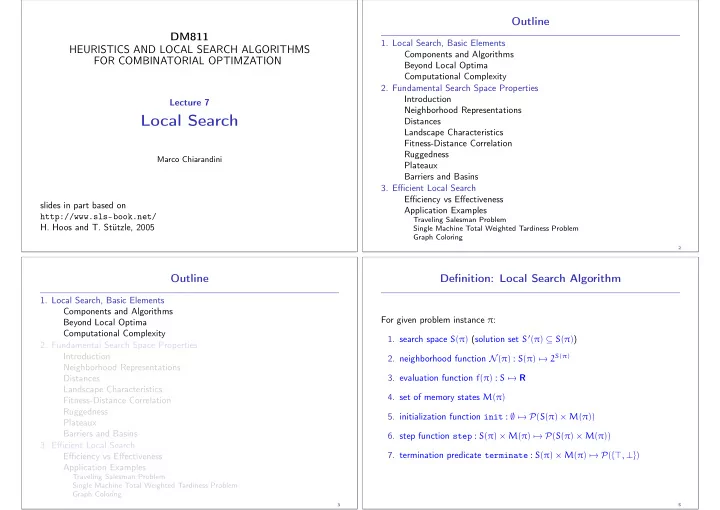
Outline DM811 1. Local Search, Basic Elements HEURISTICS AND LOCAL SEARCH ALGORITHMS Components and Algorithms FOR COMBINATORIAL OPTIMZATION Beyond Local Optima Computational Complexity 2. Fundamental Search Space Properties Introduction


slide-1
SLIDE 1

DM811 HEURISTICS AND LOCAL SEARCH ALGORITHMS FOR COMBINATORIAL OPTIMZATION

Lecture 7

Local Search

Marco Chiarandini

slides in part based on http://www.sls-book.net/

  • H. Hoos and T. Stützle, 2005

Outline

  • 1. Local Search, Basic Elements

Components and Algorithms Beyond Local Optima Computational Complexity

  • 2. Fundamental Search Space Properties

Introduction Neighborhood Representations Distances Landscape Characteristics Fitness-Distance Correlation Ruggedness Plateaux Barriers and Basins

  • 3. Efficient Local Search

Efficiency vs Effectiveness Application Examples

Traveling Salesman Problem Single Machine Total Weighted Tardiness Problem Graph Coloring

2

Outline

  • 1. Local Search, Basic Elements

Components and Algorithms Beyond Local Optima Computational Complexity

  • 2. Fundamental Search Space Properties

Introduction Neighborhood Representations Distances Landscape Characteristics Fitness-Distance Correlation Ruggedness Plateaux Barriers and Basins

  • 3. Efficient Local Search

Efficiency vs Effectiveness Application Examples

Traveling Salesman Problem Single Machine Total Weighted Tardiness Problem Graph Coloring

3

Definition: Local Search Algorithm

For given problem instance π:

  • 1. search space S(π) (solution set S′(π) ⊆ S(π))
  • 2. neighborhood function N(π) : S(π) → 2S(π)
  • 3. evaluation function f(π) : S → R
  • 4. set of memory states M(π)
  • 5. initialization function init : ∅ → P(S(π) × M(π))
  • 6. step function step : S(π) × M(π) → P(S(π) × M(π))
  • 7. termination predicate terminate : S(π) × M(π) → P({⊤, ⊥})

5

slide-2
SLIDE 2

Example: Uninformed random walk for SAT (1)

◮ search space S: set of all truth assignments to variables

in given formula F (solution set S′: set of all models of F)

◮ neighborhood function N: 1-flip neighborhood, i.e., assignments are

neighbors under N iff they differ in the truth value of exactly one variable

◮ evaluation function not used, or f(s) = 0 if model f(s) = 1 otherwise ◮ memory: not used, i.e., M := {0}

6

Example: Uninformed random walk for SAT (continued)

◮ initialization: uniform random choice from S, i.e.,

init(, {a′, m}) := 1/|S| for all assignments a′ and memory states m

◮ step function: uniform random choice from current neighborhood, i.e.,

step({a, m}, {a′, m}) := 1/|N(a)| for all assignments a and memory states m, where N(a) := {a′ ∈ S | N(a, a′)} is the set of all neighbors of a.

◮ termination: when model is found, i.e.,

terminate({a, m}, {⊤}) := 1 if a is a model of F, and 0 otherwise.

7

Definition: LS Algorithm Components (continued) Search Space

Defined by the solution representation:

◮ permutations

◮ linear (scheduling) ◮ circular (TSP)

◮ arrays (assignment problems: GCP) ◮ sets or lists (partition problems: Knapsack)

8

Definition: LS Algorithm Components (continued) Neighborhood function N(π) : S(π) → 2S(π)

Also defined as: N : S × S → {T, F} or N ⊆ S × S

◮ neighborhood (set) of candidate solution s: N(s) := {s′ ∈ S | N(s, s′)} ◮ neighborhood size is |N(s)| ◮ neighborhood is symmetric if: s′ ∈ N(s) ⇒ s ∈ N(s′) ◮ neighborhood graph of (S, N, π) is a directed vertex-weighted graph:

GN (π) := (V, A) with V = S(π) and (uv) ∈ A ⇔ v ∈ N(u) (if symmetric neighborhood ⇒ undirected graph) Note on notation: N when set, N when collection of sets or function

9

slide-3
SLIDE 3

A neighborhood function is also defined by means of an operator. An operator ∆ is a collection of operator functions δ : S → S such that s′ ∈ N(s) ⇐ ⇒ ∃ δ ∈ ∆, δ(s) = s′

Definition

k-exchange neighborhood: candidate solutions s, s′ are neighbors iff s differs from s′ in at most k solution components

Examples:

◮ 1-exchange (flip) neighborhood for SAT

(solution components = single variable assignments)

◮ 2-exchange neighborhood for TSP

(solution components = edges in given graph)

10

Definition: LS Algorithm Components (continued) Note:

◮ Local search implements a walk through the neighborhood graph ◮ Procedural versions of init, step and terminate implement sampling

from respective probability distributions.

◮ Memory state m can consist of multiple independent attributes, i.e.,

M(π) := M1 × M2 × . . . × Ml(π).

◮ Local search algorithms are Markov processes:

behavior in any search state {s, m} depends only

  • n current position s and (limited) memory m.

11

Definition: LS Algorithm Components (continued)

Search step (or move): pair of search positions s, s′ for which s′ can be reached from s in one step, i.e., N(s, s′) and step({s, m}, {s′, m′}) > 0 for some memory states m, m′ ∈ M.

◮ Search trajectory: finite sequence of search positions < s0, s1, . . . , sk >

such that (si−1, si) is a search step for any i ∈ {1, . . . , k} and the probability of initializing the search at s0 is greater zero, i.e., init({s0, m}) > 0 for some memory state m ∈ M.

◮ Search strategy: specified by init and step function;

to some extent independent of problem instance and

  • ther components of LS algorithm.

◮ random ◮ based on evaluation function ◮ based on memory 12

Uninformed Random Picking

◮ N := S × S ◮ does not use memory and evaluation function ◮ init, step: uniform random choice from S,

i.e., for all s, s′ ∈ S, init(s) := step({s}, {s′}) := 1/|S|

Uninformed Random Walk

◮ does not use memory and evaluation function ◮ init: uniform random choice from S ◮ step: uniform random choice from current neighborhood,

i.e., for all s, s′ ∈ S, step({s}, {s′}) :=

  • 1/|N(s)|

if s′ ∈ N(s)

  • therwise

Note: These uninformed LS strategies are quite ineffective, but play a role in combination with more directed search strategies.

13

slide-4
SLIDE 4

Definition: LS Algorithm Components (continued) Evaluation (or cost) function:

◮ function f(π) : S(π) → R that maps candidate solutions of

a given problem instance π onto real numbers, such that global optima correspond to solutions of π;

◮ used for ranking or assessing neighbors of current

search position to provide guidance to search process.

Evaluation vs objective functions:

◮ Evaluation function: part of LS algorithm. ◮ Objective function: integral part of optimization problem. ◮ Some LS methods use evaluation functions different from given objective

function (e.g., dynamic local search).

14

Iterative Improvement

◮ does not use memory ◮ init: uniform random choice from S ◮ step: uniform random choice from improving neighbors,

i.e., step({s}, {s′}) := 1/|I(s)| if s′ ∈ I(s), and 0 otherwise, where I(s) := {s′ ∈ S | N(s, s′) and f(s′) < f(s)}

◮ terminates when no improving neighbor available

(to be revisited later)

◮ different variants through modifications of step function

(to be revisited later) Note: II is also known as iterative descent or hill-climbing.

15

Example: Iterative Improvement for SAT

◮ search space S: set of all truth assignments to variables

in given formula F (solution set S′: set of all models of F)

◮ neighborhood function N: 1-flip neighborhood

(as in Uninformed Random Walk for SAT)

◮ memory: not used, i.e., M := {0} ◮ initialization: uniform random choice from S, i.e., init(∅, {a′}) := 1/|S|

for all assignments a′

◮ evaluation function: f(a) := number of clauses in F

that are unsatisfied under assignment a (Note: f(a) = 0 iff a is a model of F.)

◮ step function: uniform random choice from improving neighbors, i.e.,

step(a, a′) := 1/#I(a) if s′ ∈ I(a), and 0 otherwise, where I(a) := {a′ | N(a, a′) ∧ f(a′) < f(a)}

◮ termination: when no improving neighbor is available

i.e., terminate(a, ⊤) := 1 if I(a) = ∅, and 0 otherwise.

16

Definition:

◮ Local minimum: search position without improving neighbors w.r.t.

given evaluation function f and neighborhood N, i.e., position s ∈ S such that f(s) ≤ f(s′) for all s′ ∈ N(s).

◮ Strict local minimum: search position s ∈ S such that

f(s) < f(s′) for all s′ ∈ N(s).

◮ Local maxima and strict local maxima: defined analogously.

17

slide-5
SLIDE 5

There might be more than one neighbor that have better cost. Pivoting rule decides which to choose:

◮ Best Improvement (aka gradient descent, steepest descent, greedy

hill-climbing): Choose maximally improving neighbor, i.e., randomly select from I∗(s) := {s′ ∈ N(s) | f(s′) = f∗}, where f∗ := min{f(s′) | s′ ∈ N(s)}. Note: Requires evaluation of all neighbors in each step.

◮ First Improvement: Evaluate neighbors in fixed order,

choose first improving step encountered. Note: Can be much more efficient than Best Improvement; order of evaluation can have significant impact on performance.

18

Example: Iterative Improvement for TSP (2-opt)

procedure TSP-2opt-first(s) input: an initial candidate tour s ∈ S(∈)

  • utput: a local optimum s ∈ S(π)

∆ = 0; do Improvement=FALSE; for i = 1 to n − 2 do if i = 1 then n ′ = n − 1 elsen ′ = n for j = i + 2 to n ′ do ∆ij = d(ci, cj) + d(ci+1, cj+1) − d(ci, ci+1) − d(cj, cj+1) if ∆ij < 0 then UpdateTour(s,i,j); Improvement=TRUE; end end until Improvement==FALSE; end TSP-2opt-first

19

Example: Random order first improvement for the TSP

◮ Given: TSP instance G with vertices v1, v2, . . . , vn. ◮ search space: Hamiltonian cycles in G;

use standard 2-exchange neighborhood

◮ Initialization:

◮ search position := fixed canonical path < v1, v2, . . . , vn, v1 > ◮ P := random permutation of {1, 2, . . . , n}

◮ Search steps: determined using first improvement

w.r.t. f(p) = weight of path p, evaluating neighbors in order of P (does not change throughout search)

◮ Termination: when no improving search step possible

(local minimum)

20

Example: Random order first improvement for SAT

procedure URW-for-SAT(F,maxSteps) input: propositional formula F, integer maxSteps

  • utput: model of F or ∅

choose assignment ϕ of truth values to all variables in F uniformly at random; steps := 0; while not((ϕ satisfies F) and (steps < maxSteps)) do select x uniformly at random from {x′|x′ is a variable in F and changing value of x′ in ϕ decreases the number of unsatisfied clauses}; steps := steps+1; end if ϕ satisfies F then return ϕ else return ∅ end end URW-for-SAT

21

slide-6
SLIDE 6

A note on terminology

Heuristic Methods ≡ Metaheuristics ≡ Local Search Methods ≡ Stochastic Local Search Methods ≡ Hybrid Metaheuristics Method = Algorithm Stochastic Local Search (SLS) algorithms allude to:

◮ Local Search: informed search based on local or incomplete knowledge

as opposed to systematic search

◮ Stochastic: use randomized choices in generating and modifying

candidate solutions. They are introduced whenever it is unknown which deterministic rules are profitable for all the instances of interest.

22

Simple Mechanisms for Escaping from Local Optima

◮ Enlarge the neighborhood ◮ Restart: re-initialize search whenever a local optimum

is encountered. (Often rather ineffective due to cost of initialization.)

◮ Non-improving steps: in local optima, allow selection of

candidate solutions with equal or worse evaluation function value, e.g., using minimally worsening steps. (Can lead to long walks in plateaus, i.e., regions of search positions with identical evaluation function.) Note: None of these mechanisms is guaranteed to always escape effectively from local optima.

24

Diversification vs Intensification

◮ Goal-directed and randomized components of LS strategy need to be

balanced carefully.

◮ Intensification: aims to greedily increase solution quality or probability,

e.g., by exploiting the evaluation function.

◮ Diversification: aim to prevent search stagnation by preventing search

process from getting trapped in confined regions.

Examples:

◮ Iterative Improvement (II): intensification strategy. ◮ Uninformed Random Walk/Picking (URW/P): diversification strategy.

Balanced combination of intensification and diversification mechanisms forms the basis for advanced LS methods.

25

Computational Complexity of Local Search (1)

For a local search algorithm to be effective, search initialization and individual search steps should be efficiently computable. Complexity class PLS: class of problems for which a local search algorithm exists with polynomial time complexity for:

◮ search initialization ◮ any single search step, including computation of

any evaluation function value For any problem in PLS . . .

◮ local optimality can be verified in polynomial time ◮ improving search steps can be computed in polynomial time ◮ but: finding local optima may require super-polynomial time

27

slide-7
SLIDE 7

Computational Complexity of Local Search (2)

PLS-complete: Among the most difficult problems in PLS; if for any of these problems local optima can be found in polynomial time, the same would hold for all problems in PLS.

Some complexity results:

◮ TSP with k-exchange neighborhood with k > 3

is PLS-complete.

◮ TSP with 2- or 3-exchange neighborhood is in PLS, but

PLS-completeness is unknown.

28

Outline

  • 1. Local Search, Basic Elements

Components and Algorithms Beyond Local Optima Computational Complexity

  • 2. Fundamental Search Space Properties

Introduction Neighborhood Representations Distances Landscape Characteristics Fitness-Distance Correlation Ruggedness Plateaux Barriers and Basins

  • 3. Efficient Local Search

Efficiency vs Effectiveness Application Examples

Traveling Salesman Problem Single Machine Total Weighted Tardiness Problem Graph Coloring

29

Learning goals of this section

◮ Review basic theoretical concepts ◮ Learn about techniques and goals of experimental search space analysis. ◮ Develop intuition on which features of local search are adequate to

contrast a specific situation.

31

Definitions

◮ Search space S ◮ Neighborhood function N : S ⊆ 2S ◮ Evaluation function f(π) : S → R ◮ Problem instance π

Definition:

The search landscape L is the vertex-labeled neighborhood graph given by the triplet L = (S(π), N(π), f(π)).

32

slide-8
SLIDE 8

Ideal visualization of metaheuristic principles

◮ Simplified landscape

representation

◮ Tabu Search ◮ Guided Local Search ◮ Iterated Local Search ◮ Evolutionary Alg.

33

Fundamental Search Space Properties

The behavior and performance of an LS algorithm on a given problem instance crucially depends on properties of the respective search space.

Simple properties of search space S:

◮ search space size |S| ◮ reachability: solution j is reachable from solution i if neighborhood

graph has a path from i to j.

◮ strongly connected neighborhood graph ◮ weakly optimally connected neighborhood graph

◮ search space diameter diam(GN )

(= maximal distance between any two candidate solutions) Note: Diameter of GN = worst-case lower bound for number of search steps required for reaching (optimal) solutions. Maximal shortest path between any two vertices in the neighborhood graph.

34

Solution Representations and Neighborhoods

Three different types of solution representations:

◮ Permutation

◮ linear permutation: Single Machine Total Weighted Tardiness Problem ◮ circular permutation: Traveling Salesman Problem

◮ Assignment: Graph Coloring Problem, SAT, CSP ◮ Set, Partition: Knapsack, Max Independent Set

A neighborhood function N : S → S × S is also defined through an operator. An operator ∆ is a collection of operator functions δ : S → S such that s′ ∈ N(s) ⇐ ⇒ ∃δ ∈ ∆ | δ(s) = s′

36

Permutations

Π(n) indicates the set all permutations of the numbers {1, 2, . . . , n} (1, 2 . . . , n) is the identity permutation ι. If π ∈ Π(n) and 1 ≤ i ≤ n then:

◮ πi is the element at position i ◮ posπ(i) is the position of element i

Alternatively, a permutation is a bijective function π(i) = πi the permutation product π · π′ is the composition (π · π′)i = π′(π(i)) For each π there exists a permutation such that π−1 · π = ι ∆N ⊂ Π

37

slide-9
SLIDE 9

Neighborhood Operators for Linear Permutations

Swap operator ∆S = {δi

S|1 ≤ i ≤ n}

δi

S(π1 . . . πiπi+1 . . . πn) = (π1 . . . πi+1πi . . . πn)

Interchange operator ∆X = {δij

X|1 ≤ i < j ≤ n}

δij

X(π) = (π1 . . . πi−1πjπi+1 . . . πj−1πiπj+1 . . . πn)

(≡ set of all transpositions) Insert operator ∆I = {δij

I |1 ≤ i ≤ n, 1 ≤ j ≤ n, j = i}

δij

I (π) =

(π1 . . . πi−1πi+1 . . . πjπiπj+1 . . . πn) i < j (π1 . . . πjπiπj+1 . . . πi−1πi+1 . . . πn) i > j

38

Neighborhood Operators for Circular Permutations

Reversal (2-edge-exchange) ∆R = {δij

R |1 ≤ i < j ≤ n}

δij

R (π) = (π1 . . . πi−1πj . . . πiπj+1 . . . πn)

Block moves (3-edge-exchange) ∆B = {δijk

B |1 ≤ i < j < k ≤ n}

δij

B(π) = (π1 . . . πi−1πj . . . πkπi . . . πj−1πk+1 . . . πn)

Short block move (Or-edge-exchange) ∆SB = {δij

SB|1 ≤ i < j ≤ n}

δij

SB(π) = (π1 . . . πi−1πjπj+1πj+2πi . . . πj−1πj+3 . . . πn)

39

Neighborhood Operators for Assignments

An assignment can be represented as a mapping σ : {X1 . . . Xn} → {v : v ∈ D, |D| = k}: σ = {Xi = vi, Xj = vj, . . .} One-exchange operator ∆1E = {δil

1E|1 ≤ i ≤ n, 1 ≤ l ≤ k}

δil

1E

  • σ) =
  • σ : σ′(Xi) = vl and σ′(Xj) = σ(Xj) ∀j = i
  • Two-exchange operator

∆2E = {δij

2E|1 ≤ i < j ≤ n}

δij

2E

  • σ : σ′(Xi) = σ(Xj), σ′(Xj) = σ(Xi) and σ′(Xl) = σ(Xl) ∀l = i, j
  • 40

Neighborhood Operators for Partitions or Sets

An assignment can be represented as a partition of objects selected and not selected s : {X} → {C, C} (it can also be represented by a bit string) One-addition operator ∆1E = {δv

1E|v ∈ C}

δv

1E

  • s) =
  • s : C′ = C ∪ v and C

′ = C \ v}

One-deletion operator ∆1E = {δv

1E|v ∈ C}

δv

1E

  • s) =
  • s : C′ = C \ v and C

′ = C ∪ v}

Swap operator ∆1E = {δv

1E|v ∈ C, u ∈ C}

δv

1E

  • s) =
  • s : C′ = C ∪ u \ v and C

′ = C ∪ v \ u}

41

slide-10
SLIDE 10

Distances

Set of paths in GN with s, s′ ∈ S: Φ(s, s′) = {(s1, . . . , sh)|s1 = s, sh = s′ ∀i : 1 ≤ i ≤ h − 1, si, si+1 ∈ EN} If φ = (s1, . . . , sh) ∈ Φ(s, s′) let |φ| = h be the length of the path; then the distance between any two solutions s, s′ is the length of shortest path between s and s′ in GN : dN (s, s′) = min

φ∈Φ(s,s ′) |Φ|

diam(GN ) = max{dN (s, s′) | s, s′ ∈ S} Note: with permutations it is easy to see that: dN (π, π′) = dN (π−1 · π′, ι)

43

Distances for Linear Permutation Representations

◮ Swap neighborhood operator

computable in O(n2) by the precedence based distance metric: dS(π, π′) = #{i, j|1 ≤ i < j ≤ n, posπ ′(πj) < posπ ′(πi)}. diam(GN ) = n(n − 1)/2

◮ Interchange neighborhood operator

Computable in O(n) + O(n) since dX(π, π′) = dX(π−1 · π′, ι) = n − c(π−1 · π′) where c(π) is the number of disjoint cycles that decompose a permutation. diam(GNX) = n − 1

◮ Insert neighborhood operator

Computable in O(n) + O(n log(n)) since dI(π, π′) = dI(π−1 · π′, ι) = n − |lis(π−1 · π′)| where lis(π) denotes the length of the longest increasing subsequence. diam(GNI) = n − 1

44

Distances for Circular Permutation Representations

◮ Reversal neighborhood operator

sorting by reversal is known to be NP-hard surrogate in TSP: bond distance

◮ Block moves neighborhood operator

unknown whether it is NP-hard but there does not exist a proved polynomial-time algorithm

45

Distances for Assignment Representations

◮ Hamming Distance ◮ An assignment can be seen as a partition of n in k mutually exclusive

non-empty subsets One-exchange neighborhood operator The partition-distance d1E(P, P ′) between two partitions P and P ′ is the minimum number of elements that must be moved between subsets in P so that the resulting partition equals P ′. The partition-distance can be computed in polynomial time by solving an assignment problem. Given the assignment matrix M where in each cell (i, j) it is |Si ∩ S′

j| with Si ∈ P and S′ j ∈ P ′ and defined A(P, P ′)

the assignment of maximal sum then it is d1E(P, P ′) = n − A(P, P ′)

46

slide-11
SLIDE 11

Example: Search space size and diameter for the TSP

◮ Search space size = (n − 1)!/2 ◮ Insert neighborhood

size = (n − 3)n diameter = n − 2

◮ 2-exchange neighborhood

size = n

2

  • = n · (n − 1)/2

diameter in [n/2, n − 2]

◮ 3-exchange neighborhood

size = n

3

  • = n · (n − 1) · (n − 2)/6

diameter in [n/3, n − 1]

47

Example: Search space size and diameter for SAT

SAT instance with n variables, 1-flip neighborhood: GN = n-dimensional hypercube; diameter of GN = n.

48

Let N1 and N2 be two different neighborhood functions for the same instance (S, f, π) of a combinatorial optimization problem. If for all solutions s ∈ S we have N1(s) ⊆ N2(s′) then we say that N2 dominates N1

Example:

In TSP, 1-insert is domnated by 3-exchange. (1-insert corresponds to 3-exchange and there are 3-exchnages that are not 1-insert)

49

Other Search Space Properties

◮ number of (optimal) solutions |S′|, solution density |S′|/|S| ◮ distribution of solutions within the neighborhood graph

Solution densities and distributions can generally be determined by:

◮ exhaustive enumeration; ◮ sampling methods; ◮ counting algorithms (often variants of complete algorithms).

51

slide-12
SLIDE 12

Example: Correlation between solution density and search cost for GWSAT over set of hard Random-3-SAT instances:

106 105 104 103 102 20 22 24 26 28 30 32

  • log10(solution density)

search cost [mean # steps]

52

Phase Transition for 3-SAT

Random instances ⇒ m clauses of n uniformly chosen variables

0.2 0.4 0.6 0.8 1 3 3.5 4 4.5 5 5.5 6

#cl/#var P(sat), P(unsat)

−4 −3 −2 −1 1

P(sat) P(unsat) kcnfs mean sc (all)

log mean search cost [CPU sec]

0.2 0.4 0.6 0.8

1

3 3.5 4 4.5 5 5.5 6

#cl/#var P(sat), P(unsat)

−4 −3 −2 −1 1

kcnfs mean sc (unsat) kcnfs mean sc (all) nov+ mean sc (sat) P(sat) P(unsat)

log mean search cost [CPU sec]

53

Classification of search positions

SLMIN SLOPE LEDGE LMAX SLMAX LMIN IPLAT

position type > = < SLMIN (strict local min) + – – LMIN (local min) + + – IPLAT (interior plateau) – + – SLOPE + – + LEDGE + + + LMAX (local max) – + + SLMAX (strict local max) – – + “+” = present, “–” absent; table entries refer to neighbors with larger (“>”) , equal (“=”), and smaller (“<”) evaluation function values

54

Example: Complete distribution of position types for hard Random-3-SAT instances

instance avg sc SLMIN LMIN IPLAT uf20-91/easy 13.05 0% 0.11% 0% uf20-91/medium 83.25 < 0.01% 0.13% 0% uf20-91/hard 563.94 < 0.01% 0.16% 0% instance SLOPE LEDGE LMAX SLMAX uf20-91/easy 0.59% 99.27% 0.04% < 0.01% uf20-91/medium 0.31% 99.40% 0.06% < 0.01% uf20-91/hard 0.56% 99.23% 0.05% < 0.01%

(based on exhaustive enumeration of search space; sc refers to search cost for GWSAT)

55

slide-13
SLIDE 13

Example: Sampled distribution of position types for hard Random-3-SAT instances

instance avg sc SLMIN LMIN IPLAT uf50-218/medium 615.25 0% 47.29% 0% uf100-430/medium 3 410.45 0% 43.89% 0% uf150-645/medium 10 231.89 0% 41.95% 0% instance SLOPE LEDGE LMAX SLMAX uf50-218/medium < 0.01% 52.71% 0% 0% uf100-430/medium 0% 56.11% 0% 0% uf150-645/medium 0% 58.05% 0% 0%

(based on sampling along GWSAT trajectories; sc refers to search cost for GWSAT)

56

Local Minima

Note: Local minima impede local search progress. Simple properties of local minima:

◮ number of local minima: |lmin|, local minima density |lmin|/|S| ◮ localization of local minima: distribution of local minima within the

neighborhood graph Problem: Determining these measures typically requires exhaustive enumeration of search space. ⇒ Approximation based on sampling or estimation from

  • ther measures (such as autocorrelation measures, see below).

57

Example: Distribution of local minima for the TSP

Goal: Empirical analysis of distribution of local minima for Euclidean TSP instances. Experimental approach:

◮ Sample sets of local optima of three TSPLIB instances using multiple

independent runs of two TSP algorithms (3-opt, ILS).

◮ Measure pairwise distances between local minima (using bond distance

= number of edges in which two given tours differ).

◮ Sample set of purportedly globally optimal tours using multiple

independent runs of high-performance TSP algorithm.

◮ Measure minimal pairwise distances between local minima and respective

closest optimal tour (using bond distance).

58

Empirical results:

Instance avg sq [%] avg dlmin avg dopt Results for 3-opt rat783 3.45 197.8 185.9 pr1002 3.58 242.0 208.6 pcb1173 4.81 274.6 246.0 Results for ILS algorithm rat783 0.92 142.2 123.1 pr1002 0.85 177.2 143.2 pcb1173 1.05 177.4 151.8

(based on local minima collected from 1 000/200 runs of 3-opt/ILS) avg sq [%]: average solution quality expressed in percentage deviation from optimal solution

59

slide-14
SLIDE 14

Interpretation:

◮ Average distance between local minima is small compared to maximal

possible bond distance, n. ⇒ Local minima are concentrated in a relatively small region of the search space.

◮ Average distance between local minima is slightly larger than distance to

closest global optimum. ⇒ Optimal solutions are located centrally in region of high local minima density.

◮ Higher-quality local minima found by ILS tend to be closer to each other

and the closest global optima compared to those determined by 3-opt. ⇒ Higher-quality local minima tend to be concentrated in smaller regions of the search space. Note: These results are fairly typical for many types of TSP instances and instances of other combinatorial problems. In many cases, local optima tend to be clustered; this is reflected in multi-modal distributions of pairwise distances between local minima.

60

Fitness-Distance Correlation (FDC)

Idea: Analyze correlation between solution quality (fitness) g of candidate solutions and distance d to (closest) optimal solution. Measure for FDC: empirical correlation coefficient rfdc. Fitness-distance plots, i.e., scatter plots of the (gi, di) pairs underlying an estimate of rfdc, are often useful to graphically illustrate fitness distance correlations.

◮ The FDC coefficient, rfdc depends on the given neighborhood relation. ◮ rfdc is calculated based on a sample of m candidate solutions (typically:

set of local optima found over multiple runs

  • f an iterative improvement algorithm).

62

Example: FDC plot for TSPLIB instance rat783, based on 2500 local optima obtained from a 3-opt algorithm

2 2.5 3 3.5 4 4.5 5 120 140 160 180 200 220 240

distance to global optimum

2.5 4.5 4 3.5 3 5 5.5 6 6.5 7

percentage deviation from best quality percentage deviation from optimum

46 48 50 52 54 56 58 60

distance to best known solution

63

High FDC (rfdc close to one):

◮ ‘Big valley’ structure of landscape provides guidance for

local search;

◮ search initialization: high-quality candidate solutions provide

good starting points;

◮ search diversification: (weak) perturbation is better than restart; ◮ typical, e.g., for TSP.

Low FDC (rfdc close to zero):

◮ global structure of landscape does not provide guidance for local search; ◮ typical for very hard combinatorial problems, such as certain types of

QAP (Quadratic Assignment Problem) instances.

64

slide-15
SLIDE 15

Applications of fitness-distance analysis:

◮ algorithm design: use of strong intensification (including initialization)

and relatively weak diversification mechanisms;

◮ comparison of effectiveness of neighborhood relations; ◮ analysis of problem and problem instance difficulty.

Limitations and short-comings:

◮ a posteriori method, requires set of (optimal) solutions,

but: results often generalize to larger instance classes;

◮ optimal solutions are often not known, using best known solutions can

lead to erroneous results;

◮ can give misleading results when used as the sole basis for assessing

problem or instance difficulty.

65

Ruggedness

Idea: Rugged search landscapes, i.e., landscapes with high variability in evaluation function value between neighboring search positions, are hard to search.

Example: Smooth vs rugged search landscape

Note: Landscape ruggedness is closely related to local minima density: rugged landscapes tend to have many local minima.

67

The ruggedness of a landscape L can be measured by means of the empirical autocorrelation function r(i): r(i) := 1/(m − i) · m−i

k=1 (gk − ¯

g) · (gk+i − ¯ g) 1/m · m

k=1(gk − ¯

g)2 where g1, . . . gm are evaluation function values sampled along an uninformed random walk in L. Note: r(i) depends on the given neighborhood relation.

◮ Empirical autocorrelation analysis is computationally cheap compared to,

e.g., fitness-distance analysis.

◮ (Bounds on) AC can be theoretically derived in many cases, e.g., the

TSP with the 2-exchange neighborhood.

◮ There are other measures of ruggedness, such as empirical

autocorrelation coefficient and (empirical) correlation length.

68

High AC (close to one):

◮ “smooth” landscape; ◮ evaluation function values for neighboring candidate solutions are close

  • n average;

◮ low local minima density; ◮ problem typically relatively easy for local search.

Low AC (close to zero):

◮ very rugged landscape; ◮ evaluation function values for neighboring candidate solutions are almost

uncorrelated;

◮ high local minima density; ◮ problem typically relatively hard for local search.

69

slide-16
SLIDE 16

Note:

◮ Measures of ruggedness, such as AC, are often insufficient for

distinguishing between the hardness of individual problem instances;

◮ but they can be useful for

◮ analyzing differences between neighborhood relations

for a given problem,

◮ studying the impact of parameter settings of a given

SLS algorithm on its behavior,

◮ classifying the difficulty of combinatorial problems. 70

Plateaux

Plateaux, i.e., ‘flat’ regions in the search landscape Intuition: Plateaux can impede search progress due to lack of guidance by the evaluation function.

P6.2 P6.1 P5 P4.1 P4.2 P3.2 P3.1 P2 P1 P4.3 P4.4

72

Definitions

◮ Region: connected set of search positions. ◮ Border of region R: set of search positions with at least one direct

neighbor outside of R (border positions).

◮ Plateau region: region in which all positions have

the same level, i.e., evaluation function value, l.

◮ Plateau: maximally extended plateau region,

i.e., plateau region in which no border position has any direct neighbors at the plateau level l.

◮ Solution plateau: Plateau that consists entirely of solutions of the

given problem instance.

◮ Exit of plateau region R: direct neighbor s of a border position of R

with lower level than plateau level l.

◮ Open / closed plateau: plateau with / without exits.

73

Measures of plateau structure:

◮ plateau diameter = diameter of corresponding subgraph of GN ◮ plateau width = maximal distance of any plateau position to the

respective closest border position

◮ number of exits, exit density ◮ distribution of exits within a plateau, exit distance distribution

(in particular: avg./max. distance to closest exit)

74

slide-17
SLIDE 17

Some plateau structure results for SAT:

◮ Plateaux typically don’t have an interior, i.e., almost every position is on

the border.

◮ The diameter of plateaux, particularly at higher levels, is comparable to

the diameter of search space. (In particular: plateaux tend to span large parts of the search space, but are quite well connected internally.)

◮ For open plateaux, exits tend to be clustered, but the average exit

distance is typically relatively small.

75

Barriers and Basins Observation:

The difficulty of escaping from closed plateaux or strict local minima is related to the height of the barrier, i.e., the difference in evaluation function, that needs to be overcome in order to reach better search positions: Higher barriers are typically more difficult to overcome (this holds, e.g., for Probabilistic Iterative Improvement

  • r Simulated Annealing).

77

Definitions:

◮ Positions s, s′ are mutually accessible at level l

iff there is a path connecting s′ and s in the neighborhood graph that visits only positions t with g(t) ≤ l.

◮ The barrier level between positions s, s′, bl(s, s′)

is the lowest level l at which s′ and s′ are mutually accessible; the difference between the level of s and bl(s, s′) is called the barrier height between s and s′.

◮ Basins, i.e., maximal (connected) regions of search positions

below a given level, form an important basis for characterizing search space structure.

78

Example: Basins in a simple search landscape and corresponding basin tree

B4 B3 B1 B2 l2 l1 B4 B3 B1 B2

Note: The basin tree only represents basins just below the critical levels at which neighboring basins are joined (by a saddle).

79

slide-18
SLIDE 18

Outline

  • 1. Local Search, Basic Elements

Components and Algorithms Beyond Local Optima Computational Complexity

  • 2. Fundamental Search Space Properties

Introduction Neighborhood Representations Distances Landscape Characteristics Fitness-Distance Correlation Ruggedness Plateaux Barriers and Basins

  • 3. Efficient Local Search

Efficiency vs Effectiveness Application Examples

Traveling Salesman Problem Single Machine Total Weighted Tardiness Problem Graph Coloring

80

Efficiency vs Effectiveness

The performance of local search is determined by:

  • 1. quality of local optima (effectiveness)
  • 2. time to reach local optima (efficiency):
  • A. time to move from one solution to the next
  • B. number of solutions to reach local optima

82

Note:

◮ Local minima depend on g and neighborhood function N. ◮ Larger neighborhoods N induce

◮ neighborhood graphs with smaller diameter; ◮ fewer local minima.

Ideal case: exact neighborhood, i.e., neighborhood function for which any local optimum is also guaranteed to be a global optimum.

◮ Typically, exact neighborhoods are too large to be searched effectively

(exponential in size of problem instance).

◮ But: exceptions exist, e.g., polynomially searchable neighborhood in

Simplex Algorithm for linear programming.

83

Trade-off (to be assessed experimentally):

◮ Using larger neighborhoods

can improve performance of II (and other LS methods).

◮ But: time required for determining improving search steps

increases with neighborhood size.

Speedups Techniques for Efficient Neighborhood Search

1) Incremental updates 2) Neighborhood pruning

84

slide-19
SLIDE 19

Speedups in Neighborhood Examination 1) Incremental updates (aka delta evaluations)

◮ Key idea: calculate effects of differences between

current search position s and neighbors s′ on evaluation function value.

◮ Evaluation function values often consist of

independent contributions of solution components; hence, f(s) can be efficiently calculated from f(s′) by differences between s and s′ in terms of solution components.

◮ Typically crucial for the efficient implementation of

II algorithms (and other LS techniques).

85

Example: Incremental updates for TSP

◮ solution components = edges of given graph G ◮ standard 2-exchange neighborhood, i.e., neighboring

round trips p, p′ differ in two edges

◮ w(p′) := w(p) − edges in p but not in p′

+ edges in p′ but not in p Note: Constant time (4 arithmetic operations), compared to linear time (n arithmetic operations for graph with n vertices) for computing w(p′) from scratch.

86

2) Neighborhood Pruning

◮ Idea: Reduce size of neighborhoods by excluding neighbors that are

likely (or guaranteed) not to yield improvements in f.

◮ Note: Crucial for large neighborhoods, but can be also very useful for

small neighborhoods (e.g., linear in instance size).

Example: Heuristic candidate lists for the TSP

◮ Intuition: High-quality solutions likely include short edges. ◮ Candidate list of vertex v: list of v’s nearest neighbors (limited number),

sorted according to increasing edge weights.

◮ Search steps (e.g., 2-exchange moves) always involve edges to elements

  • f candidate lists.

◮ Significant impact on performance of LS algorithms

for the TSP.

87

Overview

Delta evaluations and neighborhood examinations in:

◮ Permutations

◮ TSP ◮ SMTWTP

◮ Assignments

◮ SAT

◮ Sets

◮ Max Independent Set 89

slide-20
SLIDE 20

Local Search for the Traveling Salesman Problem

◮ k-exchange heuristics

◮ 2-opt ◮ 2.5-opt ◮ Or-opt ◮ 3-opt

◮ complex neighborhoods

◮ Lin-Kernighan ◮ Helsgaun’s Lin-Kernighan ◮ Dynasearch ◮ ejection chains approach

Implementations exploit speed-up techniques

  • 1. neighborhood pruning: fixed radius nearest neighborhood search
  • 2. neighborhood lists: restrict exchanges to most interesting candidates
  • 3. don’t look bits: focus perturbative search to “interesting” part
  • 4. sophisticated data structures

90

TSP data structures

Tour representation:

◮ determine pos of v in π ◮ determine succ and prec ◮ check whether uk is visited between ui and uj ◮ execute a k-exchange (reversal)

Possible choices:

◮ |V| < 1.000 array for π and π−1 ◮ |V| < 1.000.000 two level tree ◮ |V| > 1.000.000 splay tree

Moreover static data structure:

◮ priority lists ◮ k-d trees

91

SMTWTP

◮ Interchange: size

n

2

  • and O(|i − j|) evaluation each

◮ first-improvement: πj, πk

pπj ≤ pπk for improvements, wjTj +wkTk must decrease because jobs in πj, . . . , πk can only increase their tardiness. pπj ≥ pπk possible use of auxiliary data structure to speed up the com- putation

◮ first-improvement: πj, πk

pπj ≤ pπk for improvements, wjTj + wkTk must decrease at least as the best interchange found so far because jobs in πj, . . . , πk can only increase their tardiness. pπj ≥ pπk possible use of auxiliary data structure to speed up the com- putation

◮ Swap: size n − 1 and O(1) evaluation each ◮ Insert: size (n − 1)2 and O(|i − j|) evaluation each

But possible to speed up with systematic examination by means of swaps: an interchange is equivalent to |i − j| swaps hence overall examination takes O(n2)

92

Example: Iterative Improvement for k-col

◮ search space S: set of all k-colorings of G ◮ solution set S′: set of all proper k-coloring of F ◮ neighborhood function N: 1-exchange neighborhood

(as in Uninformed Random Walk)

◮ memory: not used, i.e., M := {0} ◮ initialization: uniform random choice from S, i.e., init{∅, ϕ′} := 1/|S|

for all colorings ϕ′

◮ step function:

◮ evaluation function: g(ϕ) := number of edges in G

whose ending vertices are assigned the same color under assignment ϕ (Note: g(ϕ) = 0 iff ϕ is a proper coloring of G.)

◮ move mechanism: uniform random choice from improving neighbors, i.e.,

step{ϕ, ϕ ′} := 1/|I(ϕ)| if s ′ ∈ I(ϕ), and 0 otherwise, where I(ϕ) := {ϕ ′ | N(ϕ, ϕ ′) ∧ g(ϕ ′) < g(ϕ)}

◮ termination: when no improving neighbor is available

i.e., terminate{ϕ, ⊤} := 1 if I(ϕ) = ∅, and 0 otherwise.

93