London Olympics: Getting ahead of the Game Andy Taylor, Chief - - PDF document

london olympics getting ahead of the game andy taylor
SMART_READER_LITE
LIVE PREVIEW

London Olympics: Getting ahead of the Game Andy Taylor, Chief - - PDF document

The CIWEM Urban Drainage Group, Spring Conference, 2013 London Olympics: Getting ahead of the Game Andy Taylor, Chief Engineer, Atkins (andy.taylor@atkinsglobal.com) Andrew Hagger, Network & Process Modelling Manager, Thames Water


slide-1
SLIDE 1

The CIWEM Urban Drainage Group, Spring Conference, 2013

UDG1_London Olympics, Getting Ahead of the Game-Presentation by A Taylor.docx

1

London Olympics: Getting ahead of the Game Andy Taylor, Chief Engineer, Atkins

(andy.taylor@atkinsglobal.com)

Andrew Hagger, Network & Process Modelling Manager, Thames Water

a.p.hagger@thameswater.co.uk

  • 1. Introduction

As the Official Water Utility Services Provider of London 2012, Thames Water was responsible for the provision of water utility and waste water services at Olympic venues in the Thames Water region. In addition, there was a need to ensure that its water and wastewater assets in the vicinity of the venues, and along key transportation routes in and around London, were performing well to reduce the risk of disruptions from burst mains, flooding or pollution. Atkins was appointed to identify the main wastewater risks, with the aim of developing strategies to mitigate their impact and/or plan contingency measures. A similar study was undertaken by Thames Water on the water distribution network.

  • 2. Strategy

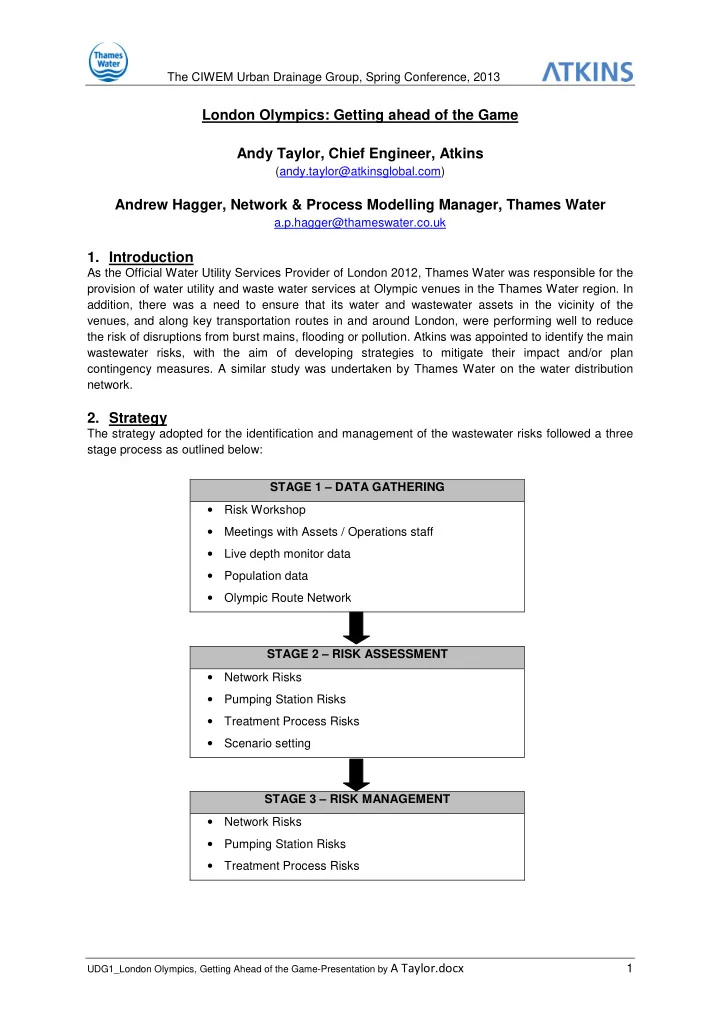
The strategy adopted for the identification and management of the wastewater risks followed a three stage process as outlined below: STAGE 1 – DATA GATHERING

  • Risk Workshop
  • Meetings with Assets / Operations staff
  • Live depth monitor data
  • Population data
  • Olympic Route Network

STAGE 2 – RISK ASSESSMENT

  • Network Risks
  • Pumping Station Risks
  • Treatment Process Risks
  • Scenario setting

STAGE 3 – RISK MANAGEMENT

  • Network Risks
  • Pumping Station Risks
  • Treatment Process Risks
slide-2
SLIDE 2

The CIWEM Urban Drainage Group, Spring Conference, 2013

UDG1_London Olympics, Getting Ahead of the Game-Presentation by A Taylor.docx

2

  • 3. Stage 1 - Data Gathering

Initially a Risk Workshop was held with Thames Water wastewater staff from Asset Management,

Capital Delivery and Operations to understand the potential risks associated from the operation of, and ongoing capital improvements to, the wastewater system. The workshop essentially considered the risks in the following areas:

  • The Olympic Park;
  • Other Venues in the Thames Water region;
  • The River Lea; and
  • Transportation routes in London.

Plans of each area were tabled and any risks, comments or issues discussed and recorded

  • accordingly. The output from the Workshop was a register of major risks, scored against impact and

probability and prioritised on the total risk score in accordance with the Thames Water Asset Management Risk Methodology. The risk register was a ‘live’ document which was updated as improvements or new information became available during the course of the project. Following the Risk Workshop, meetings were held with Thames Water Operations and Asset Management staff to better understand the risks identified, possible solutions and any other issues not discussed at the Workshop. During the meetings risk forms were prepared to document the risks, any planned work and any mitigations or contingencies required to reduce the risk. Population forecast data for the Olympics was obtained from a Government report produced by the Office for National Statistics. Based on the information provided, a 5% increase in population was added to all of the catchments, with the exception of the London Boroughs of Greenwich and Newham which were increased by 10% and 50% respectively. The impact of the increased population

  • n the sewerage system, including 135 pumping stations, and the five key wastewater treatment

works (Deephams, Rye Meads, Beckton, Crossness and Mogden) was then assessed. Thames Water had already been investigating the capabilities of FloodWorks and the possibility of using the package to help manage the wastewater system during the Olympics was considered an excellent opportunity. FloodWorks, would allow the impact of rainfall events to be predicted 6 to 12 hours in advance. This would allow customers to be warned of any impending flooding and/or Thames Water resources to be deployed to manage the impact. Using existing hydraulic models a unified InfoWorks CS model of the London catchment was created for use with Floodworks. To assist with understanding the operation of, and the risks arising from, the wastewater system 130 telemetered depth monitors were deployed in the vicinity of known or predicted high risk problem areas to act as early warning indicators. The roads to be used during the Games to provide safe, reliable transport for athletes and officials were designated as the Olympic Route Network (ORN). In the event of road traffic or other incidents, Alternative Routes were also identified, together with Training Routes for athletes during the Games. The condition and performance of the wastewater assets on and adjacent to these routes were evaluated as part of the data gathering phase. This primarily identified sewers for inspection in the vicinity of flooding hotspots and historic operational problems. With the River Lea flowing through the Olympic Park, wet weather discharges could impact adversely

  • n the aesthetics of the river. In conjunction with LOCOG, Environment Agency, British Waterways

and the London Borough of Newham, Thames Water was part of the Joint Olympic Incident Management Group, which shared information and developed collaborative approaches to the risks identified.

slide-3
SLIDE 3

The CIWEM Urban Drainage Group, Spring Conference, 2013

UDG1_London Olympics, Getting Ahead of the Game-Presentation by A Taylor.docx

3

  • 4. Stage 2 – Risk Assessment

The Risk Assessment phase investigated the risks identified in more detail, as per the examples in the following sections.

  • a. Networks

To ensure that the sewers in the vicinity of Olympic Venues and ORNs were in optimal condition prior to the Games a programme of CCTV and man-entry sewer inspections was undertaken. In total approximately 100 km of sewer was inspected. Where CCTV surveys were abandoned due to silt or debris enabling work was undertaken to facilitate re-inspections. Where access was not possible eg no manhole, restricted access etc. visual inspections were undertaken at manholes upstream and downstream to confirm flows. Each of the surveys undertaken was reviewed and assigned one of three priority grades:

  • Priority 1 – Sewers in need of pre-Games attention
  • Priority 2 – To be discussed with Thames Water
  • Priority 3 – No major work required

In total 47 Priority 1 sewers were identified, requiring immediate attention.

  • b. Pumping Station Risks

In total there are 135 sewage pumping stations in the vicinity of Olympic Venues, ORNs, and the River Lea. Based on discussions with the Area Managers, Asset Integrators and Operations staff 16 pumping stations were ranked as high risk, 18 as medium risk and 91 as low risk by virtue of their criticality, historic performance, proximity to flooding etc. As part of the risk assessment the impact of total failure on all modelled pumping stations and sewage treatment works was assessed using InfoWorks models. Each model was run under DWF conditions to determine the maximum flood volume for 3, 12 and 24 hour failures. For every flooding location an assessment of the total area affected was determined using simple analysis assuming a flood depth of 250mm to allow an estimate of the total number of properties affected. Plans showing the pumping stations affected by the Road Race and Time Trial Cycle events were prepared to allow the impact on operations and maintenance activities to be assessed.

  • c. Treatment Process Risks

The population forecast data received from the Office for National Statistics was used to calculate the additional PE that could be expected at Beckton, Deephams and Crossness STWs. Spreadsheet models of the current STW process were then developed to assess the impact of the population on the capacity and predict the performance of the STWs during the Olympic

  • Games. In addition, it was important to consider the phasing of ongoing capital improvements and

their impact on the final effluent. For the rowing events at Dorney Lake there would be up to 30,000 spectators. All wastewater flows were discharged to Windsor STW via a temporary connection into the existing sewerage

  • system. Process modelling was undertaken to understand the impact of the additional flow.
  • d. Scenario Setting

During the course of the project, a number of ‘what if’ scenarios were raised and considered

  • accordingly. Following the driest 18 months since 1922, a Drought Plan was prepared in March

2012, to evaluate possible consequences such as lower flows leading to increased blockages, greater concentrations of flow and therefore spills, and flash flooding from short summer storms

  • n less permeable ground. On completion of the report in early April, it started to rain again.
slide-4
SLIDE 4

The CIWEM Urban Drainage Group, Spring Conference, 2013

UDG1_London Olympics, Getting Ahead of the Game-Presentation by A Taylor.docx

4

  • 5. Stage 3 - Risk Management

In accordance with the TW Olympic Strategy Document, mitigation schemes were developed for risks with a score of greater than or equal to 12. Where schemes to mitigate the problem were not possible due to time constraints, contingency plans were developed to minimise the impact in the event of a

  • failure. As the Olympics approached, the demand for wastewater updates increased necessitating the

efficient communication of progress through to Thames Water Directors on a weekly basis.

  • a. Network Risks

At 26 high risk flooding and pollution locations where depth monitors were located the data collected was used with the FloodWorks model to set up alarms at each site to warn of high levels, impending flooding or overflow operation. For each site Alarm Response Packs were prepared in conjunction with Network and Process Modelling Group, outlining the actions required in the event of Amber or Red alarms to manage the impact of the incident more effectively. Out of the 47 Priority 1 sewers with structural defects 16 sewers required urgent sewer rehabilitation prior to the Games. In total 15 Cured in Place Pipe linings and one excavation repair were undertaken. For the 31 sewers where sewer rehabilitation was not possible prior to the Games a schedule of the risk, consequence and associated contingency was prepared. To monitor the risk telemetered depth monitors were installed to detect high or stationary flows.

  • b. Pumping Stations

For the 34 medium and high risk pumping stations the actions agreed were compiled into the following four schedules of work:

  • Scheduling of additional visits during the Games
  • Scheduling of site cleaning in advance of the Games
  • Procurement of spare pumps
  • Procurement of generators.

For the pumping stations affected by the road cycle events Field Operations coordinated all issues in relation to deliveries and staff access, based on road closure and crossing point information provided to Thames Water by the Government Olympic Executive (GOE).

  • c. Treatment Process Risks

The forecast increased population increased the PE at the main Sewage Treatment Works in

  • London. At Beckton STW, the 8% increase in PE required the controlling of the mixed liquor levels

to avoid the risk of blanket spills in the Final Settlement Tanks. In addition, it was necessary to provide additional sludge treatment capability at Riverside STW. At Deephams STW, the 2% increase in PE did not require any risk management. To cater for the 4% increase in PE at Crossness STW, it was necessary to ensure that all maintenance on the Final Settlement Tanks and the Activated Sludge Plant were completed prior to the Games. Asset dashboards documenting the status and availability of the process streams at all the Sewage Treatment Works were prepared and updated weekly as part of ‘Business as Usual’.

  • 6. Conclusions

Following extensive planning and risk management, as well as below average rainfall for August 2012, Thames Water was pleased to report that the Olympics passed off without any wastewater incidents, to allow the media to focus its attention on the coverage of the Games. Such was the robustness of the preparatory work, planned daily conference calls during the Games were reduced in

  • frequency. As an additional benefit the Data Gathering, Risk Assessment and Risk Management

undertaken has allowed Thames Water to benefit from a collaborative and integrated approach to urban catchment management that has informed its Drainage Area Planning approach.