Long Baseline Array Chris Phillips | LBA Lead Scientist 5 September - - PowerPoint PPT Presentation

long baseline array
SMART_READER_LITE
LIVE PREVIEW

Long Baseline Array Chris Phillips | LBA Lead Scientist 5 September - - PowerPoint PPT Presentation

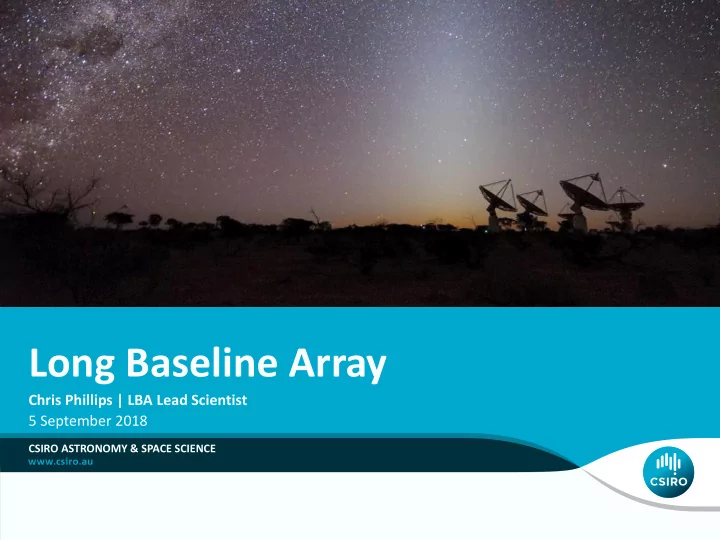
Long Baseline Array Chris Phillips | LBA Lead Scientist 5 September 2018 CSIRO ASTRONOMY & SPACE SCIENCE The Long Baseline Array (LBA) Operated as a National Facility by CSIRO Astronomy & Space Science, in close cooperation with the

slide-1
SLIDE 1

Long Baseline Array

Chris Phillips | LBA Lead Scientist 5 September 2018

CSIRO ASTRONOMY & SPACE SCIENCE

slide-2
SLIDE 2

Operated as a National Facility by CSIRO Astronomy & Space Science, in close cooperation with the University of Tasmania, Hartebeesthoek Radio Observatory and Auckland University of Technology Core elements: ATCA (5x22m), Mopra (22m), Parkes (64m), Ceduna (30m), Hobart (26m) + Tidbinbilla (70m & 34m), Warkworth (12m & 30m), Hartebeesthoek (26m & 15m), ASKAP (12m), AuScope (3x12m), plus ad-hoc arrangements with Korea and China. Typically ~25 days observing each year in ~4 sessions Plus RadioAstron survey and imaging experiments, some EVN/global experiments

The Long Baseline Array (LBA)

slide-3
SLIDE 3

EAVW 2018 | LBA | Phillips

slide-4
SLIDE 4

Baseline lengths in km

Pa At Mp Ho Cd Hh Yg Ke Ak Ww Ti Pa 322 207 1089 1361 9665 3128 2610 3091 2425 274 At 322 114 1396 1508 9847 3266 2493 3202 2409 566 Mp 207 114 1286 1448 9783 3213 2530 3159 2411 458 Ho 1089 1396 1286 1702 9167 3211 3431 3273 2415 832 Cd 1361 1508 1448 1702 8944 1792 1937 1756 3718 1455 Hh 9665 9847 9783 9167 8944 7848 9504 8019 10480 9589 Yg 3128 3266 3213 3211 1792 7848 2360 290 5362 3196 Ke 2610 2493 2530 3431 1937 9504 2360 2102 4752 2849 Ak 3091 3202 3159 3273 1756 8019 290 2102 5360 3184 Ww 2425 2409 2411 2415 3718 10480 5362 4752 5360 2301 Ti 274 566 458 832 1455 9589 3196 2849 3184 2301

slide-5
SLIDE 5

The Long Baseline Array (LBA)

  • Regular observations in 20, 13, 6, 3, 1cm bands

– 1.4-25 GHz – Not all telescopes support all bands

 ATCA, Mopra 7 & 3mm, Tid 7mm  Disk-based recorders (with most data later streamed to the correlator), eVLBI available on subset of the array  LBADR, Mk5b and flexbuf recorders  Max bit-rate 1Gbps  Data correlated on DiFX software correlator at Pawsey supercomputing facility

– Deller et al. 2007, PASP, 119, 318 (DiFX) – Deller et al. 2011, PASP, 123, 275 (DiFX-2)

slide-6
SLIDE 6

Locations & SEFDs (in Jy) of LBA elements

Lat. Long. 20cm 13cm 6cm 3cm 1.5cm 9mm ATCA 5x22m 150 E 30 S 40 40 36 39 106 180 ASKAP 1x12m 117 E 26 S 6000

  • 3500
  • Ceduna

30m 134 E 32 S 1500 400 450 600 2500

  • Hobart 26m

147 E 43 S 450 650 650 560 1800

  • Hart 26m

28 E 26 S 200 210 290 340 1320

  • Mopra 22m

149 E 31 S 340 530 350 430 675 900 Parkes 64m 148 E 33 S 40 30 110 43 810

  • Tid 70m

149 E 35 S 23 16

  • 25

60

  • Tid 34m

149 E 35 S

  • 165
  • 90
  • 180

Warkworth 12m 175 E 37 S 7000 3500

  • 3500
  • Warkworth 30m

175 E 37 S

  • 650

1000

slide-7
SLIDE 7
  • Measuring accurate position, velocity and distance (via parallax) to
  • bjects in our own Galaxy
  • Young massive stars, evolved stars, pulsars, gamma ray sources, black holes
  • Accurately measure the structure and rotation of our own Galaxy

LBA Science in a year

EAVW 2018 | LBA | Phillips – − −

– µ – − – – F – C proper motion and magnetic field me asurements. − − –c

  • –h

slide-8
SLIDE 8
  • Study the jets of Galactic and extra galactic black holes
  • Study molecular disc around Circinus galaxy using water molecules
  • Long term monitoring of radio jets from gamma ray loud AGN
  • Detection of radio emission towards recent gravitational wave

LBA Science in a year (cont)

EAVW 2018 | LBA | Phillips

slide-9
SLIDE 9
  • Improve the international radio reference frame (ICRF)
  • Determine if SMBH candidate is binary source
  • Detect radio emission from 90 Jupiter mass brown dwarf star
  • Systematically compare optical and radio positions of galaxies

LBA Science in a year (cont)

EAVW 2018 | LBA | Phillips

δ −

  • 16–18
  • 2528–253

L71–L75. 3775–3787.

slide-10
SLIDE 10

Current Developments - ASKAP

slide-11
SLIDE 11

Current Developments

  • Parkes “Ultrawideband” receivers
  • 700-4000 MHz Rx installed May 2018
  • 22 K Tsys across band
  • 4 GHz-26 GHz planned, not funded
  • Focus cabin digitizers
  • 12 bit quantization
  • GPU based backend
  • Single backend for all modes
  • Adaptive RFI mitigation
  • Investigation new calibration
  • Pseudo random noise,

picosecond pulse

slide-12
SLIDE 12

Current Status: Pulsar Fold Mode

EAVW 2018 | LBA | Phillips 12 |

Courtesy of W. van Straten

slide-13
SLIDE 13

Current Developments (cont)

  • Parkes cryo-PAF – funding proposal to be submitted
  • 36 beam backend – limited by digital backend
  • 20K Tsys – better than current 13 beam multi-beam
  • ATCA GPU backend planning
  • 8 GHz bandwidth
  • Demonstrated viability at

GPUhackathon

  • ASKAP tied array beam?
  • PAF VLBI already demonstrated
  • User Parkes-ASKAP experiment

in December

slide-14
SLIDE 14

International Collaborations?

  • Investigating formally joining “global” VLBI experiments
  • Single proposal requirement
  • Software correlation and disk base recording make array

interoperability much easier

  • Should be be doing more Asia-LBA observing?
  • Asian telescopes as part of LBA experiments
  • LBA antenna as part of EAVN?
  • Logistics are not trivial:
  • Data transport (firewalls)
  • Backend/receiver compatibility
  • Educate observers on availability
slide-15
SLIDE 15

Thank you

CASS/ATNF Chris Phillips LBA Lead Scientist t +61 2 9372 4808 E Chris.Phillips@csiro.au w www.atnf.csiro.au

CSIRO ASTRONOMY & SPACE SCIENCE

slide-16
SLIDE 16

CODIF

  • CSIRO Oversampled Data

Interchange Format

  • Extension to VDIF
  • Based on VDIF2 proposal

by Alan Whitney

  • Used with CSIRO PAF at Bonn

and Jodrell

  • Added CODIF support to DIFX
  • Used with ASKAP “CRAFT” project

to localize FRBs