SLIDE 1
SLIDE 2
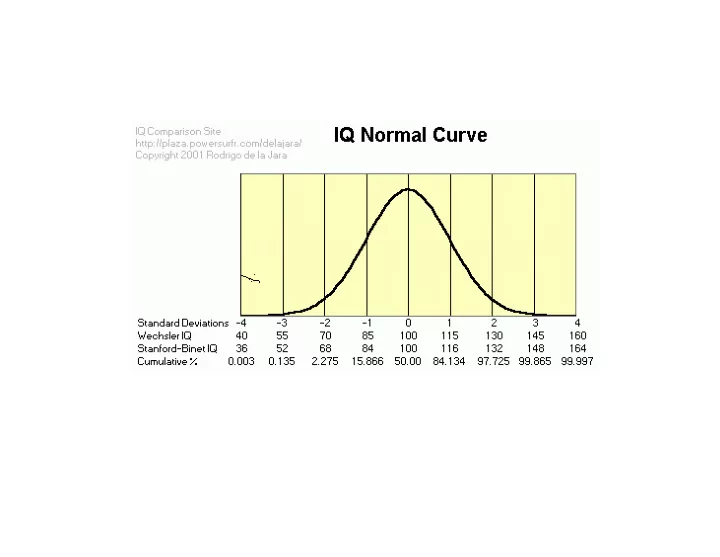
_ X = 100
Distribution of IQ scores Low High How much of this variation is due to genotypic differences among individuals? What is the heritability ?
SLIDE 3 Maze learning in rats: selection for maze “bright” and “dull” strains of rats (R.C. Tryon 1942)
- 1. Used a 17 unit (multiple “T”) maze
- 2. Counted up the number of errors made
across multiple trials in the maze (19 trials)
- 3. Errors were counted as number of entries in
a blind alley
- 4. Rats making the fewest errors were mated
among themselves; rats making the most errors were mated among themselves
SLIDE 4
Number of errors in maze test
SLIDE 5 MB MB MD MD Number of errors in maze test
10
54 190 Generation 0 Generation 4 Generation 8
SLIDE 6 The response to directional selection for maze learning indicates that the heritability
- f maze learning is above zero
What is the mode of inheritance of individual differences in maze learning?
SLIDE 7 MB MD
10
54 190
10
54 190
10
54 190
F1 rats F2 rats
SLIDE 8
Maze learning appears to exhibit typical complex or polygenic inheritance
SLIDE 9
Are the maze “bright” and maze “dull” rats good and bad, respectively, at other tasks? In other words is their “intelligence” general or specific? In three out of five different measures of learning ability, rats of the “dull” strain performed at levels equal to or Superior to rats from the “bright” strain.
SLIDE 10
_ X = 100
Distribution of IQ scores Low High
Mental retardation
SLIDE 11 MENTAL RETARDATION DSM4 (Diagnostic and Statistical Manual for Psychiatric Disorders, American Psychiatric Association)
- 1. Score of 70 or below on a standard IQ (intelligence
quotient) test
- 2. Adaptive functioning: how well the individual meets
age and culture specific standards
- 3. Age of onset before 18
Degrees of severity:
Mild: 55-70 Moderate: 35-55 Severe: 20-35 Profound: below 20
SLIDE 12 Genetic abnormalities and mental retardation
SINGLE GENE DISORDERS:
- 1. Phenylketonuria (PKU) used to be the leading single
cause of mental retardation
- 2. X-linked (GDI1, PAK3,Oligophrenin, FMR2)
- 3. Angelman syndrome
- 4. Fragile-X syndrome
- 5. Duchenne muscular dystrophy
- 6. Picks disease
- 7. Galactosemia
CHROMOSOMAL DISORDERS
- 1. Downs syndrome: trisomy 21
- 2. Turner syndrome: XO
- 3. Klinefelter syndrome: XXY, XXXY
- 4. Triplo X syndrome: XXX
SLIDE 13 Genetic abnormalities and mental retardation
SINGLE GENE DISORDERS:
- 1. Phenylketonuria (PKU) used to be the leading single
cause of mental retardation
- 2. X-linked (GDI1, PAK3,Oligophrenin, FMR2)
- 3. Angelman syndrome
- 4. Fragile-X syndrome
- 5. Duchenne muscular dystrophy
- 6. Picks disease
- 7. Galactosemia
CHROMOSOMAL DISORDERS
- 1. Downs syndrome: trisomy 21
- 2. Turner syndrome: XO
- 3. Klinefelter syndrome: XXY, XXXY
- 4. Triplo X syndrome: XXX
SLIDE 14 Evidence that genetics influences intelligence in man
- 1. Genetic abnormalities: single gene and chromosomal
aberrations are associated with impairments in intelligence
- 2. Normal variation in intelligence:
Similarities between relatives ?
SLIDE 15 Demonstrating a genetic component to behavior
- 1. Family studies: Examine similarities between
family members. The closer the genetic relationship, the more similar family members are predicted to be
- 2. Adoption Studies: Compares biological with adopted
family members. Biologically related individuals are predicted to be more similar than adopted relatives.
- 3. Twin studies: Identical twins compared to fraternal twins.
Identical twins predicted to be more similar
SLIDE 16 0.32 Biological mothers and their children adopted by
0.23 0.42 0.19 0.17 Texas 0.41 0.40 0.09 0.16 Minnesota 2 0.35 0.39 0.23 0.15 Minnesota 1 Mothers Fathers Mothers Fathers
Biological children Adoptive Children Study Parent-child correlations for IQ in three adoption studies
SLIDE 17
Conclusion: Despite variability among studies, biological relatives are more similar than adoptive ones.
SLIDE 18
MZS Monozygotic raised separately MZT Monozygotic raised together DZT Dizygotic raised together 0.74 + 0.07 0.73 0.75 0.69 MZS (34) MZT (37) DZT (38) Dominoes IQ 0.72 + 0.10 0.73 0.92 0.62 MZS (19) MST (50) DZT (50) Otis IQ 0.67 + 0.13 0.69 0.92 0.62 MZS (19) MZT (50) DZT (50) Stanford Binet IQ heritability Intra-pair Correlation Twins Test
SLIDE 20
Phrenology is the study of the structure of the skull to determine a person's character and mental capacity. The Viennese physician Franz-Joseph Gall (1758-1828)was an early phrenologist. Bumps and indentations on the skull, according to Gall, reflect specific areas of the brain that determine a person's emotional and intellectual functions. It remained popular, especially in the United States, throughout the 19th century and was highly praised by Ralph Waldo Emerson, Horace Mann, Thomas Edison, and Alfred Russell Wallace.
SLIDE 21
SLIDE 22
SLIDE 23 Where do we come from? Human origins
- 1. Relationships to other animal groups
- 2. Relationships to other primates
- 3. Early humans and their ancestors: Fossil history
- 4. Temporal and spatial aspects of human ancestors
SLIDE 24
SLIDE 25
SLIDE 26
SLIDE 27
Domain: Eukarya Kingdom: Animalia Phylum: Chordata Class: Mammalia Order: Primates Family: Hominidae Genus: Homo Species: sapiens
SLIDE 28
SLIDE 29
SLIDE 30
Australopithecus afarensis Ethiopia 4-2.9 mya No stone tools Small cranial capacity
SLIDE 31
Australopithecus africanus 3-2.3 mya South Africa No stone tools
SLIDE 32
Australopithecus robustus 2-1 mya Southern Africa No stone tools
SLIDE 33
Australopithecus boisei East Africa 2-1mya No stone tools
SLIDE 34
Homo habilis 2-1mya East Africa Stone tools
SLIDE 35
Homo rudolfensis 2-1mya East Africa Stone tools
SLIDE 36
Homo erectus Widespread Africa, Asia
SLIDE 37
Homo neandertalensis 1856 Neander Valley-Germany: various interpretations such as a race before humans, a pathological specimen of man Now known to be a specialized hominid restricted to Western Europe and Mediterranean, living in rock shelters and caves.
SLIDE 38
Homo sapiens
SLIDE 39
SLIDE 40
Chimpanzee
Teeth Brow Cranial size Sagittal crest
Gorilla
SLIDE 41
SLIDE 42
SLIDE 43
SLIDE 44
SLIDE 45
SLIDE 46
Proposed history for the development of human language
6-7 million years ago Proto-hominids Simple hand gestures. Vocalizations of alarm, emotions, etc. 4-5 million years ago Australopithecine hominids. Advent of bipedalism: appearance of more sophisticated hand signalling 1-2 million years ago Homo habilis and Homo erectus Hand gestures become fully syntactical, vocalizations start to become symbolical, stark increase in brain size 100,000 years ago Homo sapiens uses vocal language, zenith of brain development, hand gestures play secondary role
SLIDE 47
SLIDE 48
SLIDE 49
SLIDE 50
SLIDE 51
SLIDE 52
SLIDE 53
SLIDE 54 chimpanzee
- A. africanus
- H. sapiens
- H. erectus
SLIDE 55