
SLIDE 1
LP09: Lepton Photon Conference
- Hamburg
- 17-22 August 2009
- All talks Plenary (48)
- Quiet meeting
- Pre LHC…. but lots of
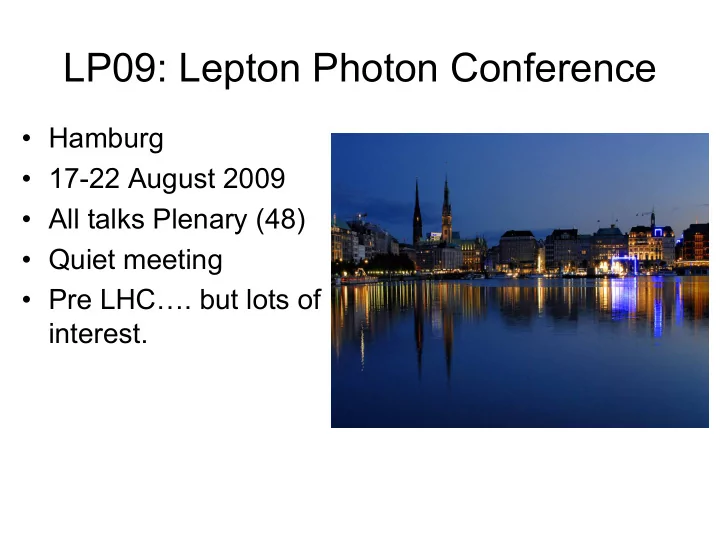
LP09: Lepton Photon Conference Hamburg 17-22 August 2009 All - - PowerPoint PPT Presentation
LP09: Lepton Photon Conference Hamburg 17-22 August 2009 All talks Plenary (48) Quiet meeting Pre LHC. but lots of interest. LP09 programme Proton structure, Alexander Glasov (DESY) First measurement of F_L
end of 2011
Tevatron Main Injector & Recycler Booster p-bar source
presented results up to 2.7 fb-1
9
benefit from:
steeply falling pT spectrum: 1% error in jet energy calibration 5—10% (10—25%) central (forward) x-section
variable: at LO, related to CM scattering angle
enhancements at low
10
small y large y
11
Measurement for dijet masses from 0.25 TeV to >1.1 TeV normalized distribution reduced experimental and theoretical uncertainties
Submitted to Phys. Rev. Lett.
12
γ
pT <400GeV agreement
shape
no PDF sensitivity yet
γ
13
interactions strong constraints: tune/improve phenomenological models
spectra :: angular distributions) many distributions for pQCD tests and for model tuning
need to find missing pieces in theory
:: dijet mass :: dijet angle) first look into physics in the TeV regime strongest constraints on high-x gluon – for some time precision measurements of fundamental observables @2TeV consistent results from CDF and D0
– 1photon counting – QE ~ 25 % – Gain ~ 106 – B field OK (~1.5 T) – Position resolution ~5mm typ (multi-anode) – Fast !
(transit time spread) ~ 50 ps
σt = 6.2 ps measured (w/ electronics) – At #photon ~ 180 (quartz radiator) – 4.7 ps intrinsic – Hamamatsu R3809U-50, φ6μm hole
– X-ray cameras, image intensifiers, etc. – Cerenkov photon detections (e.g. DIRCs)
Channel ~400μm φ~10μm
R3809
– Amplification by
hits APD (~103)
– Typical total gain ~ 4x10⁴
– 144ch HAPD for Belle-II Forward RICH
, 5x5 mm2 cell
counting: good energy resolution – Much better than typical PMT – Thanks to the large 1st stage gain
photon ~8kV phoocathode APD (~200 V across)
3pe 2pe 1pe
→ imaging photon detector
RICH (collaboration with Photonis)
83 mm
Hybrid pixel sensor
0.5x0.5mm2 x 8192 pixels 8 or → 1024 chs
mapping
Glow light
each with quenching resister. Operate them in Geiger mode and gang the
– Quick enough recovery time – Output ∝ number of fired cells
– Standard MOS process – Now produced worldwide
(Moscow/Geneva)
(Moscow)
– They use their own names.
31
νμ
43°
μ (~ ν) trajectory Energy PMT amplitudes
2009 August 20 Lepton Photon 2009 Per Olof Hulth
2009 August 20 Lepton Photon 2009 Per Olof Hulth
32
Mediterranean sea Mediterranean sea ANTARES+NEMO+NESTOR: ANTARES+NEMO+NESTOR: Joint effort for km Joint effort for km3
3
scale scale detector KM3NeT detector KM3NeT
Baikal AMANDA/IceCube
South Pole
Installation: Junct.Box ‐ Dec 2002 Line 1 ‐ March 2006 Line 5‐10 ‐ Dec 2007 Line 11‐12‐ May 2008 900 Optical modules 12 lines 25 storeys / line 3 PMTs / storey
< 40 km 2500 m depth
2009 August 20
33
Lepton Photon 2009 Per Olof Hulth
750 upgoing neutrinos (multi‐line) Unblinding once reprocessed with final alignment
2009 August 20 Lepton Photon 2009 Per Olof Hulth
35
ATIC 2 Flight from McMurdo 2002
Total of 4 flights Total of 4 flights – – 3 successful 3 successful
Goal: measure CR fluxes of electrons, protons, and nuclei to ~ 1 TeV Instrument not optimized for electron detection.
ATIC 1+2
Significance of bump for ATIC1+2 is about 3.8 σ This caused considerable excitement and
speculation.
Recently analyized Flight 4 data shows same “bump”
and significance of ATIC1+2+4 is 5.1σ
Dashed line indicates expected electron spectrum
extrapolated from lower energy ATIC 1+2+4
Preliminary ATIC 1 ATIC 2 ATIC 4 Preliminary
Launched in Spring 2007 Launched in Spring 2007 A High Energy Electron Event A High Energy Electron Event Magnetic Spectrometer measure sign of charge and momentum Magnetic Spectrometer measure sign of charge and momentum Goal: measure Goal: measure e+/e e+/e-
, p/ , He
He/anti
/anti-
He, etc. as well as spectra
, etc. as well as spectra
p
Unexpected! Unexpected!
Positron fraction increases above 10 GeV! Note that Geomagnetic cut-off of primary cosmic rays is O(10 GeV) Data below 10 GeV is dominated by trapped radiation and fluxes are sensitive to Solar Cycle ATIC Electron Spectra & PAMELA e ATIC Electron Spectra & PAMELA e+
+
Fraction caused excitement in 2008! Fraction caused excitement in 2008! More than 200 papers in the last year More than 200 papers in the last year
Local source of electrons – – Astrophysical? Dark Matter? Astrophysical? Dark Matter?
Systems work together to identify and measure the flux of cosmic gamma rays AND (e++e-) with energy 20 MeV > 300 GeV.
Calorimeter Tracker ACD
[surrounds 4x4 array of TKR towers]
1500 electron
events/day above 100 GeV
1 LAT day ~ year for
PAMELA
1 LAT day ~ ATIC
Balloon Flights Large number of events allows Large number of events allows for detailed systematic studies for detailed systematic studies Large number of events Large number of events seen in the LAT seen in the LAT
Lepton Photon 2009
56
quark transition
ud us ub cd cs cb td ts tb
' ' ' d d s V s b b ⎛ ⎞ ⎛ ⎞ ⎜ ⎟ ⎜ ⎟ = ⎜ ⎟ ⎜ ⎟ ⎜ ⎟ ⎜ ⎟ ⎝ ⎠ ⎝ ⎠
Lepton Photon 2009
57
(areas of squares proportional to |Vij |2)
… reflects size of matrix elements
CKM
Lepton Photon 2009
58
Lepton Photon 2009
59
| 0.97424 0.00022 | | 0.2252 0.0009 | | (4.07 0.38) 10 | | 0.231 0.010 | | 1.03 0.04 | | (40.6 1.3) 10
us ud ub cs cd cb
V V V V V V = ± = ± = ± × = ± = ± = ± ×
3
| | (8.1 0.6) 10 | | (38.7 2.3) 10 | | (1.00 0.10) 10
ts td tb
V V V = ± × = ± × = ± ×
ud us ub cd cs cb td ts tb
V V V V V V V V V ⎛ ⎞ ⎜ ⎟ ⎜ ⎟ ⎜ ⎟ ⎝ ⎠
2 2 2 2 2 2 2 2 2 2 2 2
| | | | | | 1 0.0004 0.0007 ( 0.6 ) | | | | | | 1 0.11 0.08 ( 1.3 ) | | | | | | 1 0.00 0.20 ( 0.0 ) | | | | | | 1 0.003 0.005 ( 0.6 ) |
ud us ub cd cs cb td ts tb ud cd td
V V V V V V V V V V V V σ σ σ σ + + − = − ± − + + − = + ± + + + − = + ± + + + − = + ± +
2 2 2 2 2 2
| | | | | 1 0.11 0.08 ( 1.4 ) | | | | | | 1 0.00 0.20 ( 0.0 )
us cs ts ub cb tb
V V V V V V σ σ + + − = + ± + + + − = + ± +
2
From Vcb and Vts
Magnitudes of CKM matrix elements fulfill unitarity well
D*s0 (2317) Ds1 (2460) inconsistent with model predictions Ds1 (2700)→DK in B→DDK, DsJ (2860)→DK in e+e-→DKX
D* helicity angle
Ds1 (2700) DsJ (2860)
Ds
s1 1(2700) and D
(2700) and DsJ
sJ(2860)
(2860) have have natural J natural JP
P=1
=1-
,2+
+,3
,3-
... D DsJ
sJ(3040)
(3040) not seen in not seen in DK DK
unnatural JP
P=0
=0-
,1+
+,2
,2-
...
MeV 35 239 MeV 8 3044 ) 3040 ( MeV 6 3 48 MeV 2 2862 ) 2860 ( MeV 7 149 MeV 2 2710 ) 2700 (
46 42 30 5 5 2 39 52 12 7 1 + − + − + − + − + −
± = Γ ± = ± ± = Γ ± = ± = Γ ± = M D M D M D
sJ sJ s
confirmed in D*K confirmed in D*K new, only in D*K
Fit to M(DK) M(DK) and and M(D*K) M(D*K): :
arXiv: 0908.0806 D Ds2
s2
(2573) (2573) D Ds
s1 1
(2700) (2700) D DsJ
sJ
(2860) (2860) D Ds2
s2
(2573) (2573) D Ds
s1 1
(2700) (2700) D DsJ
sJ
(2860) (2860)
470fb 470fb-
1
M(D M(D0
0K
K+
+)
) M(D M(D+
+K
Ks
s0 0)
)
D Ds
s1 1
(2700) (2700) D DsJ
sJ
(2860) (2860) D Ds
sJ J
( (3040 3040) )
M(D M(D* *+
+K
Ks
s0 0)
) Interpretation: n=2 radial excitations? L=2 orbital excitations? Interpretation: n=2 radial excitations? L=2 orbital excitations?
B B+
+→
→XK XK+
+
N=125 N=125± ±14 14
657M 657M B BB B
M(J/ψπ+π-)
B →KD0D*0
657M B 657M BB B
D*→Dγ D*→D0π0
[ ] ( ) ( ) ( )
5 . 1 . 3875 ) 3872 ( 4 . 6 . 3872 ) 3872 ( 4 . 8 . 3871 19 . 16 . 61 . 3871 3872 07 . 37 . 46 . 3871 3872 6 . 4 . 3871 07 3872 MeV
7 . 5 . * 5 . 4 . * *
± → ± → ± + ± ± → ± ± → ± →
+ − + −
Babar D D X Belle D D X M M CDF J X Belle J X PDG J X Mass Mode
D D
ππ ψ ππ ψ ππ ψ arXiv:0810.0358 arXiv:0809.1224
M(J/ψπ+π-) Preliminary
2.4 fb 2.4 fb-
1
MeV 3 . 2
) 3872 (
< ΓX ( ) ( )
10 ~ * ππ ψ J X Br DD X Br → →
don’t match the peaks in D(*)D(*) x-sections
too large for conventional charmonia
DD1 [→DD*π] decay should dominate but no signal found
D*D* DD*
ψ(4040) ψ(4160) Y(4008) ψ(4415)
Y(4660)
Y(4260) Y(4350)
DD DDπ Λc
+Λc –
PRD77,011103(2008) PRL100,062001(2008) PRL98, 092001 (2007) PRL101, 172001(2008)
e e+
+e
e-
→open charm
γISR
ISR
PRD79,092001(2009)
Y(4660) ? Y(4660) ?
( )
( )
( )
( )
( )
40 / 34 / 1 /
* * *
< < < ψππ ψππ ψππ J Br D D Br J Br D D Br J Br D D Br
( )
( ) ( )
9 / 4260 4260
*
< → → ψππ π J Y Br D D Y Br
0908.0231[hep-ex]
DD*π
Y(4260) ψ(4415)
all known K*→Kπ+ and Z+→ψ(2S)π+ favored by data
PRL100, 142001 (2008) PRD80, 031104 (2009)
Significance: Significance: 6.4 6.4σ σ
MeV MeV M
74 86 53 43 19 15 13 12
107 4433
+ + − − + + − −
= Γ =
M M2
2(
(ψ ψ(2S) (2S)π π+
+)
) M M2
2(K
(Kπ π+
+)
) K*(890) K2 *(1430) Z+(4430) M M2
2(
(ψ ψ(2S) (2S)π π+
+)
) after after K* veto K* veto
657M B 657M BB B
– – ̶̶ – – ̶̶ fit
fit for model for model with K* with K*’ ’s only s only
– – ̶̶ – – ̶̶ fit
fit for model for model with K* with K*’ ’s and Z s and Z
monochromatic line in inclusive γ spectrum
suppression), large multiplicities
s m s E
b
2
2
η
γ
− =
PRL 100, 06200 (2008) Non-peaking Background subtracted
χbJ 19 19K K ± ± 2 2K K (10 (10σ σ) )
b 120M 120M Y Y(3S) (3S)
γISR
Peaking background: Peaking background: Y(nS) Y(nS)→ →χ χbJ
bJγ
γsoft
soft
Y(1S) (1S)γ γhard
hard
e e+
+e
e-
→γ γ
ISR ISR
Y(1S) Y(1S)
arXiv:0903.1124
( )
MeV 7 . 2 9 . 9388
1 . 3 3 . 2 ±
=
+ − b
M η
( )
MeV 8 . 1 9 . 9392
6 . 4 8 . 4 ±
=
+ − b
M η
( ) ( ) ( ) ( )
MeV 60 ~ MeV 1 . 3 9 . 69 1 MeV 1 . 3 4 . 9390 Theory M S Y M M
b b
± = − ± = η η
100M 100M Y Y( (2 2S) S)
χbJ 1 14 4K K ± ± 3.5 3.5K K ( (>3.5 >3.5σ σ) )
b
γISR
Ωb-→J/ψΩ- fully reconstructed, special tracking for long lived particles, production rate wrt Ξb- →J/ψΞ-
( )
σ 4 . 5 8 . 9 . 4 8 . 17 ± ±
( )
MeV 13 10 6165 ± ± = Ωb M ( ) ( ) ( ) ( )
14 . 22 .
32 . 80 .
+ −
± = Ξ → Ξ Ξ → Ω → Ω Ω → ψ ψ J Br b f J Br b f
b b b b
arXiv:0905.3123 PRL101, 232002 (2008)
( )
σ 5 . 5 16 6
4 + −
( ) ( )
ps M
b b
02 . 13 . 1 MeV 9 . 8 . 6 4 . 6054
53 . 40 .
± = Ω ± ± = Ω
+ −
τ
Ω Ωb
b-
mass from CDF and DØ Ø different. different. The same baryon observed? The same baryon observed?
( )
GeV M Theory
b
12 . 6 94 . 5 : < Ω <
( )
ps Theory
b
67 . 1 83 . : < Ω <τ
W, Z ~45% 120 GeV Higgs ~30% 1 TeV Z’ ~18% Ratios of cross-sections at 7/10 and 10/14 TeV for processes induced by gg and qq
J.S tirling J.S tirling
K.Jon-And, Lepton Photon, Hamburg, 17/8/2009 89
90 (all quark/anti-quark subprocesses)
direct photons emerge unaltered from the hard subprocess direct probe of the hard scattering dynamics sensitivity to PDFs (gluon!) …but only if theory works also fragmentation contributions: suppress by isolation criterion
91
investigate source for disagreement measure more differential:
reconstruct full event kinematics
/ yjet
γ
L = 1 fb L = 1 fb-
1
discrepancies in data/theory figure out what is missing…
Unique sensitivity to new physics:
theory @NLO is reliable (±10%) Precision phenomenology
92
xT
In the absence of new physics: jet jet
93
And we have only started:
(Hamamatsu) – Low temperature operation
(- 110 deg C) etc.
current saturation
immersed in Liq Ar, Liq
experiments)
Nothing surprising seen in anti Nothing surprising seen in anti-
proton / proton ratio Anti Anti-
proton abundance consistent with expectations for secondary CR production off the Interstellar Medium production off the Interstellar Medium
– Overall good fit (CKMFitter: global p-value 45%) – ~2σ tension between sin2β and εK / Vub
4.4 4.2
+ −
Lepton Photon 2009
101
CKM angles Other constraints All constraints
0.025 0.027 0.016 0.015
UTFit: 0.154 0.022 CKMFitter: 0.139 0.342 0.014 0.341 ρ ρ η η
+ − + −
= ± = = ± =
+
Lepton Photon 2009
102 Before nucleus- dependent corrections … … and after
'
(1 )(1 )
R NS C
Ft ft δ δ δ ≡ + + −
ud
New Penning-trap measurements of decay energies
ud us ub cd cs cb td ts tb
V V V V V V V V V ⎛ ⎞ ⎜ ⎟ ⎜ ⎟ ⎜ ⎟ ⎝ ⎠
J.Brodzicka @ LP09 103
conventional molecular tetraquark hybrid
π
D D(*)
„Coloured Coloured” ” quarks tightly bound quarks tightly bound by gluon exchange by gluon exchange
Decay: rearrange into rearrange into „ „white white” ” mesons mesons → → dissociation dissociation
Meson and antimeson loosely bound by pion exchange by pion exchange
Mass ≈ ≈ sum of meson masses sum of meson masses
Decay: dissociation into constituent mesons
Lattice QCD QCD: hybrids > : hybrids > 4.2GeV 4.2GeV
Possible exotic J JPC
PC :
: 0 0+
+-
, 1-
+, 2
, 2+
+-
…
Large hadronic transitions (ψ ψππ ππ, , ψω ψω, ,… … ) )
If properties conventional
If empty slot in cc c spectrum spectrum
conventional molecular tetraquark hybrid
minimal quark content: [c minimal quark content: [cc cu ud d] ]
must be exotic!
π
D D(*)