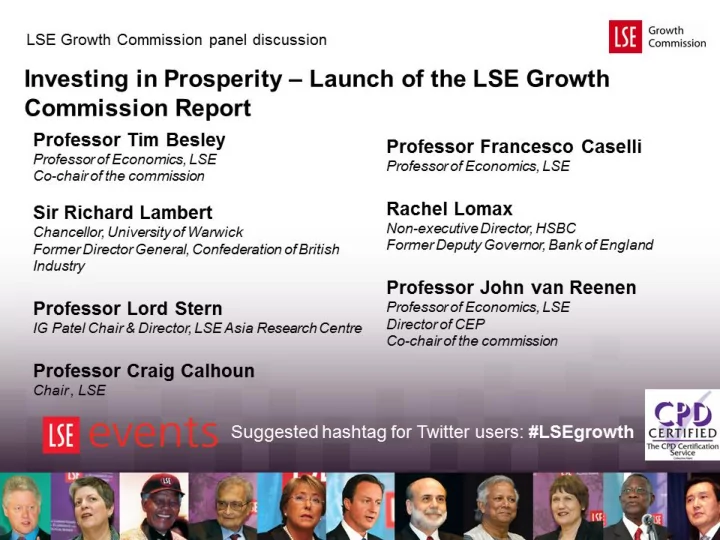
SLIDE 1
SLIDE 2
Twitter Hashtag #lsegc
SLIDE 3
THANKS TO OUR FUNDERS….
SLIDE 4 SET UP (IN JAN 2012)
IN PARTNERSHIP WITH THE INSTITUTE FOR GOVERNMENT
- Co-Chairs Tim Besley & John Van Reenen
- Financed by HEIF 5 and ESRC
- Commissioners:
- Philippe Aghion
- Lord John Browne
- Francesco Caselli
- Sir Richard Lambert
- Rachel Lomax
- Lord Nick Stern
- Nobel Laureate Chris Pissarides
SLIDE 5 WHY AN LSE GROWTH COMMISSION?
- Focus on long-term structural issues beyond debates
about austerity
- Numerous reports on growth
- Focus on evidence (report short but “feeder” reports in
detail on website)
- Commissioner background: academics from UK and
- verseas, but also business & policy-makers
- Political economy: why things have not been fixed
before? What institutions could be built to last?
SLIDE 6 INTRODUCTION & SUMMARY
- Optimistic story, UK has many assets
– Rule of law, flexible labour market, competition, universities, openness – Reversal of relative decline in last 3 decades
– Policy instability – Growth not inclusive: Inequality
- Leads to failure of long-term investment
– Human capital (especially bottom third) – Infrastructure (especially transport & energy) – Private investment & Innovation – Low productivity
- Wanted: A Manifesto for Growth
SLIDE 7 MODUS OPERANDI
- Commissioner Meetings
- Evidence sessions
- Written Evidence
- Background documents
- Report
- Follow on …?
SLIDE 8 INTRODUCTION & SUMMARY
– Improve teaching through freer entry & more exit – Flexible ecology to deepen academy system – Reduce disadvantage by information, inspection
– New institutional architecture of Infrastructure Strategy Board, Infrastructure Planning Commission & Infrastructure Bank
– Increase retail banking competition – Business Bank
SLIDE 9
Human Capital Infrastructure Innovation & investment The Economic Story of the UK Measuring Progress Conclusions
SLIDE 10 USA USA USA USA Ger Ger Ger Ger Fr Fr Fr Fr 20 40 60 80 100 120 140 160 1870 1950 1979 2007 Per cent UK
DECLINE AND REBOUND: RELATIVE GDP PER CAPITA FROM 1870
Source: LSE Growth Commission
SLIDE 11 UK US Ger Fr
20 40 60 80 100 120 140 160 1950 1960 1970 1980 1990 2000 2010 Per cent
UK US Ger Fr
A REVERSAL OF MISFORTUNE, GDP PER CAPITA, 1980=100
Source: LSE Growth Commission
SLIDE 12 0.4 0.5 0.6 0.5 0.6 0.1 0.1 0.5 0.7 0.3 0.8 0.2 0.4
0.0 0.5 1.0 1.5 2.0 2.5 3.0 3.5 1979-1997 1997-2007 Annual average growth rates in percentage points
Financial intermediation Business services and renting of m&eq Distribution services Personal and social services Other goods producing industries Manufacturing excluding electrical Electrical machinery, post and communication Reallocation
PRODUCTIVITY GROWTH (GDP PER HOUR ) : IT WASN’T ALL FINANCE
Source: LSE Growth Commission
SLIDE 13 WHAT WORKED
– Tougher competition through privatization; independent regulators; competition policy – Flexible labour markets through reforms to employment services, benefits & union law – Increases in university education (5% had degree in 1980 compared to 31% in 2011) – Openness to FDI & immigration
- Independent bodies – experts & political resilience
– Competition Commission & OFT – NICE – Bank of England MPC – OBR – MAC, LPC, NPRB, CCC
SLIDE 14 WHAT DIDN’T WORK
- Policy failures (procrastination, reversals)
– Short-term political horizons – Adversarial politics causes tinkering, rebranding, reversals – Lack of independent expert advice & evaluations – Populist pressure
- Outcome is high uncertainty & low investment in long-
term assets
SLIDE 15 Men Women 0.85 0.95 1.05 1.15 1.25 1.35 1979 1984 1989 1994 1999 2004 2009 90-10 Log FT Weekly Wage Differentials
Men Women
THE INEQUALITY CHALLENGE: GROWING WAGE DIFFERENCES
Source: LSE Growth Commission
SLIDE 16
Human Capital by JOHN VAN REENEN Infrastructure Innovation The Economic Story of the UK Measuring Progress Conclusions
SLIDE 17 WHY HUMAN CAPITAL MATTERS
- Strong relationship between skills & growth
– We focus on schooling age 4-18 – Quality not just quantity of schooling matters – Teaching most important input – “Double Dividend” of increasing human capital of disadvantaged: boosts growth & reduces inequality
– Mediocre test scores (e.g. OECD PISA) – “Long tail” of underachievement – Stronger link between disadvantage and low academic achievement than in other countries
17
SLIDE 18
- 1. `FLEXIBLE ECOLOGY’ FOR SCHOOLS
- Make the system work better to spread better teaching
practices – Greater school autonomy – Strengthened accountability (Ofsted Inspection; information; curriculum) – Wider parental choice – Flexibility for good schools to grow
- School-level expansion
- Sponsored academies. Leadership & governance.
Takeover of struggling schools
18
SLIDE 19
- 2. TACKLING DISADVANTAGE
- Current system leads to focus on average (e.g. floor
targets) & not “long tail” of disadvantage – Information on performance across the distribution (e.g. League Tables must show progression of disadvantaged kids) – Ofsted Inspection criteria reflect this information – Revise floor targets (to avoid incentives to target only “marginal” children around threshold) – Expansion of sponsored academies in disadvantaged areas
19
SLIDE 20
- 3. IMPROVING TEACHER QUALITY
- Key finding: hard to predict which teachers will be good
in advance; but can discover after classroom experience
– Expansion of Teach First (top graduates) – Wider intake and more rigorous selection at end – Probation period extension (e.g. 2 to 4 years) – Sharing best practice (e.g. London Challenge)
20
SLIDE 21
- 4. SUPPLEMENTARY PROPOSALS
- Financial support for disadvantaged via pupil premium
(PP) rising £600 to £900, but targeting issue – “PP Plus”: pupils can keep some PP themselves if attendance & performance improvements 14+ (cf. EMA, an evaluation success story)
– Quality too low. Employer control & incentives
– Children’s Centres; Family-Nurse partnerships
21
SLIDE 22 WHY HAVE PROBLEMS PERSISTED?
- Difficulties/complexity in measuring performance
– political and media focus on average
- Changes to give perception of policy change &
differentiation (reflects adversarial political culture)
SLIDE 23 SUMMARY ON HUMAN CAPITAL
- People are key resource: we have failed to unlock talent
- More flexible school model helps spread good practice &
gives incentives to improve – Need to help disadvantaged for growth reasons (not just social justice) – Best way is to improve teaching
- Complementary proposals on financial support, post-
school & pre-school
- Huge potential gain if reforms can raise quality
SLIDE 24
Human Capital Infrastructure by NICK STERN Innovation The Economic Story of the UK Measuring Progress Conclusions
SLIDE 25 INFRASTRUCTURE
– Transport (roads, aviation, rail) – Energy
- Government induced policy risk
– Lack of clear sense of strategy – uncertainty – Vacillation in and politicisation of policies and projects
– Rationale with little economic content – Limited scope to share benefits
- Rigid and misleading public accounting conventions
SLIDE 26 NEW INSTITUTIONAL ARCHITECTURE
- Infrastructure Strategy Board
– Independent expert advice – Accountable to Parliament – Foundation for cross-party consensus
- Infrastructure Planning Commission
– Delivery – planning implications – Share benefits of development – No ministerial veto
– Reduce policy risk to encourage private sector investment – Develop sector-specific skills in new areas – Catalytic/multiplier effects on private investment
SLIDE 27
PROMOTING CONFIDENCE AND TRANSPARENCY
SLIDE 28 OTHER PROPOSALS
- Fiscal targets should recognise assets, not just debt
- Road pricing / RAB model for new national roads
- Housing
- Broadband
“Third runway at Heathrow? Beijing builds an airport with seven”
The Times, 15th January 2013
“Power shortage risks by 2015, Ofgem warns”
BBC News Business, 5th October 2012.
“HS2 cost rises £2bn in 12 months”
Financial Times, 28th January 2013
SLIDE 29
Human Capital Infrastructure Innovation by RICHARD LAMBERT The Economic Story of the UK Measuring Progress
SLIDE 30
- Low investment as a share of GDP
- heavily weighted towards property and buildings
- Weak intangible investment
– Low R&D and patent intensity – Weak commercialisation – Poor management quality
- Financing gaps affecting start-ups and SMEs
- Aggravated by lack of skilled labour and
infrastructure investment
INVESTMENT AND INNOVATION
SLIDE 31
- Short-termism
- Lack of competition in retail banking
- Lack of economies of scale in SME financing
- Excessive reliance on debt
PROBLEMS IN UK CAPITAL MARKETS
SLIDE 32
- Increase competition in retail/SME banking
– Account switching; banking license – Referral to Competition & Markets Authority
- Business Bank to focus on innovative start-ups
– Independent board – Focus on innovation investments – SME securitisation
– Voting linked to length of holding shares – Implement Vickers in spirit & letter – Allowance for Corporate Equity – Industrial Strategy – Management
PROPOSALS
SLIDE 33
Human Capital Infrastructure Innovation The Economic Story of the UK Measuring Progress by FRANCESCO CASELLI Conclusions
SLIDE 34 MEASURING PERFORMANCE
- Important to define criterion for success: growth of what?
- Exclusive focus on GDP not helpful
– Goes up even if most people are left behind – Measures production not income
- Proposed: greater focus on Median Household Income
– Captures what happens in the core of the population – Measures income – Focuses on families
- Recommendation: direct statistical agencies to devote
more effort and resources to providing timely and accurate measures of MHI
SLIDE 35 MEDIAN INCOME AND GDP PER CAPITA
Source: ONS
SLIDE 36
Human Capital Infrastructure Innovation The Economic Story of the UK Measuring Progress Conclusions by RACHEL LOMAX
SLIDE 37
- The problems are well known - why don’t we tackle
them more effectively?
- The fundamental weakness: failure to create a
stable policy framework for long term investment – Short term policy horizons – Adversarial politics – Amplified by 24/7 media – Privately owned infrastructure
POLITICAL ECONOMY OF GROWTH
SLIDE 38
Build institutions that put politics in the right place – Making strategic choices – Setting high level objectives – Holding executive bodies to account supported by – More capability at the centre of government – A bipartisan commitment to evidence based policy Effective action requires sustained cross party commitment: – to tackle the key problems holding back long term growth – to develop the institutions needed to create a stable long term policy framework
OUR APPROACH
SLIDE 39
Twitter Hashtag #lsegc
SLIDE 40 Ger Fr UK USA* Italy 88.0 90.0 92.0 94.0 96.0 98.0 100.0 102.0 104.0 106.0 108.0 110.0 2008Q1 2009Q1 2010Q1 2011Q1 2012Q1 Perc cent Ger Fr UK USA Italy
GDP PER HOUR: THE PRODUCTIVITY PUZZLE (IN US)
SLIDE 41 UK US Ger Fr Jp 5 10 15 20 25 30 35 40 1970 1975 1980 1985 1990 1995 2000 2005 Per cent UK US Ger Fr Jp
INVESTMENT (GFCF) OVER GDP
SLIDE 42 BETTER COGNITIVE SKILLS ASSOCIATED WITH FASTER GROWTH
Source: Hanushek & Woessmann (2012)
SLIDE 43 WHAT WON’T WORK
– Ever smaller state – Ever more de-regulation
– More redistribution (less inequality desirable but not generator of growth) – More regulation e.g. ever higher minimum/Living Wage
- Short-run policies for austerity or stimulus & leave long-
run to look after itself
SLIDE 44
INVESTING FOR PROSPERITY
REPORT OF THE LSE GROWTH COMMISSION
#lsegc
Twitter HashTag #lsegc
SLIDE 45