SLIDE 1
1
LXX Isaiah 53
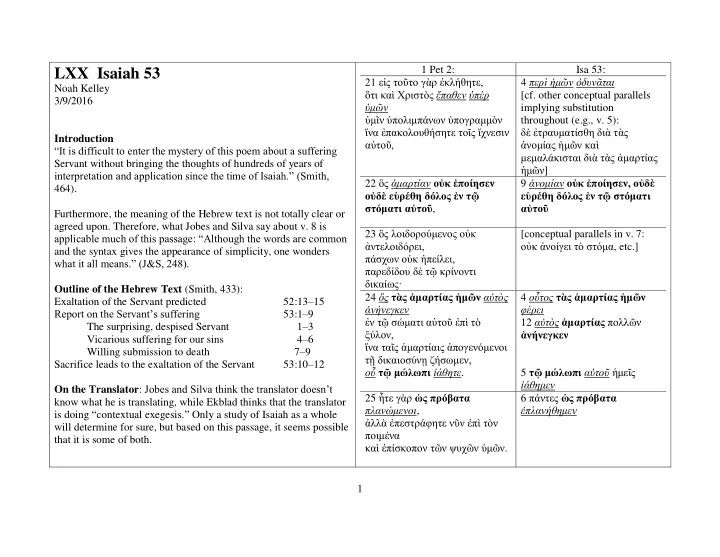
Noah Kelley 3/9/2016 Introduction “It is difficult to enter the mystery of this poem about a suffering Servant without bringing the thoughts of hundreds of years of interpretation and application since the time of Isaiah.” (Smith, 464). Furthermore, the meaning of the Hebrew text is not totally clear or agreed upon. Therefore, what Jobes and Silva say about v. 8 is applicable much of this passage: “Although the words are common and the syntax gives the appearance of simplicity, one wonders what it all means.” (J&S, 248). Outline of the Hebrew Text (Smith, 433): Exaltation of the Servant predicted 52:13–15 Report on the Servant’s suffering 53:1–9 The surprising, despised Servant 1–3 Vicarious suffering for our sins 4–6 Willing submission to death 7–9 Sacrifice leads to the exaltation of the Servant 53:10–12 On the Translator: Jobes and Silva think the translator doesn’t know what he is translating, while Ekblad thinks that the translator is doing “contextual exegesis.” Only a study of Isaiah as a whole will determine for sure, but based on this passage, it seems possible that it is some of both. 1 Pet 2: Isa 53: 21 εἰς τοῦτο γὰρ ἐκλήθητε, ὅτι καὶ Χριστὸς ἔπαθεν ὑπὲρ ὑμῶν ὑμῖν ὑπολιμπάνων ὑπογραμμὸν ἵνα ἐπακολουθήσητε τοῖς ἴχνεσιν αὐτοῦ, 4 περὶ ἡμῶν ὀδυνᾶται [cf. other conceptual parallels implying substitution throughout (e.g., v. 5): δὲ ἐτραυματίσθη διὰ τὰς ἀνομίας ἡμῶν καὶ μεμαλάκισται διὰ τὰς ἁμαρτίας ἡμῶν] 22 ὃς ἁμαρτίαν οὐκ ἐποίησεν οὐδὲ εὑρέθη δόλος ἐν τῷ στόματι αὐτοῦ, 9 ἀνομίαν οὐκ ἐποίησεν, οὐδὲ εὑρέθη δόλος ἐν τῷ στόματι αὐτοῦ 23 ὃς λοιδορούμενος οὐκ ἀντελοιδόρει, πάσχων οὐκ ἠπείλει, παρεδίδου δὲ τῷ κρίνοντι δικαίως· [conceptual parallels in v. 7: οὐκ ἀνοίγει τὸ στόμα, etc.] 24 ὃς τὰς ἁμαρτίας ἡμῶν αὐτὸς ἀνήνεγκεν ἐν τῷ σώματι αὐτοῦ ἐπὶ τὸ ξύλον, ἵνα ταῖς ἁμαρτίαις ἀπογενόμενοι τῇ δικαιοσύνῃ ζήσωμεν, οὗ τῷ μώλωπι ἰάθητε. 4 οὗτος τὰς ἁμαρτίας ἡμῶν φέρει 12 αὐτὸς ἁμαρτίας πολλῶν ἀνήνεγκεν 5 τῷ μώλωπι αὐτοῦ ἡμεῖς ἰάθημεν 25 ἦτε γὰρ ὡς πρόβατα πλανώμενοι, ἀλλὰ ἐπεστράφητε νῦν ἐπὶ τὸν ποιμένα καὶ ἐπίσκοπον τῶν ψυχῶν ὑμῶν. 6 πάντες ὡς πρόβατα ἐπλανήθημεν
SLIDE 2 2 Notes on Heb. text Isa 53:1: BHS Isa 53:1: Göttingen Notes on LXX This verse contains two rhetorical questions emphasizing that the message that the people heard was surprising and difficult to believe, even though the LORD’s saving strength was at work in front of their very eyes. Two possibilities for וֽנֵ֒ תָעֻמֱׁשִל are “our report” and “what we have heard” (Oswalt, 374).
יִִ֦מ ַעוִֺ֦רֱׁזוֽ וֽנֵ֒ תָעֻמֱׁשִל ןיִִ֗מֱאֶה ׃הָתָ־ָלֱׁגִנ יִִ֦מ־לַע הִָ֗והֱׁי
κύριε, τίς ἐπίστευσε τῇ ἀκοῇ ἡμῶν; καὶ ὁ βραχίων κυρίου τίνι ἀπεκαλύφθη;
- 1. Vocab is similar to MT. The one
exception is that LXX has κύριε, making the speech a prayer (Jobes and Silva [J&S], 244).
- 2. The syntax is very similar to the MT,
including similar numbers of lexemes and similar word order. Verb tense, voice, mood, person and number all match.
- 3. J&S note the ambiguity of וֽנֵ֒ תָעֻמֱׁשִל is
resolved with τῇ ἀκοῇ ἡμῶν (p. 244).
- 4. The dative is the object of a verb of
trusting (cf. Wallace, 171–3), and the ל
- prep. can have the same sense (Williams,
108).
- 5. A slight divergence is τίνι for יִִ֦מ־לַע.
However, it means the same thing; interestingly, see variant. Translation: Who has believed
- ur message? And the arm of the
LORD—to whom was it revealed? Translation: Lord, who has believed our message? And the arm of the Lord—to whom was it revealed? NT Use John 12:38: κύριε, τίς ἐπίστευσεν τῇ ἀκοῇ ἡμῶν; καὶ ὁ βραχίων κυρίου τίνι ἀπεκαλύφθη; Rom 10:16: κύριε, τίς ἐπίστευσεν τῇ ἀκοῇ ἡμῶν; Notes: “The two NT quotations of the passage understand it in this way: the people of God who have heard the news and seen the revelation have refused to believe it (John 12:38; Rom. 10:16)” (Oswalt, 381). No variants. Both are word-for-word the same as LXX, including κύριε. Text:
- 1. Interestingly, there is no variant for κύριε in LXX; it is consistent.
- 2. τίνι has a couple variants:
- a. επι is added before it in one MS (88, attributed to θ΄), and apparently this reading is marked by an asterisk in Q (attributes it to
α΄θ΄) and Syh (attributes it to α΄σ΄). Seems to be a harmonization with (proto-)MT.
- b. One ms has τινα (86; accusative instead of dative).
- 3. The original hand of Sinaiticus has απεκαλυφη for ἀπεκαλύφθη. This looks like a misspelling that was corrected by a later hand.
SLIDE 3 3 Notes on Heb. text Isaiah 53:2 (BHS) Isaiah 53:2 (Göttingen) Notes on LXX This passage explains why the message was
“arm of the LORD” was revealed in a manner that appeared weak from a human perspective.
ויָָ֘נָפֱׁל קֵ֝ נוֺיַכ לַעַַּ֩יַו הָָּ֕יִצ ץֶרֶֶ֤א מ ׁ֚שֶרַּ֩ שַכֱׁו רֵָ֒דָה אֶ֤ לֱׁו ִ֗וֺל רַאִ֦ ת־א ל הִֶ֗אֱׁרַמ־אָ־ לֱׁו וֽהִ֦ אֱׁרִנֱׁו ׃וֽהָ־ דֱׁמֱׁחֶנֱׁו
ἀνέτειλε μέν ἐναντίον αὐτοῦ ὡς παιδίον, ὡς ῥίζα ἐν γῇ διψώσῃ, οὐκ ἔστιν εἶδος αὐτῷ οὐδὲ δόξα· καὶ εἴδομεν αὐτόν, καὶ οὐκ εἶχεν εἶδος οὐδὲ κάλλος·
- 1. Translator chose ὡς παιδίον (as a child) forקֵ֝ נוֺיַכ (like a
shoot/infant), which eliminates the possibility of ambiguity, but also seems the less likely translation in light of the parallelism of the plant metaphor (notice the choice of ὡς ῥίζα for ׁ֚שֶרַּ֩ שַכ).
- 2. Note the different syntactical expressions translating the
same Hebrew idiom for possession: οὐκ ἔστιν εἶδος αὐτῷ . . . οὐκ εἶχεν εἶδος.
- 3. Also, there is a change of tense is (ἔστιν is present, vs εἶχεν
which is imperfect).
- 4. The flow is different. I translated וֽהִ֦ אֱׁרִנֱׁו as “that we would
take notice of him,” whereas καὶ εἴδομεν αὐτόν is more simply, “and we saw him,” possibly to contrast with Isa 52:15, where the nations will see in the future (Ekblad, 204).
- 5. κάλλος is found where MT has וֽהָ־ דֱׁמֱׁחֶנֱׁו. J&S (p. 244)
suggest the translator may have read this as הָדֱׁמֶח (“something desirable”). Translation: For he came up like a tender shoot before him, and like a root out of a desert
attractive form, nor majesty that we would take notice of him, and no impressive appearance that we would delight in him. Translation: Indeed, he sprouted up before him like a child, like a root in dry ground, and there is no form to him, nor glory; and we saw him, and he did not have form, neither beauty; Text: Rhalfs has ἀνηγγείλαμεν instead of ἀνέτειλε μέν. See Göttingen preface p. 99. The editors of Göttingen suspect corruption, and demonstrate how ἀναγγέλειν and ἀνατέλλειν are often variants in the MSS of LXX Isaiah (cf. 42:9; 45:8; 43:19; 47:13). On the other hand, Ekblad (p. 199) prefers ἀνηγγείλαμεν because “it is unanimously attested by the uncials, minuscules, and church fathers,” and considers it “contextual exegesis.” He translates this verse, “we announced before him like a little servant” (p. 198). This would be more convincing if it were not for the Göttingen evidence.
SLIDE 4 4 Notes on
Isaiah 53:3 (BHS) Isaiah 53:3 (Göttingen) Notes on LXX: This verse continues the previous verse’s explanation for why the message was not believed.
לֶַ֤דֲחַו ׁ֚הֶזֱׁבִנ שיִִ֦א םיִָּ֕שיִא ַעוֶֽ֤דיִו תוִֺ֗ב אֱׁכַמ רֵּ֥ תֱׁסַמֱׁכוֽ יִלֵ֒ ח וֽנֶָּֽ֕מִמ ׁ֚םיִנָפ אִ֦ לֱׁו הִֶ֗זֱׁבִנ ֱׁבַשֲח׃וֽהָ־ֻנ
ἀλλὰ τὸ εἶδος αὐτοῦ ἄτιμον ἐκλεῖπον παρὰ πάντας ἀνθρώπους, ἄνθρωπος ἐν πληγῇ ὢν καὶ εἰδὼς φέρειν μαλακίαν, ὅτι ἀπέστραπται τὸ πρόσωπον αὐτοῦ, ἠτιμάσθη καὶ οὐκ ἐλογίσθη.
- 1. The addition of ἀλλὰ τὸ εἶδος αὐτοῦ seems to be explanatory (answering the
question, “what was despised?”). It changes the referent of the first clause but does not drastically change the whole.
- 2. Interestingly, the word ׁ֚הֶזֱׁבִנ (despised) is translated as an adjective (ἄτιμον)
and a verb (ἠτιμάσθη). This appears to be stylistic variation.
- 3. Addition of prepositions: the construct relationship םיִָּ֕שיִא לֶַ֤דֲחַו is expressed
by ἐκλεῖπον παρὰ πάντας ἀνθρώπους which clarifies and interprets the vague meaning of the construct relationship. The use of ἄνθρωπος ἐν πληγῇ for שיִִ֦א תוִֺ֗ב אֱׁכַמ is not exactly parallel in syntax, but intelligible.
- 4. Vocabulary: the addition of πάντας clarifies the contrast that the translator
sees in םיִָּ֕שיִא לֶַ֤דֲחַו. Ekblad points out that תוִֺ֗ב אֱׁכַמ is rare in MT, and that elsewhere, πληγή translates הָכַמ (p. 207).
- 5. The passive ptcp. יִלֵ֒ ח ַעוֶֽ֤דיִו is changed to an active with a more interpretive
gloss: εἰδὼς φέρειν μαλακίαν. This may also be intending to connect this passage with v. 4, where the servant “bears [φέρει] our sins.”
- 6. The interpretive ὅτι ἀπέστραπται τὸ πρόσωπον αὐτοῦ is given for רֵּ֥ תֱׁסַמֱׁכוֽ
וֽנֶָּֽ֕מִמ ׁ֚םיִנָפ, which neglects וֽנֶָּֽ֕מִמ and adds αὐτοῦ. Furthermore. Ekblad suggests that יִכ was read instead of ֱׁכ (p. 209), which would explain the ὅτι.
- 7. Though normally following, here ὅτι precedes the main clause (see Muraoka,
420; cf. Gen 3:14; cf. Ekblad, 211).
- 8. Translator seems to have changed the sense slightly from וֽהָ־ֻנֱׁבַשֲח (1 cp active
+ 3ms) to ἐλογίσθη, which softens the audience’s culpability. Translation: He was despised and rejected by men, a man who suffered and was familiar with affliction, and as
people hid their faces, he was despised and we did not value him. Translation: But his form was dishonored, failing more than all men, because he was an afflicted man and knew how to bear sickness; because his face was turned away, he was dishonored and not valued. Text:
- 1. ἐκλεῖπον is preceded by καί in multiple MSS (other than Alexandrian witnesses, cf. Ekblad, p. 206).
- 2. Instead of πάντας ἀνθρώπους, many MSS read τους υιους των ανθρωπων. J&S suggest this is a later elaboration for the purpose of
imitating a Semitic idiom (p. 245).
- 3. There is an active עַ ד י ֱׁו (Qa, peshitta, Vulgate) or עדיו (Qb) in some MSS for MT’s passive ַעוֶֽ֤דיִו. The LXX has the active εἰδὼς with the
interpretive addition of φέρειν μαλακίαν. Peshitta and Vulgate would follow LXX, but Qab could be evidence for a genuine reading.
SLIDE 5 5 Notes on Heb. text: Isa 53:4 (BHS) Isa 53:4 (Göttingen) Notes on LXX: The Servant bore the afflictions and sufferings of the people, but there seems to be a contrast between what the Servant was doing and what the people thought about his suffering. Perhaps this implies that they thought he was suffering as an
emphatic use of the 3MS pronoun and the waw- disjunctive introducing 1CP pronoun.
אָָּ֕שָנ אוֶֽ֤ה ׁ֚וֽנַּ֩ יָלֳח ןֵּ֥ כָא וֽנֱׁחֶַ֤נֲאַו םֵָ֒לָבֱׁס וֽניִ֗ ב אֱׁכַמוֽ לֱֺא הִ֦ כֻמ ַעוֽ֛גָנ וֽהָֻּ֕נֱׁבַשֲח םיִִ֗ה ׃הָ־ֶנֻֽעֱׁמוֽ
οὗτος τὰς ἁμαρτίας ἡμῶν φέρει καὶ περὶ ἡμῶν ὀδυνᾶται, καὶ ἡμεῖς ἐλογισάμεθα αὐτὸν εἶναι ἐν πόνῳ καὶ ἐν πληγῇ καὶ ἐν κακώσει.
- 1. LXX has a minus for ןֵּ֥ כָא, and has οὗτος for
אוֽה. This could be a way to represent the emphasis of ןֵּ֥ כָא (Ekblad, 211).
- 2. φέρει for אָשָנ: J&S suggest the translator read
this as a participle (p. 246). Ekblad suggests it is actualized for the audience (215). φέρει may have sacrificial overtones as seen by the use in LXX-Lev 5:6–8 (Ekblad, 213). The clustering of terms such as φέρω, περί _____, ἁμαρτίας, and πρόβατον + σφαγή (v. 7) may call up sacrificial imagery.
- 3. Note the use of ἁμαρτίας for יִלֳח. The same
word was translated μαλακίαν above, which may have indicated translator’s desire to connect sin and sickness/affliction (Ekblad, 212).
- 4. The translator seems to omit םֵָ֒לָבֱׁס (Ekblad,
215).
- 5. The translation of םיִִ֗הלֱֺא הִ֦ כֻמ with ἐν πληγῇ
seems to remove God as the cause of suffering (J&S, 246).
- 6. The use of ἐν and the addition of a καί is a
slightly different idiom, but similar in meaning.
- 7. There are lexical ties between LXX Isa 53
and 1:4–6 (ἁμαρτίων, ἄνομοι, πληγή, πόνον, τραῦμα, μώλωψ). Translation: Indeed, he carried our afflictions, and our sufferings – he bore them. But we considered him stricken, struck by God and afflicted. Translation: This one bears
- ur sins and suffers for us, and
we considered him to be in pain and affliction and mistreatment. NT Use Matt 8:17: αὐτὸς τὰς ἀσθενείας ἡμῶν ἔλαβεν καὶ τὰς νόσους ἐβάστασεν. 1 Pet 2:24 (cf. 53:12): ὃς τὰς ἁμαρτίας ἡμῶν αὐτὸς ἀνήνεγκεν Notes: Matthew’s translation is noticeably different. In some ways it is closer to the MT (syntax and vocab). Peter (if he is quoting or alluding here) is closer to LXX, though not the same. There are no substantial variants that are related to LXX. Text:
- 1. A second אוֽה is found after וֽניִ֗ ב אֱׁכַמוֽ in some medieval Heb. MSS, as well as the
Peshitta and Vulgate. There doesn’t seem to be LXX support for this reading.
- 2. There is some support for μαλακιας instead of ἁμαρτίας (Lucianic, possibly
harmonizing with v. 3).
SLIDE 6 6 Notes on Heb. text Isa 53:5 (BHS) Isa 53:5: Göttingen Notes on LXX: Another waw- disjunctive switches the subject back to the Servant, who suffers because of the wrongs of the people, and for the purpose of healing and bringing “well- being” to them (Oswalt, 384). Oswalt notes connections between 53:4–5 and 1:5–6, with the nation being struck (הכנ), afflicted (יִלֳח), and wounded (הָרוֽבַֽח) because of their rebellion (p. 387).
וֽנָּ֕ עָשֱׁפִמ לֶָ֤ל חֱׁמ ׁ֚אוֽהֱׁו רֵַּ֥סוֽמ וֽניֵ֒ ת נוֲֺע מ אִָ֗כֻדֱׁמ ִ֗וֺתָרֻבֲחַבוֽ ויָָּ֕לָע ׁ֚וֽנַּ֩ מוֺלֱׁש ׃וֽנָ־ָל־אָפֱׁרִנ
αὐτὸς δὲ ἐτραυματίσθη διὰ τὰς ἀνομίας ἡμῶν καὶ μεμαλάκισται διὰ τὰς ἁμαρτίας ἡμῶν, παιδεία εἰρήνης ἡμῶν ἐπʼ αὐτόν, τῷ μώλωπι αὐτοῦ ἡμεῖς ἰάθημεν.
- 1. J&S (p. 246) note that μεμαλάκισται (has become
sick) is noticeably more toned down than אִָ֗כֻדֱׁמ (crushed).
- 2. δέ represents well the waw-disjunctive.
- 3. The translation of ןִמ with διά + accusative (2x)
shows that the translator also read ןִמ as causal.
- 4. J&S (p. 246) note the syntactical matching
between ׁ֚וֽנַּ֩ מוֺלֱׁש רֵַּ֥סוֽמ ויָָּ֕לָע and παιδεία εἰρήνης ἡμῶν ἐπʼ αὐτόν. Translation: But he was pierced because of our transgressions, crushed because of our iniquities. The punishment that led to
him, and because he was wounded, we were healed. Translation: But he was wounded because of our lawless deeds, and has become sick because of our sins; the discipline that led to our peace came upon him; by his hurt, we were healed. NT Use 1 Pet 2:24: τῷ μώλωπι ἰάθητε. Notes: This is an explicit quote which appears to have been changed only in verb person to apply it to Peter’s readers. 1 Peter has several related variants that seem to be harmonizations to LXX Isa. (+αὐτοῦ, +-θημεν). Text: There is a question about the vocalization of ללחמ (Barthélemy, 396–7). See also Oswalt, 384, n.2. If it reads לָל חֱׁמ (as the MT), it has the sense of “pierced.” If it reads לָלֻחֱׁמ (as the editors of BHS suggest it be emended), it has the sense of “defiled.” Apparently Aquila translated it with βεβηλωμενος (from βεβηλόω, to “desecrate” [BDAG]) and it seems that Eusebius of Caesarea’s commentary on Isaiah apparently witnesses this reading. However, it seems to be an idiosyncratic reading, and should probably be rejected.
SLIDE 7 7 Notes on the Heb. Text: Isa 53:6: BHS Isa 53:6: Göttingen Notes on the LXX: General: After showing that the Servant suffered for the benefit of the people (v. 5), this verse continues the contrast by showing that while the people had strayed from the LORD, the LORD “laid on him” the people’s wickedness. The verb ַעיִֶ֤גֱׁפִה could mean to meet, strike, or intercede (cf. 53:12), but here the translation “laid
good way to make sense
stem and the ב preposition.
וֽניִָּ֕עָת ןאֶ֤ צַכ ׁ֚וֽנַָּ֩לֻכ שיִִ֦א וֽניִֵ֒נָפ וִֺ֗כֱׁרַדֱׁל תִ֗ א ָּ֕וֺבֽ ַעיִֶ֤גֱׁפִה ׁ֚הָוהיָ־ַו ׃וֽנָ־ָלֻכ ןִ֦וֲֺע
πάντες ὡς πρόβατα ἐπλανήθημεν, ἄνθρωπος τῇ ὁδῷ αὐτοῦ ἐπλανήθη, καὶ κύριος παρέδωκεν αὐτὸν ταῖς ἁμαρτίαις ἡμῶν. The first clause is a close match syntactically and
- lexically. The translator even retains the Semitic
distributive (שיִִ֦א = ἄνθρωπος = “each,” though the Greek verb is made singular to agree in number). πλανάω translates both וֽניִָּ֕עָת and וֽניִֵ֒נָפ (J&S, 247). On the translation of “his own way,” see Isa 55:8–9; 63:3, where people’s ways are contrasted with God’s way (Ekblad, 225). The final clause seems to be slightly different:
- 1. Heb. waw-disjunctive is rendered with καί,
which could be adversative, but it less likely.
- 2. Translator gives παρέδωκεν αὐτὸν for
ָּ֕וֺבֽ ַעיִֶ֤גֱׁפִה. This reads the preposition as marking the object. J&S say that this translation softens the force of the verb. Ekblad (p. 227) says that this makes connections with v. 5, (where the Servant becomes sick b/c of our sins) and v. 12 (where the Servant is delivered over to death).
- 3. He also reads ת א as indicating that the Servant
was handed over “to” or “for” our sins. “To” seems more appropriate in light of the use of παρέδωκεν αὐτὸν (Ekblad, 226). Translation: All of us have wandered away like sheep, and each one has turned to his own way; but the LORD has laid on him the iniquity that belongs to all of us. Translation: All of us have wandered away like sheep, each man has wandered to his
given him over to our sins. NT Use 1 Pet 2:25: ἦτε γὰρ ὡς πρόβατα πλανώμενοι Notes: Peter changes the 1pl. to 2pl. to apply it to his audience, and renders the verb as a periphrastic construction which adds imperfective aspect (possibly indicating that going astray was characteristic of the readers). Text:
- 1. According to MS 86, σ΄ has εκαστος, which eliminates the Semiticism.
- 2. Also, according to Eusebius’ commentary, σ΄ translates: κυριος δε καταντησαι εποιησεν εις αυτον την ανομιαν παντων. This is much
closer to the MT above.
SLIDE 8 8 Notes on Heb. text Isa 53:7: BHS Isa 53:7: Göttingen Notes on LXX: These verses generally give a picture of the Servant’s willing submission to
than protesting and defending himself, the Servant goes silently like a sheep who is passive when shorn or
imperfects here ( ויִפ־חַתֱׁפִי אֶ֤ לֱׁו) may indicate continual action (“was not
indicating that this characterized the Servant as these afflictions were happening to him.
אֶ֤ לֱׁו ֮הֶנֲעַנ אוֶֽ֤הֱׁו שַַּ֩גִנ חַבֶֶ֤טַל ׁ֚הֶשַכ ויִפ־חַתֱׁפִי ָהיִֶ֗זֱׁז ג יִ֦ נֱׁפִל לֵ֖ חָרֱׁכוֽ לָָּ֕בוֽי ָ־ִפ חִַ֗תֱׁפִי אִ֦ לֱׁו הָמֵָ֒לֱאֶנ׃וי
καὶ αὐτὸς διὰ τὸ κεκακῶσθαι οὐκ ἀνοίγει τὸ στόμα, ὡς πρόβατον ἐπὶ σφαγὴν ἤχθη καὶ ὡς ἀμνὸς ἐναντίον τοῦ κείροντος αὐτὸν ἄφωνος οὕτως οὐκ ἀνοίγει τὸ στόμα αὐτοῦ.
- 1. Translator totally omits שַַּ֩גִנ (J&S, 248).
- 2. I agree with J&S (p. 248) that
אוֶֽ֤הֱׁו ֮הֶנֲעַנ is probably concessive; διὰ τὸ κεκακῶσθαι could be causal (J&S) or temporal (Ekblad). Either way this seems an odd rendering for a simple construction.
- 3. Both the imperfect חַתֱׁפִי and the present ἀνοίγει
highlight imperfective aspect. Translation: He was
- ppressed and afflicted, yet
he did not open his mouth. Like a lamb led to the slaughter, and like a sheep silent before her shearers, so he did not open his mouth. Translation: and because he was mistreated, he does not
- pen his mouth; he was led
like a sheep to the slaughter and as a lamb before those who shear it is silent, so he likewise does not open his mouth. NT Use Acts 8:32 (cf. 53:8): ὡς πρόβατον ἐπὶ σφαγὴν ἤχθη καὶ ὡς ἀμνὸς ἐναντίον τοῦ κείραντος αὐτὸν ἄφωνος, οὕτως οὐκ ἀνοίγει τὸ στόμα αὐτοῦ. Notes: Luke uses the LXX word-for-word. There is a variant with quite a bit of support which renders the participle as a present (κείροντος), thus harmonizing it to the LXX. Text:
- 1. Some MSS have αὐτοῦ after the first occurrence of τὸ στόμα.
- 2. Some MSS have κείραντος, which seems to be a harmonization to Acts 8:32.
SLIDE 9 9 Notes on Heb. text Isa 53:8: BHS Isa 53:8: Göttingen Notes on LXX: This is a difficult verse, and the syntax is not always clear. It seems to indicate that in his death, the Servant was either taken away from judgment and
means of them. The rest seems to indicate that it would never occur to those living at his time that it was actually for their sins that he died.
־תֶאֱׁו חָָּ֕קֻל ׁ֚טָפֱׁשִמִמוֽ רֶצֵּ֥ ע מ ׁ֚רַזֱׁגִנ יִֵּ֥כ ַחֵ֒ חוֺשֱׁי יִֶ֤מ וִֺ֗רוֺד עַגִֶֶ֦֦נ יִִ֗מַע עַשִֶ֦פִמ םיִָּ֕יַח ץֶרֶֶ֤א מ ׃וֺמָ־ָל
ἐν τῇ ταπεινώσει ἡ κρίσις αὐτοῦ ἤρθη, τὴν γενεὰν αὐτοῦ τίς διηγήσεται; ὅτι αἴρεται ἀπὸ τῆς γῆς ἡ ζωὴ αὐτοῦ, ἀπὸ τῶν ἀνομιῶν τοῦ λαοῦ μου ἤχθη εἰς θάνατον.
- 1. J&S (p. 248) suggest that the translator
interpreted the first clause as בוטפשמ רצע. Ekblad (p. 231) points out that רֶצ ע is a rare word (only also in Ps 107:39, Prov 30:16), and that the translator may have been looking for something that fit the context.
- 2. Ekblad convincingly argues that the LXX
asks “who will tell his generation” because the servant dies (p. 233).
- 3. םיִיַח may have been read as ויח (“his life,” = ἡ
ζωὴ αὐτοῦ, cf. J&S, 248–9). However, this translation does not change the overall meaning of the passage.
- 4. J&S (p. 249) suggest that עַגִֶֶ֦֦נ was read as a
verb (עַגָנ “touch,” “strike”) and interpreted as “to lead” (= ἤχθη). They suggest that this is not accurate. Ekblad suggests it was confused with גַהָנ (“was led”) which is often translated by ἄγω (p. 236).
- 5. וֺמָ־ָל may have been read as תֶוָמַל, which
resulted in εἰς θάνατον in LXX. This may establish connections with the lamb led to slaughter in v. 7, and τοῦ θανάτου αὐτοῦ in v. 9. Translation: He was taken away by oppression and by judgment, but as for his generation, who would have considered that he was cut off from the land of the living, struck because of the rebellion of my people? Translation: By that humiliation, his judgment was taken away; who will tell his generation? Because his life was taken from the earth, he was led away to death because of the lawless deeds of my people. NT Use Acts 8:33 (cf. 53:7): Ἐν τῇ ταπεινώσει [αὐτοῦ] ἡ κρίσις αὐτοῦ ἤρθη· τὴν γενεὰν αὐτοῦ τίς διηγήσεται; ὅτι αἴρεται ἀπὸ τῆς γῆς ἡ ζωὴ αὐτοῦ. Notes: Luke continues the use of the LXX word-for-word. If αὐτοῦ is original here, the lack of it could be a harmonization with the LXX (Metzger, 315). Text:
- 1. Qa has ומע for ימע (Syp alone agrees). Smith says that this is an emendation to resolve the problem of Isaiah saying that Israel was “my
people” (p. 455). LXX and MT agree against this (as does 1QIsab, according to Ekblad, 235).
- 2. עַגִֶֶ֦֦נ could also be read as ַעגֻנ or ַעגִנ according to Qa and LXX.
SLIDE 10 10 Notes on Heb. text Isa 53:9: BHS Isa 53:9: Göttingen Notes on LXX: The main point of the first half of the verse is that he was associated with wicked men and a rich man death. If there is a contrast between the “wicked” and “rich,” לַַ֛ע should be understood as giving a reason (as with NKJV, NASB), but if the “wicked” and “rich” are associated, לַַ֛ע should be concessive (NIV, NRSV, ESV). The second part clearly has to do with the Servant’s righteousness and blamelessness. The first and last two clauses are semantically contrasted, but the exact relationship of the center is difficult to determine. The plural ויֵָ֒ת מֱׁבֽ is curious.
ׁ֚םיִעָשֱׁר־תֶא ןֵּ֥ תִיַו לַַ֛ע ויֵָ֒ת מֱׁבֽ ריִִ֗שָע־תֶאֱׁו וָֺּ֕רֱׁבִק הִָ֗מֱׁרִמ אִ֦ לֱׁו הָָּ֕שָע סֶָ֤מָח־א ל ׃ויָ־ִפֱׁבֽ
καὶ δώσω τοὺς πονηροὺς ἀντὶ τῆς ταφῆς αὐτοῦ καὶ τοὺς πλουσίους ἀντὶ τοῦ θανάτου αὐτοῦ, ὅτι ἀνομίαν οὐκ ἐποίησεν, οὐδὲ εὑρέθη δόλος ἐν τῷ στόματι αὐτοῦ.
- 1. δώσω is a change from 3ms preterite
imperfect ( ַון תִי) to 1sg. future tense. Possibly the reason for this is that it continues the 1sg. speaker from the previous verse. Theologically, in light of
- ther changes, it also posits the Lord as
speaking against the wicked and rich (Ekblad, 237). “The very grave of the ungodly and the rich (MT) becomes in the LXX a destination the servant will escape because of the Lord’s retributive justice against the wicked and rich” (ibid).
- 2. Translator read ׁ֚םיִעָשֱׁר־תֶא as a direct object
rather than a preposition.
- 3. Where does ἀντὶ come from (2x)? This
also changes the meaning: “emphasizing that the Lord will eventually exercise divine justice, burying the wicked in place
- f the innocent servant” (Ekblad, 238).
- 4. ריִִ֗שָע־תֶאֱׁו is changed to plural, making a
stronger connection with the wicked.
- 5. לַע is understood causally by the translator.
- 6. Ekblad says that ἀνομίαν for סָמָח is
motivated by the desire to indicate the total innocence of the Servant (p. 240). Translation: His grave was appointed with wicked men, but he was with a rich man in his death, because he did no violence, and there was no deceit in his mouth. Translation: And I will give the wicked men in place of his grave, and the rich men in place of his death, because he has not committed lawlessness, neither was deceit found in his mouth. NT Use 1 Pet 2:22: ὃς ἁμαρτίαν οὐκ ἐποίησεν οὐδὲ εὑρέθη δόλος ἐν τῷ στόματι αὐτοῦ, Notes: Peter uses LXX almost word-for-word, but exchanges ἁμαρτίαν for LXX’s ἀνομίαν. There is no variant in Peter. Text:
- 1. For ןֵּ֥ תִיַו Qa has ונתיו. α΄σ΄θ΄ are said to have δωσει, which would be closer to the MT.
- 2. For ויֵָ֒ת מֱׁבֽ Qa has ותמוב (as does Peshitta and Vulgate?).
SLIDE 11 11 Notes on Heb. text Isa 53:10: BHS Isa 53:10: Göttingen Notes on LXX: The waw-disjunctive introduces the LORD as the one who brings the Servant to suffering. The conditional clause expresses that the blessing of God (expressed as descendants and length of days) is based on the Servant’s willingness to make his soul (i.e., life) a guilt offering.
ׁ֚וֺאֱׁכַד ץֵּ֥ פָח הָָ֟והיַו ׁ֚םָשָא םיִֵּ֥שָת־םִא יִָּ֕לֱחָ־ֶה ךֱיִֶ֤רֲאַי עַרִֶֶ֦֗ז הִֶ֦אֱׁרִי וָֺּ֕שֱׁפַנ ִ֦ חֱׁו םיִֵ֒מָי וִֺ֦דָיֱׁבֽ הִָ֗והֱׁי ץֶפ ׃חָ־ָלֱׁצִי
καὶ κύριος βούλεται καθαρίσαι αὐτὸν τῆς πληγῆς, ἐὰν δῶτε περὶ ἁμαρτίας, ἡ ψυχὴ ὑμῶν ὄψεται σπέρμα μακρόβιον, καὶ βούλεται κύριος ἀφελεῖν Ekblad, 240: “The LXX of Isaiah 53:10 is completely different from the MT.” There are a number of what seem like theologically motivated changes here:
- 1. καί for waw-disjunctive does not seem right here. It
eliminates the contrast with the previous material found in MT.
- 2. καθαρίσαι (“cleanse”) for אכד (“crush”) appears to
make the passage say the opposite in LXX. J&S, p. 251: this “is another instance of the translator’s concern to avoid attributing to God the action of mistreating the servant.” Perhaps this was read as הָכָז (“to cleanse”) or the Aramaic parallel ָכֱׁדא (ibid.). See α΄σ΄ below.
- 3. τῆς πληγῆς as a translation for יִָּ֕לֱחָ־ֶה may be
“contextual exegetical linkage” (Ekblad, 243).
- 4. ἐὰν δῶτε περὶ ἁμαρτίας translates ׁ֚םָשָא םיִֵּ֥שָת־םִא as a
- 2pl. Here it is likely 3fs, but 2ms is possible as well.
- 5. How the translator gave ἀφελεῖν (2 aorist of
ἀφαιρέω) for חָ־ָלֱׁצִי is a mystery. Possibly it was read as חַלַשֱׁי (piel of חַלָש “to send”) by the translator (Ekblad, 248). Translation: But the LORD was pleased to crush him; he made him suffer. If his soul will make a guilt offering, he will see his descendants, he will lengthen his days, and the desire of the LORD will prosper in his hand. Translation: And the Lord wants to cleanse him from the
an offering for sin, your soul will see long-lived
Lord wants to take away . . . Text:
- 1. Qa has והללחיו for יִָּ֕לֱחָ־ֶה.
- 2. κύριος — πληγῆς]: α΄ has: κυριος εβουληθη επιτριψαι (or επιστρεψαι) αυτου το αρρωστημα
- 3. κύριος — πληγῆς]: σ΄ has: κυριος ηθελησεν αλοησαι (or ελεησαι) αυτον εν τω τραυματισμω
- 4. וִֺ֦דָיֱׁבֽ has been totally left out by LXX, but notice the variants (especially from οἱ γ΄) that contain some version of it.
SLIDE 12 12 Notes on Heb. Text: Isa 53:11: BHS Isa 53:11: Göttingen Notes on LXX: The Servant will see light (see text note) and be satisfied in the knowledge of what his suffering has accomplished. This righteous Servant will justify/make righteous/get justice for many. In light of the vicarious suffering shown here, justify or make righteous are the better
ָ֘וֺתֱׁעַדֱׁבֽ עָָּ֕בֱֽׁשִי הֶֶ֤אֱׁרִי ׁ֚וֺשֱׁפַנ לֵַּ֥מֲע מ םִָ֗ת נוֲֺעַו םיִֵ֒בַֽרָ־ָל יִִ֗דֱׁבַע קיִ֛דַצ קיִִ֦דֱׁצַי ׃לָ־ בֱֽׁסִי אוִֽ֦ה
ἀπὸ τοῦ πόνου τῆς ψυχῆς αὐτοῦ, δεῖξαι αὐτῷ φῶς καὶ πλάσαι τῇ συνέσει, δικαιῶσαι δίκαιον εὖ δουλεύοντα πολλοῖς, καὶ τὰς ἁμαρτίας αὐτῶν αὐτὸς ἀνοίσει.
- 1. ἀπό is appropriate for ןִמ, but the meaning
is different in this context.
- 2. The LXX has translated the three
imperfects as infinitives (possibly to make them complements of βούλεται in the previous verse; cf. Ekblad, 250).
- 3. הֶאֱׁרִי has been translated as δεῖξαι.
- 4. The translation of עָבֱֽׁשִי as πλάσαι is hard
to explain. Ekblad may be correct to say that עָבֱֽׁשִי points to God’s satisfaction with the suffering of the Servant, which the translator might be trying to distance himself from (p. 252–3). See α΄θ΄σ΄ 5. ֱׁצַיקיִד has been translated as δικαιῶσαι. Instead of the servant justifying the many, God wants to justify the righteous man (Ekblad, 254).
- 6. τῇ συνέσει is possible for
ָ֘וֺתֱׁעַדֱׁבֽ, but the translator seems to have removed the pronominal suffix.
- 7. The last clause is an appropriate
translation. Translation: Because of the misery
- f his soul he will see light, and he
will be satisfied by his knowledge; my righteous servant will justify the many, and he will bear their iniquities. Translation: . . . from the pain of his soul, to show him light, and to form his understanding, to justify the righteous one who serves many well, and he himself will bear their sins. NT Use of “many” Rom 5:19? ὥσπερ γὰρ διὰ τῆς παρακοῆς τοῦ ἑνὸς ἀνθρώπου ἁμαρτωλοὶ κατεστάθησαν οἱ πολλοί, οὕτως καὶ διὰ τῆς ὑπακοῆς τοῦ ἑνὸς δίκαιοι κατασταθήσονται οἱ πολλοί. Mark 8? καὶ γὰρ ὁ υἱὸς τοῦ ἀνθρώπου οὐκ ἦλθεν διακονηθῆναι ἀλλὰ διακονῆσαι καὶ δοῦναι τὴν ψυχὴν αὐτοῦ λύτρον ἀντὶ πολλῶν. Matt 26? τοῦτο γάρ ἐστιν τὸ αἷμά μου τῆς διαθήκης τὸ περὶ πολλῶν ἐκχυννόμενον εἰς ἄφεσιν ἁμαρτιῶν. Are there possible conceptual links between the Suffering Servant’s work for “the many” and these NT passages (cf. also 53:12)? Text:
- 1. Qab has a plus of רוֺא after הֶֶ֤אֱׁרִי. This seems to be supported by 4Qd as well (according to Barthélemy, 404, there is a lacuna after the א
with enough room for רו to follow).
- 2. δεῖξαι] α΄σ΄θ΄ have οψεται
- 3. πλάσαι] α΄θ΄ have: εμπλησθησεται
- 4. πλάσαι] σ΄ has: χορτασθησεται
SLIDE 13 13 Notes on Heb. text Isa 53:12: BHS Isa 53:12: Göttingen Notes on LXX: The servant either receives the many/mighty ones as his portion, or is among the many/mighty (those who are victorious in battle). The latter seems to be better in light of the use of ב and the flow
406, but Smith, 463 takes the opposite view). The reason for this exaltation is his intercessory work (“because” = רֶַּ֩שֲא תַחַָ֘ת,
is summarized as pouring out his life to death, being numbered among transgressors, bearing sin, and making intercession for transgressors.
־תֶאֱׁו םיִָ֘בַֽרָב ֶ֤וֺל־קֶלַחֲא ןָ֟ כָל ִמוֽצֲע רֶַּ֩שֲא תַחַָ֘ת לָלָש קֶ֤ לַחֱׁי ֮םי םיִִ֗עֱׁש פ־תֶאֱׁו וָֺּ֕שֱׁפַנ ׁ֚תֶוַָּ֩מַל הֵָּ֥רֱעֶה אָָּ֕שָנ םיִֶ֤בַֽר־אֱׁט ח ׁ֚אוֽהֱׁו הֵָ֒נֱׁמִנ ס ׃ַעיָ־ִגֱׁפַי םיִִ֗עֱׁש פַלֱׁו
διὰ τοῦτο αὐτὸς κληρονομήσει πολλοὺς καὶ τῶν ἰσχυρῶν μεριεῖ σκῦλα, ἀνθʼ ὧν παρεδόθη εἰς θάνατον ἡ ψυχὴ αὐτοῦ, καὶ ἐν τοῖς ἀνόμοις ἐλογίσθη, καὶ αὐτὸς ἁμαρτίας πολλῶν ἀνήνεγκεν καὶ διὰ τὰς ἁμαρτίας αὐτῶν παρεδόθη.
- 1. Change of person from קֶלַחֲא to
κληρονομήσει.
- 2. ἀνθʼ ὧν is a pretty close match to
רֶַּ֩שֲא תַחַָ֘ת.
- 3. παρεδόθη (2x) translates הֵָּ֥רֱעֶה and
ַעיָ־ִגֱׁפַי. These seem to be significant
- changes. On the former, Ekblad (p.
264) says, “While the MT here emphasizes the servant’s willing participation in pouring himself out to death, the LXX emphasizes that the servant was delivered over (i.e. by the Lord, as in 53:6) to death as a direct consequence of the people’s (and not the servant’s) sins.” On the latter: “In the final line of the LXX there is no hint of the servant interceding for rebels, as in the MT. In contrast, the LXX emphasizes that the servant was delivered because of their sins” (ibid, 266).
- 4. καὶ ἐν τοῖς ἀνόμοις ἐλογίσθη is not
the exact same idiom as םיִִ֗עֱׁש פ־תֶאֱׁו הֵָ֒נֱׁמִנ, but it points in the same direction.
- 5. See text note on the final clause.
Translation: Therefore I will divide a portion for him among the many, and he will divide spoils with the mighty ones, because he poured out his life to death, and he was numbered with the rebels, and he himself bore the sin of many, and for the transgressors he made intercession. Translation: Therefore, he will inherit many, and will divide spoils with the mighty
- nes, because his soul was
given over to death, and he was accounted among the lawless, and he bore the sins
- f many, and was given over
because of their sins. NT Use 1 Pet 2:24 (cf. 53:4): ὃς τὰς ἁμαρτίας ἡμῶν αὐτὸς ἀνήνεγκεν Luke 22:37: καὶ μετὰ ἀνόμων ἐλογίσθη· Notes: Peter seems to have combined vv. 4 and 12. Luke reads almost word-for-word, except for the change of preposition and case, as well as the loss of the article. Text: Where MT has םיִִ֗עֱׁש פַלֱׁו (“and for the transgressors”), Qab has םָעֱׁשִפשֱׁלוֽ (“and for their transgressions”), and LXX agrees here.
SLIDE 14 14 BIBLIOGRAPHY Archer, Gleason Leonard, Gregory Chirichigno, and Evangelical Theological Society. Old Testament Quotations in the New
- Testament. Chicago: Moody Press, 1983.
Barthélemy, Dominique, et al. Critique textuelle de l'Ancien Testament. Vol 2: Isaïe, Jérémie, Lamentations. Göttingen: Vandenhoeck & Ruprecht, 1986. Bellinger, W. H., William Reuben Farmer, and Conference on Isaiah 53 and Christian Origins. Jesus and the Suffering Servant: Isaiah 53 and Christian Origins. Harrisburg, Pa.: Trinity Press, 1998. Ekblad, Eugene Robert Jr. Isaiah's Servant Poems According to the Septuagint: An Exegetical and Theological Study. Leuven: Peeters, 1999. Jobes, Karen H. and Moisés Silva. Invitation to the Septuagint. Second Edition. Grand Rapids: Baker Academic, 2015. Metzger, Bruce M. A Textual Commentary on the Greek New Testament. 2nd ed. Stuttgart: Deutsche Bibelgesellschaft, 1994. Oswalt, John. The Book of Isaiah, Chapters 40–66. NICOT. Grand Rapids: Eerdmans, 1998. Pietersma, Albert, and Benjamin G. Wright., eds. A New English Translation of the Septuagint. New York, Oxford University Press, 2007. Smith, Gary V. Isaiah 40–66. NAC 15B. Nashville: B&H, 2009.