
SLIDE 1
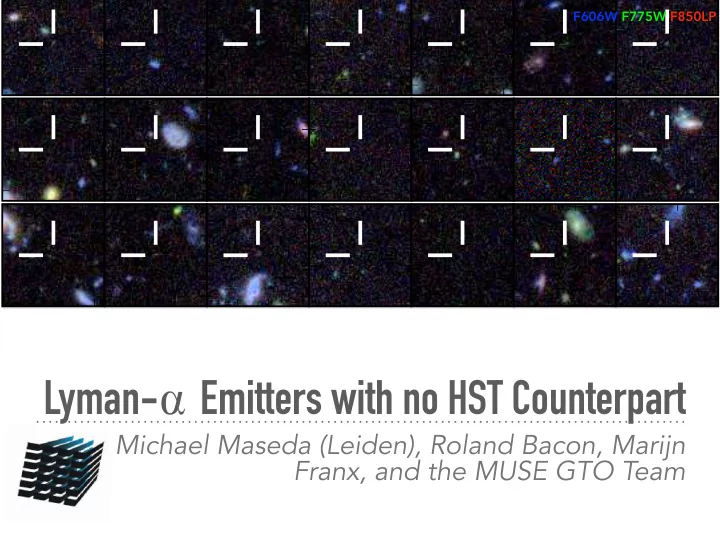
Lyman-⍺ Emitters with no HST Counterpart
Michael Maseda (Leiden), Roland Bacon, Marijn Franx, and the MUSE GTO Team
F606W F775W F850LP
Lyman- Emitters with no HST Counterpart Michael Maseda (Leiden), - - PowerPoint PPT Presentation
F606W F775W F850LP Lyman- Emitters with no HST Counterpart Michael Maseda (Leiden), Roland Bacon, Marijn Franx, and the MUSE GTO Team HOW WE GOT HERE MUSE is fantastic, because before we had to do things like this: Rauch+08 (92h FORS2)
F606W F775W F850LP
➤ MUSE is fantastic, because before we had to do things like
this:
Rauch+08 (92h FORS2)
➤ Bacon+15:
➤ Bacon+17: 72 “HST-undetected” LAEs in the UDF
➤ Maseda+18: 155 “high-EW” LAEs in the UDF
➤ Maseda+18: 155 “high-EW” LAEs in the UDF
➤ Plausibly high-EW LAEs (> 200 Å) ➤ Can only occur with young ages (< 10 Myr), very low
metallicities, and/or top-heavy IMFs
Hashimoto+17a
➤ Using correction from zLyα to zsys using FWHMLyα (Verhamme+
submitted)
(Preliminary)
➤ Blue continuum slopes ➤ MUV ~ -15 ➤ Effect of Ly-⍺ visible
➤ Blue continuum slopes ➤ MUV ~ -15 ➤ Effect of Ly-⍺ visible
➤ Blue continuum slopes ➤ MUV ~ -15 ➤ Effect of Ly-⍺ visible
β λrest (Å)
➤ mUV from stacks for a given object (otherwise limit) ➤ 휷 from stacks in redshift bin
➤ Based on an EW distribution (Hashimoto+17b) and
a UV luminosity function (Bouwens+15), can predict fraction of LAEs that are below a detection limit
➤ Based on an EW distribution (Hashimoto+17b) and
a UV luminosity function (Bouwens+15), can predict fraction of LAEs that are below a detection limit
➤ Based on an EW distribution (Hashimoto+17b) and
a UV luminosity function (Bouwens+15), can predict fraction of LAEs that are below a detection limit
➤ Based on an EW distribution (Hashimoto+17b) and
a UV luminosity function (Bouwens+15), can predict fraction of LAEs that are below a detection limit Force EW < 240 Å
➤ Based on an EW distribution (Hashimoto+17b) and
a UV luminosity function (Bouwens+15), can predict fraction of LAEs that are below a detection limit
It’s hard to distinguish between these models, but undetected sources are expected
➤ More than 150 high-EW LAEs in the UDF ➤ MUV as faint as -15 ➤ Blue (β ~ -2) UV continuum slopes ➤ They appear to be an extension of the known LAE
➤ More work (JWST?) will be required to fully