m m i b 2 binary by - - PDF document

m m i b 2 binary by where the b
SMART_READER_LITE
LIVE PREVIEW

m m i b 2 binary by - - PDF document

Decimal and binary representation systems They both are positional representation systems In decimal numbers are represented by the coefficients of the powers of 10 Example: 321 = 3 . 10 2 + 2 . 10 1 + 1. 10 0 Decomposing 321 in


slide-1
SLIDE 1

1

1/8/99 CSE378 Number rep. 1

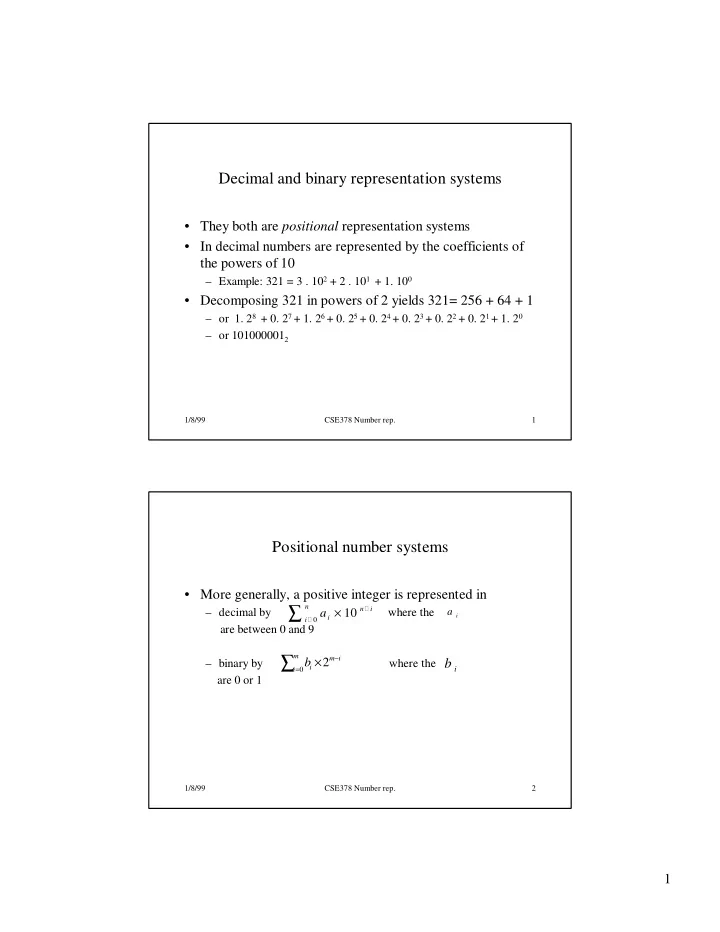
Decimal and binary representation systems

  • They both are positional representation systems
  • In decimal numbers are represented by the coefficients of

the powers of 10

– Example: 321 = 3 . 102 + 2 . 101 + 1. 100

  • Decomposing 321 in powers of 2 yields 321= 256 + 64 + 1

– or 1. 28 + 0. 27 + 1. 26 + 0. 25 + 0. 24 + 0. 23 + 0. 22 + 0. 21 + 1. 20 – or 1010000012

1/8/99 CSE378 Number rep. 2

Positional number systems

  • More generally, a positive integer is represented in

– decimal by where the are between 0 and 9 – binary by where the are 0 or 1

i n n i i

a

  • ×

10

i

a

i m m i i

b

− =

×

2

i

b

slide-2
SLIDE 2

2

1/8/99 CSE378 Number rep. 3

Binary and Hexadecimal representation systems

  • Writing binary numbers quickly becomes error-prone and

unwieldy

  • Instead use hexadecimal system, positional representation

system in base 16

– Example: 321 = 1 .162 + 4 .161 + 1 .160 = 14116

  • Since the coefficients are between 0 and 15, we need new

symbols to represent 10 through 15. They will be A through F

– A (hex) = 10 (decimal) = 1010 (binary) – B (hex) = 11 (decimal) = 1011 (binary) ... – F (hex) = 15 (decimal) = 1111 (binary)

1/8/99 CSE378 Number rep. 4

Conversion between binary and hexadecimal

  • Group bits (abbreviation for binary digits) by groups of

four, starting from the right (least significant bit or lsb)

– Example: 101000001 = 1 0100 0001 (binary) = 141 (hex) – 111001011 = 1 1100 1011 (binary) = 1CB (hex) – Note that the greatest magnitude bit , the leftmost one, is called (most significant bit or msb)

  • Why hexadecimal?

– Very convenient to represent strings of 4, 8, …,16,…32, …64 bits by 1,2,..,4,…8….16 hex digits

slide-3
SLIDE 3

3

1/8/99 CSE378 Number rep. 5

Some useful powers of two

  • We’ll often round-off and talk about, say, 16 KB or 64 MB

G M K 1 10 2 1 10 2 1 10 1024 2

9 30 6 20 3 10 10

= ≈ = ≈ = ≈ =

1/8/99 CSE378 Number rep. 6

Representing positive and negative integers

  • In an n-bit register, you can represent 2n patterns

– Example: in a 32-bit register, we can represent unsigned integers in the range [0:232-1]

  • How to represent positive and negative integers with the

following properties:

– Equal number of positive and negative numbers – Unique (and easily testable) representation of zero – Easy sign test – Easy rules for addition and subtraction

slide-4
SLIDE 4

4

1/8/99 CSE378 Number rep. 7

Three representation systems

  • Historically, 3 different numbering systems have been used

– Two’s complement now used in all machines for integer representation – sign and magnitude used (partially) for floating-point representation – One’s complement (very similar to 2’s complement but with a few more drawbacks)

1/8/99 CSE378 Number rep. 8

Two’s complement representation

  • Positive numbers as unsigned binary with msb always 0
  • Zero is represented as a string of 0’s
  • To represent a negative number:

– Consider the representation of its absolute value – Flip all 1’s to 0’s and 0’s to 1’s (this is 1’s complement) – Add 1 to lsb using binary arithmetic rules

slide-5
SLIDE 5

5

1/8/99 CSE378 Number rep. 9

2’s complement

  • Example assuming a 4-bit register

– What is the representation of (decimal) 6? – What is the representation of (decimal) -6? – What is the representation of 0? – What is the range of representation of positive numbers? – What is the range of representation of negative numbers? – How do I recognize whether a number is positive or negative or zero?

1/8/99 CSE378 Number rep. 10

Addition in 2’s complement

  • Addition

– Perform an ordinary binary addition and discard the carry-out – If you add 2 numbers of opposite sign, everything will always be all right – If you add two positive numbers and the result appears to be negative (i.e., msb = 1) then you have an overflow. This will generate an exception in your program. – If you add two negative numbers and the result appears to be positive (i.e., msb = 0) then you have an underflow.

  • Subtraction

– Take the 2’s complement of the subtrahend and add it to the other

  • perand