
SLIDE 1
SYNTHESIS OF HIGHLY FUNCTIONALIZED NON-RACEMIC CHIRAL ALKYL HALIDES USING KHARASCH ADDITION M.Montserrat Martínez,a Zhen You,b Marc L. Snapperb*
aDepartamento de Química Fundamental, Universidade da Coruña, E-15071 A Coruña,
- Spain. B Department of Chenistry, Boston College, Chestnut Hill, Massachusetts 02467.
E-mail: mmartinezc@usc.es
■ ABSTRACT
We have developed a new catalytic asymmetric method for the synthesis of highly functionalized non-racemic chiral alkyl halides using Kharasch addition in good yields and moderate enantioselectivities.
■ INTRODUCTION
The addition of polyhalogenated alkanes to carbon-carbon double bonds (Kharasch reaction) has been of interest during the last years.1 In our group, this reaction has been applied to the synthesis of highly functionalized halogenated compounds.2 Although the Kharasch reaction offers a powerful tool to functionalize olefins with a high level of atom economy, most
- f
the successful examples are limited in terms of
- stereoselectivity. Therefore, the control
- f the absolute configuration in this
reaction constitutes an important goal in
- rganic synthesis.
■ RESULTS AND DISCUSSION
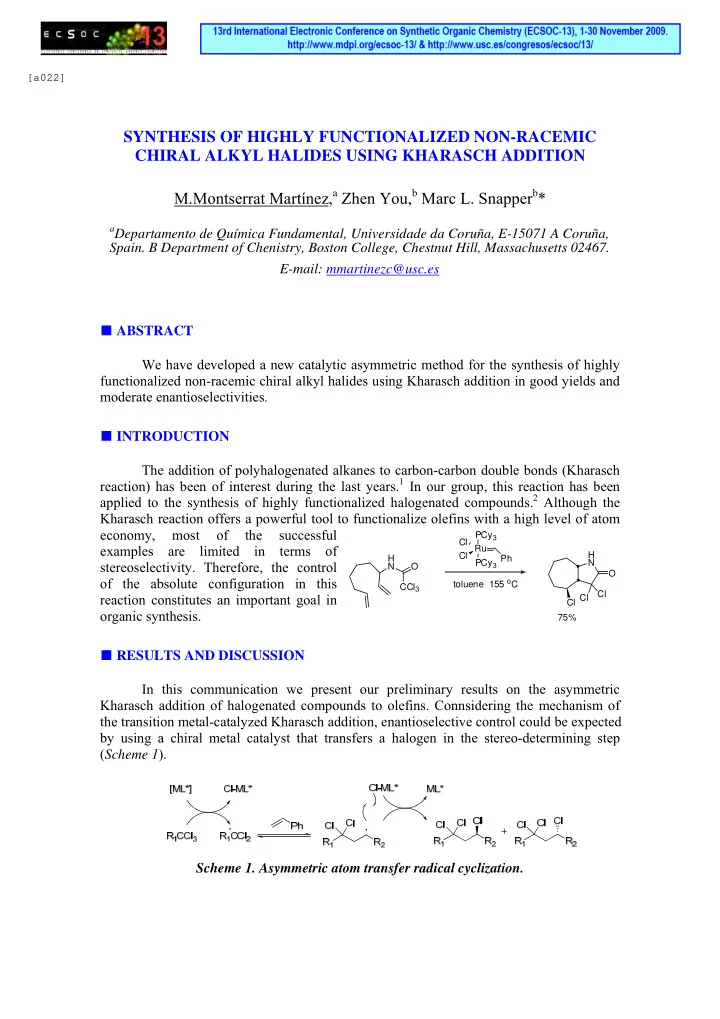
In this communication we present our preliminary results on the asymmetric Kharasch addition of halogenated compounds to olefins. Connsidering the mechanism of the transition metal-catalyzed Kharasch addition, enantioselective control could be expected by using a chiral metal catalyst that transfers a halogen in the stereo-determining step (Scheme 1). Scheme 1. Asymmetric atom transfer radical cyclization.
H N CCl3 O 75% H N Cl Cl O Cl Ru Cl Cl PCy3 PCy3 Ph toluene 155 oC