MA 123, Chapter 1 Equations, functions, and graphs (pp. 1-15) - - PowerPoint PPT Presentation

ma 123 chapter 1
SMART_READER_LITE
LIVE PREVIEW

MA 123, Chapter 1 Equations, functions, and graphs (pp. 1-15) - - PowerPoint PPT Presentation

MA 123, Chapter 1 Equations, functions, and graphs (pp. 1-15) Chapters Goal: Solve an equation for one variable in terms of another. What is a function? Find inverse functions. What is a graph? Understand linear and


slide-1
SLIDE 1

MA 123, Chapter 1

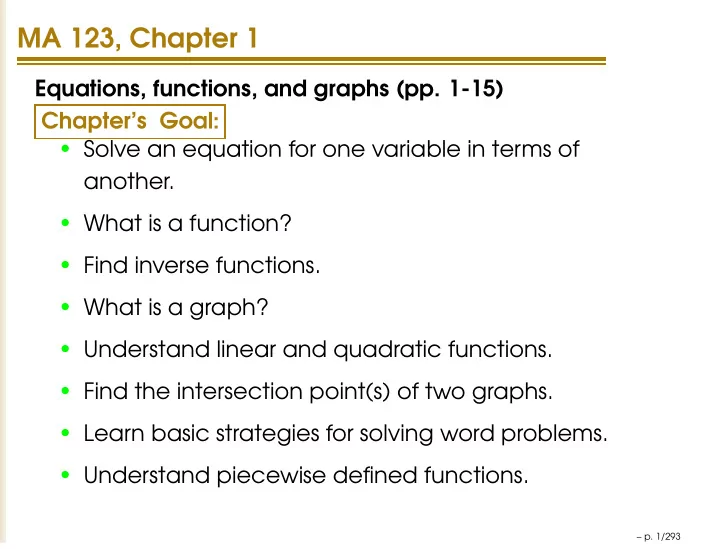
Equations, functions, and graphs (pp. 1-15) Chapter’s Goal:

  • Solve an equation for one variable in terms of

another.

  • What is a function?
  • Find inverse functions.
  • What is a graph?
  • Understand linear and quadratic functions.
  • Find the intersection point(s) of two graphs.
  • Learn basic strategies for solving word problems.
  • Understand piecewise defined functions.

– p. 1/293

slide-2
SLIDE 2

Example 1:

Solve the equation x3 + 2xy + 5y = 7 for y in terms of x.

– p. 2/293

slide-3
SLIDE 3

Example 2:

Find the domain of the following functions: (a) f(x) = √ 3 − x (b) g(x) = 1 x2 − 4 (c) h(x) = 1 x + √ x + 2

– p. 3/293

slide-4
SLIDE 4

Example 3:

If f(x) = √6x + 4, write an expression for:

  • f(1 + h) − f(1)
  • ·
  • f(1 + h) + f(1)
  • .

– p. 4/293

slide-5
SLIDE 5

Example 4:

If P(x) = 3x3 + 2x2 + x + 11 and we rewrite P(x) in the form P(x) = A+B(x−1)+C(x−1)(x−2)+D(x−1)(x−2)(x−3), what are the values of A and B?

– p. 5/293

slide-6
SLIDE 6

Example 5:

If we rewrite the function f(x) = 3 x(x − 1)(x − 2) in the form: f(x) = A x + B x − 1 + C x − 2, what are the values of A, B, and C?

– p. 6/293

slide-7
SLIDE 7

Example 6:

If h(t) = 3t + 7, find a function g(t) such that h(g(t)) = t.

– p. 7/293

slide-8
SLIDE 8

Example 7:

If F(x) = √4x + 9 − 7, find the inverse function F −1(x).

– p. 8/293

slide-9
SLIDE 9

Example 8:

Suppose a line passes throught the points (3, 4) and (−1, 6). Determine the values of A and B if the equation of the line is written in the following forms: (a) y = A + B(x + 1) (b) y = A + Bx (c) y = A + B(x + 2)

– p. 9/293

slide-10
SLIDE 10

Example 9:

Suppose the linear function, f, satisfies f(1.5) = 2 and f(3) = 5 . Determine f(4) .

– p. 10/293

slide-11
SLIDE 11

Example 10:

(a) The parabola y = x2 − 15x + 54 intersects the x-axis at the two points P and Q. What is the distance from P to Q? (b) If we rewrite the inequality x2 − 15x + 54 < 0 in the form A < x < B, what are the values of A and B?

– p. 11/293

slide-12
SLIDE 12

Example 11:

Find the point(s) of intersection between the graph of the equation 4x2 + 9y2 = 36 and (a) the line with equation y = −2; (b) the line with equation y = 1; (c) the x-axis.

– p. 12/293

slide-13
SLIDE 13

Example 12:

Find all points where the graph of (y − 1)2 − 2 = x crosses (a) the y-axis; (b) the line y = x.

– p. 13/293

slide-14
SLIDE 14

Example 13:

The owner of a coffee shop decides to sell a blend of her two most popular types of coffee. The premium roast costs $2.50 per pound and the classic roast costs $1.75 per pound. How many pounds of the premium roast should she include in the blend if she wants 20 pounds of the blend coffee, and she wants to sell the blend at $1.95 per pound?

– p. 14/293

slide-15
SLIDE 15

Example 14:

Suppose a fuel mixture is 4% ethanol and 96%

  • gasoline. How much ethanol (in gallons) must you

add to one gallon of fuel so that the new fuel mixture is 10% ethanol?

– p. 15/293

slide-16
SLIDE 16

Example 15:

The area of a right triangle is 7. The sum of the lengths

  • f the two sides adjacent to the right angle of the

triangle is 11. What is the length of the hypotenuse of the triangle?

– p. 16/293

slide-17
SLIDE 17

Example 16:

Suppose f(x) =        2x + 1, for x ≤ −1; x2, for − 1 < x < 2; −3, for 2 ≤ x. (a) Find each of f(−2), f(−1), f(0), f(1), f(3), f(4) (b) Sketch the graph of f(x).

– p. 17/293

slide-18
SLIDE 18

Example 17:

Sam’s cell phone provider charges him $35.00 per month for basic service, which includes 150 “anytime minutes”. Sam is charged and extra $0.75 for each minute beyond 150 minutes. Let t denote the number

  • f minutes that Sam used in a given month and B(t)

denote the amount of Sam’s cell phone bill. Write a piecewise defined function for B(t).

– p. 18/293

slide-19
SLIDE 19

Example 18 (Greatest Integer Function):

The greatest integer function (a.k.a, unit step function), denoted [[x]], associates to each real number x the greatest integer less than or equal to x. (a) Find each of [[0]], [[1]], [[2]], [[1.2]], [[1.97]], [[−1.8]] (b) Sketch the graph of f(x).

– p. 19/293