MA/CSSE 474 Theory of Computation Reduction: Decidability and - - PDF document

ma csse 474 theory of computation
SMART_READER_LITE
LIVE PREVIEW

MA/CSSE 474 Theory of Computation Reduction: Decidability and - - PDF document

2/3/2012 MA/CSSE 474 Theory of Computation Reduction: Decidability and Undecidability Proofs SD and Turing Enumerable Theorem: A language is SD iff it is Turing-enumerable. Proof that Turing-enumerable implies SD : Let M be the Turing machine


slide-1
SLIDE 1

2/3/2012 1

MA/CSSE 474 Theory of Computation

Reduction: Decidability and Undecidability Proofs

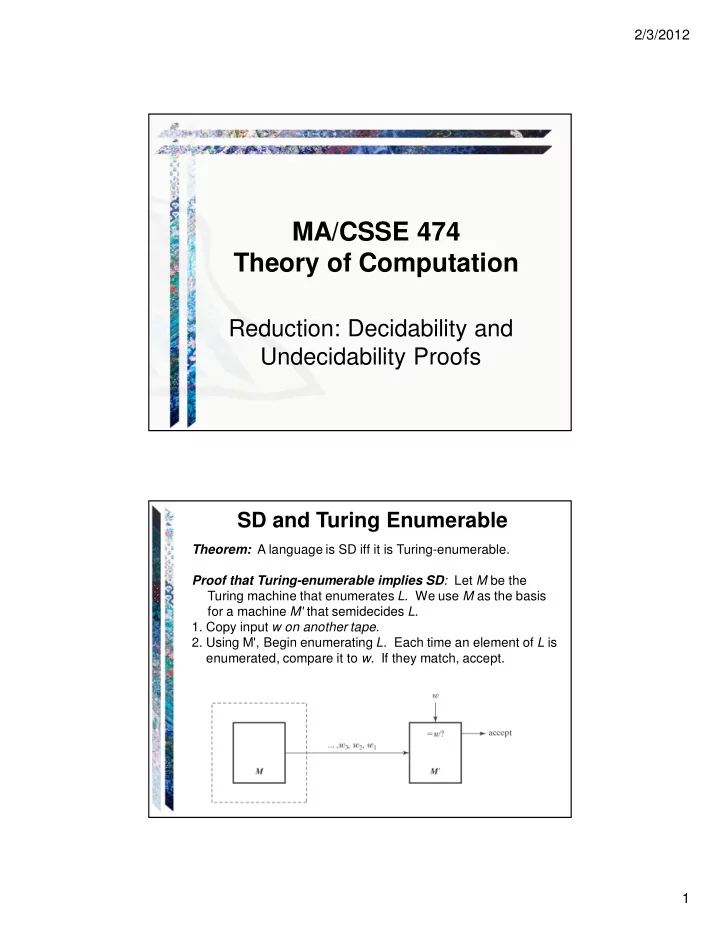
Theorem: A language is SD iff it is Turing-enumerable. Proof that Turing-enumerable implies SD: Let M be the Turing machine that enumerates L. We use M as the basis for a machine M' that semidecides L.

  • 1. Copy input w on another tape.
  • 2. Using M', Begin enumerating L. Each time an element of L is

enumerated, compare it to w. If they match, accept.

SD and Turing Enumerable

slide-2
SLIDE 2

2/3/2012 2

Proof that SD implies Turing-enumerable: If L ⊆ Σ* is in SD, then there is a Turing machine M that semidecides L. A procedure E to enumerate all elements of L:

  • 1. Enumerate all w ∈ Σ* lexicographically.

e.g., ε, a, b, aa, ab, ba, bb, …

  • 2. As each is enumerated, use M to check it.

w3, w2, w1 ∈L? yes w E M M'

But there is a problem with this …

The Other Direction Solution: "Dovetail" the computations

Let L = L(M) for some TM M. A procedure to enumerate all elements of L:

  • 1. Enumerate all w ∈ Σ* lexicographically.
  • 2. As each string wi is enumerated:
  • 1. Start up a copy of M (call it Mi)with wi as its input.
  • 2. Execute one step of each Mj (j < i),

excluding those Mj that have previously halted.

  • 3. Whenever an Mi accepts, output wi.

*

slide-3
SLIDE 3

2/3/2012 3 M lexicographically enumerates L iff M enumerates the elements of L in lexicographic order. A language L is lexicographically Turing-enumerable iff there is a Turing machine that lexicographically enumerates it. Example: AnBnCn = {anbncn : n ≥ 0} Lexicographic enumeration:

Lexicographic Enumeration

*

Theorem: A language is in D iff it is lexicographically Turing- enumerable. Proof that D implies lexicographically TE: Let M be a Turing machine that decides L. Then M' lexicographically generates the strings in Σ* and tests each using M. Whenever M accepts wi, M' outputs wi. Thus M' lexicographically enumerates L.

Lexicographically Enumerable = D

slide-4
SLIDE 4

2/3/2012 4

Proof that lexicographically Turing Enumerable implies D: Let M be a Turing machine that lexicographically enumerates

  • L. Then, on input w, M' starts up M and waits until:
  • M generates w (then M' accepts),
  • M generates a string that comes after w (M' rejects), or
  • M halts (so M' rejects).

Thus M' decides L.

Proof, Continued

IN SD OUT Semideciding TM H Reduction Enumerable Unrestricted grammar D Deciding TM AnBnCn Diagonalize

  • Lexic. enum

Reduction L and ¬L in SD Context-Free CF grammar AnBn Pumping PDA Closure Closure Regular Regular Expression a*b* Pumping FSM Closure

Language Summary

slide-5
SLIDE 5

2/3/2012 5

OVERVIEW OF REDUCTION

Reducing Decision Problem P1 to another Decision Problem P2

We say that P1 is reducible to P2 (written P1 ≤ P2) if

  • there is a Turing-computable function f that finds,

for an arbitrary instance I of P1, an instance f(I) of P2, and

  • f is defined such that for every instance I of P1,

I is a yes-instance of P1 if and only if f(I) is a yes-instance of P2. So P1 ≤ P2 means "if we have a TM that decides P2, then there is a TM that decides P1.

slide-6
SLIDE 6

2/3/2012 6

Example of Turing Reducibility

Let

  • P1(n) = "Is the decimal integer n divisible by 4?"
  • P2(n) = "Is the decimal integer n divisible by 2?"
  • f(n) = n/2 (integer division, which is clearly

Turing computable) Then P1(n) is "yes" iff P2(n) is "yes" and P2(f(n)) is "yes" . Thus P1 is reducible to P2, and we write P1 ≤ P2. P2 is clearly decidable (is the last digit an element of {0, 2, 4, 6, 8} ?), so P1 is decidable

Reducing Language L1 to L2

  • L1 (over alphabet Σ1) is reducible to L2

(over alphabet Σ2) and we write L1 ≤ L2 if there is a Turing-computable function f : Σ1* → Σ2* such that ∀x ∈ Σ1*, x ∈ L1 if and only if f(x) ∈ L2

slide-7
SLIDE 7

2/3/2012 7

Using reducibility

  • If P1 is reducible to P2, then

– If P2 is decidable, so is P1. – If P1 is not decidable, neither is P2.

  • The second part is the one that we

will use most.

DETAILS OF REDUCTION

slide-8
SLIDE 8

2/3/2012 8

More Examples of Reduction

  • Theorem proving

Suppose that we want to establish Q(A) and that we have, as a theorem: ∀x (R(x) ∧ S(x) ∧ T(x) → Q(x)). Q(A) R(A) S(A) T(A)

*

More Examples of Reduction

  • Computing a function (where x and y are unary

representations of integers) multiply(x, y) =

  • 1. answer := ε.
  • 2. For i := 1 to |y| do:

answer = concat (answer, x) .

  • 3. Return answer.

So we reduce multiplication to addition.

slide-9
SLIDE 9

2/3/2012 9

At each turn, a player chooses one pile and removes some sticks from it. The player who takes the last stick wins. Problem: Is there a move that guarantees a win for the current player?

Nim Nim

  • Obvious approach: search the

space of possible moves.

  • Reduction to an XOR computation

problem: 100 1 10 101 1 01 010 11 011

  • XOR them together:

♦ 0+ means state is losing for current player ♦ otherwise current player can win by making a move that makes the XOR 0.

slide-10
SLIDE 10

2/3/2012 10

Using Reduction for Undecidability

Theorem: There exists no general procedure to solve the following problem: Given an angle A, divide A into sixths using only a straightedge and a compass. Proof: Suppose that there were such a procedure, which we’ll call

  • sixth. Then we could trisect an arbitrary angle:

trisect(a: angle) =

  • 1. Divide a into six equal parts by invoking sixth(a).
  • 2. Ignore every other line, thus dividing a into thirds.

trisect(a) sixth(a) ignore lines sixth exists → trisect exists. But we know that trisect does not exist. So:

*

http://en.wikipedia.org/wiki/Angle_trisection

Using Reduction for Undecidability

A reduction R from L1 to L2 is one or more Turing machines such that: If there exists a Turing machine Oracle that decides (or semidecides) L2, then the TMs in R can be composed with Oracle to build a deciding (or semideciding) TM for L1. P ≤ P′ means that P is reducible to P′.

slide-11
SLIDE 11

2/3/2012 11 (R is a reduction from L1 to L2) ∧ (L2 is in D) → (L1 is in D) If (L1 is in D) is false, then at least one of the two antecedents of that implication must be false. So: If (R is a reduction from L1 to L2) is true, then (L2 is in D) must be false.

Using Reduction for Undecidability

Showing that L2 is not in D: L1 (known not to be in D) L1 in D But L1 not in D R L2 (a new language whose if L2 in D So L2 not in D decidability we are trying to determine)

Using Reduction for Undecidability

slide-12
SLIDE 12

2/3/2012 12

  • 1. Choose a language L1:
  • that is already known not to be in D, and
  • that can be reduced to L2.
  • 2. Define the reduction R.
  • 3. Describe the composition C of R with Oracle.
  • 4. Show that C does correctly decide L1 iff Oracle exists. We

do this by showing:

  • R can be implemented by Turing machines,
  • C is correct:
  • If x ∈ L1, then C(x) accepts, and
  • If x ∉ L1, then C(x) rejects.

To Use Reduction for Undecidability Mapping Reductions

L1 is mapping reducible to L2 (L1 ≤M L2) iff there exists some computable function f such that: ∀x∈Σ* (x ∈ L1 ↔ f(x) ∈ L2). To decide whether x is in L1, we transform it, using f, into a new object and ask whether that object is in L2. Example: DecideNIM(x) = XOR-solve(transform(x))

slide-13
SLIDE 13

2/3/2012 13

  • 1. Hε

ε ε ε is in SD. T semidecides it:

T(<M>) =

  • 1. Run M on ε.
  • 2. Accept.

T accepts <M> iff M halts on ε, so T semidecides Hε. * Recall: "M halts on w" is a short way of saying "M, when started with input w, eventually halts"

Consider Hε

ε ε ε = {<M> : TM M halts on ε

ε ε ε} *

  • 2. Theorem: Hε

ε ε ε = {<M> : TM M halts on ε

ε ε ε} is not in D. Proof: by reduction from H: H = {<M, w> : TM M halts on input string w} R (?Oracle) Hε {<M> : TM M halts on ε} R is a mapping reduction from H to Hε: R(<M, w>) =

  • 1. Construct <M#>, where M#(x) operates as follows:

1.1. Erase the tape. 1.2. Write w on the tape and move the head to the left end. 1.3. Run M on w.

  • 2. Return <M#>.

ε ε ε = {<M> : TM M halts on ε

ε ε ε}

*

slide-14
SLIDE 14

2/3/2012 14

R(<M, w>) =

  • 1. Construct <M#>, where M#(x) operates as follows:

1.1. Erase the tape. 1.2. Write w on the tape and move the head to the left end. 1.3. Run M on w.

  • 2. Return <M#>.

If Oracle exists, C = Oracle(R(<M, w>)) decides H:

  • C is correct: M# ignores its own input. It halts on everything or
  • nothing. So:
  • <M, w> ∈ H: M halts on w, so M# halts on everything. In

particular, it halts on ε. Oracle accepts.

  • <M, w> ∉ H: M does not halt on w, so M# halts on nothing and

thus not on ε. Oracle rejects.

Proof, Continued A Block Diagram of C

slide-15
SLIDE 15

2/3/2012 15

R must construct <M#> from <M, w>. Suppose w = aba. M# will be: So the procedure for constructing M# is:

  • 1. Write:
  • 2. For each character x in w do:

2.1. Write x. 2.2. If x is not the last character in w, write R.

  • 3. Write L M.

R Can Be Implemented as a Turing Machine

R can be implemented as a Turing machine. C is correct. So, if Oracle exists: C = Oracle(R(<M, w>)) decides H. But no machine to decide H can exist. So neither does Oracle.

Conclusion

slide-16
SLIDE 16

2/3/2012 16

If we could decide whether M halts on the specific string ε, we could solve the more general problem of deciding whether M halts on an arbitrary input. Clearly, the other way around is true: If we could solve H we could decide whether M halts on any one particular string. But we used reduction to show that H undecidable implies Hε undecidable; this is not at all obvious.

This Result is Somewhat Surprising

H = {<M, w> : TM M halts on input string w} R (?Oracle) Hε {<M> : TM M halts on ε} H contains strings of the form: (q00,a00,q01,a10,←),(q00,a00,q01,a10,→),…,aaa Hε contains strings of the form: (q00,a00,q01,a10,←),(q00,a00,q01,a10,→),… The language on which some M halts contains strings of some arbitrary form, for example, (letting Σ = {a, b}): aaaba

How Many Languages Are We Dealing With?

slide-17
SLIDE 17

2/3/2012 17

H = {<M, w> : TM M halts on input string w} R (?Oracle) Hε {<M> : TM M halts on ε} R is a reduction from H to Hε: R(<M, w>) =

  • 1. Construct <M#>, where M#(x) operates as follows:

1.1. Erase the tape. 1.2. Write w on the tape. 1.3. Run M on w.

  • 2. Return <M#>.
  • Oracle (the hypothesized machine to decide Hε).
  • R (the machine that builds M#. Actually exists).
  • C (the composition of R with Oracle).
  • M# (the machine we will pass as input to Oracle). Note that we never run it.
  • M (the machine whose membership in H we are interested in determining;

thus also an input to R).

How Many Machines Are We Dealing With?

A Block Diagram of C

slide-18
SLIDE 18

2/3/2012 18

  • A clear declaration of the reduction “from” and “to”

languages.

  • A clear description of R.
  • If R is doing anything nontrivial, argue that it can be

implemented as a TM.

  • Note that machine diagrams are not necessary or even

sufficient in these proofs. Use them as thought devices, where needed.

  • Run through the logic that demonstrates how the “from”

language is being decided by the composition of R and

  • Oracle. You must do both accepting and rejecting

cases.

  • Declare that the reduction proves that your “to” language

is not in D.

Important Elements in a Reduction Proof

// let L = {<M> | M is a TM that halts on epsilon} // if L is decidable, let this function decide L: bool HaltsOnEpsilon(TM M); // defined in magic.h // HaltsOn decides H using HaltsOnEpsilon // .: HaltsOn reduces to HaltsOnEpsilon as such: bool HaltsOn(TM M, string w) {// a nested TM void Wrapper(string idontcare) { M(w); } return HaltsOnEpsilon(Wrapper); }

Another Way to View the Reduction

slide-19
SLIDE 19

2/3/2012 19

The right way to use reduction to show that L2 is not in D:

  • 1. Given that L1 is not in D,

L1

  • 2. Reduce L1 to L2, i.e., show how to solve L1

(the known one) in terms of L2 (the unknown one) L2 Doing it wrong by reducing L2 (the unknown one) to L1: If there exists a machine M1 that solves H, then we could build a machine that solves L2 as follows:

  • 1. Return (M1(<M, ε>)).

This proves nothing. It’s an argument of the form: If False then …

The Most Common Mistake: Doing the Reduction Backwards

Theorem: HANY is in SD. Proof: by exhibiting a TM T that semidecides it. What about simply trying all the strings in Σ* one at a time until one halts?

HANY = {<M> : there exists at least one string on which TM M halts}

slide-20
SLIDE 20

2/3/2012 20

T(<M>) =

  • 1. Use dovetailing to try M on all of the elements of Σ*:

ε [1] ε [2] a [1] ε [3] a [2] b [1] ε [4] a [3] b [2] aa [1] ε [5] a [4] b [3] aa [2] ab [1]

  • 2. If any instance of M halts, halt and accept.

T will accept iff M halts on at least one string. So T semidecides HANY.

HANY is in SD

H = {<M, w> : TM M halts on input string w} R (?Oracle) HANY = {<M> : there exists at least one string on which TM M halts} R(<M, w>) =

  • 1. Construct <M#>, where M#(x) operates as follows:

1.1. Examine x. 1.2. If x = w, run M on w, else loop.

  • 2. Return <M#>.

If Oracle exists, then C = Oracle(R(<M, w>)) decides H:

  • R can be implemented as a Turing machine.
  • C is correct: The only string on which M# can halt is w. So:
  • <M, w> ∈ H: M halts on w. So M# halts on w. There exists at least one

string on which M# halts. Oracle accepts.

  • <M, w> ∉ H: M does not halt on w, so neither does M#. So there exists

no string on which M# halts. Oracle rejects. But no machine to decide H can exist, so neither does Oracle.

HANY is not in D

slide-21
SLIDE 21

2/3/2012 21

(Another R That Works)

Proof: We show that HANY is not in D by reduction from H: H = {<M, w> : TM M halts on input string w} R (?Oracle) HANY = {<M> : there exists at least one string on which TM M halts} R(<M, w>) =

  • 1. Construct the description <M#>, where M#(x) operates as follows:

1.1. Erase the tape. 1.2. Write w on the tape. 1.3. Run M on w.

  • 2. Return <M#>.

If Oracle exists, then C = Oracle(R(<M, w>)) decides H:

  • C is correct: M# ignores its own input. It halts on everything or nothing. So:
  • <M, w> ∈ H: M halts on w, so M# halts on everything. So it halts on at

least one string. Oracle accepts.

  • <M, w> ∉ H: M does not halt on w, so M# halts on nothing. So it does not

halt on at least one string. Oracle rejects. But no machine to decide H can exist, so neither does Oracle.

  • 1. Choose an undecidable language to reduce from.
  • 2. Define the reduction R.
  • 3. Show that C (the composition of R with Oracle) is

correct. indicates where we make choices.

The Steps in a Reduction Proof

slide-22
SLIDE 22

2/3/2012 22

We show that HALL is not in D by reduction from Hε. Hε = {<M> : TM M halts on ε} R (?Oracle) HALL = {<M> : TM M halts on all inputs } R(<M>) =

  • 1. Construct the description <M#>, where M#(x) operates as follows:

1.1. Erase the tape. 1.2. Run M.

  • 2. Return <M#>.

If Oracle exists, then C = Oracle(R(<M>)) decides Hε:

  • R can be implemented as a Turing machine.
  • C is correct: M# halts on everything or nothing, depending on whether M

halts on ε. So:

  • <M> ∈ Hε: M halts on ε, so M# halts on all inputs. Oracle accepts.
  • <M> ∉ Hε: M does not halt on ε, so M# halts on nothing. Oracle rejects.

But no machine to decide Hε can exist, so neither does Oracle.

HALL = {<M> : TM M halts on all inputs}