SLIDE 1
. .
MA111: Contemporary mathematics
Jack Schmidt
University of Kentucky
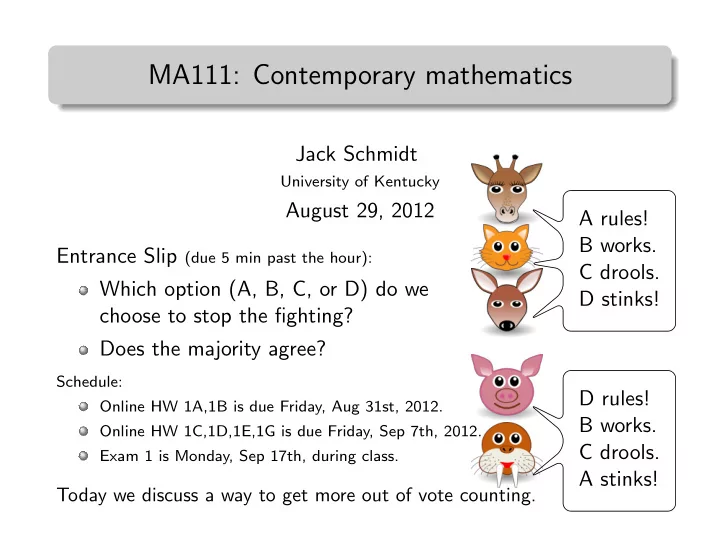
August 29, 2012 Entrance Slip (due 5 min past the hour): Which option (A, B, C, or D) do we choose to stop the fighting? Does the majority agree? . . A rules! B works. C drools. D stinks! . D rules! B works. C drools. A stinks!
Schedule: Online HW 1A,1B is due Friday, Aug 31st, 2012. Online HW 1C,1D,1E,1G is due Friday, Sep 7th, 2012. Exam 1 is Monday, Sep 17th, during class.
Today we discuss a way to get more out of vote counting.
SLIDE 2
Expectations
I expect you to have turned in your entrance slip now I expect you to have read and understood pages 4-9 (Ch 1.1 - 1.2) I expect you to have read pages 2-11. I expect you to have completed HW 1A and most HW 1B I expect you to have been to office hours (Monday 2pm to 4pm; mathskeller) if you had questions
SLIDE 3
Context
The plurality vote counting method was both “fair” and “unfair”:
It satisfied the majority (winner) fairness criterion It failed the majority loser fairness criterion It failed the Condorcet fairness criterion
It failed because it ignored second place votes. Many groups succeeded on Monday by paying attention to second place votes. Maybe we can make a more reliable system by giving points to second place?
SLIDE 4 Activity: Gaming the system again
Each group will turn in a piece of paper with their top TWO votes (ranked, 1st then 2nd) Each 1st place vote will get 2 points, and each 2nd place vote will get 1 point. Here is your “payoff schedule” (top wins=100%, 2nd=90%, etc.) .
A B C D
.
A C D B
.
B C A D
.
B C D A
.
C A D B
.
C B D A
.
D B A C
.
D B C A
.
Front
Decide how your group will vote. Each group will secretly vote (1st and 2nd place) in 5 or 10 minutes and we will total them up.
SLIDE 5 Fast: Borda count mechanics
The full Borda count gives points to third place, fourth place, etc. . .
Ballot 1st A 2nd B 3rd C 4th D
Each ballot gives each candidates some points:
- ne point for every candidate equal to or lower than them
A is on top, all 4 candidates are equal or lower, so 4 points B is second, 3 candidates are equal or lower, so 3 points C is third, so 2 points D is fourth, so 1 points Total up the points from all the ballots to get the final score Borda count winner is the one with the high score
SLIDE 6
Fast: Borda count example
Here is a small example: 10 5 2 1st A B B 2nd B C D 3rd C D C 4th D A A The first column ballots give A 4 points each, 10 ballots like that, so 40 points A gets (10)(4) + (5)(1) + (2)(1) = 40 + 5 + 2 = 47 points total B gets (10)(3) + (5)(4) + (2)(4) = 30 + 20 + 8 = 58 points total C gets (10)(2) + (5)(3) + (2)(2) = 20 + 15 + 4 = 39 points total D gets (10)(1) + (5)(2) + (2)(3) = 10 + 10 + 6 = 26 points total B is the clear winner!
SLIDE 7
Fast: Borda count is unfair
A is majority winner! B is Borda count winner 10 5 2 1st A B B 2nd B C D 3rd C D C 4th D A A .
Theorem
. . Borda count does not satisfy the majority fairness criterion. A is also a Condorcet winner. (Why?) .
Theorem
. . Borda count does not satisfy the Condorcet fairness criterion. Borda count elects “moderate” candidates, even if an “extreme” candidate has a majority!
SLIDE 8
Fast: Borda count is fair
Borda count will not elect a “bad” candidate! .
Theorem
. . Borda count satisfies the majority loser fairness criterion. In fact, it satisfies a stricter criterion: .
Definition
. . A candidate is said to be a Condorcet loser if it loses every head-to-head competition. .
Definition
. . A vote counting method is said to satisfy the Condorcet loser fairness criterion if a Condorcet loser never wins. .
Theorem
. . Borda count satisfies the Condorcet loser fairness criterion.
SLIDE 9
Fast: Condorcet loser photo
After the last match-up:
SLIDE 10 Assignments
Read pages 12-16 and reread pages 10-11. Book exercises #21-#26 are all good. You can now try full #62.
Exit Slip: Who is the:
. .
1
Plurality winner . .
2
Our activity winner (2 pts for 1st, 1 pt for 2nd) . .
3
Condorcet loser
4 3 2 1st A D C 2nd B C B 3rd C B D 4th D A A Who should win? (Or at least who is the Borda count winner?) When you are done discussing your exit slip, pass it to the end of the row. Raise your hand for homework problems.