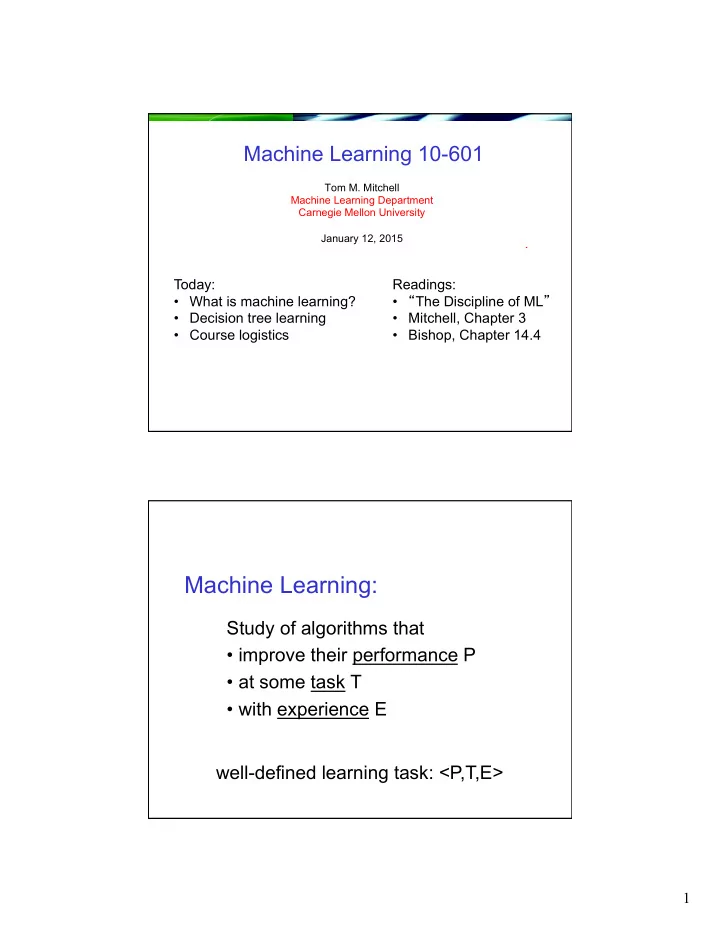
Machine Learning: Study of algorithms that improve their - - PDF document

machine learning
SMART_READER_LITE
LIVE PREVIEW

Machine Learning: Study of algorithms that improve their - - PDF document

Machine Learning 10-601 Tom M. Mitchell Machine Learning Department Carnegie Mellon University January 12, 2015 Today: Readings: What is machine learning? The Discipline of ML Decision tree learning Mitchell, Chapter 3


slide-1
SLIDE 1

1

Machine Learning 10-601

Tom M. Mitchell Machine Learning Department Carnegie Mellon University January 12, 2015

Today:

  • What is machine learning?
  • Decision tree learning
  • Course logistics

Readings:

  • “The Discipline of ML”
  • Mitchell, Chapter 3
  • Bishop, Chapter 14.4

Machine Learning:

Study of algorithms that

  • improve their performance P
  • at some task T
  • with experience E

well-defined learning task: <P,T,E>

slide-2
SLIDE 2

2

Learning to Predict Emergency C-Sections

9714 patient records, each with 215 features

[Sims et al., 2000]

Learning to classify text documents

spam vs not spam

slide-3
SLIDE 3

3

Learning to detect objects in images

Example training images for each orientation

(Prof. H. Schneiderman) Learn to classify the word a person is thinking about, based

  • n fMRI brain activity
slide-4
SLIDE 4

4

Learning prosthetic control from neural implant

[R. Kass

  • L. Castellanos
  • A. Schwartz]

Machine Learning - Practice

Object recognition Mining Databases Speech Recognition Control learning

  • Support Vector Machines
  • Bayesian networks
  • Hidden Markov models
  • Deep neural networks
  • Reinforcement learning
  • ....

Text analysis

slide-5
SLIDE 5

5

Machine Learning - Theory

PAC Learning Theory # examples (m) representational complexity (H) error rate (ε) failure probability (δ)

Other theories for

  • Reinforcement skill learning
  • Semi-supervised learning
  • Active student querying

… also relating:

  • # of mistakes during learning
  • learner’s query strategy
  • convergence rate
  • asymptotic performance
  • bias, variance

(supervised concept learning)

Machine Learning in Computer Science

  • Machine learning already the preferred approach to

– Speech recognition, Natural language processing – Computer vision – Medical outcomes analysis – Robot control – …

  • This ML niche is growing (why?)

All software apps. ML apps.

slide-6
SLIDE 6

6

  • Machine learning already the preferred approach to

– Speech recognition, Natural language processing – Computer vision – Medical outcomes analysis – Robot control – …

  • This ML niche is growing

– Improved machine learning algorithms – Increased volume of online data – Increased demand for self-customizing software

All software apps.

Machine Learning in Computer Science

ML apps.

Tom’s prediction: ML will be fastest-growing part of CS this century Animal learning

(Cognitive science, Psychology, Neuroscience)

Machine learning Statistics Computer science Adaptive Control Theory Evolution Economics and Organizational Behavior

slide-7
SLIDE 7

7

What You’ll Learn in This Course

  • The primary Machine Learning algorithms

– Logistic regression, Bayesian methods, HMM’s, SVM’s, reinforcement learning, decision tree learning, boosting, unsupervised clustering, …

  • How to use them on real data

– text, image, structured data – your own project

  • Underlying statistical and computational theory
  • Enough to read and understand ML research papers

Course logistics

slide-8
SLIDE 8

8

Machine Learning 10-601

Faculty

  • Maria Balcan
  • Tom Mitchell

TA’s

  • Travis Dick
  • Kirsten Early
  • Ahmed Hefny
  • Micol Marchetti-Bowick
  • Willie Neiswanger
  • Abu Saparov

Course assistant

  • Sharon Cavlovich

website: www.cs.cmu.edu/~ninamf/courses/601sp15

See webpage for

  • Office hours
  • Syllabus details
  • Recitation sessions
  • Grading policy
  • Honesty policy
  • Late homework policy
  • Piazza pointers
  • ...

Highlights of Course Logistics

On the wait list?

  • Hang in there for first few weeks

Homework 1

  • Available now, due friday

Grading:

  • 30% homeworks (~5-6)
  • 20% course project
  • 25% first midterm (March 2)
  • 25% final midterm (April 29)

Academic integrity:

  • Cheating à Fail class, be expelled

from CMU

Late homework:

  • full credit when due
  • half credit next 48 hrs
  • zero credit after that
  • we’ll delete your lowest HW score
  • must turn in at least n-1 of the n

homeworks, even if late

Being present at exams:

  • You must be there – plan now.
  • Two in-class exams, no other final
slide-9
SLIDE 9

9

Maria-Florina Balcan: Nina

  • Foundations for Modern Machine Learning
  • Theoretical Computer Science, especially connections

between learning theory & other fields

Game Theory Approx. Algorithms Matroid Theory

Machine Learning Theory

Discrete Optimization Mechanism Design Control Theory

  • E.g., interactive, distributed, life-long learning

Travis Dick

  • When can we learn many concepts

from mostly unlabeled data by exploiting relationships between between concepts.

  • Currently: Geometric relationships
slide-10
SLIDE 10

10

Kirstin Early

  • Analyzing and predicting

energy consumption

  • Reduce costs/usage and help

people make informed decisions Energy disaggregation: decomposing total electric signal into individual appliances Predicting energy costs from features of home and occupant behavior

Ahmed Hefny

  • How can we learn to track and predict the state of a

dynamical system only from noisy observations ?

  • Can we exploit supervised learning methods to devise a

flexible, local minima-free approach ?

  • bservations (oscillating pendulum)

Extracted 2D state trajectory

slide-11
SLIDE 11

11

Micol Marchetti-Bowick

How can we use machine learning for biological and medical research?

  • Using genotype data to build personalized

models that can predict clinical outcomes

  • Integrating data from multiple sources to

perform cancer subtype analysis

  • Structured sparse regression models for

genome-wide association studies

x y x y x y x y x y x y x y y x x y sample weight genetic relatedness

Gene expression data w/ dendrogram (or have

  • ne picture per task)

Willie Neiswanger

  • If we want to apply machine learning

algorithms to BIG datasets…

  • How can we develop parallel, low-communication machine

learning algorithms?

  • Such as embarrassingly parallel algorithms, where machines

work independently, without communication.

slide-12
SLIDE 12

12

Abu Saparov

  • How can knowledge about the

world help computers understand natural language?

  • What kinds of machine learning

tools are needed to understand sentences?​

“Carolyn ate the cake with a fork.” “Carolyn ate the cake with vanilla.” person_eats_food consumer Carolyn food cake instrument fork person_eats_food consumer Carolyn food cake topping vanilla

Tom Mitchell

How can we build never-ending learners? Case study: never-ending language learner (NELL) runs 24x7 to learn to read the web

see http://rtw.ml.cmu.edu

reading accuracy vs. time (5 years) mean avg. precision top 1000 # of beliefs vs. time (5 years)

slide-13
SLIDE 13

13

Function Approximation and Decision tree learning Function approximation

Problem Setting:

  • Set of possible instances X
  • Unknown target function f : XàY
  • Set of function hypotheses H={ h | h : XàY }

Input:

  • Training examples {<x(i),y(i)>} of unknown target function f

Output:

  • Hypothesis h ∈ H that best approximates target function f

superscript: ith training example

slide-14
SLIDE 14

14

Day Outlook Temperature Humidity Wind PlayTennis?

Simple Training Data Set

Each internal node: test one discrete-valued attribute Xi Each branch from a node: selects one value for Xi Each leaf node: predict Y (or P(Y|X ∈ leaf))

A Decision tree for f: <Outlook, Temperature, Humidity, Wind> à PlayTennis?

slide-15
SLIDE 15

15

Problem Setting:

  • Set of possible instances X

– each instance x in X is a feature vector – e.g., <Humidity=low, Wind=weak, Outlook=rain, Temp=hot>

  • Unknown target function f : XàY

– Y=1 if we play tennis on this day, else 0

  • Set of function hypotheses H={ h | h : XàY }

– each hypothesis h is a decision tree – trees sorts x to leaf, which assigns y

Decision Tree Learning Decision Tree Learning

Problem Setting:

  • Set of possible instances X

– each instance x in X is a feature vector

x = < x1, x2 … xn>

  • Unknown target function f : XàY

– Y is discrete-valued

  • Set of function hypotheses H={ h | h : XàY }

– each hypothesis h is a decision tree

Input:

  • Training examples {<x(i),y(i)>} of unknown target function f

Output:

  • Hypothesis h ∈ H that best approximates target function f
slide-16
SLIDE 16

16

Decision Trees

Suppose X = <X1,… Xn> where Xi are boolean-valued variables How would you represent Y = X2 X5 ? Y = X2 ∨ X5 How would you represent X2 X5 ∨ X3X4(¬X1)

slide-17
SLIDE 17

17

node = Root [ID3, C4.5, Quinlan]

Sample Entropy

slide-18
SLIDE 18

18

Entropy

Entropy H(X) of a random variable X H(X) is the expected number of bits needed to encode a randomly drawn value of X (under most efficient code) Why? Information theory:

  • Most efficient possible code assigns -log2 P(X=i) bits

to encode the message X=i

  • So, expected number of bits to code one random X is:

# of possible values for X

Entropy

Entropy H(X) of a random variable X Specific conditional entropy H(X|Y=v) of X given Y=v : Mutual information (aka Information Gain) of X and Y : Conditional entropy H(X|Y) of X given Y :

slide-19
SLIDE 19

19

Information Gain is the mutual information between input attribute A and target variable Y Information Gain is the expected reduction in entropy

  • f target variable Y for data sample S, due to sorting
  • n variable A

Day Outlook Temperature Humidity Wind PlayTennis?

Simple Training Data Set

slide-20
SLIDE 20

20

slide-21
SLIDE 21

21

Each internal node: test one discrete-valued attribute Xi Each branch from a node: selects one value for Xi Each leaf node: predict Y

Final Decision Tree for f: <Outlook, Temperature, Humidity, Wind> à PlayTennis?

Which Tree Should We Output?

  • ID3 performs heuristic

search through space of decision trees

  • It stops at smallest

acceptable tree. Why?

Occam’s razor: prefer the simplest hypothesis that fits the data

slide-22
SLIDE 22

22

Why Prefer Short Hypotheses? (Occam’s Razor)

Arguments in favor: Arguments opposed:

Why Prefer Short Hypotheses? (Occam’s Razor)

Argument in favor:

  • Fewer short hypotheses than long ones

à a short hypothesis that fits the data is less likely to be a statistical coincidence à highly probable that a sufficiently complex hypothesis will fit the data Argument opposed:

  • Also fewer hypotheses with prime number of nodes

and attributes beginning with “Z”

  • What’s so special about “short” hypotheses?
slide-23
SLIDE 23

23

Overfitting

Consider a hypothesis h and its

  • Error rate over training data:
  • True error rate over all data:

We say h overfits the training data if Amount of overfitting =

slide-24
SLIDE 24

24

slide-25
SLIDE 25

25 Split data into training and validation set Create tree that classifies training set correctly

slide-26
SLIDE 26

26

slide-27
SLIDE 27

27

You should know:

  • Well posed function approximation problems:

– Instance space, X – Sample of labeled training data { <x(i), y(i)>} – Hypothesis space, H = { f: XàY }

  • Learning is a search/optimization problem over H

– Various objective functions

  • minimize training error (0-1 loss)
  • among hypotheses that minimize training error, select smallest (?)
  • Decision tree learning

– Greedy top-down learning of decision trees (ID3, C4.5, ...) – Overfitting and tree/rule post-pruning – Extensions…

Questions to think about (1)

  • ID3 and C4.5 are heuristic algorithms that

search through the space of decision trees. Why not just do an exhaustive search?

slide-28
SLIDE 28

28

Questions to think about (2)

  • Consider target function f: <x1,x2> à y,

where x1 and x2 are real-valued, y is

  • boolean. What is the set of decision surfaces

describable with decision trees that use each attribute at most once?

Questions to think about (3)

  • Why use Information Gain to select attributes

in decision trees? What other criteria seem reasonable, and what are the tradeoffs in making this choice?

slide-29
SLIDE 29

29

Questions to think about (4)

  • What is the relationship between learning

decision trees, and learning IF-THEN rules