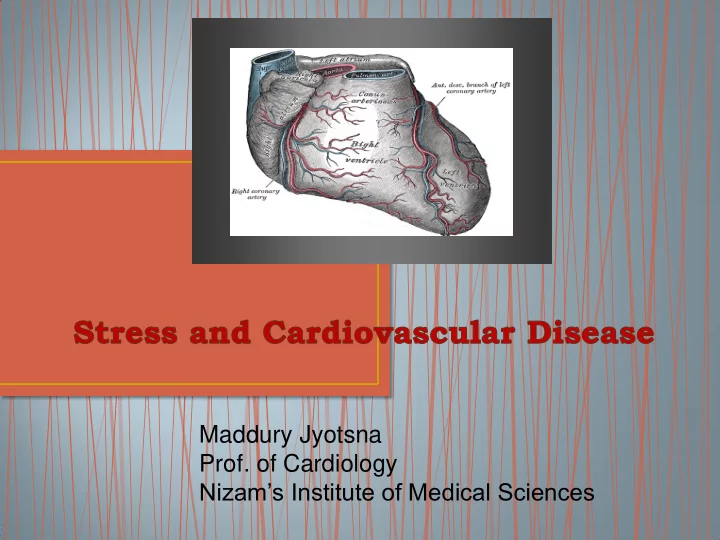
SLIDE 1 Maddury Jyotsna
Nizam’s Institute of Medical Sciences
SLIDE 2 ― For every affection of the mind that is attended with either pain or pleasure, hope or fear, is the cause of an agitation whose influence extends to the heart, and there induces change from the natural constitution,in the temperature, the pulse and the rest‖
SLIDE 3
- 55 year old diabetic, hypertensive patient was shouting at a
person who was responsible for huge economic loss to him, suddenly developed sub-stennal chest pain with sweating.
- Rushed to EMD – ECG showed AMI.
- Treated with primary angioplasty.
SLIDE 4
- p value
- Anger (4 studies) 0.00
- Anxiety 0.01
- Bereavement 0.00
- Depressed mood 0.04
Eur Heart J. 2013 Jan 21; 34(4): 300–306.
SLIDE 5
Rozanski et al., JACC 2005
SLIDE 6
Rozanski et al., JACC 2005
SLIDE 7
Psychosocial index based on individual items of depression, locus of control, work or home stress, financial stress, and adverse life events.
SLIDE 8
- Psychologic – e.g, anxiety, depression
- Psychosocial – e.g., work stress, discrimination, emotional
support
- Social-structural – e.g., socioeconomic status, social
integration, neighborhood effects
SLIDE 9
- Estimated prevalence of major depression in India is
14%, but up to 30% in cardiac patients
- Characterized by a depressed mood and combination
- f other symptoms such as weight change, sleep
disturbance, insomnia, fatigue, feelings of guilt, worthlessness, and/or hopelessness.
- Of all psychosocial factors, evidence of association
with CVD is strongest for depression.
SLIDE 10
- Frasure-Smith et al (JAMA 1993) reported a 4-fold increase in
mortality during 6 months following acute MI from depression in cardiac patients.
- Meta-analysis examining depression as a factor in development
- f CHD in healthy individuals showed a risk factor-adjusted
RR=2.69 for CHD incidence ( Rugulies, Am J Prev Med 2002).
SLIDE 11
Lesperance et al. Circulation 2002
SLIDE 12
- An 68-year-old female presented to the EMD with chest pain
- f ten hours duration, which began while watching television.
- The pain was 9/10, substernal and non-radiating, pressure-like,
without other associated symptoms.
SLIDE 13
- Vital signs were: BP of 185/88 mm Hg, pulse of 71
beats/min,respirations of 20 breaths/min, O2 sat of 98% on room air,and temperature of 35.7°C.
- She reported medical history of
hypertension, hypothyroidism, gout, and a hysterectomy.
SLIDE 14
- Cardiac risks included age, hypertension, and family
history
- f coronary disease.
- Her daughter stated that her mother had been under
extreme stress due to sudden accidental death of her son two weeks ago.
- Her physical exam was unremarkable.
SLIDE 15
- Initial ECG revealed a NSR with ST elevation in
V2 and V3,ST depression in V4 and V5, and T wave inversions in inferior and precordial leads.
- Chest radiograph revealed no acute disease.
- Lab studies showed
Troponin I of 3.23 ng/ml White blood cell count 12,000/mm3.
SLIDE 16
- Serum electrolytes were normal.
- She had cardiac catheterization with left ventriculography,
which showed mid-anterior and apical akinesia with preserved anterobasal and posterobasal function, with an EF of 30%.
SLIDE 17
- Coronary arteries were unremarkable
- Echocardiogram showed apical akinesis with reduced LV
function with EF of 34%.
- The mid septum showed marked hypertrophy with a thinned
apex.
SLIDE 18
SLIDE 19
SLIDE 20
SLIDE 21
- Anxiety is characterized by heightened levels of perceived fear
and nervousness– may include panic disorder, social phobia,
- bsessive-compulsive disorder, acute stress disorder,
posttraumatic stress disorder.
- Clear relation to sudden cardiac death in a dose-dependent
fashion
- 32-year follow-up of men in the Normative Aging Study who
reported two or more phobic anxiety symptoms had a 3.2- fold increased risk of fatal CHD and 5.7-fold increased risk of sudden death.
- Ventricular arrhythmia may be the underlying mechanism since
no relation seen between anxiety and MI. Anxious individuals also have reduced heart rate variability.
SLIDE 22
- Began with classic work by Friedman and Rosenman
- n the Type A Behavior Pattern (TABP), the most
widely known psychosocial risk factor, shown to be related to both CAD risk and recurrent MI; however subsequent studies showed no relationship, so this has been of diminished interest.
- The Recurrent Coronary Prevention Project did
show intervention from counselling on Type A behavior to reduce recurrent MI rates and cardiac deaths (Friedman et al., Am Heart J 1986)
SLIDE 23
- Reflects emotional (anger, contempt), behavioral
(verbal and physical aggression), and cognitive (cynicism, mistrust) factors.
- Predicts incident CHD in healthy individuals, even
after risk factor adjustment (Niaura et al.. Health Psychol 2002).
- Hostility is associated with heightened cardiovascular
reactivity and higher blood pressure.
- Higher prevalence in those with lower SES; has been
suggested as a mechanism linking low SES with CVD
- utcomes.
- May be a stronger indicator of incident CHD than of
recurrent CHD or its progression.
SLIDE 24
- Vast literature on social networks, social support, and CVD
- Alameda County Study showed those who lacked ties to
- thers (index of contacts with friends and relative, marital
status, and church membership) were 1.9-3.1 times more likely to die over 9 years, including from ischemic heart disease and
- ther causes.
- A large study in Tecumseh, Michigan found a strong positive
association in men, but not women between social support and mortality,. Even after adjustment for other risk factors.
- US Physicians Study showed socially isolated men had a 1.8-
fold significantly greater risk of fatal CHD in multivariable analysis.
SLIDE 25
SLIDE 26
SLIDE 27
- Falk et al (Am J Pub Health 1992) showed job strain
to be associated with a 2-fold increase in mortality; this was amplified when accompanied with poor social networks.
- Other studies have shown a higher prevalence of MI
in those with increased job strain, and higher job control to be associated with a lower prevalence of hypertension.
- Some studies have shown no relation of job demands
- r strain with hypertension or elevated blood
pressure.
SLIDE 28
- This construct argues that risk is increased when workplace
effort is not commensurate with tangible—eg salary or intangible—support rewards.
- Prospective studies show ERI predicts CVD incidence, even
after adjustment for other risk factors.
SLIDE 29
- AN EXAMPLE FROM CORPORATE WORLD
SLIDE 30
- Ranjan, just 42 years of age, was the CEO of SAP-
Indian Subcontinent, the youngest CEO of an MNC in India.
- He was very active in sports, was a fitness freak and a
marathon runner.
- Just after Diwali, on 21st Oct, he returned home from his
gym after a workout, collapsed with a massive heart attack and died.
SLIDE 31
- It was certainly a wake-up call for corporate India.
- Ranjan was an avid marathoner ( in Feb 09, he ran Chennai
Marathon), the question came as to why an exceptionally active, athletic person succumb to heart attack at 42 years of age.
SLIDE 32
SLIDE 33
- Ranjan had mentioned that he faced a lot of stress, that is a
common element in most of our lives.
- We used to think that by being fit, one can conquer the
bad effects of stress.
SLIDE 34
- Ranjan used to make do with 4-5 hours of sleep.
- Said in an earlier interview of Ranjan on NDTV in the program
‗Boss‘ Day Out‘: Boss‘ Day Out: Ranjan Das of SAP India
SLIDE 35
- Short sleep duration ( <5 or 5-6 hours ) increased risk for
high BP by 350% to 500% compared to those who slept longer than 6 hours per night.
- Young people ( 25-49 years of age ) are twice as likely to get
high BP if they sleep less. ·
SLIDE 36
- Individuals who slept less than 5 hours a night had a 3-fold
increased risk of heart attacks.
- Complete and partial lack of sleep increased the blood
concentrations of High sensitivity C-Reactive Protein (hs-cRP), the strongest predictor of heart attacks. Even after getting adequate sleep later, the levels stayed high!!
SLIDE 37
- Just one night of sleep loss increases very toxic substances in
body such as Interleukin-6 (IL-6), Tumour Necrosis Factor- Alpha (TNF-alpha) and C-reactive protein (cRP).
- They increase risks of many medical conditions, including
cancer, arthritis and heart disease
SLIDE 38
- Sleeping for <=5 hours per night leads to 39% increase in
heart disease. Sleeping for <=6 hours per night leads to 8% increase in heart disease.
SLIDE 39 Table 14-1. Selected Clinical Trials Involving Psychosocial and/or Behavioral Interventions to Reduce Cardiovascular Disease Risk Program Sample Intervention Major Outcome(s) Secondary Outcome(s)
Recurrent Coronary Prevention Project Post-MI cardiac patients (n=862) Type A counseling (Ix) vs cardiac counseling (4.5 year program) Lower recurrence of nonfatal MI at 3, 4.5
3.5 years of Ix, fewer cardiac deaths. During program: - reduced type A behavior, hostility, anger, impatience, and depression. ENRICHD Post-MI cardiac patients (n=2481) CBT-based individual and group therapy with SSRIs for severely depressed (Ix) vs usual care No Ix effect on event- free survival. Reduced depression and higher social support. Ischemic Heart Disease Life Stress Monitoring Program Post-MI cardiac patients (n=461) Monthly stress monitoring and home-based nurse visits for highly distressed (Ix) vs usual care 2-fold higher cardiac mortality among
fewer MI recurrences. No effect of Ix on general, cardiac, or elective bypass surgery readmissions during program or at follow-up. Montreal Heart Attack Readjustment Trial Post-MI cardiac patients (n=1376) Monthly stress monitoring and home-based nurse visits vs usual care No Ix effect on survival. No effect of Ix on psychological factors
Abbreviation: IX= intervention, LV= left ventricular, Ss = subjects CBT= cognitive behavioral therapy SSRI= selective serotonin reuptake inhibitor; from Bennett and Berkman, Preventive Cardiology 2005
SLIDE 40
- Enhancing Recovery in Coronary Heart Disease (ENRICHD)
study was a multicenter randomized clinical trial of 2,481 post-MI patients
- Subjects met criteria DSM-IV criteria for major depression, minor
depression with hx of major depression, or met certain criteria on a social support instrument.
- Primary endpoint of cardiovascular mortality and non-fatal
recurrent MI
- Intervention involved 6 group sessions over 6 months, followed by
- pen group membership
- Intervention did not increase event-free survival after 29 months
(75.8% vs/ 75.9%). Also no differences in mortality or infarction in any of the subgroups (e.g. those isolated and depressed).
- There were, however, significant improvements in depression and
social support effected by the intervention.
SLIDE 41
- Based on the Ischemic Heart Disease Life Stress Monitoring
Program, involving 461 male pts recovering from MI randomized to a stress monitoring intervention vs. usual care. Intervention involved home nursing interventions, individually tailored involving education, support, collaborative problem solving, and referral.
- After 1 year, risk of death due to cardiac causes was reduced in
half, and after 7 years differences still persisted (Fraser-Smith et al, Psychosom Med 1985 and 1989).
- Montreal Heart Attack Readjustment Trial involved treatment of
life stress in a larger cohort of 1376 men and women post-MI, but showed no benefit, and in fact a significant increase in cardiac and all-cause mortality among women in the intervention group (Fraser-Smith et al., The Lancet 1997).
- Those responding to the support intervention within two home
visits had improved outcomes, compared to those who continued to display high levels of distress.
SLIDE 42 Rozanski et al., ACC Review on Psychosocial Factors and CHD, JACC 2005
Suggested open ended questions to screen for psychosocial Risk Factors
- How would you describe your energy level?
- How you being sleeping?
- How has your mood been recently?
- What kind of pressure have you been under at work or at home?
- What do you do to unwind after work or at the end of the day? Do you
have difficulty unwinding?
- Who do you turn to for support?
- Are there any personal issues that we have not covered that you would like
to share with me?
SLIDE 43
Rozanski et al., JACC 2005
SLIDE 44
Rozanski et al., JACC 2005
SLIDE 45
- The recommendations, which are endorsed by the American
Psychiatric Association, include:
- early and repeated screening for depression in heart
patients;
- the use of two questions to screen patients – if depression
is suspected the remaining questions are asked (9 questions total);
- coordinated follow-up for both heart disease and depressive
symptoms in patients who have both.
SLIDE 46
Lichtman J et al., Circulation 2008
SLIDE 47
Lichtman J et al., Circulation 2008
SLIDE 48
Lichtman J et al., Circulation 2008
SLIDE 49
- Patients who have depressive symptoms should be evaluated by a professional
qualified in diagnosing and managing depression, and should be screened for
- ther psychiatric disorders, such as anxiety.
- Treatment options include cognitive behavioral therapy, physical activity, cardiac
rehabilitation, antidepressant drugs or combinations of those treatments.
- Selective serotonin reuptake inhibitor (SSRI) treatment soon after a heart
attack is considered safe, relatively inexpensive and may be effective for treating depression.
- Routine screening for depression in coronary heart disease patients should be
done in multiple settings, including the hospital, physician‘s office, clinic and cardiac rehabilitation center, to avoid missing the opportunity to effectively treat depression in cardiac patients and improve physical health outcomes.
- Coordination of care between health providers is essential for patients with
combined medical and psychiatric diagnoses. Lichtman J et al., Circulation 2008
SLIDE 50
- Ample empirical evidence of associations between a number of
psychosocial factors (including depression, anxiety, hostility, social networks and support, and occupational stress) and cardiovascular disease (CVD) morbidity and mortality.
- Adverse psychosocial characteristics tend to cluster with traditional
biological and behavioral risk factors; the highest levels of psychosocial risk are generally found among the socially disadvantaged.
- Results of large-scale clinical trials of psychosocial interventions
have been mixed with respect to their impact on CVD outcomes.
- Greater innovation in the consideration of psychosocial influences
- n cardiovascular outcomes, behavioral risk factors, and
intermediary biological processes may enhance clinical efforts to improve both primary and secondary prevention outcomes.
From Bennett and Berkman, Preventive Cardiology 2005
SLIDE 51