Main Memory Tevfik Ko ar Louisiana State University February 28 th - - PDF document

main memory
SMART_READER_LITE
LIVE PREVIEW

Main Memory Tevfik Ko ar Louisiana State University February 28 th - - PDF document

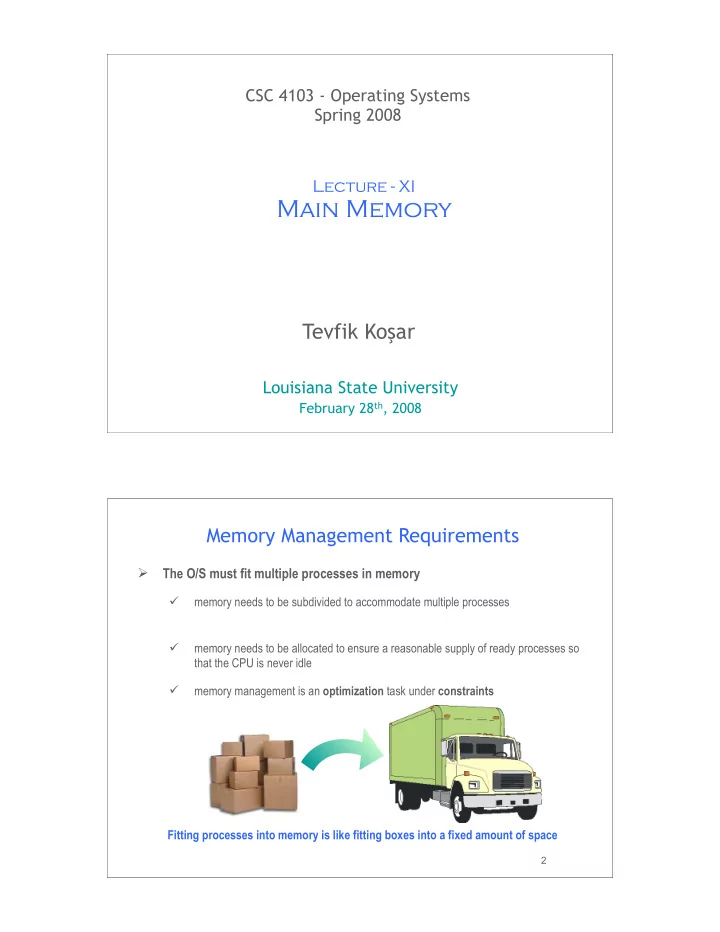
CSC 4103 - Operating Systems Spring 2008 Lecture - XI Main Memory Tevfik Ko ar Louisiana State University February 28 th , 2008 1 Memory Management Requirements The O/S must fit multiple processes in memory memory needs to be


slide-1
SLIDE 1

1

CSC 4103 - Operating Systems Spring 2008

Tevfik Koar

Louisiana State University

February 28th, 2008

Lecture - XI

Main Memory

2

  • The O/S must fit multiple processes in memory
  • memory needs to be subdivided to accommodate multiple processes
  • memory needs to be allocated to ensure a reasonable supply of ready processes so

that the CPU is never idle Fitting processes into memory is like fitting boxes into a fixed amount of space

  • memory management is an optimization task under constraints

Memory Management Requirements

slide-2
SLIDE 2

12

Memory Allocation - contiguous

  • Fixed-partition allocation

– Divide memory into fixed-size partitions – Each partition contains exactly one process – The degree of multi programming is bound by the number of partitions – When a process terminates, the partition becomes available for other processes no longer in use

OS process 5 process 9 process 2 process 10 13

Memory Allocation (Cont.)

  • Variable-partition Scheme

– When a process arrives, search for a hole large enough for this process – Hole – block of available memory; holes of various size are scattered throughout memory – Allocate only as much memory as needed – Operating system maintains information about: a) allocated partitions b) free partitions (hole)

OS process 5 process 2 OS process 5 process 2 OS process 5 process 9 process 2 process 9 process 10

slide-3
SLIDE 3

14

Dynamic Storage-Allocation Problem

  • First-fit: Allocate the first hole that is big

enough

  • Best-fit: Allocate the smallest hole that is big

enough; must search entire list, unless ordered by size. Produces the smallest leftover hole.

  • Worst-fit: Allocate the largest hole; must also

search entire list. Produces the largest leftover hole.

How to satisfy a request of size n from a list of free holes First-fit and best-fit better than worst-fit in terms of speed and storage utilization

Example

6

slide-4
SLIDE 4

15

Fragmentation

  • External Fragmentation – total memory space

exists to satisfy a request, but it is not contiguous (in average ~50% lost)

  • Internal Fragmentation – allocated memory may

be slightly larger than requested memory; this size difference is memory internal to a partition, but not being used

  • Reduce external fragmentation by compaction

– Shuffle memory contents to place all free memory together in one large block – Compaction is possible only if relocation is dynamic, and is done at execution time

8

Logical Address Space

  • Each process has a

separate memory space

  • Two registers provide

address protection between processes:

  • Base register: smallest

legal address space

  • Limit register: size of

the legal range

slide-5
SLIDE 5

9

Address Binding

  • Addresses in a source program are generally symbolic

– eg. int count;

  • A compiler binds these symbolic addresses to

relocatable addresses

– eg. 100 bytes from the beginning of this module

  • The linkage editor or loader will in turn bind the

relocatable addresses to absolute addresses

– eg. 74014

  • Each binding is mapping from one address space to

another

10

Binding of Instructions and Data to Memory

  • Compile time: If memory location known a

priori, absolute code can be generated; must recompile code if starting location changes

  • Load time: Must generate relocatable code if

memory location is not known at compile time; need only reload if starting address changes

  • Execution time: Binding delayed until run

time if the process can be moved during its execution from one memory segment to

  • another. Need hardware support for address

maps. Address binding of instructions and data to memory addresses can happen at three different stages

slide-6
SLIDE 6

11

Logical vs Physical Address Space

  • Address generated by CPU is referred as logical address
  • Address seen by the memory is seen as physical address
  • Compile time and load time methods generate identical

logical and physical addresses

  • Execution-time method generates different logical and

physical addresses

– Logical address referred as virtual address

12

Memory-Management Unit (MMU)

  • Hardware device that maps

virtual to physical address

  • In MMU scheme, the value in the

relocation register (base register) is added to every address generated by a user process at the time it is sent to memory

  • The user program deals with

logical addresses; it never sees the real physical addresses

slide-7
SLIDE 7

13

HW Address Protection

  • CPU hardware compares every address generated in user mode

with the registers

  • Any attempt to access other processes’ memory will be trapped

and cause a fatal error

16

Paging - noncontiguous

  • Physical address space of a process can be

noncontiguous

  • Divide physical memory into fixed-sized blocks

called frames (size is power of 2, between 512 bytes and 8192 bytes)

  • Divide logical memory into blocks of same size

called pages.

  • Keep track of all free frames
  • To run a program of size n pages, need to find n

free frames and load program

  • Set up a page table to translate logical to physical
slide-8
SLIDE 8

17

Address Translation Scheme

  • Address generated by CPU is divided into:

– Page number (p) – used as an index into a page table which contains base address of each page in physical memory – Page offset (d) – combined with base address to define the physical memory address that is sent to the memory unit

18

Address Translation Architecture

slide-9
SLIDE 9

19

Paging Example

20

Paging Example

slide-10
SLIDE 10

21

Free Frames

Before allocation After allocation

22

Shared Pages

  • Shared code

– One copy of read-only (reentrant) code shared among processes (i.e., text editors, compilers, window systems). – Shared code must appear in same location in the logical address space of all processes

  • Private code and data

– Each process keeps a separate copy of the code and data – The pages for the private code and data can appear anywhere in the logical address space

slide-11
SLIDE 11

23

Shared Pages Example

22

Midterm

  • Chapters 1 - 7 from Silbershatz
  • Important Topics:

– Processes – Threads – CPU Scheduling – Process Syncronization – Threads

  • Closed book exam
  • Midterm review next Tuesday
  • Solve the sample exam