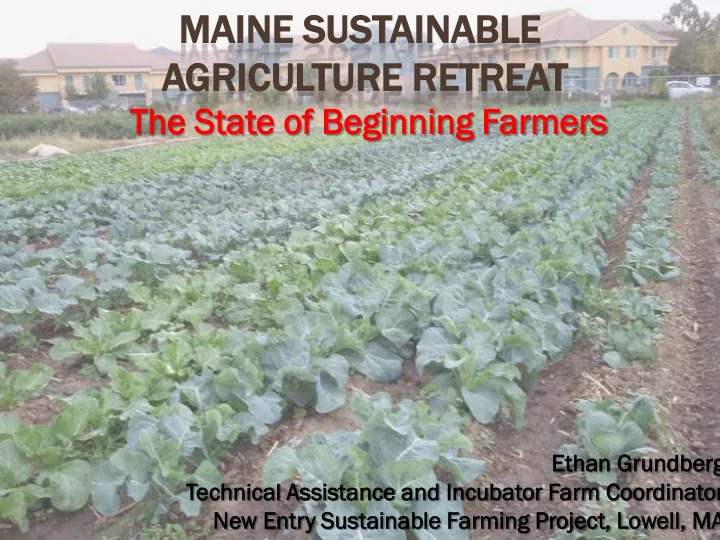
SLIDE 1 MAINE INE SU SUST STAINAB INABLE LE AGRI RICUL ULTURE URE RE RETRE REAT
The e Sta tate e of Be Begi ginni nning ng Farmer ers
Ethan han Grundbe berg rg Technic nical al Assist istanc ance e and Incubator
dinat ator
New Entry y Susta tainable inable Farming ing Proje ject, ct, Lowell, l, MA
SLIDE 2
WHY FOCUS ON BEGINNING FARMERS?
Vilsack’s goal of 100,000 new farmers Average age of US farmers increasing: Estimated
that 500,000 farmers will retire 2012-2030
Need to feed a growing global population Unique challenges faced by beginning farmers
SLIDE 3
WHO ARE BEGINNING FARMERS?
“Those who have operated a farm or ranch for 10
years or less either as sole operator or with others who have operated a farm or ranch for 10 years or less.”
SLIDE 4
WHO ARE BEGINNING FARMERS?
Younger, more diverse, and working second jobs
SLIDE 5
WHO ARE BEGINNING FARMERS?
Smaller farms, higher percentage of organic
(only captures certified organic) and direct to consumer sales
SLIDE 6
WHO ARE BEGINNING FARMERS?
Lots of animals and specialty crops, fewer grains
SLIDE 7
WHO ARE BEGINNING FARMERS?
SLIDE 8 WHO ARE BEGINNING FARMERS?
100 200 300 400 500 600 700 Number er of Farmers
Top 10 Beginning ning Farmer er Industri tries es in MA
The numbers in
Massachusetts
SLIDE 9 WHAT ARE THE CHALLENGES FOR BEGINNING FARMERS?
- 1. Most didn’t grow up farming -- must acquire production
skills, technical/mechanical skills. business skills, and managerial skills elsewhere
SLIDE 10 WHAT ARE THE CHALLENGES FOR BEGINNING FARMERS?
- 2. Lack of access to capital and credit
- Hard to save money
- Traditional sources of ag credit sometime
inappropriate or difficult to obtain
SLIDE 11 WHAT ARE THE CHALLENGES FOR BEGINNING FARMERS?
- 3. Lack of access to land
U.S. Average Land Values
$0 $200 $400 $600 $800 $1,000 $1,200 $1,400 $1,600 $1,800 $2,000 1950 1953 1956 1959 1962 1965 1968 1971 1974 1977 1980 1983 1986 1989 1992 1995 1998 2001 2004
SLIDE 12
WHAT ARE THE CHALLENGES FOR BEGINNING FARMERS?
4.High costs of student loan debt payment and health care
SLIDE 13 WHAT ARE THE CHALLENGES FOR BEGINNING FARMERS?
- 5. Direct to consumer marketing
SLIDE 14 RESOURCES TO HELP BEGINNING FARMERS SUCCEED
Government
programs
BFRDP Funding Individual
Development Accts (2008 Farm Bill)
FSA Beginning Farmer
Fund
Micro-lenders Student Farms Incubator Programs
SLIDE 15 THE NEW ENTRY MODEL
The missio sion n of t f the New Entry y Sustain ainab able le Farm rming g Proj roject ct (New Entry) y) is to assist pe peopl ple with limit ited d re resourc rces es who have an interes rest in smal all-scale scale com
rcial l ag agri ricultur lture, e, to
farm rming in Massac sachuse usetts.
roader r goals s of Ne f New Entry y are re to supp pport t the vitality ity and sustain ainabili ability ty of t f the re region's 's agri ricultu lture re, , to build long term rm economic mic self-rel relian iance ce and food securi rity ty among pa partic icip ipants ants an and their r com
nities, es, an and to
pand ac access ss to
uali lity, , cultur urally ally app pprop ropri riate e foods in underser erved ed are reas throug rough h pro production tion of l f locall lly-gr grown n foods.
SLIDE 16
THE NEW ENTRY MODEL
Ex Explore lore Far arming! ng!
SLIDE 17
THE NEW ENTRY MODEL
Far arm Business ness Pla lanning ing Cla lass
SLIDE 18
THE NEW ENTRY MODEL
Incuba cubator Far arm Trai aining ing Sites
SLIDE 19
THE NEW ENTRY MODEL
Pr Prac actical tical Field ld Trai ainings ings
SLIDE 20 THE NEW ENTRY MODEL
World ld PEA EAS S Mark arketin ting g Cooperat
ive
SLIDE 21
THE NEW ENTRY MODEL
Lan and d Mat atch ching ng Service ice
SLIDE 22 THE NEW ENTRY MODEL
Mi Miscellaneous cellaneous projects: ects: Livest stock
/MPPU U an and BF BFAA
SLIDE 23
REMAINING GAPS IN SERVICE PROVISION
Mechanical training Access to appropriate
credit sources
Access to larger tracts of
land
Assistance with laws,
regulation, and certification
Assistance with
accounting/record keeping
Advanced training
curriculum for beginning farmers scaling-up
SLIDE 24
REMAINING GAPS IN SERVICE PROVISION
SLIDE 25
QUESTIONS?
SLIDE 26 PRIMARY REFERENCES
2007 Census of Agriculture: New Farms, New Farm Operators. http://www.agcensus.usda.gov/Publications/2007/Online_Highlights/Fact_Sheets/new_farm s.pdf Ahearn, Mary and Doris Newton. Beginning Farmers and Ranchers. USDA Economic Information Bulletin Number 53, May 2009. http://ers.usda.gov/Publications/EIB53/EIB53.pdf Duffy, Michael. Issues Facing Beginning Farmers and Ranchers. Iowa State Beginning Farmer Center, July 2007. www.apfo.usda.gov/Internet/FSA_File/issues sues.ppt Low, Sarah A. and Stephen Vogel. Local Foods Marketing Channels Encompass a Wide Range of
- Producers. Amber Waves Magazine, a Publication of the ERS.,December 2011.
http://www.ers.usda.gov/AmberWaves/December11/Features/LocalFoodMarketing.htm Shute, Lindsey et al. Building a Future with Farmers: Challenges Faced by Young, American Farmers and a National Strategy to Help Them Succeed. National Young Farmers Coalition, November 2011. http://www.youngfarmers.org/reports/Building_A_Future_With_Farmers.pdf