Mainstreaming concepts and approaches of SEPLS into policy and - - PowerPoint PPT Presentation

mainstreaming concepts and
SMART_READER_LITE
LIVE PREVIEW

Mainstreaming concepts and approaches of SEPLS into policy and - - PowerPoint PPT Presentation

Satoyama Initiative Thematic Review vol.2 Mainstreaming concepts and approaches of SEPLS into policy and decision- making Presented by Suneetha M Subramanian UNU-IAS @ COP 13, Cancun Satoyama Initiative Thematic Review A compilation


slide-1
SLIDE 1

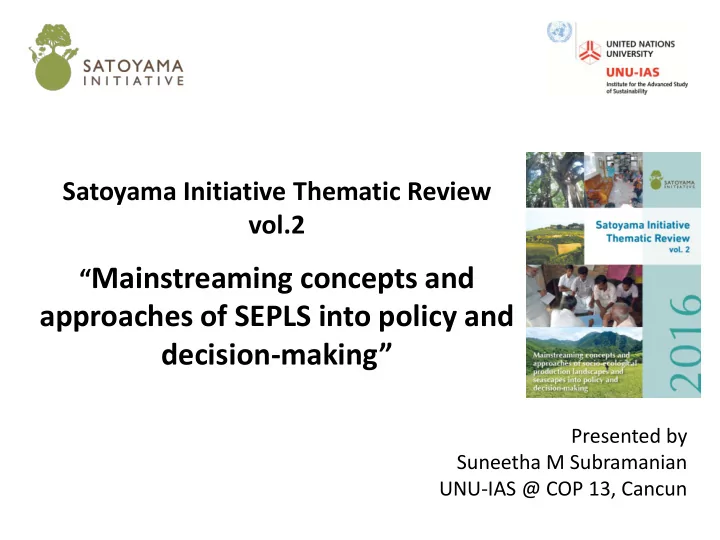
Satoyama Initiative Thematic Review vol.2 “Mainstreaming concepts and

approaches of SEPLS into policy and decision-making”

Presented by Suneetha M Subramanian UNU-IAS @ COP 13, Cancun

slide-2
SLIDE 2

Satoyama Initiative Thematic Review

  • A compilation of case studies from IPSI

members on a specific issue in SEPLS

  • Vol. 1: Tools and approaches for enhancing

knowledge for SEPLS management –

  • Vol. 2 Mainstreaming concepts and approaches of

SEPLS

  • Provide useful knowledge based on

members’ on-the-ground activities

  • Make targeted contributions to policy and

academic discussions to encourage the application of lessons learned in the field.

  • IPSI Collaborative

Activity (UNU-IAS and IGES)

  • Initiated in 2015
slide-3
SLIDE 3

Publication process

  • Developed through a multi-stage process
  • Provide feedback on papers among authors
  • In-depth discussion among authors

Case Study Workshop:

  • Feedback from

participants

  • In-depth

discussion on the theme

Revision of papers Synthesis paper development Publication Review by

  • ther

authors Submission

slide-4
SLIDE 4

Satoyama Initiative Thematic Review

Vol 2

“Mainstreaming concepts and approaches of socio- ecological production landscape and seascapes into policy and decision-making” Larger-scale adoption of activities for SEPLS conservation

– Replication of community level activities – Upscaling by incorporating into policy-planning and implementation processes

slide-5
SLIDE 5

Case Studies

Authors Sites Topic

Liu & Liu Yunnan, China Policies and development interventions related to forest use and traditional knowledge (TFRK) Gualandi & Gualandi Tuscany, Italy Revitalization of ancient wheat varieties through coordinated links among producers, processors and others Kieninger et al Wachau, Austria Policy tools and market mechanisms for cultural landscapes conservation Lee et al Hualien County, Taiwan Tailoring of the concept of SEPLS in the planning of protected area planning Olupot & Isabirye- Basuta Mabira Central Forest Reserve, Uganda Evaluation of landscape values for ecotourism in a Reserve Forest area Kumar & Prajeesh Kerala, India Action research and advocacy projects for agro-biodiversity, livelihood improvement, and capacity building Pandit et al Four districts in Nepal Development LBSAPs and domestication of wild herb species

slide-6
SLIDE 6

Various dimensions of mainstreaming activities

  • Focuses of the activities

Biodiversity conservation, resource management, sectoral activities, poverty and livelihood, cultural aspects, social equity

  • Socio-economic contexts

Demography, literacy, knowledge, values, adaptive capacity, institutions, economic activities, power structure, policy and planning, climate change, disasters

  • Relevant sectors

Agriculture, forest, tourism, protected area, production and consumption, etc

  • Existing policy/institutional framework utilized

NBSAP, protected area zoning and management plan, regional laws on use of local products; agricultural subsidies, local action groups, etc

slide-7
SLIDE 7

Overarching principles for successful mainstreaming

Mobilise knowledge towards action

  • Integrate traditional and modern scientific knowledge on management of SEPLS

for appropriate pathways for their conservation under different social, political and economic contexts

  • Translate, transcribe and transform knowledge through inter- and trans-

disciplinary approaches

Foster and leverage inclusive participation

  • Foster a participatory approach to create a shared vision and identify composite or

inter-linked goals that address multiple objectives

  • Foster “collective efficacy” through:

– Building trust among stakeholders – Identifying relevant institutions and define roles – Engaging higher political systems and get feedback – Encouraging cross-learning among communities and stakeholders for development of capacities and to raise awareness

Adaptive planning and management of activities

  • Establish long-term monitoring and periodic review
  • Make sure replication efforts are flexible
slide-8
SLIDE 8

Call for abstract for Thematic Review vol. 3 is now open!

Thank you for your attention!