making it possible. Darko Brkan, May 22, 2012 Creating a Civic - - PowerPoint PPT Presentation

making it possible darko brkan may 22 2012 creating a
SMART_READER_LITE
LIVE PREVIEW

making it possible. Darko Brkan, May 22, 2012 Creating a Civic - - PowerPoint PPT Presentation

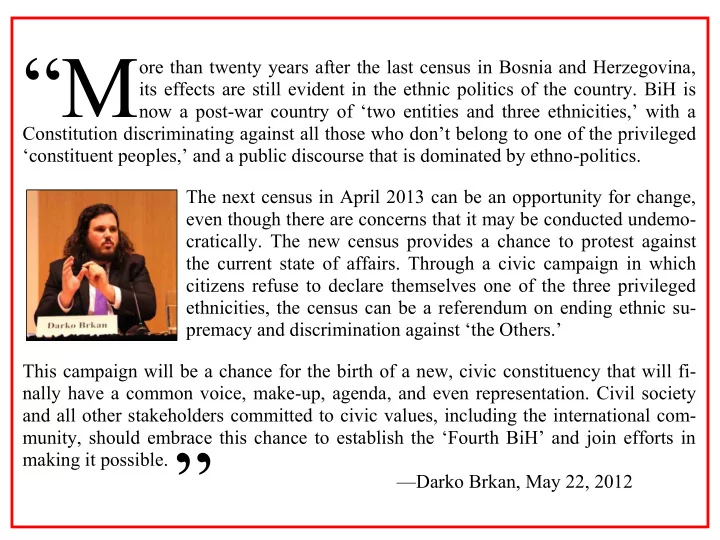
M ore than twenty years after the last census in Bosnia and Herzegovina, its effects are still evident in the ethnic politics of the country. BiH is now a post-war country of two entities and three ethnicities, with a Constitution


slide-1
SLIDE 1
  • re than twenty years after the last census in Bosnia and Herzegovina,

its effects are still evident in the ethnic politics of the country. BiH is now a post-war country of ‘two entities and three ethnicities,’ with a Constitution discriminating against all those who don’t belong to one of the privileged ‘constituent peoples,’ and a public discourse that is dominated by ethno-politics. The next census in April 2013 can be an opportunity for change, even though there are concerns that it may be conducted undemo-

  • cratically. The new census provides a chance to protest against

the current state of affairs. Through a civic campaign in which citizens refuse to declare themselves one of the three privileged ethnicities, the census can be a referendum on ending ethnic su- premacy and discrimination against ‘the Others.’ This campaign will be a chance for the birth of a new, civic constituency that will fi- nally have a common voice, make-up, agenda, and even representation. Civil society and all other stakeholders committed to civic values, including the international com- munity, should embrace this chance to establish the ‘Fourth BiH’ and join efforts in making it possible. —Darko Brkan, May 22, 2012

“M ”

slide-2
SLIDE 2

Creating a Civic Constituency in Bosnia and Herzegovina

Darko Brkan

Reagan-Fascell Democracy Fellow National Endowment for Democracy 22 May 2012

The views expressed in this presentation are those of the speaker and do not necessarily reflect the views of the National Endowment for Democracy or its staff.

slide-3
SLIDE 3

I. INTRODUCTION TO THE BASIC CONCEPTS II. THE CENSUS AND “THE OTHERS” III. THE ROAD TO “THE FOURTH BiH” IV. THE CAMPAIGN V. RECOMMENDATIONS

PRESENTATION OVERVIEW

slide-4
SLIDE 4
  • I. INTRODUCTION TO BASIC CONCEPTS

1.

  • 1. BOS

OSNIA NIA AND ND HE HERZEGOVINA GOVINA 2.

  • 2. ET

ETHN HNO-PO POLITI LITICS CS 3.

  • 3. CIVIC

VIC CON ONSTITUENCY TITUENCY

slide-5
SLIDE 5
  • Defined as a state by the

Dayton Peace Agreement (1995)

  • Comprised of two entities
  • Republic of Srpska
  • Federation BiH
  • Federation BiH consists of

10 Cantons

  • Brčko District is an

autonomous district

BASIC FACTS ON BiH – TERRITORY

slide-6
SLIDE 6
  • State level
  • Presidency – 3 members
  • Two chamber parliament (15 + 42)
  • Council of Ministries (10)
  • Republic of Srpska Entity
  • President and two vice presidents
  • Two chamber parliament (28 + 83)
  • Government (17)
  • Federation BiH Entity
  • President and two vice presidents
  • Two chamber parliament (58 + 98)
  • Government (17)
  • 10 cantonal parliaments and governments

BASIC FACTS ON BiH – GOVERNMENT

28 14 83

8 8 8 4

98

17 17 17 7 9 5 3 1?

˃5

  • Bosniak
  • Serb
  • Croat
  • Other
  • Any
slide-7
SLIDE 7

Main Characteristics

  • Defined in the constitution
  • “Bosniaks, Croats, and Serbs, as constituent peoples (along with

Others), and citizens of Bosnia and Herzegovina hereby determine that the Constitution of Bosnia and Herzegovina is as follows…”

  • Enshrined in the legislation
  • Election legislation, civil service legislation, human rights

protection legislation, etc.

  • Public discourse dominated by ethno-politics
  • Ethnicity protection presumed to justify any public action

ETHNIC SOCIETY IN BiH – THE DOMINANT THREE

slide-8
SLIDE 8
  • Majority of the population identifies with one of the three

ethnicities

  • Any of the ethnic groups is much bigger than any other non-

ethnicity based group in the society

  • Each ethnic group has a common and inherent political agenda
  • Ethnic groups are the only relevant groups with a common

political agenda

  • Ethnic groups have a unified voice and representation
  • Ethno-politics results from the necessity to protect ethnic

groups

  • The three groups fought the war – current political reality is a

compromise to end it

ARGUMENTS FOR ETHNO-POLITICS

slide-9
SLIDE 9
  • Mostly perceived as “The Others”
  • Undefined in terms of make-up, agenda, or political

representation

  • Lacks a common voice in public discourse
  • Geographically dispersed
  • Perceived as a minority

CIVIC CONSTITUENCY – CURRENT ASSUMPTIONS

slide-10
SLIDE 10
  • II. THE CENSUS AND “THE OTHERS”
slide-11
SLIDE 11
  • Conducted in March 1991
  • The last accurate demographic set of data in BiH
  • The impact of the question on ethnicity
  • The impact of the 1990 elections – referendum
  • n ethnicity
  • Result –current legislation related to ethnic

representation is based on it

THE LAST CENSUS

slide-12
SLIDE 12

THE 1991 CENSUS - RESULTS

500000 1000000 1500000 2000000 2500000 3000000 3500000 4000000 4500000

TOTAL Bosniaks Serbs Croats 4,377,033 1,902,956 1,366,104 760,852

TOTAL Bosniaks Serbs Croats 4,377,033 1,902,956 1,366,104 760,852 100.00% 43.48% 31.21% 17.38%

slide-13
SLIDE 13
slide-14
SLIDE 14

ETHNIC STRUCTURE – CURRENT ESTIMATES

TOTAL Bosniaks Serbs Croats 3,900,000 1,900,000 1,400,000 550,000 100.00% 48.71% 35.89% 14.10%

500000 1000000 1500000 2000000 2500000 3000000 3500000 4000000

TOTAL Bosniaks Serbs Croats 3,900,000 1,900,000 1,400,000 550,000

slide-15
SLIDE 15

ETHNIC STRUCTURE – CURRENT ESTIMATES

500000 1000000 1500000 2000000 2500000 3000000 3500000 4000000 4500000

TOTAL 1991 TOTAL 2006 Bosniaks 1991 Bosniaks 2006 Serbs 1991 Serbs 2006 Croats 1991 Croats 2006 4,337,033 3,900,000 1,902,956 1,900,000 1,366,104 1,400,000 760,852 550,000

TOTAL Bosniaks Serbs Croats 4,337,033 1,902,956 1,366,104 762,852 3,900,000 1,900,000 1,400,000 550,000

slide-16
SLIDE 16

LET’S HAVE A LOOK AT HOW THE ETHNIC STRUCTURE HAS CHANGED... 1991 vs. NOW?

slide-17
SLIDE 17
slide-18
SLIDE 18

THE MISSING LINK

TOTAL Bosniaks Serbs Croats 4,377,033 1,902,956 1,366,104 760,852 100.00% 43.48% 31.21% 17.38%

The 1991 Census Current Estimates

TOTAL Bosniaks Serbs Croats 3,900,000 1,900,000 1,400,000 550,000 100.00% 48.71% 35.89% 14.10%

43.48 + 31.21 + 17.38 = 92.07 48.71 + 35.89 + 14.10 = 98.70

7.93% = ??? 1.30% = ???

“The Others” – all of the population of BiH that is not Bosniak, Serb or Croat - Constituent

slide-19
SLIDE 19

Constituencies of “The Others”

  • 17 ethnic minorities in BiH
  • People from mixed marriages (not deciding between

their parents)

  • People who don’t identify with ethnicity

How are they represented

  • Census 1991 – under-represented
  • Current estimates – not even considered
  • Public perception of “The Others” as non-constituent

“THE OTHERS” – ETHNIC PERSPECTIVE

slide-20
SLIDE 20
slide-21
SLIDE 21
  • The name itself
  • Election legislation (Presidency, House of Peoples)
  • Sejdić-Finci case at the European Court of Human Rights
  • Many elected offices (House of Peoples in both entities,

Governments on state and entity levels, parliaments on state and entity levels)

  • Civil service employment procedures and legislation
  • Even the institution of the Ombudsman for Human Rights
  • Police governing body

“THE OTHERS” – EXAMPLES OF DISCRIMINATION

slide-22
SLIDE 22
  • Ethnic minorities – probably between 100-150,000

people

  • People from mixed marriages – potential of several

hundred thousand (12% of all marriages since the ’70s,

  • ver 25% in bigger cities)
  • Not identifying with ethnicity – several hundred

thousand, mostly urban areas (reference – recent elections)

  • On the 1991 Census – 347,121 people identified as not
  • ne of the three main ethnicities

HOW MANY ARE “THE OTHERS”?

slide-23
SLIDE 23
  • III. THE ROAD TO “THE FOURTH BiH”
slide-24
SLIDE 24
  • Giving voice to the “Civic Constituency”
  • Introducing civil society (ie. society of citizens) as a

legitimate alternative

  • Giving a public platform to all not favoring the

exclusivity of ethnic representation

  • Ending discrimination against “The Others”
  • Providing the basis for ending ethnic supremacy

GOALS OF “THE FOURTH BiH”

slide-25
SLIDE 25

Traditional constituencies: “The Others”

  • 1. Ethnic minorities
  • 2. Undecided from mixed marriages
  • 3. Not identifying with ethnicity

The new constituency

  • 4. Civic concept as a response to ethno-politics
  • a. Don’t agree with ethnic representation as such
  • b. Don’t agree with the discrimination
  • c. A bridge from “The Others” to “The Civic Constituency”

FOUR CONSTITUENCIES OF THE FOURTH BiH

slide-26
SLIDE 26
  • IV. THE CAMPAIGN
slide-27
SLIDE 27

Advocates for civic values in past years

  • NGOs
  • Political parties/politicians
  • Academics and engaged public figures
  • Individual citizens and informal civic groups
  • International community
  • Independent media outlets

ADVOCATES & CAMPAIGNS TO DATE

slide-28
SLIDE 28

THE CENSUS FORM

G R A Đ A N I N

slide-29
SLIDE 29
  • It will have tangible results
  • It will have direct and indirect implications on the legal system

and public discourse

  • All major actors, domestic and international, will be

interested and engaged

  • It opens an arena to debate ethnicity issues
  • It is a chance to mobilize people
  • It is a chance for a broad coalition of civil society
  • It is a chance to include various stakeholders
  • It can counter all ethno-politics based arguments

WHY IS CENSUS THE RIGHT TIME AND PLACE

slide-30
SLIDE 30

ARGUMENTS FOR ETHNO POLITICS ARGUMENTS FOR CIVIC CONSTITUENCY

  • There is a considerable population NOT identifying with

the three ethnicities

  • This group is bigger than or equal to at least one of the

constituent groups

  • The above mentioned group has a common and

inherent political agenda

  • “Civic constituency” is also a relevant group with a

common political agenda

  • This group also has a unified voice and representation
  • Civic constituency’s goal is to protect individuals and

human rights

  • The three groups have had enough exclusivity – it is

time for a new social contract

slide-31
SLIDE 31
  • V. NEXT STEPS
slide-32
SLIDE 32

To BiH civil cociety and civic groups

  • Be aware of the importance and implications of the census
  • Form a strong and open coalition
  • Formulate a strong and unified message
  • Create an action plan both for the census and post-census

campaigns

  • Mobilize members and supporters

To public figures, academics and citizens

  • Use media appearances to inform and engage the people
  • Echo the civil society message to shape public debate

NEXT STEPS

slide-33
SLIDE 33

To BiH political parties

  • Ensure fairness of the census

To parties against ethnic exclusivity

  • Support the goals of the campaign
  • Call on members to participate

To parties for ethnic exclusivity

  • Refrain from militant rhetoric
  • Refrain from using fear/hatred campaigning around census

To the international community

  • Time to walk the walk
  • Condemn any use of militant rhetoric
  • Prevent forging of the results
  • Empower civil society and help with the campaign implementation

NEXT STEPS

slide-34
SLIDE 34

THANK YOU!