Making the Global Goals Local Business June, 2017 Responding to an - - PowerPoint PPT Presentation

making the global goals local business
SMART_READER_LITE
LIVE PREVIEW

Making the Global Goals Local Business June, 2017 Responding to an - - PowerPoint PPT Presentation

Making the Global Goals Local Business June, 2017 Responding to an Uncertain World Inequality and Globalisation Refugees, migrants and asylum Refugees in Numbers T op Hosting Countries Of the 65.3m forcibly Approximately half of all The


slide-1
SLIDE 1

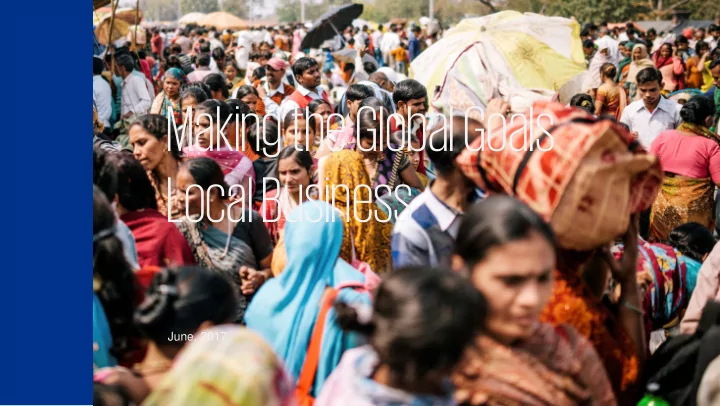
Making the Global Goals Local Business

June, 2017
slide-2
SLIDE 2
slide-3
SLIDE 3

Responding to an Uncertain World

slide-4
SLIDE 4
slide-5
SLIDE 5
slide-6
SLIDE 6
slide-7
SLIDE 7

Inequality and Globalisation

slide-8
SLIDE 8
slide-9
SLIDE 9
slide-10
SLIDE 10
slide-11
SLIDE 11
slide-12
SLIDE 12
slide-13
SLIDE 13

Refugees, migrants and asylum

slide-14
SLIDE 14
slide-15
SLIDE 15
slide-16
SLIDE 16
slide-17
SLIDE 17

Refugees in Numbers

T

  • p Hosting Countries
  • Jordan, 664,000
  • Ethiopia, 736,100
  • Iran, 979,400
  • Lebanon, 1.1m
  • Pakistan, 1.6m
  • Turkey, 2.6m

Of the 65.3m forcibly displaced people around the world nearly 21.3m are refugees and over half are under the age

  • f 18 with 98,400

unaccompanied. The average refugee child, or internally displaced child, spends up to 17 years in camps away from home and education. Approximately half of all refugee and internally displaced children receive a primary education with less that 25% getting a secondary education.

Source: UNHCR, 2016
slide-18
SLIDE 18

The European Refugee Crisis

slide-19
SLIDE 19

UN’s Sustainable Development Goals

slide-20
SLIDE 20
  • 836 million people still live in

extreme poverty

  • About one in five persons in

developing regions lives on less than $1.25 per day

  • The overwhelming majority of

people living on less than $1.25 a day belong to two regions: Southern Asia and sub-Saharan Africa

  • High poverty rates are often

found in small, fragile and conflict-affected countries

  • One in four children under age

five in the world has inadequate height for his or her age

  • 33,972 people a day are forced

to flee their homes because of conflict and persecution

slide-21
SLIDE 21
slide-22
SLIDE 22

Lifelong Learning

slide-23
SLIDE 23
slide-24
SLIDE 24

1 2 3

Equitable, quality education can increase a country’s gross domestic product per capitaby 23% in 40 years1. US$1 dollar invested in an additional year of schooling generates US$10 in earnings and health benefits in low-income countries (US$4 return in lower-middle income countries and US$2 return in upper-middle income countries)2. In 2030 in low-income countries, under present trends, only 1 out of 10 young people will be on track to gain basic secondary-level skills4. There are 758 million adults who still cannot read or write – two-thirds of them are women5. If current trends continue, more than 1.5 billion adults will have no education beyond primary school in 20303.

Return on Investment Schooling

US$1

23%

GDP increase fromeducation

1.5bn

adults experience restricted basiceducation

Literacy

4 5

1in

Only10 758m teenagers adults areilliterate will acquire basicskills
  • f schoolinggenerates

US$10

More than

Ten Stunning Statistics

slide-25
SLIDE 25 No country has everachieved continuous and rapid economic growth without having first achieved an adult literacy rate above 40%6. Functional illiteracy costs the world US$1.2 trillion per year7. In 2015, the Youth Unemployment Rate among OECD countries was more than 40% in Italy, Spain, Greece and SouthAfrica9. 40% of employers globally are finding it difficult to recruit people with the skills they need10. 600 million young people(one
  • ut of every two) are without
productive employment8.

Literacy (continued)

US$1.2tn 600m 40%

young people withoutproductive employment peryear

40%

iskey to rapid economicgrowth Youth Unemployment rate

40%

  • f employers havedifficulty
recruiting skilledpeople

1

Employability

2 3 4 5

More than Illiteracycosts Adult literacyabove

Ten Stunning Statistics (continued)

slide-26
SLIDE 26

A Business Response

slide-27
SLIDE 27

Companies that Change the World

Vodafone and Kenyan telecom company Safaricom had modest expectations for the mobile-money platform they created in 2007 . Many thought M-Pesa - which lets people who lack bank accounts use their phones to save and transfer money, receive pensions, and pay bills - was a worthwhile idea but didn’t imagine it would transform the regional

  • economy. Within months, though, membership rocketed. Today 17 million

people in East Africa, India, Romania, and Albania - many of whom are on the financial grid for the first time - use M-Pesa. “It has been revolutionary, ” says World Bank economist Wolfgang Fengler. “It has changed lives, businesses, and the perception of Africa, and brought substantial flows into the financial system that would have

  • therwise been lying literally under mattresses.

” A staggering 42% of Kenya’s GDP is transacted through M-Pesa, and for Vodafone, brand loyalty has followed. Fewer than 0.1% of its customers in Kenya have dropped the company since 2010, says Vodafone’s Michael Joseph, a former Safaricom CEO who oversees M-Pesa.

slide-28
SLIDE 28

Vodafone m-pesa M for mobile, pesa is Swahili for money

slide-29
SLIDE 29

Unilever’s Sustainable Living Plan

slide-30
SLIDE 30

Project Literacy (Pearson)

slide-31
SLIDE 31

KPMG and the Millennium Villages Project Our purpose was to see the Millennium Develop Goals achieved.

slide-32
SLIDE 32

KPMG Hungary and the SDGs

Sustainable Development Goals (SDGs): The goals were adopted by world leaders in September 2015 at an historic UN Summit. Our services and other local internal and external activities directly or indirectly contributes to achieve these

  • goals. (The most relevant ones

are highlighted.)

Environmental and economic value creation:
  • Renewable energy and energy efficiency advisory
  • Sustainability services (e.g. strategy, True Value)
  • Decreasing emissions
  • Paperless solutions in the office
Social value creation:
  • Diversity audit and
activities
  • Maternity related
activities Economic value creation:
  • Transparency through
  • ur audit services
  • Efficiency through our
tax and advisory services Economic value creation:
  • Rural development
related services
  • Equal rights in HR
policies
  • Mentor programs
Social value creation:
  • Workplace health and
wellbeing programs
  • Healthcare advisory
solutions Social value creation:
  • Education related advisory and IT services
  • Learning&development programs to employees
  • Education programs to university students (dual
trainings, competitions)
  • Lectures, mentoring and donation
Social value creation:
  • Cooperation with
chambers, professional
  • rganizations,
universities, etc. Environmental and social value creation:
  • Smart City related
solutions Economic and social value creation:
  • Agriculture and rural
development related services Environmental value creation:
  • Sustainable sourcing in our
procurement
  • Waste management
  • Responsible event
management Social value creation:
  • Corporate
Responsibility programs (pro bono, donations, etc.) Environmental, economic and social value creation:
  • Energy advisory
projects,
  • Global Energy
Centre of excellence Economic value creation:
  • Infrastructure,
technology developments,
  • Major project advisory
Economic and social value creation:
  • Ethics&compliance
  • EU&gov. &NGO work
  • Risk consulting
solutions (IA, SDD) Economic and social value creation:
  • Agriculture and
rural development related services
slide-33
SLIDE 33

Approx 600 sustainability professionals in 60 countries ■ Sustainability reporting & assurance ■ Social/environmental impact assessment ■ Social/environmental risk assessment and strategy ■ Human rights advisory ■ Green bonds ■ Sustainable supply chains ■ Carbon footprinting and reduction ■ Environmental, Health & Safety assessment and ESG due diligence

Helping our clients

slide-34
SLIDE 34

Financial Services Transportation Industrial Manufacturing Healthcare & Life Sciences Food, Beverage & Consumer Goods Energy, Natural Resources & Chemicals

slide-35
SLIDE 35
slide-36
SLIDE 36

Thank you!

@LordHastings