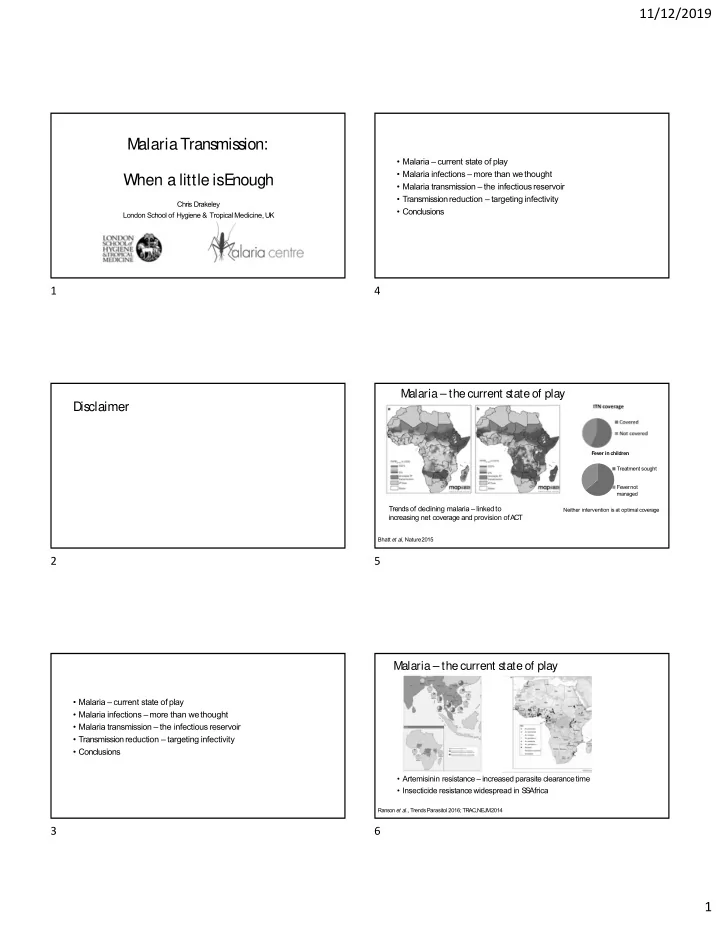
Malaria Transmission: Malaria current state of play Malaria - - PDF document

malaria transmission
SMART_READER_LITE
LIVE PREVIEW

Malaria Transmission: Malaria current state of play Malaria - - PDF document

11/12/2019 Malaria Transmission: Malaria current state of play Malaria infections more than wethought When a little isE nough Malaria transmission the infectiousreservoir Transmission reduction targeting


slide-1
SLIDE 1

11/12/2019 1

Malaria Transmission: When a little isE nough

Chris Drakeley London School of Hygiene & Tropical Medicine,UK

Disclaimer

  • Malaria – current state of play
  • Malaria infections – more than wethought
  • Malaria transmission – the infectiousreservoir
  • Transmission reduction – targeting infectivity
  • Conclusions
  • Malaria – current state of play
  • Malaria infections – more than wethought
  • Malaria transmission – the infectiousreservoir
  • Transmission reduction – targeting infectivity
  • Conclusions

Malaria – the current s tate of play

Bhatt et al, Nature2015

Trends of declining malaria – linkedto increasing net coverage and provision ofACT

Fever in children Treatment sought Fevernot managed Neither intervention is at optimalcoverage

Malaria – the current s tate of play

  • Artemisinin resistance –increased parasite clearancetime
  • Insecticide resistance widespread in S

S Africa

Ranson et al., Trends Parasitol 2016; TRAC, NEJM2014

1 2 3 4 5 6

slide-2
SLIDE 2

11/12/2019 2

Malaria – the current s tate of play

3

WHO World Malaria Report2018

Current investment is insufficient with siginifcantly less per personat risk invested now thanpreviously Bending the curve Alternative strategiesand targeting transmission

  • Malaria – current state of play
  • Malaria infections – more than wethought
  • Malaria transmission – the infectiousreservoir
  • Transmission reduction – targeting infectivity
  • Conclusions

Malariainfections

  • Do we unders

tand enough about natural infections and their infectivity?

  • Symptomatic – readily detectablewith

concurrent symptoms

  • Asymptomatic –no symptoms atthe

time of sampling

  • Patent/detectable by RDT
  • r

microscopy (~100 parasites/ul)

  • Subpatent/submicroscopic –

infections that are below thelimit

  • f detection of conventional

diagnostics

Malaria infections : The more you look the more you see…

  • Large number of studies (n=~300)

reporting infections beneath the limitof microscopy and latterly RDT

  • Nucleic acid amplification tests (NAA

T) such as P C R detect at least twice asmany infections asmicroscopy or RDT

  • Sensitivity of microscopy increaseswith

P C Rprevalence

Whittaker et al under review

Malaria infections: S ubmicroscopic infections and age

Microscopy RD T under 5yrs 6-15yrs 15yrs+ Both Microscopy and RDT sensitivity is decreased in older agegroups

Ok ll N t C 2013 W N t 2015

Malaria infections: submicroscopic infections and transmission level

Microscopy RD T 5% 5-20% 20-50% Both RDT and microscopy show more discordance at lower transmissionlevels

Okell Nature Comms 2013, Wu Nature 2015

7 8 9 10 11 12

slide-3
SLIDE 3

11/12/2019 3

  • Malaria – current state of play
  • Malaria infections – more than wethought
  • Malaria transmission – the infectiousreservoir
  • Transmission reduction – targeting infectivity
  • Conclusions

Malaria transmission: gametocytes

Parasites/µl Haemoglobin g/dL ASIA

  • The vast majority of asymptomatic infectionshave

gametocytes

  • Specifically detecting gametocytes may havelimited

utility

  • Gametocyte density loosely associated with asexual

parasitaemia

  • Gametocyte densities highest in younger agegroups

AFRICA WWARN, BMC Med 2016; Goncalves et al, Nature Comm2017

Malaria Transmission: assessing infectiousnessto mosquitoes

  • Measurement of infectiousness istypically

done using mosquito feeding experiments

  • Colony (or rarely F1) mosquitoes fed onblood

from potentially infectiousindividuals

  • Mosquitoes dissected 7 days later for presence
  • f infection
  • Because of the relative logistical complexity

these studies are comparatively rare and on small numbers of samples.

  • Many submicroscopic gametocyte carriers

infect mosquitoes

  • Infection rates increase above~5

gametocytes/μL

  • Estimating male and femalegametocytes

improves prediction of infectionrates

  • Deviation from the best fit association is

indication of reduced infectivity (immunity & drugs)

Malaria Transmission: gametocyte density & infection

Goncalves et al, Nature Comm 2017; Bradley et al. eLife 2018

Malaria transmission: S ex &Drugs

  • Antimalarial drugs have varying

effects on gametocytes

  • ACT have markedeffect

Methylene blue appears to affect male gametocytes andPrimaquine females

Bousema CMR 2011, Roh Lancet ID2018

The infectious reservoir

  • f malaria

Do submicroscopic infections contribute to the infectious reservoir ?

Stone et al. Trends Parasitol 2017

13 14 15 16 17 18

slide-4
SLIDE 4

11/12/2019 4

Malaria transmission: historical reservoir estimates

  • Cross sectional surveys in wet and dry season with mosquitofeeding

(Burkina Faso,Kenya)

  • Assesments of natural mosquito biting rates

Goncalves et al Nature Comm2017 Guelbeogo et al Elife 2018 Age & infection Mosquito bitingrates P aras ite density & infection

Malaria transmission: recent reservoirestimates

Before After adjustment forbites

Malariatransmission: natural infection dynamics - modelled

Drakeley et al, Malaria Elimination INTECH2018

Malaria transmission: questionsremain…

  • More data are needed from low endemic sites (ideally combinedwith

transmission networks at molecular level)

  • Longitudinal data on parasite kinetics and infectiousness of natural

infections remain limited

  • Whilst mosquito biting is higher in adults there aresignificant

variations within household and between season

  • Variability in transmissibility of parasiteclones
  • Laboratory data suggest mosquitoes with more oocysts aremore

infectious

  • Malaria – current state of play
  • Malaria infections – more than wethought
  • Malaria transmission – the infectiousreservoir
  • Transmission reduction – targeting infectivity
  • Conclusions

Transmission reduction: Do we need to target the reservoir?

No

  • Submicroscopic infections infect

mosquitoes infrequently

  • Data from S

E Asia suggest clinical cases considerably more infectious than low density

  • Settings eliminating without specifically

targeting

  • Improving/enhancing case management

seems to have significant effect on transmission in somesettings Yes

  • Low density infections are still infectious

and predominate in somesettings

  • High density asymptomatic infections in

African settings

  • Elimination in mainly lowendemic with

historically low transmission

  • Case management alone may not

reduce all transmission and/or sufficiently rapidly

  • Drug resistance

19 20 21 22 23 24

slide-5
SLIDE 5

11/12/2019 5

Trans mis s ion reduction: what can we do?

  • How can the information on parasite carriage and infectivitybe used at

programme level?

  • What effects do different controlapproaches have on parasite densities,

carriage, age distribution and the infectiousreservoir

  • Is targeting clinical infections at clinics issufficient?
  • Mildsymptoms commonly occur upon infection can these be detected with

Enhanced community case management before gametocytes arise?

  • Infections that are initially asymptomatic and missed by CCM maybe

detected/removed by screening and treatment ?

  • Infections need to be treated/cleared (MDA) such that new infectionsilicit

symptoms ?

Transmission reduction: Targetingsymptomatics

Effective case management to catch infections early but will depend onthe ratio between symptomatic/asymptomatics 21 villages in Northern Cambodia compared clinic derived incidence and community prevalence Surveys identified a number of villages significant infections not detected by CM Requires detailed epidemiological surveillance & stratification

Falq Malaria Journal 2016

Transmission reduction: Targetingeveryone

  • Zambia - 3 rounds of MDA(DHA-P) delivered in 30 health facility catchment areas
  • Mass drug administration shown to be effective reducing prevalence and incidence
  • Questions around cost/coverage/sustainability
  • New HS-RDT may change this profoundly and make MSA

T a more viable option

Eisele, JID2016

Transmission reduction: demographictargeting

  • SMC with SP-AQ inSenegal
  • Effects on incidence and parasiteprevalence

when age range extended

  • School based in intervention inUganda
  • Significant reduction in prevalence in

individuals in environs of treatedschools

Cisse et ak 2017, Staedke et al 2018

  • Malaria – current state of play
  • Malaria infections – more than wethought
  • Malaria transmission – the infectiousreservoir
  • Transmission reduction – targeting infectivity
  • Conclusions

25 26 27 28 29 30

slide-6
SLIDE 6

11/12/2019 6

The reservoir- findingthe right analogy

Targeting thereservoir

  • What is the imperative totarget

the reservoir ?

  • What is the capacity totarget the

reservoir ?

Now it is to these gametocytes that an extreme interest attaches, because it isto them, that we owe the solution of the malaria problem.”

Sir Ronald Ross, 1900 Malaria andmosquitoes

  • Nature. Vol 61(1587)

p:523

Thanksto...

26

LS HTM, UK

  • BronnerGonçalves
  • JohnBradley
  • Lynn Grignard

CNR FP , BurkinaFas

  • Alfred Tiono
  • MoussaGuelbeogo
  • AissataBarry
  • IssaNebie
  • Sodiomon Sirima

MR TC, Mali

  • AlassaneDicko
  • AlmahamoudouMahamar
  • Harouna Soumare
  • HalimatouDiawara
  • IbrahimaBaber,

KEMRI-Wellcome, Kenya

  • MelissaKapulu
  • PhilipBejon

UC-S an Francis co, US

  • RolyGosling
  • Ingrid Chen
  • Michelle Roh
  • JoelleBrown

Imperial College, UK

  • T
  • mChurcher
  • Hannah S

later

  • Lucy Okell

UCS F – IDRC, Uganda

  • Grant Dorsey
  • MosesKamya
  • SarahSteadke
  • BryanGreenhouse

MRC Gambia

  • Umberto D’allesandro
  • JaneAchan
  • AbullahaiAhmed

Radboudumc

  • T

eun Bousema

  • Katherinne Collins
  • Kjerstin Lanke
  • Will Stone
  • Fitsum T

adesse

  • Lisette Meerstein-Kessel

31 32 33