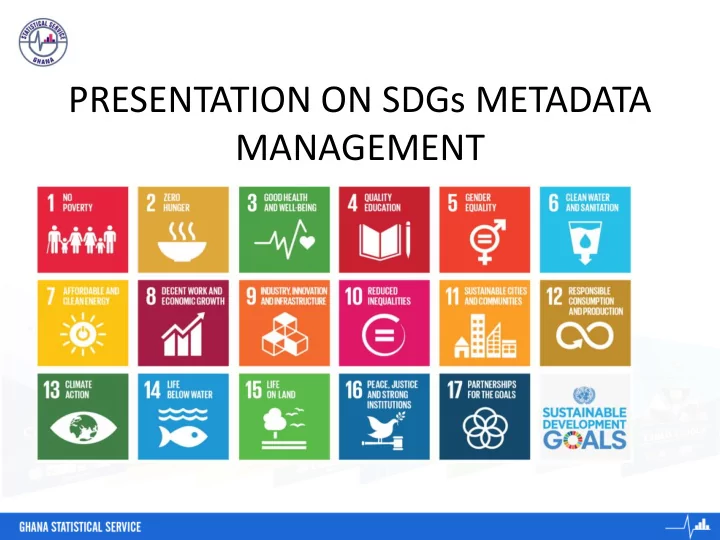
SLIDE 1
PRESENTATION ON SDGs METADATA MANAGEMENT
SLIDE 2 To fulfill the commitment to “Leave No One Behind” on which Agenda 2030 (SDGs) is based, require robust data production and tracking systems to be built so that achievements at the national and local levels can be assessed and fed into the wider global framework. Harnessing new data sources and integrating them into
- fficial statistics is key to ensure adequate supply of data
to measure the SDGs .
INTRODUCTION
SLIDE 3 NATIONAL CAPACITY ASSESSMENT
3
SLIDE 4 MEETING WITH STAKEHOLDERS WITHIN THE NSS To ensure improved method for data collection and analysis that will reduce data gaps and provide a sound base for monitoring the SDGs: ▪ Engagement with Chief Directors of MDAs
- f RSIM, PPME and MMDA to have their
buy-in to the SDGs. ▪ Prioritise the SDGs monitoring and data disaggregation in their agenda.
SLIDE 5
▪ SDGs teams were formed within the MDAs to help
facilitate the production of SDGs indicators in their respective ministries. FORMATION OF SDGs TEAMS
SLIDE 6
ALIGNMENT OF DATA ▪ The SDGs indicators were aligned to the various stakeholders within the NSS. ▪ Data collection instruments were reviewed ▪ data collection templates were developed to ensure that standardized SDG data sets and indicators are produced to monitor the SDGs at both local and global levels.
SLIDE 7
Training on Meta Data ▪ GSS invited UNSD to Ghana to train some MDAs on meta-data compilation to help solve problem of mismatch between data producers and users.
SLIDE 8
The SDGs Metadata Template
The template covers 8 broad areas: ▪ Indicator information ▪ Definitions and concepts ▪ Data sources ▪ Data collection methods ▪ Method of computation and other methodological considerations ▪ Comparability with international data/standards ▪ References and documentation
SLIDE 9
Data without metadata
▪ Data without metadata raises questions which include: ▪ What message is being carried across by the data ▪ When the data was collected ▪ How the data was collected ▪ Where it was collected
SLIDE 10 Data without metadata
83.2 8.2 8.6
SLIDE 11 Data With Metadata: Percentage distribution of population aged 12-17 years by school attendance.
83.2 8.2 8.6 Currently attending Attended in the past Never attended school
SLIDE 12
- Source Data : Ghana Statistical Service 2010
Census
SLIDE 13
Why Meta tadata ata?
▪ It gives detail data content ▪ It provide basis for understanding the data
SLIDE 14 National Reporting Platform
This was launched by the Minister of Planning
- n African Statistics day, November 18th 2018
The platform allows users to explore, visualize data and to perform basic analysis which helps to track and monitor the SDG indicators
SLIDE 15
Data Preparation and Upload Teams ▪ Data and metadata compilation team: Prepare data and meta data ▪ Data and metadata validation team: Review data and meta data for upload ▪ Data and metadata upload team: Upload and Publish indicators
SLIDE 16
END OF PRESENTATION
THANK YOU