Management Management of Stress of Stress Stress can be brought - - PDF document

management management of stress of stress
SMART_READER_LITE
LIVE PREVIEW

Management Management of Stress of Stress Stress can be brought - - PDF document

Further Definitions of Stress Further Definitions of Stress Management Management of Stress of Stress Stress can be brought on by: 1. An internal state (conflict) 2. An external event (marriage, divorce, 2 A t l t ( i di accident,


slide-1
SLIDE 1

1

Management

  • f Stress

Management

  • f Stress

Radu V. Saveanu, MD Chair, OSU Department of Psychiatry

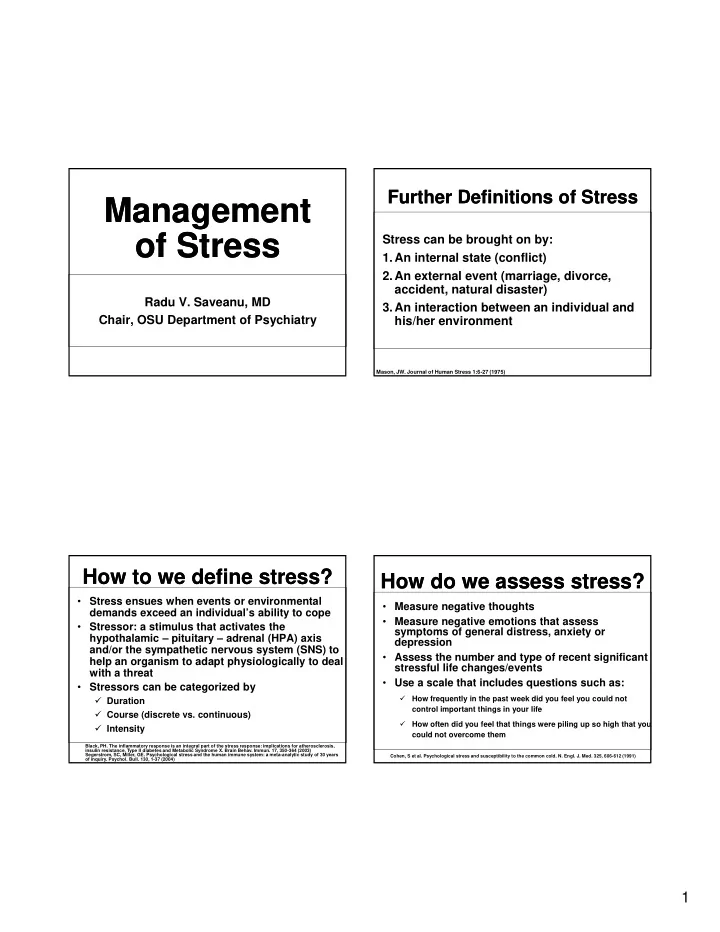
How to we define stress? How to we define stress?

  • Stress ensues when events or environmental

demands exceed an individual’s ability to cope

  • Stressor: a stimulus that activates the

hypothalamic – pituitary – adrenal (HPA) axis and/or the sympathetic nervous system (SNS) to help an organism to adapt ph siologicall to deal help an organism to adapt physiologically to deal with a threat

  • Stressors can be categorized by

Duration Course (discrete vs. continuous) Intensity

Black, PH. The inflammatory response is an integral part of the stress response: implications for atherosclerosis, insulin resistance, Type II diabetes and Metabolic Syndrome X. Brain Behav. Immun. 17, 350-364 (2003) Segerstrom, SC, Miller, GE. Psychological stress and the human immune system: a meta-analytic study of 30 years

  • f inquiry. Psychol. Bull. 130, 1-37 (2004)

Further Definitions of Stress Further Definitions of Stress

Stress can be brought on by:

  • 1. An internal state (conflict)

2 A t l t ( i di

  • 2. An external event (marriage, divorce,

accident, natural disaster)

  • 3. An interaction between an individual and

his/her environment

Mason, JW. Journal of Human Stress 1:6-27 (1975)

How do we assess stress? How do we assess stress?

  • Measure negative thoughts
  • Measure negative emotions that assess

symptoms of general distress, anxiety or depression

  • Assess the number and type of recent significant

Assess the number and type of recent significant stressful life changes/events

  • Use a scale that includes questions such as:
  • How frequently in the past week did you feel you could not

control important things in your life

  • How often did you feel that things were piling up so high that you

could not overcome them

Cohen, S et al. Psychological stress and susceptibility to the common cold. N. Engl. J. Med. 325, 606-612 (1991)

slide-2
SLIDE 2

2

How Much Stress is Too Much? How Much Stress is Too Much?

1. No definitive answer 2. Holmes and Rahe constructed a Social Readjustment Rating Scale in an attempt to j g p quantify stressful life events:

a) Promotion = 31 LCU’s (Life Change Units) b) Marital separation: 56 LCU’s c) Death of a spouse = 100 LCU’s d) An accumulation of 200 or more LCU’s in a single year increases incidence of psychosomatic disorders

Holmes, T.H., Rahe, R.H. Journal of Psychosomatic Medicine 11:213-218 (1967)

Stress and Negative Emotions Stress and Negative Emotions

1. Stress frequently leads to feelings of:

  • Depression
  • Anxiety
  • Hostility / Anger

2. Negative emotions are associated with increased morbidity and mortality 3. Different emotions may make unique contributions to some disease processes 4. What is the impact of positive emotions on morbidity and mortality?

Ryff, CD, Singer, BS. The Contours of Positive Human Health. Psychol. Inq. 9:1-28 (1998) Kiebolt-Glaser, JK, et al. Emotions, Morbidity and Mortality: New Perspectives from Psychoneuroimmunology. Annu. Rev.

  • Psychol. 53: 83-107 (2002)

Depression Depression

  • Depressive symptoms increase risk of a first heart attack

1.5 to 2 fold

  • Mortality among patients who suffer an MI is 4 times

higher among those with depressive symptoms

  • Chronic depressed mood is linked to cancer risk
  • Depressed mood is a risk factor for all cause mortality in

medical inpatients

  • Depressed mood can magnify pain – and pain can

increase disease severity and mortality

Glassman AH, Shapiro PA. Depression and the Course of Coronary Artery Disease. Am. J. Psychiatry 155:4-11 (1998) Frasure-Smith H et al. Depression following myocardial infarction: impact on 6-month survival. JAMA 270: 1819-25 (1993) Herrmann C. Et al. Diagnostic groups and depressed mood as predictors of 22-month mortality in medical inpatients.

  • Psychosom. Med. 60:570-77 (1998)

Staats, PS. Pain, depression and survival. Am Fam. Physician 60:42-43 (1999)

Anxiety Anxiety

  • Individuals with significant anxiety have

double the risk of fatal CHD and nonfatal myocardial infarction in both men and women women

  • Anxiety has negative consequences for

recovery from surgery

Kawachi I. et al. Symptoms of anxiety and risk of coronary heart disease. The Normative Aging Study. Circulation 90:2225-29 (1994) Kiecolt-Glaser JK. Et al. Psychological influences on surgical recovery: perspectives from psychoneuroimmunology.

  • Am. Psychol. 53:1209-18 (1998)
slide-3
SLIDE 3

3

Hostility / Anger Hostility / Anger

  • 9-year population-based study found that

men high in hostility had more than twice the risk of all-cause and cardiovascular mortality

  • Meta – analysis concluded that hostility is a

robust factor for CHD, as well as for all- cause mortality

Everson SA, et al. Hostility and increased risk of mortality and acute myocardial infarction: The Mediating Role of Behavioral risk factors. Am. J. Epidemiol. 146: 142-52 (1997) Miller PJ, et al. A meta-analytic review of research on hostility and physical health. Psychol. Bull. 119: 322-48 (1996)

Psychological Stress Psychological Stress

  • Slows wound healing
  • Alters the immune response to antiviral and

antibacterial vaccines (influenza, Hepatitis B, ( , p , rubella, pneumococcal vaccine)

  • Increases risk of reactivation of several viruses

(herpes, EBV, CMV)

  • May be a factor in cancer risk and progression

Kiecolt-Glaser, JK, et al. The lancet. 346:1-3 (1995) Kiecolt-Glaser, JK, et al. Proc. Natl. Acad. Sci. USA. 93:3043-3047

Stress and the Metabolic Syndrome Stress and the Metabolic Syndrome

  • Metabolic Syndrome: Combination of impaired glucose

and lipid metabolism, obesity, and hypertension

  • It increases risk for morbidity and mortality from CVD,

diabetes and all cause mortality diabetes, and all-cause mortality

  • Study showed that depressive symptoms and stressful

life events predicted MS among middle-aged women

  • Marital dissatisfaction, divorce, and widowhood predicted

increased risk of MS over an average 11.5 years

Raikkonen K, et al. Diabetes Care, 30:872-877 (2007)

slide-4
SLIDE 4

4

Stress and HIV Infection Stress and HIV Infection

  • In HIV-infected men, stress increases the rate of disease

progression

a) A longitudinal study of HIV-positive men asymptomatic at entry to the study: * At 5.5 years after entry into the study, men who had higher levels of stress and/or lower levels of support were 2-3 times more likely to develop AIDS b) A study showed that gay men who concealed their homosexual identity had an accelerated course of HIV infection compared to men who did not

Leserman, J. et al. Progression to AIDS: The effects of stress, depressive symptoms, and social support. Psychosom.Med. 61, 397-406 (1999) Cole, SW, et al. Accelerated course of human, immunodeficiency virus infection in gay men who conceal their homosexual identify.

  • Psychosom. Med. 58, 1-13 (1996)

Stress and Psychiatric Illness Stress and Psychiatric Illness

Stress increases risk of:

  • Major depression
  • PTSD
  • Alcohol/substance abuse/dependence
  • Anxiety disorders
  • Psychiatric decompensation in vulnerable

individuals

Vulnerability and Resilience Factors Vulnerability and Resilience Factors

A. Sociodemographic variables

1. Age

* Early and late life vulnerabilities

2. Gender * Women are at higher risk for depression and anxiety Women are at higher risk for depression and anxiety 3. Socioeconomic status * Typically measured by education, income and occupation * Inverse relationship with depression and hostility * Inverse relationship with most major causes of morbidity and mortality across populations 4. Race/Ethnicity

Adler N, et al. Socioeconomic status and health. Am Psychol. 49:15-24 (1994) Taylor SE, et al. Health psychology: what is an unhealthy environment and how does it get under the skin? Annu.

  • Rev. Psychol. 48: 411-17 (1997)

Vulnerability and Resilience Factors Vulnerability and Resilience Factors

  • B. Personality traits and coping styles
  • Reflect differences in appraisal and response to stressful situations
  • In longitudinal studies, personality and coping characteristics

predict physical illness and mortality ( )

  • Type D (distressed) Personality predicts cardiac morbidity and

mortality over a 10-year period

  • Optimism predicts better health outcomes among cardiac patients
  • Positive emotions might “undo” the aftereffects of negative

emotions but mechanism is not well understood

  • C. Genetics

Denollet J, et al. Personality as independent predictor of long-term mortality in patients with coronary heart disease. Lancet 347: 417-21 (1996) Frederickson BL. What good are positive emotions? Rev. Gen. Psychol. 2: 271-99 (1998)

slide-5
SLIDE 5

5 Vulnerability and Resilience Factors Vulnerability and Resilience Factors

  • D. Social relationships
  • Social isolation constitutes a major risk factor for

morbidity and mortality

  • Strong link between personal relationships and
  • Strong link between personal relationships and

immune function

1. Supportive personal relationships associated with better immune function 2. Close personal relationships that are chronically hostile or stressful can trigger depression and other negative emotions as well as persistent immune dysregulation

Kiecolt-Glaser JK, et al. Emotions, Morbidity, and Mortality: New Perspectives from Psychoneuroimmunology. Annu. Rev.

  • Psychol. 53: 83-107 (2002)

Can Stress be Beneficial? Can Stress be Beneficial?

  • Studies in mice exposed to brief stressors (2

hours) showed better skin wound healing than non-stressed control animals

  • In humans short term stressors such as public

In humans, short term stressors, such as public speaking, briefly increase natural-killer-cell activity and increase number of some leukocytes

  • Absence of stress can lead to boredom and lack
  • f meaning in life.

Segerstrom, SC, Miller, GE. Psychological stress and the human immune system: a meta-analytic study of 30 years of inquiry. Psychol.

  • Bull. 130, 1-37 (2004)

Dhabhar, FS. Stress, leukocyte trafficking and the augmentation of skin immune function. Ann. NY Acad. Sci. 992, 1-13 (2003)

Management

  • f Stress

Management

  • f Stress

Kenneth R. Yeager, PhD Associate Professor, Clinical OSU Department of Psychiatry

So What is Stress? So What is Stress?

  • We generally use the word "stress" when

we are overloaded and wonder whether we really can cope with the pressures placed upon us.

  • Some stresses are positive. They get you

going and - without any stress at all many think our lives would be far less interesting and productive.

slide-6
SLIDE 6

6

  • It is important to note: when the stresses undermine

both our mental and physical health they are bad.

  • Most of us have varying interpretations of what

stress is and its impact

What is the Stress Response? What is the Stress Response?

stress is and its impact.

  • Some focus on the immediate issue i.e. deadlines at

work, or getting a promotion. Others think more about the event and circumstances. Still others focus

  • n collateral issues such as the boss, or why things

are the way they are.

  • What really matters are how situations and the

resulting thought process, as this controls how each person responds to the stress event.

  • We all respond differently to a given

situation for three main reasons We do not all interpret each situation in h

The Stress Response The Stress Response

the same way. As a result, everyone calls on different resources to manage each situation. Not all have the same resources and skill sets.

Common Signs, Symptoms and Psychological Responses to Crisis (Emotional and Behavioral) Common Signs, Symptoms and Psychological Responses to Crisis (Emotional and Behavioral)

Emotional Emotional

  • Mood swings

Mood swings

  • Agitation/irritability

Agitation/irritability

  • Restlessness

Restlessness

  • Impatience

Impatience Behavioral Behavioral

  • Teeth

Teeth grinding ( grinding (bruxism bruxism) or ) or

  • Jaw

Jaw clenching clenching

  • Hypersomnia

Hypersomnia or insomnia

  • r insomnia
  • Over

Over or under eating

  • r under eating
  • Tendency

Tendency toward isolation toward isolation p

  • Feeling “on edge”

Feeling “on edge”

  • Excessive tension

Excessive tension

  • Feeling overwhelmed

Feeling overwhelmed

  • Feeling isolated

Feeling isolated

  • Feeling misunderstood

Feeling misunderstood

  • Dystopia

Dystopia

  • Tendency

Tendency toward isolation toward isolation

  • Procrastination

Procrastination

  • Increased

Increased alcohol, alcohol, cigarettes, or cigarettes, or drugs drugs consumption to consumption to relax relax

  • Obsessive responses (e.g

Obsessive responses (e.g. . over

  • ver

attention attention to to small detail small detail) )

  • Overreacting

Overreacting to problems to problems

  • Displacement

Displacement of anger

  • f anger and

and feelings feelings of

  • f inadequacy

inadequacy

  • Lashing out at others

Lashing out at others

First three steps to improve how we cope with stress First three steps to improve how we cope with stress

Understanding how you respond to stress: recognizing our emotions and their effects. Enhanced self - knowledge: knowing our strengths and limitations. Increased levels of confidence: building a strong sense of our self-worth and capabilities.

slide-7
SLIDE 7

7

Understanding how you respond to stress Understanding how you respond to stress

  • Once you know how you respond to stress

building coping skills around your weaknesses will strengthen your stress response.

  • Focus first on your personal response.

Address the thoughts in your head. Practice not reacting from an emotional base. Practice replacing the negative “automatic thought” with a positive, e.g. “that’s impossible” replaced by “I’m up for the challenge.”

  • Next build on situational awareness:

Chances are good if you are feeling stress so are others. Understand

  • r a dience and ho
  • r

Understanding the situation…You’re not in this alone. Understanding the situation…You’re not in this alone.

  • Understand your audience, and how your

response can heighten stress or build social relationships.

  • Practice building positive relationships and

partnerships to answer tough situations and/or questions.

  • Finally, build social skills. Be aware of

social situations that lead to stress.

  • Practice dealing with each challenging

situation Think first of others viewpoints

Understanding how to manage situations and relationships Understanding how to manage situations and relationships

  • situation. Think first of others viewpoints.

Then respond to the situation.

  • Place persons around you that are

supportive and understanding.

  • Make every effort to understand the

situation and to manage relationships.

To Sum It Up… To Sum It Up…

  • Essentially: the skill set you are seeking to

build is: Understanding Yourself Understanding Yourself Managing Yourself Understanding Others and, Managing Relationships

slide-8
SLIDE 8

8

An overall approach to dealing with day-to-day stress An overall approach to dealing with day-to-day stress

  • Exercise - exercise has been proven to have a

beneficial effect on a person's mental and physical state For many people exercise is an

Take Care of Yourself:

physical state. For many people exercise is an extremely effective stress buster.

  • Nutrition - eat plenty of fruit and vegetables. Make

sure you have a healthy and balanced diet.

  • Breathing - there are some effective breathing

techniques which will slow down your system and help you relax.

  • Division of labor - try to delegate your

responsibilities at work, or share them. If you make yourself indispensable the likelihood of your feeling highly stressed is significantly

Ask for help!

An overall approach to dealing with day-to-day stress An overall approach to dealing with day-to-day stress

your feeling highly stressed is significantly greater.

  • Assertiveness - don't say yes to everything. If

you can't do something well, or if something is not your responsibility, try to seek ways of not agreeing to do them.

  • Talk - talk to you family, friends, work colleagues

and your boss. Express your thoughts and worries.

  • Alcohol and drugs - alcohol and drugs will not

help you manage your stress better. Either stop

Skip the quick fix:

An overall approach to dealing with day-to-day stress An overall approach to dealing with day-to-day stress

consuming them completely, or cut down.

  • Caffeine - if your consumption of coffee and other

drinks which contain caffeine is high, cut down.

  • Fast food - if you think this saves time think
  • again. Making time for a balanced home cooked

meal will, in the long run lead to clearer thoughts and greater levels of productivity

  • Time - make sure you set aside some time each

day just for yourself. Use that time to organize

Stick with what works:

An overall approach to dealing with day-to-day stress An overall approach to dealing with day-to-day stress

y j y g your life, relax, and pursue your own interests.

  • Maintain a balance – “All work and no play…”
  • Relaxation techniques – mediation, massage, or

yoga have been known to greatly help people with stress.

  • Try something new - Many therapies which help

you relax, such as aromatherapy, or reflexology, may have a beneficial effect.

slide-9
SLIDE 9

9

In Closing In Closing

  • Effective stress management can help you

to either: Remove or change the source of stress, Alter the way you view a stressful event, Lower the impact that stress might have

  • n your body, and

Teach you alternative ways of coping.