Management of She was not taking NSAIDS and was h.pylori negative. - - PowerPoint PPT Presentation

management of
SMART_READER_LITE
LIVE PREVIEW

Management of She was not taking NSAIDS and was h.pylori negative. - - PowerPoint PPT Presentation

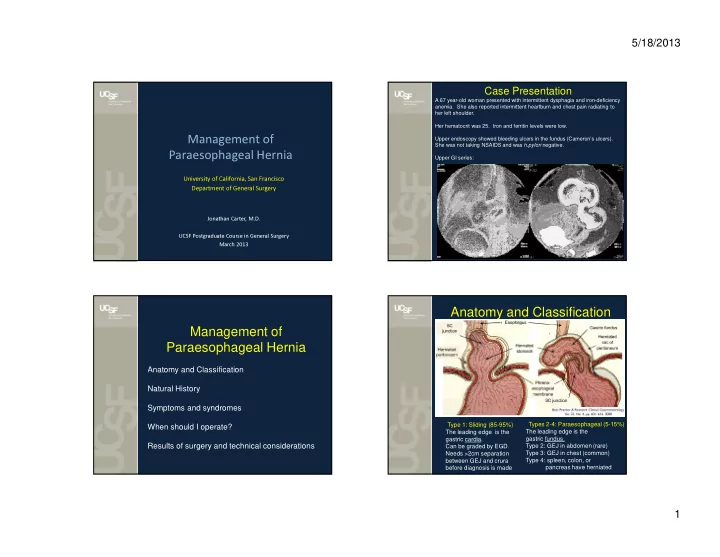
5/18/2013 Case Presentation A 67 year-old woman presented with intermittent dysphagia and iron-deficiency anemia. She also reported intermittent heartburn and chest pain radiating to her left shoulder. Her hematocrit was 25. Iron and ferritin


slide-1
SLIDE 1

5/18/2013 1

Management of Paraesophageal Hernia

University of California, San Francisco Department of General Surgery

Jonathan Carter, M.D. UCSF Postgraduate Course in General Surgery March 2013

Case Presentation

A 67 year-old woman presented with intermittent dysphagia and iron-deficiency

  • anemia. She also reported intermittent heartburn and chest pain radiating to

her left shoulder. Her hematocrit was 25. Iron and ferritin levels were low. Upper endoscopy showed bleeding ulcers in the fundus (Cameron’s ulcers). She was not taking NSAIDS and was h.pylori negative. Upper GI series:

Management of Paraesophageal Hernia

Anatomy and Classification Natural History Symptoms and syndromes When should I operate? Results of surgery and technical considerations

Anatomy and Classification

Type 1: Sliding (85-95%) The leading edge is the gastric cardia. Can be graded by EGD. Needs >2cm separation between GEJ and crura before diagnosis is made Types 2-4: Paraesophageal (5-15%) The leading edge is the gastric fundus. Type 2: GEJ in abdomen (rare) Type 3: GEJ in chest (common) Type 4: spleen, colon, or pancreas have herniated

slide-2
SLIDE 2

5/18/2013 2

Natural History

Skinner and Belsey (1967) reported on cohort of 21 patients managed with watchful waiting and reported 6 deaths (29%) related to strangulation, perforation, or hemorrhage. Hill (1973) reported a 30% rate of incarceration in a cohort of patients managed with watchful waiting The reported mortality of emergency operations was 17%. …and as a result, for years textbooks recommended prophylactic repair for all comers. Many questioned these recommendations because the predicted disasters weren’t evident in everyday practice. There was not (and still isn’t) good data on the natural history

  • f PEH

Natural History

Ann Surg 2002;236:492.

Attempt to model elective PEH repair versus watchful waiting in Markov decision analysis. The best available statistics were used in the model: Mortality of elective PEH repair: 1.4% Mortality of emergency PEH repair: 5.4% (based upon NIS data) Probability of symptoms with watchful waiting: 1.1% /year

Natural History

  • For patients >65 years, watchful waiting was superior to

elective PEH repair with an improvement of 0.13 QALYs.

  • Sensitivity analysis showed that this result persisted across a

wide range of expected surgical mortalities:

  • The data supporting this model have been questioned. Peters

reported a 21% in-house mortality for emergency PEH repairs and 1% mortality for elective repairs in the modern era (JGISurg 2010). And the 1.1%/year rate of symptoms based upon very weak data. These data favor elective repair over watchful waiting.

  • Confounder: The are no truly asymptomatic patients. Careful

interview will reveal foregut symptoms in over 90%.

When to operate?

Reflux symptoms Heartburn, regurgitation, chest pain, cough, hoarseness, aspiration with or without pneumonia Obstructive symptoms Dysphagia, chest pain, early satiety, bleeding or iron deficiency anemia from gastric stasis ulcers (Cameron lesions) Entrapment symptoms Acute pain, perforation, sepsis Borchardt's triad =acute epigastric pain, inability to vomit, inability to pass NG tube = impending gangrene = immediate exploration needed. Respiratory symptoms Recurrent aspiration. Shortness of breath and dyspnea on exertion are generally caused from anemia, not mass effect / displacement of lung

Indications for surgery

In general, repair the PEH when these symptoms are present. pearl: if you have a young patient, find some symptoms
slide-3
SLIDE 3

5/18/2013 3

Key Elements of the Operation

  • Reduce the stomach. Dissect

the herniated stomach away from the hiatus and get a penrose around all the herniated contents. Don’t injure the left gastric artery or vagus nerves. Detach the sac from the stomach circumferentially.

  • Mobilize the lower esophagus

high into the mediastinum

  • circumferentially. This

lengthens it. Stop when GEJ is in abdomen without having to pull on it.

  • Remove the sac and fat pad
  • ff the stomach, GEJ, hiatus.

Fat will be hypertrophied.

  • Close the crura posteriorly.

No benefit to pledgets. Mesh to be discussed.

  • Do a 360°fundoplication.
  • Divide the short gastrics
  • Do a posterior gastropexy
  • Do collar anchoring

stitches

  • No anterior gastropexy or

gastrostomy tube in primary repairs.

Sack Attack

Completed dissection Sutured cruroplasty Completed repair

slide-4
SLIDE 4

5/18/2013 4

Results: recurrence

  • Radiographical recurrence will occur in 20-60% of patients

who are followed for at least 5 years.

  • The vast majority of patients with radiographical recurrence

will be minimally symptomatic. The few with symptoms can generally be managed with PPIs. preop Day 1 Day 120

Results: Symptom control Results: Symptom control Results: Symptom control

slide-5
SLIDE 5

5/18/2013 5

Results: Symptom control Results: Symptom control

So what can be done to reduce the risk of recurrence?

  • Granderath et al (2005)

– Prospective randomized trial of 100 patients undergoing laparoscopic floppy Nissen fundoplication for GERD and hiatal hernia repair. 1 year follow-up. – 45 with simple sutured crural closure (Group 1), – 45 with onlay of polypropylene mesh (Group 2). – Intrathoracic wrap migration in 13 patients (26%) with suture closure vs only 4 (8%) with onlay polypropylene mesh.

Strategy 1: reinforce hiatus with synthetic mesh

slide-6
SLIDE 6

5/18/2013 6

Strategy 1: reinforce hiatus with synthetic mesh Strategy 1: reinforce hiatus with synthetic mesh Strategy 1: reinforce hiatus with synthetic mesh

  • Carpelan-Holmstrom 2010
  • PTFE Mesh erosion

Strategy 1: reinforce hiatus with synthetic mesh

slide-7
SLIDE 7

5/18/2013 7

De Moor 2012: Protack and Parietex mesh migration into gastric lumen

Strategy 1: reinforce hiatus with synthetic mesh

  • Frantzides 2012

Cardiac tamponade can result from inappropriate fixation of mesh to the central tendon of the diaphragm. 10 cases of cardiac injury reported in literature after hiatal hernia repair with 6 being fatal. Central tendon of diaphragm averages 3mm in thickness ProTack helical tacks are 4mm in length.

Strategy 1: reinforce hiatus with synthetic mesh

  • Frantzides 2012

Cardiac tamponade can result from inappropriate fixation of mesh to the central tendon of the diaphragm. 10 cases of cardiac injury reported in literature after hiatal hernia repair with 6 being fatal. Central tendon of diaphragm averages 3mm in thickness ProTack helical tacks are 4mm in length.

Strategy 1: reinforce hiatus with synthetic mesh Strategy 1: reinforce hiatus with synthetic mesh

slide-8
SLIDE 8

5/18/2013 8

How many recurrences is

  • ne erosion

worth?

Strategy 2: reinforce hiatus with biological mesh Strategy 2: reinforce hiatus with biological mesh Strategy 2: reinforce hiatus with biological mesh

Outcome Variable Biomesh Sutured Radiographical recurrence at 6 months 9% 24% Radiographical recurrence at 5 years 54% 59% Heartburn at 5 years 2.3 ± 3.1 1.4 ± 2.4 Regurgitation at 5 years 0.8 ± 1.7 1.5 ± 2.5 Dysphagia at 5 years 1.4 ± 2.5 1.6 ± 2.8 Chest Pain at 5 years 0.6 ± 1.4 1.0 ± 2.4 Abdominal pain at 5 years 2.0 ± 2.8 2.1 ± 2.7 Bloating at 5 years 2.1 ± 2.5 2.3 ± 2.6 Early satiety at 5 years 1.2 ± 2.0 2.1 ± 2.5 SF 36 QOL physical at 5 years 44 ± 11 44 ± 13 SF 36 QOL mental at 5 years 47 ± 15 49 ± 13

slide-9
SLIDE 9

5/18/2013 9

Other strategies? Conclusions

  • 1. The lifetime risk of incarceration or strangulation of PEH decreases

with age and is not very high. The older and more frail your minimally symptomatic patient is, the less he/she is likely to benefit from repair.

  • 2. Younger patients (i.e. age<65) have higher lifetime risk of

symptoms and the operation is less risky. Your threshold to operate should be lower.

  • 3. True short esophagus rarely exists. Perform a high mediastinal

circumferential mobilization and you will almost always get the GEJ into the abdomen.

  • 4. Resect the sac around the stomach, lower esophagus, and hiatus.

This means also resecting the hypertrophied phenoesophageal fat pad.

  • 5. Close the crura with permanent sutures. Pledgets don’t add benefit

and can erode into esophagus. Collis lengthening procedures are rarely needed and don’t improve long term results.

  • 6. Prosthetic mesh reinforcement probably reduces radiographical

recurrences at the cost of occasional catastrophic complications.

  • 7. Biological mesh reinforcement may reduce short term

radiographical recurrence, but not long term, and has no proven symptom benefit.