
SLIDE 1
Hugo Pettingell ACSM FIQ September 2012
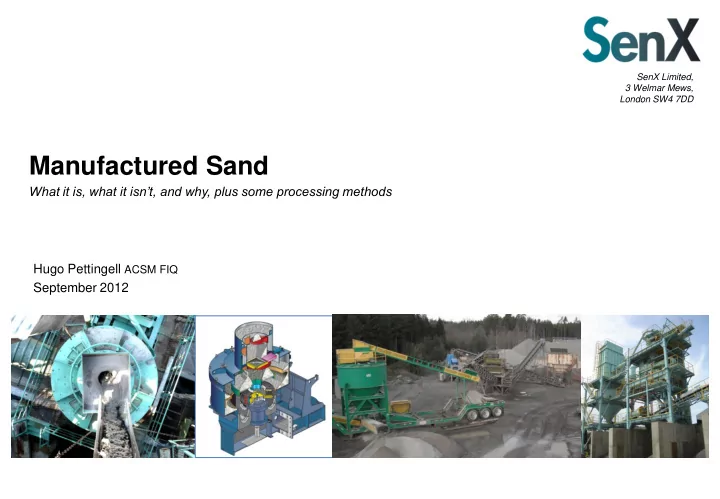
Manufactured Sand
What it is, what it isn’t, and why, plus some processing methods
SenX Limited, 3 Welmar Mews, London SW4 7DD
Manufactured Sand What it is, what it isnt, and why, plus some - - PowerPoint PPT Presentation
SenX Limited, 3 Welmar Mews, London SW4 7DD Manufactured Sand What it is, what it isnt, and why, plus some processing methods Hugo Pettingell ACSM FIQ September 2012 Define manufactured sand What Manufactured Sand is and what it is not!
Hugo Pettingell ACSM FIQ September 2012
What it is, what it isn’t, and why, plus some processing methods
SenX Limited, 3 Welmar Mews, London SW4 7DD
BARRY HUDSON 1999
Particle Size (mm) (spherical) Particle Volume (mm³) Number of particles in 8200 mm3 Surface area in 8200 mm3 (m2) 25 8200 1 0.002 4 33.5 244 0.012 0.075 2x10ˉ4 4x10⁷ 0.7 0.002 2x 10ˉ9 2x10¹² 24
Some things we can affect by processing: ...And some we can’t change so readily:
0.3-0.15mm 2.5-1.2mm 0.6-0.3mm
Solids ratio as measured under JIS.A.5005-1104 (2.5-1.2mm) Calculation of cement saving due to improved solids ratio 1% better solids ratio can save 3-4kg water/m³ of concrete Given W/C(water cement ratio) = 50% Improvement of solid ratio Feed to BM = 1.5% (56.3% – 54.8%) Saving water = 3 - 4 kg/m³ x 1.5 = 4.5 – 6 kg/m³ Cement saving = 4.5 – 6 kg/m³ divided by 0.5 = 9 – 12 kg/m³ Improvement of solid ratio BM to US7 = 1.4% (57.7% - 56.3%) Saving water = 3-4kgs/m³ x 1.4 = 4.2-5.6kg/m³ Cement saving = 4.2-5.6kg/m³ divided by 0.5 = 8.4 – 11.2kg/m3
CONE BM 55m/s BM 65m/s US7 45m/s US7 55m/s 54.8% 56.3% 56.8% 56.9% 57.7%
New Zealand Flow Cone A sample of 1 kg of fine aggregate is passed through a 12-mm orifice mounted under a sample hopper. The material free falls into a collecting container of known volume while the time taken for the sample to pass is measured. The mass of material in the collection container is measured and the un-compacted unit mass of the fine aggregate can be calculated. The specific gravity of the fine aggregate compared with the unit mass allows the un-compacted voids content of the aggregate to be calculated. The results are reported graphically on a plot of voids versus flow time.
But….”Research demonstrates that there are difficulties with the use of the Flow Cone apparatus in testing manufactured sands, and unless these issues were resolved, it would not be practical to use the method for specification. No other suitable procedure was found for specifying the shape and surface texture
specialised equipment and highly trained staff.”4
Cement Concrete & Aggregates Australia Research Report Manufactured Sand National test methods and specification values January 2007
It seems to work well with a standard grading reconstructed from the test material, eliminating the variation due to particle size distribution
10 20 30 40 50 60 70 80 90 100 0.01 0.1 1 10 CUMULATIVE % PASSING PARTICLE SIZE (mm)
Ryall Clearwell Clearwell Clearwell ASTM C33 ASTM C33
Remains the sole criterion for sand specification in most places, apart from deleterious material exclusions. Useful for defining consistency Has less relevance in defining performance, because compliant PSD is no guarantee of suitability for concrete
BEST WORST
Some real gradings and their performance in concrete
“Members agreed that product grading should not be a specification test. Instead, the product supplier should provide a submitted grading to which the deviation limits current in AS 2758.1 would apply. How these deviation limits might be applied to the broad range of possible product gradings will require careful consideration. Gradings would obviously become a quality control tool with results of interest to individual suppliers and their customers. However, it was considered necessary for the purposes of definition to specify that 'manufactured sands' for use in concrete would have:
THE KEY HERE IS NOT AN ABSOLUTE GRADATION, BUT CONSISTENCY!
Cement Concrete & Aggregates Australia Research Report Manufactured Sand National test methods and specification values January 2007
10 20 30 40 50 60 70 80 90 100 0.01 0.1 1 10 CUMULATIVE % PASSING PARTICLE SIZE (mm)
Ryall Clearwell Clearwell Clearwell CCAA CCAA
AS SIEVE MAX DEVIATION
6.7
±5 2.36 ±10 1.18 ±15 0.6 ±15 0.3 ±10 0.15 ±5 0.075 ±3 An ideal grading is one that makes good concrete and does not vary
However, there is usually a preference for abundant particles in in the range 250-1000µm
ICAR102-1F: “Compared to concrete made with lower-fines content natural sand, high-fines manufactured sand concrete generally had higher flexural strength, improved abrasion resistance, higher unit weight, and lower permeability due to filling of the pores with microfines. (Lower permeability is important for reducing corrosion). Compressive strength varied but was acceptable, and shrinkage, although slightly higher, was within generally acceptable ranges. Good-quality concrete could be made from nearly all of the aggregates (with microfines contents ranging from 7 to 18%) used in the test program without the use of admixtures.”5
…and, according to Kaya, Nagahara & Yamamoto:6
aggregate without detrimental effect on the properties of fresh concrete.
properties of fresh concrete, including maintaining favourable slump.
gradation was not markedly reduced. Do we need to reconsider the size below which we eliminate crushed rock fines?
Loss of consistency due to : Wind and weather action Stratification on conveyors Careless handling Transfer to stockpiles
Luffing radial stockpiler Water adding mixer (c. 3%)
Excessively dry sand may absorb water when concrete mixing and cause slump loss.
Assuming we already have a competently designed and operated crushing plant, we need to consider only the final stage or two of reduction and sizing. Manufacture of sand is usually, in practice, a matter of turning crushed rock fines produced using compression crushers or possibly HSI’s into something of superior quality.
10 20 30 40 50 60 70 80 90 100 0.01 0.1 1 10 CUMULATIVE % PASSING PARTICLE SIZE (mm)
Clearwell Limestone Cribarth Gritstone Belgard Limestone Ledinge ASTM C33 ASTM C33
REDUCE THIS CONTROL THIS IMPROVE THE SHAPE THROUGHOUT
In the years between 1979 and 2012 many explanations and theories have been put forward about how the VSI actually works. Most theories have merit and must be accepted as valid points of view. As nobody can show hard evidence of “seeing the machine work” we can only rely on what goes in and what comes out: Our rotors work well in nearly all the applications we use them in, but be warned that we have records of rotors underperforming dramatically in applications we took for granted! We now know why they failed and this is one of Oresizer’s strengths. We know what doesn’t work!” Peter Crymble, Oresizer
REMco, Kemco, Oresizer, Milestone,
Kemco hybrid machine for sand only Metso Barmac, Sandvik, and most Indian and Chinese copies
Applications—how are they used?
Frequently – and erroneously - regarded as merely a shaping
machine, the Autogenous VSI is indeed a producer of well- shaped aggregates. For this task it is often used in open circuit, just to decrease the flakiness and elongation of a compression crusher product
Crushing action simulates nature, selectively disintegrating weak
material, unlike compression crushing
Since it has no closed side setting to limit the product top size, it
is invariably necessary to install it in closed circuit with a screen. Much larger circulating loads are usual than with compression crushers
Unlike compression crushers and rock-on-steel machines, the
superior particle shape created in a VSI persists throughout the size range, even into the microfines. This is most beneficial in the production of sand from crushed rock or gravel, and sand from a VSI will invariably perform better than that from
It is usually the case that if a VSI fails to give satisfaction it has
been misapplied!
Properly-applied, it is extremely cost-effective in crushing very
abrasive and tough materials
Most manufacturers still mainly offer 3-port designs. Some manufacturers offer 4-, 5-, and 6-port rotors, and Oresizer has developed 7- and 8-port versions Additional ports increase the number of ‘rock pulses’ that occur during each revolution, improving the continuity, and thus the
efficiency of the crushing action.
The fewer the ports, the longer the internal grinding path inside the rotor, resulting in more abrasive reduction, and greater
microfines generation. However, it can be suggested that the best particle shape is dependent upon abrasion...
Extra ports also spread the tip wear over a larger number of tips and as a result further lengthen the period between tip changes. Some rotor designs offer improved serviceability, and some extravagant claims are made in regard to operating cost. It is easy to persuade most reputable manufacturers to put their rotors into customers’ machines on a trial basis.
Feed from jaw/cone crushers
Feed from jaw/cone crushers
Example of grading adjustment using Wet Process VSI
Rod mill product lacks fines, poor shape Solution: Add VSI to circuit Special Kemco design to handle 20% moisture content May be applicable to existing crusher dust washing processes
KEMCO VSI
ROD MILL SEA DREDGED SAND
2.5 -1.2mm SOLIDS CONTENT KEMCO BM 55.6% ROD MILL 53.9% SEA SAND 53.9%
Sieve Size (mm) 0.075 0.15 0.3 0.6 1.2 2.5 4 BARMAC FEED 1.6 6.4 17.4 34.1 59.0 89.7 100.0 2.93 BARMAC PRODUCT 4.4 11.4 26.1 43.9 69.1 93.1 100.0 2.56 PRODUCT 100% FINES REMOVED 1.7 6.9 20.0 38.9 65.2 92.9 100.0 2.76 PRODUCT 30% FINES REMOVED 3.2 9.4 22.9 39.9 65.3 91.9 100.0 2.71 Passing(%) Fineness Modulus
10 20 30 40 50 60 70 80 90 100 0.01 0.1 1 10 100
Cum % Passing Sieve Size (mm.)
VSI Feed VSI Prod Screen prod.
To make an all-in aggregate for specialised concrete: Very high speed and specialised rotor to generate large amount of microfines Replace fly ash
DRY PROCESS: Positives: Lower capital investment. Lower running cost. Smaller space requirement. Disposal of industrial waste to landfill or silt lagoons is not necessary. Classified fillers are a saleable product …or should be! Negatives: Need <2% moisture in feed, possibly less. May not be possible to remove strongly adhering clay coating from aggregate particles without wet scrubbing. NOTE: If feedstock valuation is realistic (it is often unsaleable, or cost of stockpiling may produce negative value), then drying may be an option.
A dry sand process should include: The means to produce the right amount of the right-sized and right-shaped grains A screen to set the top size, and return unwanted coarse particles for further crushing A microfines extraction system able to control the quality and quantity of filler retained in the sand
10 20 30 40 50 60 70 80 90 100 0.01 0.1 1 10 CUMULATIVE % PASSING PARTICLE SIZE (mm)
Clearwell Limestone Cribarth Gritstone Belgard Limestone Ledinge ASTM C33 ASTM C33
REDUCE THIS CONTROL THIS IMPROVE GRAIN SHAPE THROUGHOUT
THE DEVELOPMENT OF THE KEMCO V7 DRY SAND MAKING SYSTEM Dry process Control of:
Improved particle shape Consistent product Product adjustable to meet specification Small footprint Minimal environmental impact OBJECTIVE: TO DESIGN A FULLY INTEGRATED SYSTEM FOR DRY PROCESSING OF CRUSHER DUST OR GRIT TO MAKE SPECIFICATION SAND.
10 20 30 40 50 60 70 80 90 100 0.01 0.1 1 10 100 CUMULATIVE % PASSING PARTICLE SIZE (mm)
FEED Barmac US6 ASTM C33 ASTM C33
Improved reduction without extra microfines More abundant 500-1000µm Improved particle shape
BM 55m/s BM 65m/s US7 45m/s US7 55m/s 56.3% 56.8% 56.9% 57.7%
OVERSIZE PLUS % COARSE UNDERSIZE NEW FEED RECIRCULATION FILLER TO COLLECTOR SAND PRODUCT
BLOWER
CRUSHER AIRSCREEN WATER 3% SKIMMER MIXER
CONTROL PANEL
0.3-0.15mm 2.5-1.2mm 0.6-0.3mm
Approximately 8-10kWh/tonne
10 7 5 2.5 1.2 0.6 0.3 0.15 0.075 0% 10% 20% 30% 40% 50% 60% 70% 80% 90% 100% % Passing Sieve size (mm)
①Raw material ②V7 product ③V7 filler ④After Preduster ⑤Final filler ⑥Final product BS 0/2(MP) JIS
①Raw material ②V7 product ③V7 filler ④After Preduster ⑤Final filler ⑥Final product weight(t/h) 3.00 1.96 1.04 0.39 0.65 2.35 yield ratio 100.0% 65.3% 34.7% 13.0% 21.7% 78.3%
Density(Size:2.5-1.2mm) ①Raw material ②V7 product Density(surface dry)(g/cm³) 2.68 2.69 Density(oven dry)(g/cm³) 2.65 2.67 Water absorption ratio(%) 0.88 0.69 Solid content(%) 54.0 57.0
10 20 30 40 50 60 70 80 90 100 0.01 0.1 1 10 PARTICLE SIZE (mm) CUMULATIVE % PASSING Limestone Feed FM 3.67 V7 Product #1 FM 2.38 V7 Product #2 FM 2.15 BS12620 Max BS12620 Min
10 20 30 40 50 60 70 80 90 100 0.01 0.1 1 10 PARTICLE SIZE (mm) CUMULATIVE % PASSING GRANITE FEED FM 4.58 V7 Product #1 FM 2.45 V7 Product #2 FM 2.67 V7 Product #3 FM 2.40 BS12620 Max BS12620 Min
Results : - Strengths (N/mm²)
Cement Content kg/m3 Strength N/mm² @ 28 days Control Product A Product B Product C 250 32.0 32.0 33.5 34.0 350 56.0 57.5 54.5 55.5 450 64.5 66.0 65.5 66.0
Results : - Fresh Wet Properties
Scope The following trials were carried out to evaluate the performance of three samples of UK Quarry X dust produced by Kemco, in comparison to natural Trent Valley Sand as currently used within the Midlands Area. The samples are identified as A, B and C with proportionately higher fines contents from A - C. Sample A produced concrete coarser in nature and appeared prone to segregation, whilst sample C resulted in higher water demands and appeared sticky. Sample B produced the better looking concrete and resulted in water demands almost identical to natural Trent Valley Sand. Likewise strengths were comparable.
Total Free water l/m³ Total Free W/C Ratio Plastic Density Kg/m³ Cement content kg/m³ Control Prod A Prod B Prod C Control Prod A Prod B Prod C Control Prod A Prod B Prod C 250 176 176 171 181 0.704 0.704 0.684 0.724 2389 2349 2402 2402 350 174 174 176 182 0.497 0.497 0.503 0.520 2412 2414 2402 2408 450 182 186 182 193 0.404 0.413 0.404 0.429 2420 2438 2424 2399
Designed for cut points from 300 to 63µm Designed for cut points from 10 to 63µm. Will complement AC27 and AC30 for making speciality products and decrease filler top size
Maximum of four decks - wide screening size range from coarse aggregates down to micro-fines. High efficiency screening - 2.5 to 3 times better screening efficiency compared with conventional vibrating screen. Wash effect by air - dust adhering to the surface
Compact size – required screen area is just 1/3
Environmentally friendly - dust encapsulated. Easy maintenance. Less pegging of fine screen mesh.
MODEL AS RCAS DECKS 1+ RELIEVING DECK 4 SIZE 1200/1600/2500 1200/1900/2500 APPLICATIONS SAND-MAKING (V7) RECYCLING AND AGGREGATES CAPACITY Up to 250t/h depending on application
20mm 40mm
Ducting outlet Skimmer Access doors Adjustable damper Scalper unit Feed inlet
Used in conjunction with existing or dedicated bag filter
Adjustable air flow liberates and extracts fine material Skimmer returns desirable larger grains to product
¹
AGGREGATE SHAPE AFFECTS CONCRETE COST - B P Hudson, Quarry Magazine, November 1998
2
IMPACT OF MANUFACTURED SAND IN CONCRETE - B P Hudson, Quarry Magazine, December 1998
3
MINERAL FINES, TODAY’S OPPORTUNITY, TOMORROW’S SUCCESS - R.H. Brown, Vulcan Materials
4 MANUFACTURED SAND - NATIONAL TEST METHODS AND SPECIFICATION VALUES - Cement
Concrete & Aggregates Australia Research Report January 2007
5 ICAR Report 102-1F, AN EXPERIMENTAL STUDY ON THE GUIDELINES FOR USING HIGHER
CONTENTS OF AGGREGATE MICROFINES IN PORTLAND CEMENT - Namshik Ahn & David W. Fowler, International Centre for Aggregate Research, The University of Texas, Austin, Texas Dec.2001
6 RESEARCH INTO THE OPTIMUM LEVEL OF ROCK-DERIVED MICRO-FINE PARTICLES IN SAND
FOR CONCRETE - T.Kaya, Kotobuki Eng. and Mfg. Co, Ltd., Kure, Hiroshima, Japan; Y.Nagahara, Kotobuki Eng. and Mfg. Co, Ltd., Kure, Hiroshima, Japan; H.Yamamoto, Graduate School for International Development and Cooperation, Hiroshima University, Hiroshima Japan – November 2008 I have used material from Metso (previously Svedala), Sandvik, Oresizer, Remco, Kemco and some others’ publications in the public domain. Individuals’ work as follows:
SenX Limited, Quarry Process Consultants, 3 Welmar Mews, London SW4 7DD