Manufacturing on Main Street: The Return of Small Scale Production - - PowerPoint PPT Presentation

manufacturing on main street the return of small scale
SMART_READER_LITE
LIVE PREVIEW

Manufacturing on Main Street: The Return of Small Scale Production - - PowerPoint PPT Presentation

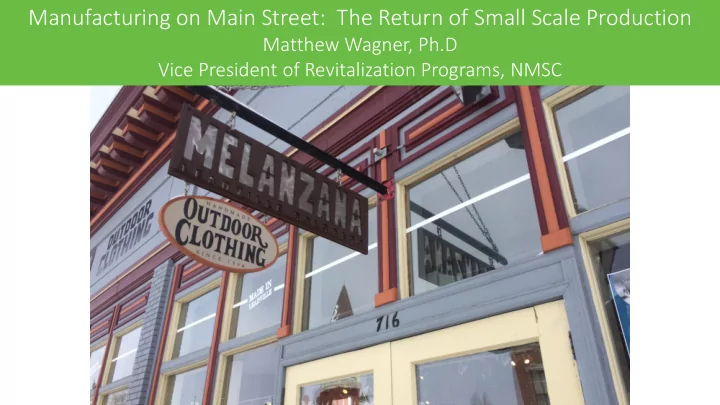
Manufacturing on Main Street: The Return of Small Scale Production Matthew Wagner, Ph.D Vice President of Revitalization Programs, NMSC Defined Small scale production refers to the production of a commodity with a small plant size firm.


slide-1
SLIDE 1

Manufacturing on Main Street: The Return of Small Scale Production

Matthew Wagner, Ph.D Vice President of Revitalization Programs, NMSC

slide-2
SLIDE 2

Defined…

  • Small scale production refers to the production of a commodity with

a small plant size firm. It requires less amount of capital and is labor intensive in nature. The investment in machinery is lower when compared to large scale units.

slide-3
SLIDE 3

The evolution of manufacturing in our downtowns and urban districts…

slide-4
SLIDE 4

Small Scale Production – MS Statistics

Main Streets: Manufacturing accounts for 2.4% of all businesses Average Main Street Capture of City-Wide Manufacturing Industry:

  • Manufacturing Businesses: 18.5%
  • Manufacturing Sales: 22.8%
  • Manufacturing Jobs: 20.1%

Takeaway: In the average city with a Main Street, about a fifth of manufacturing is located within the Main Street boundary. In Main Streets (2015-16) City-Wide (2015-16) Difference (Higher Growth in MS) Manufacturing Business Growth Rate 5.1% 0.0% 5.1% Manufacturing Sales Growth Rate 31.7% 27.7% 4.0% Manufacturing Job Growth Rate 15.9% 9.0% 6.9% Takeaway: 1. Manufacturing sales are up over the last year. 2. Main Streets are experiencing greater manufacturing growth from 2015 to 2016 than elsewhere in cities.

slide-5
SLIDE 5

What’s Driving the Shift…A Convergence of Trends

  • Technology
  • Equipment costs – 3D Printers, High Speed Sewing Machines; Performance Mixers and High

Speed Ovens

  • Barriers to entry to global markets – Shipping and Retail Platforms
  • Rental Rates and Building Functionality
  • Overbuilt Retail Environment and Need for Downtowns to Diversity

Use/Functions

  • New Platforms for Distribution
  • Etsy
  • Larger Retailers Seeking Unique Products for Differentiation
  • Side Hussle Economy
  • The Changing Nature of Retailing and Consumer Preferences
  • Growing Importance of Place to Consumerism
slide-6
SLIDE 6

Nearly 1 in 4 Americans Participate in the Digital Platform Economy

slide-7
SLIDE 7

Experiential Retailing - Nordstrom

  • Female shoppers can try on clothes

together in the roomy “girlfriend” dressing rooms while others can wait in “The Apartment,” a lounge

  • utside complete with a comfy

couch and flat-screen television. Bringing children along for the day? This location provides a playhouse with crayons, coloring books, and a 32-inch touch-screen with interactive games. In addition, this store offers an Ebar for espressos, plus charging stations, a sit-down restaurant

slide-8
SLIDE 8

“Creative/Experiential” Retail

slide-9
SLIDE 9

Architecture & Place Matters

  • Cushman Wakefield Study of

500 Companies:

  • Many respondents mention

their hunt for an open-office feel — converted warehouses and lofts impress potential

  • workers. In addition, they

take advantage of a surplus of underutilized buildings that convey local heritage.

  • They looked for locations that

were “live/work/play” neighborhoods, located near bars, restaurants and cafes. INTERSECTIONS OF SPACE AND BRANDING

  • Breweries, Cafes, Etc primarily locating in

historic buildings.

slide-10
SLIDE 10

Sm Small F ll Farm rmin ing G Growth th

  • The number of farmers’

markets rose to 8,284 in 2014, up from 3,706 in 2004 and 1,755 in 1994, according to USDA’s Agricultural Marketing Service

  • Direct to consumer

markets continues to grow (USDA)

  • Consumption of locally

grown food continues rise! Accounts for 8% of all food sales and $6.2 billion in sales (up from $4.8 four years ago)

  • Culinary Districts

Formation

  • Farm to Table

Restaurants

  • Value Add

Production with Retail Components

  • Farmer’s Markets as

Year-Round Retail Anchors

slide-11
SLIDE 11

Small Scale Production – Business Examples

  • Breweries
  • Food Production
  • Popcorn
  • Bakery
  • Chocolate
  • Apparel
  • Furniture
  • Sporting Goods
  • Jewelry/Watches
  • Artisans
slide-12
SLIDE 12

Small Scale Production – Main Street Community Examples

  • Hasting, NE –
  • Pacha Soap Company – a for-profit social enterprise

selling into places like Whole Foods and Bed Bath and

  • Beyond. 46 employees
  • Leadville, CO
  • Melanzana – retail and manufacturer of outdoor

recreation apparel. Employ 20 people in downtown.

  • Salt Lake City – The Granary District –
  • Frida’s Bistro – Restaurant with back-office production of

Mexican food products (under the Roco Brands) shipped to West regional grocers. Employs nearly 100 in this urban commercial district.

slide-13
SLIDE 13

Examples of Small Scale Production Clusters

  • Owosso, Michigan
  • Popcorn

Manufacturer

  • Chocolate

Manufacturer

  • Leather goods

Manufacturer

  • Glass blowing
  • Brewery
  • Duluth, MN’s “Craft

District”

  • Bent Paddle

Brewing Company (39 employees)

  • Frost River –

Canvas and Leather Bags (32 employees)

  • Hemlocks

Leatherworks

slide-14
SLIDE 14

Other Initiatives

  • Memphis, Tennessee, conducted a research study to learn more about the needs of their creative

community and what actions they can take to support this sector of their economy.

  • Kennesaw, Georgia, held a Maker and Micro Business Expo aimed at connecting creative

entrepreneurs to information and inspiration about how to scale and grow in the Metro-Atlanta region.

  • Knoxville, Tennessee, organized a city-specific summit to unite the maker community in Knoxville

and announce the formation of a mayoral Maker’s Council, to ensure creative entrepreneurs have a voice in local policy.

slide-15
SLIDE 15

Other Initiatives

  • Pittsburgh, Pennsylvania, is working with

the city’s development corporation to identify buildings ready for rehabilitation that can be converted to work spaces for makers.

  • Tacoma, Washington, incorporated small

scale production into the city’s long term strategic plan, Artful Tacoma, and established the Made in Tacoma initiative.

  • Talent, Oregon, makers formed their own

nonprofit organization, Talent Maker City, and worked with the mayor and the development planning office to write a makerspace commitment into the strategic plans for the City.

slide-16
SLIDE 16

What is needed to further drive?

  • Pipelines:
  • Maker Spaces – acts as the R&D

laboratory for filling the pipeline with entrepreneurs in the small scale production space

  • Farmer’s Markets
  • Kitchen Incubators
  • Permanent Pop-up Space

dedicated to Small Scale Producers

  • Technical assistance on the

retail/merchandising side of the business…know the product but perhaps not retail.

  • Branding/Image development

focused on this…create the buzz

  • Equipment grants
  • Proactive targeting -
slide-17
SLIDE 17

What is needed to further drive

  • Partnerships
  • Universities and

Technical/Community Colleges – Engineering

  • SBDCs
  • Incentives that specifically target

Small Scale Producers

  • Could you crowdfund or approach

local factories/foundations for seed pool?

  • Regulatory Environment
  • Zoning
  • Codes
  • Parking Loading Zones for

Deliveries

  • Promotions/Marketing that

highlight opportunities

slide-18
SLIDE 18

Discussion and Questions…Thanks!

Matthew Wagner, Ph.D. Vice President for Revitalization Programs National Main Street Center 312-610-5617 mwagner@savingplaces.org