Mapping Food Access in Immokalee, FL Lusi Wang, Christina Zhang, - PowerPoint PPT Presentation
Mapping Food Access in Immokalee, FL Lusi Wang, Christina Zhang, Lena Knezevic, Mackenzie Mann, & Keely Meyers In partnership with Dr. Thomas Felke Existing food insecurity definition by USDA > mile > 10 mile Food Desert 500 people
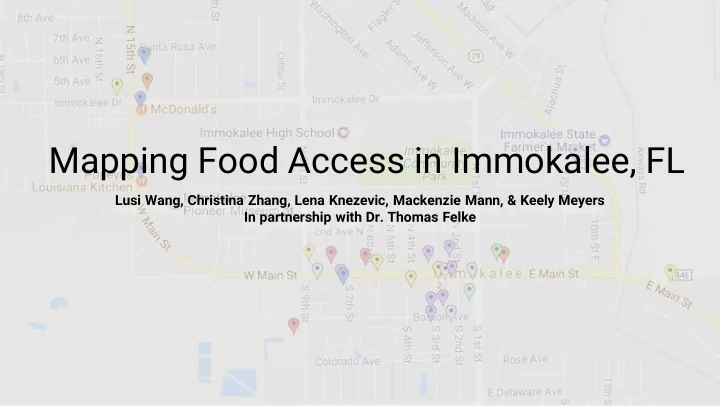
Mapping Food Access in Immokalee, FL Lusi Wang, Christina Zhang, Lena Knezevic, Mackenzie Mann, & Keely Meyers In partnership with Dr. Thomas Felke
Existing food insecurity definition by USDA > ½ mile > 10 mile Food Desert 500 people or/and 33% of census tract population http://americannutritionassociation.org/newsletter/usda-defines-food-deserts
Issues not addressed in this definition Quality (Food Swamps) Transportation Weather
Context: Immokalee, FL - Agricultural community - Census data: - 24,154 residents (underestimate) - 75.6% Latino (Mexican, Cuban, Guatemalan, Haitian) - Over half of residents are foreign born - 44.8% of individuals live below the Federal Poverty Line - 46% of surveyed households use SNAP/EBT
Immokalee, FL - Social issues - Education - Housing ($325/week for trailer section) - Healthcare access - Immigration enforcement - Hurricane Irma - Food insecurity - High prices - Lack of transportation - Availability and quality of foods - Weather
Project Goal Questions: - Where do people in Immokalee buy their food other than supermarkets? - What is sold at these locations? Can SNAP/WIC be used? - What do necessary items cost at these locations? Expected Product: - Create a spatial visualization of food access points in Immokalee, FL, including farmer’s markets, mini-marts, bodegas, restaurants, and other food vendors, as well as data about these access points.
Research Methodology Survey food access points in Immokalee - Access point location - Acceptance of SNAP/WIC EBT cards - Types of foods available - Prices of food items based on size Based on a statewide tobacco vendor survey conducted by the Department of Health in summer 2016 Create a map using ArcGIS to visualize data of how and where residents purchase their food
Food Access in Immokalee N
Findings Figure: 2% milk price for different vendor types - Variable prices - Vast amount of unhealthy food → chronic health conditions - Limited access to healthy fresh vegetables and fruits - Lots of jarred fruit and fruit juices (i.e. Jumex) - Food grown locally is shipped to neighboring communities - Cannot use EBT at farmer’s market - Milk prices and availability - Limited quantities or unavailable - $5-6/gallon - Rotten milk sold at discount - Our collected data can be found here https://drive.google.com/open?id=1bKu8N8yU-uAtAbYb61z3eo72GS_7k8Az]
SNAP/EBT Access - SNAP: Supplemental Nutrition Assistance Program - EBT: Electronic Benefit Transfer card
Reflections - Methodology - Importance of definitions for food purchasing sites - Narrowing the scope of survey questions to better reflect food access - Price differences across brands - Outsiders entering a new community - Unlabeled food and higher prices? - Fear and suspicion - Knowledge of cultural food choices - Language barriers → Spanish/Creole speakers needed - Work with team with diverse backgrounds reflective of the community
Next Steps Mapping data - Population density - Buffer zones (“as the crow flies”) Focus groups with store owners and residents of Immokalee about food purchasing/selling decisions Use models in other communities of southwest FL (Golden Gate, etc.) Hopefully expand EBT access to farmer’s markets and other locations with healthy food options
Recommend
More recommend
Explore More Topics
Stay informed with curated content and fresh updates.